
























US Carrier Strike Groups Merge in High-Seas Show of Force: Signals to China and Iran

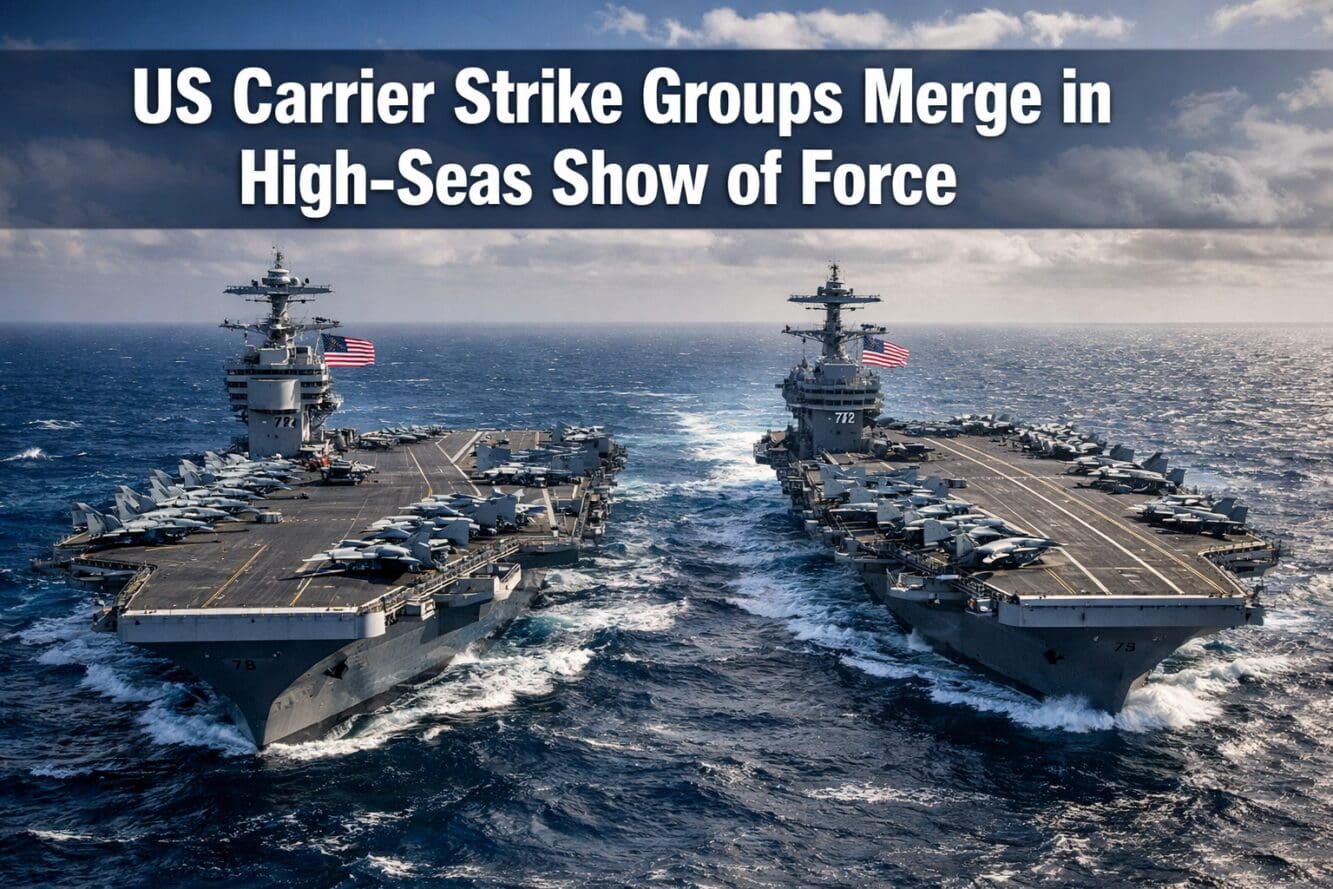
The world’s oceans have become a chessboard for global power projection. In February 2026, the United States orchestrated a dramatic naval convergence that sent shockwaves through diplomatic circles from Tehran to Beijing.
US Carrier Strike Groups Merge in High-Seas Show of Force: Signals to China and Iran as the USS Gerald R. Ford and USS Abraham Lincoln prepare to operate simultaneously in the Middle East for the first time in nearly a year, assembling more than 50 military assets in a coordinated display of American naval supremacy.

This unprecedented merger comes at a critical juncture—just weeks after the Ford participated in the January 3, 2026, operation that captured Venezuelan President Nicolás Maduro in Caracas, and amid ongoing diplomatic tensions with Iran over nuclear negotiations[2]. The timing is no coincidence; it represents a calculated signal to adversaries and allies alike about America’s ability to project power across multiple theaters simultaneously.

Key Takeaways
- 🚢 Dual-Carrier Presence: The USS Gerald R. Ford and USS Abraham Lincoln will operate together in CENTCOM waters, marking the first such deployment in nearly a year with over 50 combined military assets
- ⚡ Extended Deployment: The Ford’s deployment, originally scheduled to end in early March 2026, has been extended indefinitely with crew members now expecting to return to Norfolk in late April or early May
- ✈️ Combined Air Power: The merged strike groups will command approximately 70+ tactical jets, including F-35C stealth fighters, F/A-18E/F Super Hornets, and EA-18G Growler electronic warfare aircraft
- 🎯 Strategic Timing: The deployment coincides with President Trump’s pursuit of negotiations with Iran while simultaneously preparing contingency plans for “sustained, weeks-long operations”
- 🌍 Multi-Theater Message: The Ford’s rapid redeployment from Caribbean operations demonstrates U.S. capability to pivot between Venezuela/Cuba tensions and Middle East crisis zones
The Strategic Merger: Two Carrier Strike Groups, One Message
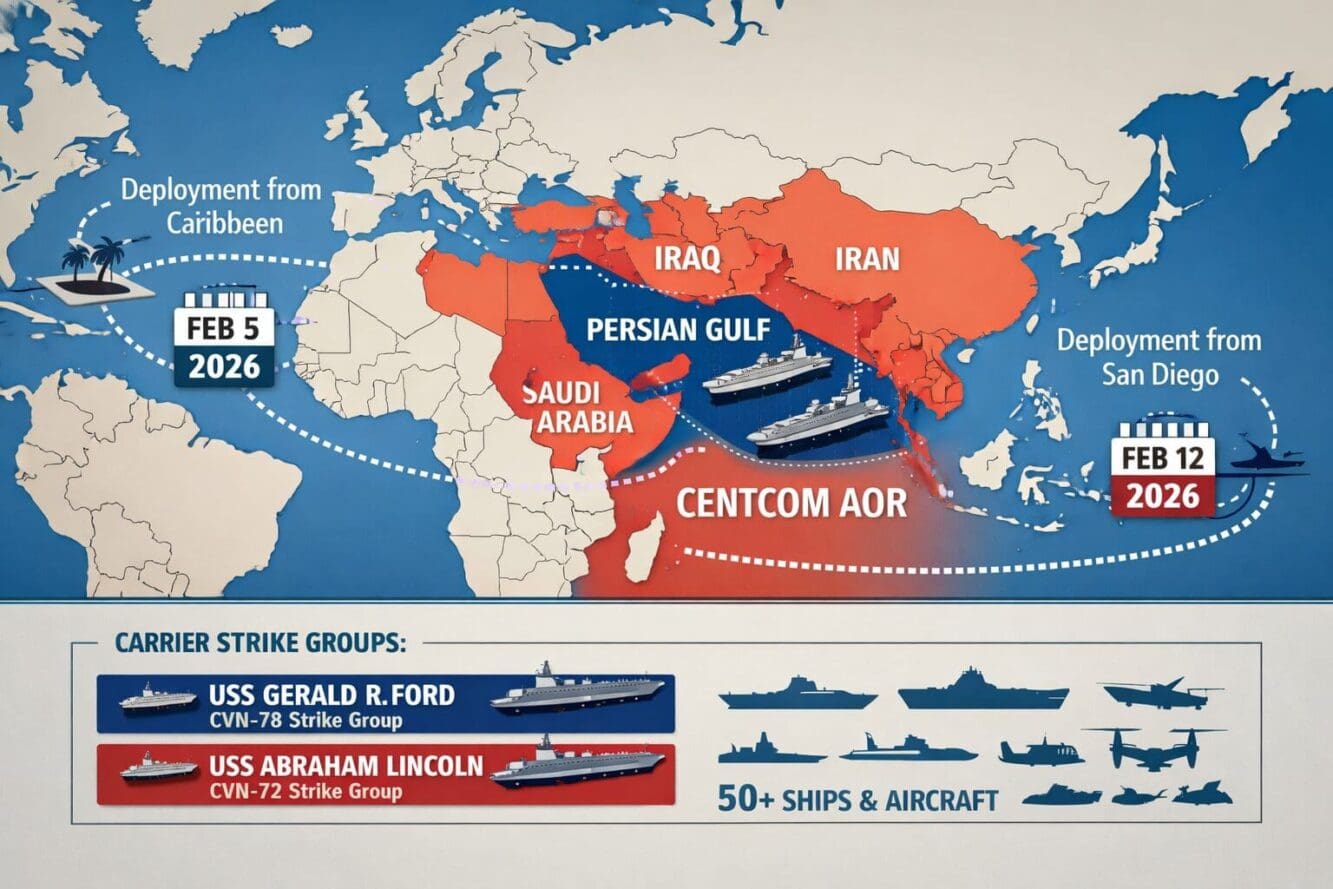
The convergence of US Carrier Strike Groups Merge in High-Seas Show of Force: Signals to China and Iran represents far more than routine naval movements. The USS Gerald R. Ford, the world’s largest and most technologically advanced aircraft carrier, received official orders for redeployment to the Middle East on February 13, 2026, according to confirmation by the New York Times[2]. The carrier was redirected from the Caribbean, where it had been conducting Operation Southern Spear and played a pivotal role in the dramatic Caracas operation[2].
Meanwhile, the USS Abraham Lincoln has been maintaining a steady presence in the Persian Gulf since January 26, 2026, after departing San Diego in November 2025[2]. This creates the first dual-carrier presence in the U.S. Central Command (CENTCOM) area of responsibility in nearly twelve months—a deployment pattern that signals serious strategic intent[2].
Understanding the Scale of Naval Power
The combined force represents an extraordinary concentration of military capability:
| Asset Category | USS Gerald R. Ford Strike Group | USS Abraham Lincoln Strike Group | Combined Total |
|---|---|---|---|
| Aircraft Carriers | 1 (Ford-class) | 1 (Nimitz-class) | 2 |
| Tactical Jets | 35+ aircraft | 35+ aircraft | 70+ aircraft |
| Destroyers | 3 Arleigh Burke-class | 3 Arleigh Burke-class (Frank E. Peterson Jr., Spruance, Michael Murphy) | 6 |
| Tomahawk Missiles | Hundreds | Hundreds | 500+ estimated |
| Personnel | 5,000+ | 5,000+ | 10,000+ sailors |
The Abraham Lincoln strike group operates with Carrier Air Wing 9, featuring cutting-edge F-35C stealth fighters, F/A-18E/F Super Hornets, EA-18G Growler electronic warfare jets, E-2D Hawkeyes for airborne early warning, and MH-60R and MH-60S helicopters for anti-submarine warfare and logistics[2]. Each of the accompanying Arleigh Burke-class destroyers comes equipped with Tomahawk cruise missiles and advanced ballistic missile defense capabilities[2].
When combined with existing air assets in the region—including F-15E Strike Eagles, A-10 Thunderbolt IIs, and additional electronic warfare jets based at land facilities—the total air power available to CENTCOM commanders exceeds 100 tactical aircraft[1][5].
Timeline and Transit: From Caribbean to Crisis Zone
The USS Gerald R. Ford’s journey exemplifies the extended deployments that have become increasingly common for U.S. naval forces. The carrier’s deployment originally began on June 24, 2025, and was scheduled to conclude in early March 2026 with a return to Norfolk[2]. However, crew members received notification of their reassignment on February 12, 2026, just one day before the official public announcement[2].
Transit estimates suggest the Ford will arrive in the Middle East within 3-6 weeks from the Caribbean, though operational urgency may compress this timeline to approximately 3 weeks[5]. For context, if a second carrier strike group had been ordered to deploy from the U.S. East Coast, analysts projected it would arrive by mid-March at the earliest, requiring transit across the Atlantic through either the Mediterranean or Suez Canal[1].
The extended deployment has significant implications for crew morale and readiness. Sailors aboard the Ford now face an indefinite extension, with return to Norfolk pushed back to late April or early May 2026 instead of early March[2]. This extension could potentially break recent deployment records, raising questions about sustainable operational tempo for the Navy’s most advanced vessels[4].
Diplomatic Signals: The Iran Nuclear Question
The US Carrier Strike Groups Merge in High-Seas Show of Force: Signals to China and Iran arrives at a particularly sensitive moment in U.S.-Iran relations. President Trump held a three-hour meeting with Israeli Prime Minister Benjamin Netanyahu before February 13, 2026, where Netanyahu strongly advocated against any Iran deal that fails to halt Iran’s nuclear weapons ambitions and eliminate its ballistic missile stockpile[1].
Trump subsequently stated on his Truth Social platform that he was pursuing a negotiated settlement with Iran but would not hesitate to pursue military action if negotiations failed[1]. This dual-track approach—diplomacy backed by overwhelming military presence—represents classic gunboat diplomacy updated for the 21st century.
“The carrier deployment represents both pressure and a contingency for sustained military operations.” – Pentagon officials speaking to defense analysts[1]
Pentagon planners are reportedly developing plans for “sustained, weeks-long operations” against Iran, indicating that the dual-carrier presence represents capability for protracted conflict rather than limited strikes[3]. This planning suggests the merger of carrier strike groups serves multiple strategic purposes:
- Deterrence: Demonstrating overwhelming force to discourage Iranian aggression
- Negotiation leverage: Providing credible military backing to diplomatic initiatives
- Operational readiness: Ensuring sufficient assets for sustained combat operations if required
- Regional reassurance: Signaling commitment to Gulf allies and partners
The Broader Military Footprint in the Region
The carrier strike groups do not operate in isolation. The broader U.S. military presence in the Middle East includes more than 30,000 troops stationed at bases throughout the region, along with at least nine warships including multiple Arleigh Burke-class guided missile destroyers[1]. Additionally, submarine presence remains undisclosed but is presumed significant given standard operational security protocols[1].
This extensive footprint enables the United States to maintain what military strategists call “escalation dominance”—the ability to match or exceed any adversary’s military response at every level of conflict intensity. The merger of carrier strike groups represents the apex of conventional military power projection, short of nuclear weapons deployment.
For those interested in how advanced technology shapes modern military operations, the integration of artificial intelligence and advanced sensors aboard these carriers represents a quantum leap in combat capability compared to previous generations of naval vessels.
Multi-Theater Implications: Venezuela, Cuba, and Beyond
The Ford’s rapid pivot from Caribbean operations to Middle East deployment demonstrates a critical capability: the ability to respond to crises across multiple theaters simultaneously. The carrier’s participation in Operation Southern Spear and the January 3, 2026, Caracas operation marked a significant U.S. intervention in Latin American affairs[2].
The redeployment raises important questions about ongoing U.S. commitments in the Caribbean and potential power vacuums. With the Ford moving to the Middle East, other naval assets must fill the gap to maintain pressure on Cuba and monitor Venezuelan developments following Maduro’s capture.
This multi-theater juggling act reflects the strategic challenge facing U.S. military planners in 2026: how to maintain credible deterrence and operational capability across the Indo-Pacific (China), Middle East (Iran), and Western Hemisphere (Venezuela/Cuba) simultaneously. The Arctic territories also demand increasing attention as climate change opens new strategic waterways, further stretching naval resources.
Allied Reactions and International Response
The US Carrier Strike Groups Merge in High-Seas Show of Force: Signals to China and Iran has generated varied reactions from American allies. Canada, as a NATO partner with significant interests in Middle East stability, has expressed cautious support for the deployment while emphasizing the importance of diplomatic solutions. Canadian military officials have noted the deployment’s potential impact on regional security dynamics and the importance of maintaining open communication channels with Tehran.
European allies have similarly welcomed the American commitment to regional security while urging restraint and continued emphasis on diplomatic engagement. The deployment reassures Gulf Cooperation Council (GCC) states—including Saudi Arabia, the United Arab Emirates, and Bahrain—that American security guarantees remain credible despite shifting global priorities.
From Beijing’s perspective, the deployment serves as a reminder of American naval superiority and the ability to project power across vast distances. Chinese military analysts have undoubtedly noted the operational tempo and logistical sophistication required to maintain dual-carrier operations while simultaneously managing commitments in the Western Pacific.
Operational Challenges and Sustainability Concerns
Maintaining two carrier strike groups in the Middle East presents significant operational and logistical challenges. The extended deployment of the USS Gerald R. Ford raises questions about sustainable operational tempo and the Navy’s ability to maintain readiness across the fleet[4].
Key challenges include:
- Crew fatigue and morale: Extended deployments strain sailors and their families
- Maintenance cycles: Delayed returns compress time available for essential maintenance
- Fleet readiness: Keeping carriers deployed reduces availability for other contingencies
- Supply chain logistics: Supporting 10,000+ personnel and dozens of aircraft requires extensive logistical networks
- Budget implications: Extended operations consume resources and may require supplemental funding
The Navy has faced criticism in recent years for unsustainable deployment patterns that compromise long-term readiness. The Ford’s extended deployment, if it continues beyond May 2026, could exacerbate these concerns and potentially impact the carrier’s availability for future operations.
For perspective on how military operations intersect with broader geopolitical trends, the current deployment pattern reflects the challenging strategic environment facing the United States in 2026.
What This Means for Global Security Architecture
The merger of carrier strike groups represents more than a tactical military deployment—it reflects fundamental shifts in the global security architecture. The United States faces the challenge of maintaining its role as global security guarantor while managing resource constraints and competing domestic priorities.
Key strategic implications include:
✅ Deterrence credibility: Demonstrating the will and capability to deploy overwhelming force when national interests are threatened
✅ Alliance reassurance: Signaling to regional partners that American security commitments remain viable
✅ Diplomatic leverage: Creating favorable conditions for negotiations by demonstrating alternatives to diplomatic solutions
✅ Adversary calculations: Forcing Iran, China, and other potential adversaries to recalculate the costs and risks of aggressive actions
✅ Power projection: Maintaining the ability to influence events in critical regions despite geographic distance
The deployment also highlights the enduring importance of naval power in an era of cyber warfare, space-based assets, and hypersonic missiles. While new technologies reshape warfare, the ability to position 70+ tactical jets off an adversary’s coast remains a uniquely powerful form of strategic messaging.
Looking Ahead: Scenarios and Possibilities
As the USS Gerald R. Ford transits toward the Middle East to join the Abraham Lincoln, several scenarios could unfold:
Scenario 1: Successful Deterrence – The overwhelming military presence convinces Iran to make meaningful concessions in nuclear negotiations, allowing for a diplomatic resolution and eventual drawdown of naval forces.
Scenario 2: Extended Standoff – Negotiations stall, leading to an indefinite dual-carrier presence that strains Navy resources and potentially requires additional deployments to maintain operational tempo.
Scenario 3: Limited Military Action – Diplomacy fails, resulting in targeted strikes against Iranian nuclear facilities or military infrastructure, followed by potential escalation requiring the full capabilities of both carrier strike groups.
Scenario 4: Regional Crisis Expansion – Events in other theaters (Taiwan Strait, Korean Peninsula, Ukraine) force redeployment of one or both carriers, testing American ability to manage multiple simultaneous crises.
Each scenario carries distinct implications for U.S. military posture, alliance relationships, and global security dynamics. The coming weeks will reveal which path emerges as most likely.
Conclusion: Naval Power in the 21st Century
The US Carrier Strike Groups Merge in High-Seas Show of Force: Signals to China and Iran represents a defining moment in contemporary geopolitics. With more than 50 military assets converging in the Middle East, the United States has assembled a formidable concentration of naval power designed to achieve multiple strategic objectives simultaneously: deterring Iranian aggression, supporting diplomatic initiatives, reassuring regional allies, and signaling to China and other potential adversaries that American military reach remains unmatched.
The deployment’s success will ultimately be measured not by battles fought but by conflicts prevented. If the overwhelming display of military capability creates conditions for diplomatic breakthroughs with Iran while simultaneously deterring Chinese adventurism in the Taiwan Strait or South China Sea, the strategic investment will have achieved its purpose.
For military families, particularly those aboard the USS Gerald R. Ford facing extended deployments, the personal costs of maintaining American global security commitments remain significant. For policymakers and citizens, the deployment raises fundamental questions about sustainable military strategy in an era of multiple simultaneous challenges.
Actionable Next Steps
For policymakers and analysts:
- Monitor diplomatic developments with Iran closely for signs of negotiation progress or breakdown
- Assess the sustainability of current deployment patterns and their impact on long-term Navy readiness
- Evaluate allied contributions to regional security and opportunities for burden-sharing
For concerned citizens:
- Stay informed about developments in U.S.-Iran relations and their potential impact on regional stability
- Support military families facing extended deployments through community organizations and advocacy
- Engage in informed discussions about the appropriate balance between military deterrence and diplomatic engagement
For military professionals:
- Study the operational lessons from dual-carrier deployments for future planning
- Consider the logistical and personnel management challenges of extended deployments
- Evaluate technological and procedural innovations that could enhance operational sustainability
The merger of carrier strike groups in 2026 will be studied by military historians and strategists for years to come. Whether it represents the successful application of naval power to achieve diplomatic objectives or a harbinger of unsustainable operational tempo remains to be seen. What is certain is that the eyes of the world—from Tehran to Beijing, from allied capitals to adversary command centers—are watching closely as these floating cities of American military power converge in the world’s most volatile region.
References
[1] Second Carrier Strike Group Ordered To Spin Up For Deployment To Middle East Report – https://www.twz.com/news-features/second-carrier-strike-group-ordered-to-spin-up-for-deployment-to-middle-east-report
[2] Us Deploys Second Aircraft Carrier Uss Gerald R Ford To Middle East Amid Tensions With Iran – https://www.armyrecognition.com/news/navy-news/2026/us-deploys-second-aircraft-carrier-uss-gerald-r-ford-to-middle-east-amid-tensions-with-iran
[3] Two Carriers Three Fronts A War Washington Cant Win – https://www.struggle-la-lucha.org/2026/02/16/two-carriers-three-fronts-a-war-washington-cant-win/
[4] Carrier Fords Extension To The Middle East Could Break Recent Deployment Records – https://news.usni.org/2026/02/13/carrier-fords-extension-to-the-middle-east-could-break-recent-deployment-records
[5] Watch – https://www.youtube.com/watch?v=UavU4Qj2bxQ
[6] Second Us Aircraft Carrier Being Sent Middle East Source Says Iran Tensions High – https://www.military.com/daily-news/2026/02/13/second-us-aircraft-carrier-being-sent-middle-east-source-says-iran-tensions-high.html
Some content and illustrations on GEORGIANBAYNEWS.COM are created with the assistance of AI tools.
GEORGIANBAYNEWS.COM shares video content from YouTube creators under fair use principles. We respect creators’ intellectual property and include direct links to their original videos, channels, and social media platforms whenever we feature their content. This practice supports creators by driving traffic to their platforms.
Much Appreciate You Sharing This Post - It Helps MUCH!!!