


















Vancouver High-Rise Earthquake Risks: New Study on West End Concrete Buildings and Retrofit Urgency

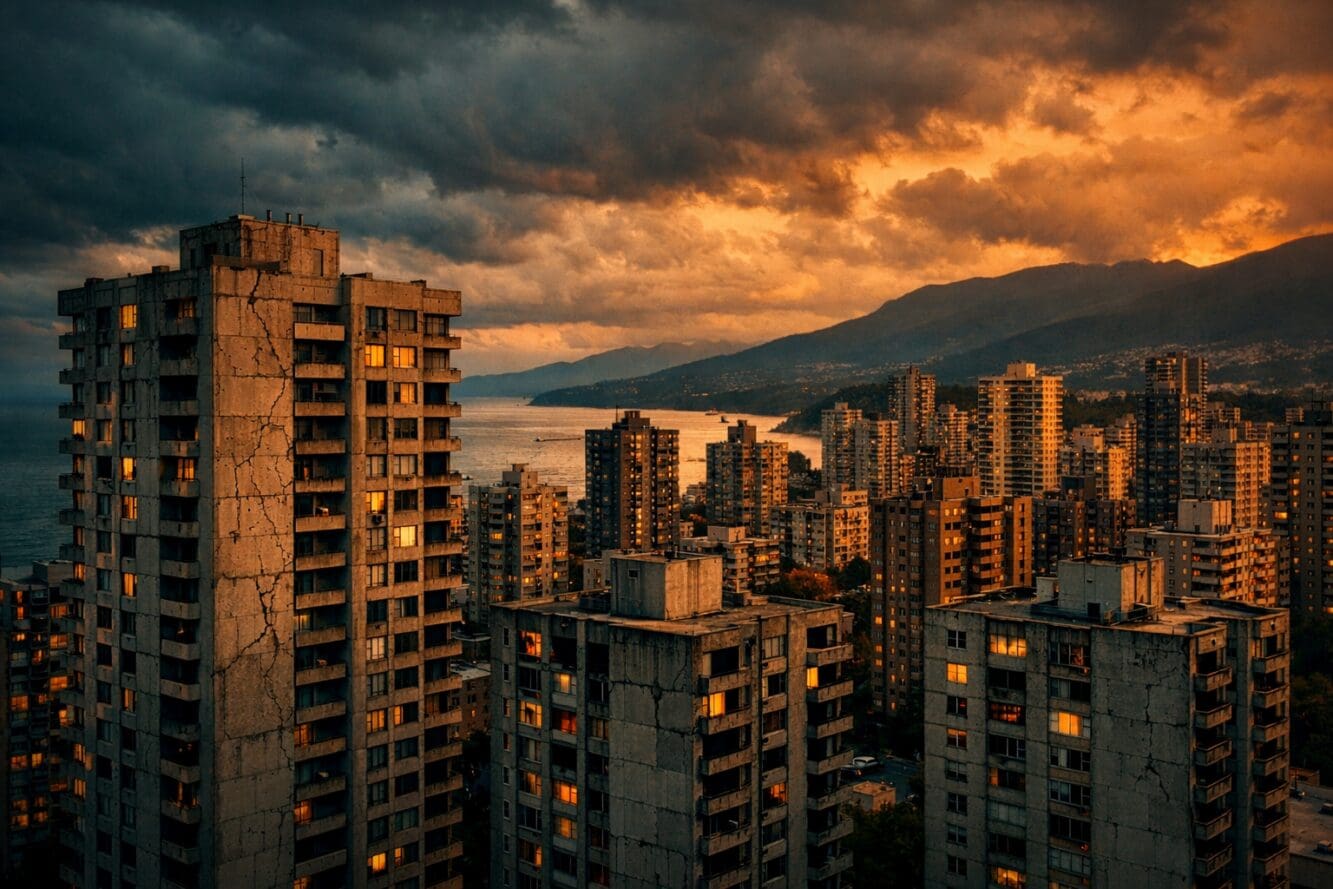
Vancouver sits on borrowed time. Beneath the gleaming towers of one of Canada’s most iconic skylines, a seismic threat lurks that could turn concrete into rubble in minutes. A wave of new research in 2026 has brought Vancouver high-rise earthquake risks into sharp focus, with alarming findings about West End concrete buildings and the urgent need for retrofitting. The question is no longer if a major earthquake will strike—but whether the city will be ready when it does.
Recent studies reveal that many of Vancouver’s aging concrete towers were built long before modern seismic codes existed [5]. These buildings house tens of thousands of residents. And the clock is ticking.
Key Takeaways 📋
- Over 1,300 casualties and $17 billion in damage could result from a major earthquake centered near Vancouver [1].
- The West End, Yaletown, Downtown Eastside, Kitsilano, Fairview, and Mount Pleasant face the highest risk [1].
- Buildings made with non-ductile reinforced concrete—common before modern seismic standards—are the most vulnerable [5].
- Half of BC’s public schools still lack seismic upgrades, despite over $2 billion already spent [3].
- UBC researchers have developed innovative self-centering friction dampers that could protect future high-rises [2].
Why Vancouver’s West End Towers Are Ground Zero for Seismic Risk
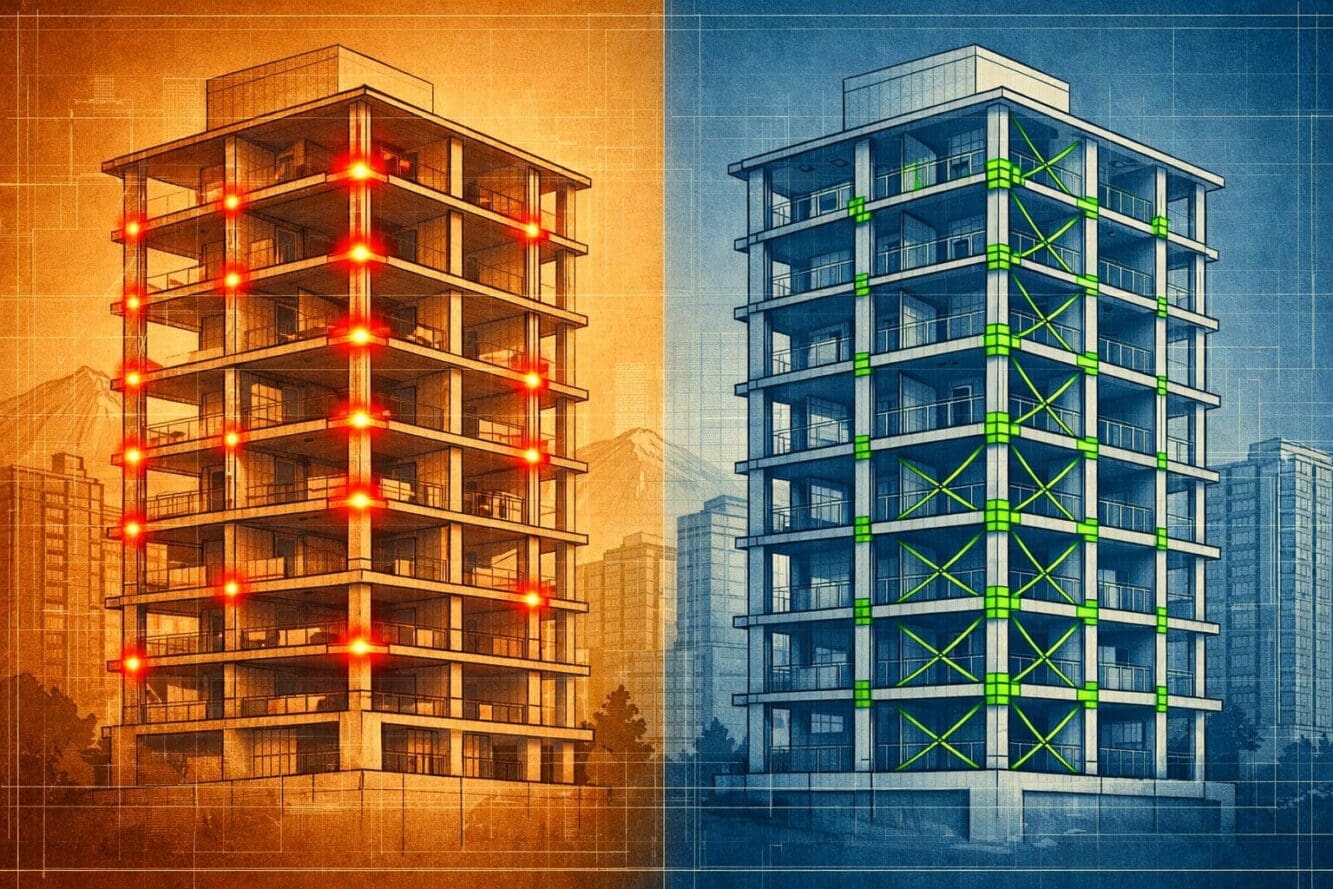
Vancouver’s West End is one of the most densely populated neighborhoods in Canada. Rows of concrete high-rises, many built during the 1960s and 1970s construction boom, define its skyline. But these towers carry a dangerous secret: most were constructed using non-ductile reinforced concrete, a building method that lacks the flexibility to absorb earthquake energy [5].
Non-ductile concrete is stiff and brittle. During violent shaking, it doesn’t bend—it snaps. Columns can fail suddenly, causing floors to pancake on top of each other. This is the exact failure mode that has killed thousands in earthquakes around the world.
A November 2024 city report projected that a large earthquake centered at the Strait of Georgia could:
| Impact Category | Projected Outcome |
|---|---|
| Casualties | Over 1,300 [1] |
| Damaged private buildings | More than 6,000 [1] |
| Economic loss (Vancouver) | Exceeding $17 billion [1] |
| Economic loss (province-wide) | $30 billion [1] |
In a catastrophic scenario, 18,000 buildings could be damaged and more than 3,400 people could be dead within minutes of violent shaking [4]. These are not distant possibilities—they are modeled projections based on known fault activity.
🔴 “Three building categories require priority retrofitting: older concrete high-rises in the West End and downtown, and older brick and wood residential buildings.” [1]
The neighborhoods at greatest risk—West End, Yaletown, Downtown Eastside, Kitsilano, Fairview, and Mount Pleasant—are also among the city’s most populated and economically vital [1]. The stakes could not be higher.
Understanding Building Code Gaps and Vulnerability Categories
Not all buildings carry the same risk. British Columbia’s building stock falls into distinct vulnerability categories based on when structures were built:
- Pre-code buildings (before the 1970s): Classified as “highly vulnerable.” This includes red brick heritage buildings in Chinatown and Victoria’s inner core [4].
- Low-code buildings (1970s–1980s): Built with minimal seismic consideration. Many West End towers fall into this category.
- Moderate-code buildings (late 1980s–early 2000s): Improved but still below current standards [4].
Modern seismic codes require buildings to flex, absorb energy, and remain standing even after significant shaking. Older buildings simply weren’t designed with these principles in mind.
This matters for residents and property owners alike. Insurance premiums in high-risk zones are climbing as insurers reassess earthquake exposure. Building assessments—once a routine formality—are now critical tools for understanding structural vulnerability.
For communities thinking about infrastructure resilience and public safety planning, Vancouver’s situation offers a cautionary tale about the cost of delayed action.
What the City and Province Are Doing About It 🏗️
Progress is happening—but it’s uneven.
School Seismic Upgrades
The province is replacing or seismically upgrading 71 schools through its Seismic Mitigation Program, with 58 projects completed as of January 2026 [4]. However, half of BC’s vulnerable public schools still lack retrofits, despite more than $2 billion invested so far [3]. That means thousands of children attend buildings that could collapse in a major quake.
Hospital Improvements
BC has made significant upgrades to seismic systems in hospitals throughout the province. Strict guidelines now govern new hospital construction to ensure seismic resilience [4]. This is encouraging, since hospitals are the facilities communities need most after a disaster.
Municipal Programs
Victoria has taken a proactive approach, upgrading most of its underground infrastructure to be seismically resilient. The city also offers tax incentive programs for heritage buildings undergoing seismic alterations [4]. Vancouver, by contrast, has been slower to implement similar incentive structures for private building owners.
The gap between public and private building preparedness remains a major concern. While governments can mandate upgrades for schools and hospitals, the thousands of privately owned concrete towers in the West End present a far more complex challenge involving strata councils, financing, and political will.
As communities across Canada consider how environmental challenges intersect with infrastructure planning, Vancouver’s retrofit urgency stands out as one of the most pressing issues of 2026.
Breakthrough Research: UBC’s Self-Centering Friction Dampers
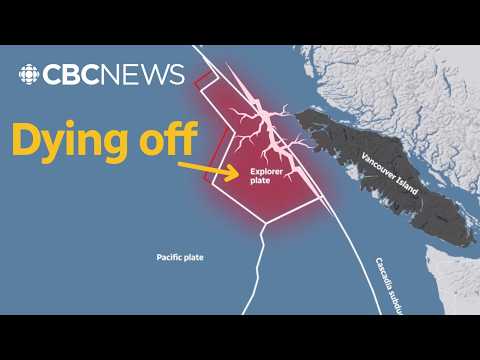
There is hope on the engineering front. Researchers at the University of British Columbia have developed a groundbreaking technology: self-centering friction dampers on outrigger systems [2].
Here’s how it works in simple terms:
- Outrigger systems connect a building’s central core to its outer columns.
- Friction dampers are installed at these connection points.
- During an earthquake, the dampers allow the building to rock gently while absorbing and dissipating seismic energy.
- After the shaking stops, the self-centering mechanism pulls the building back to its original position.
This technology was tested on a simulated 30-story high-rise and showed remarkable results [2]. Unlike traditional approaches that rely on brute strength to resist earthquakes, this system works with the seismic forces rather than against them.
💡 Think of it like a tree in a storm—bending with the wind instead of snapping.
While this innovation is primarily designed for new construction, the principles behind it could inform retrofit strategies for existing buildings. The research represents a significant step forward in making tall buildings safer in seismic zones.
For those interested in how technology and innovation are reshaping daily life, UBC’s seismic research is a powerful example of applied science solving real-world problems.
What Residents and Building Owners Should Do Now
The research on Vancouver high-rise earthquake risks and retrofit urgency isn’t just an academic exercise. It demands action from residents, strata councils, and policymakers alike.
For Residents 🏠
- Know your building’s age and construction type. If it was built before the mid-1980s with reinforced concrete, it may be in a high-risk category.
- Review your earthquake insurance. Standard home insurance does not cover earthquake damage in BC. Separate earthquake insurance is essential.
- Prepare an emergency kit. Include 72 hours of water, food, medications, and a communication plan.
For Strata Councils and Building Owners 🔧
- Commission a seismic assessment. Hire a qualified structural engineer to evaluate your building’s earthquake resilience.
- Explore retrofit financing options. Look into provincial grants, tax incentives, and low-interest loan programs.
- Advocate for municipal incentive programs similar to Victoria’s heritage building tax incentives [4].
For Policymakers 📜
- Accelerate school and public building retrofits. Half of vulnerable schools remain unprotected [3].
- Create financial incentives for private building retrofits. Without them, strata councils face costs that can reach millions of dollars.
- Update building codes to reflect the latest seismic research, including technologies like UBC’s friction dampers [2].
Understanding how communities prepare for and respond to challenges can help inform broader conversations about civic responsibility and public safety.
The importance of preserving heritage while ensuring safety also applies directly to Vancouver’s older neighborhoods, where architectural character and seismic resilience must coexist.
Conclusion
The evidence is clear: Vancouver’s high-rise earthquake risks are real, measurable, and urgent. New studies on West End concrete buildings have exposed vulnerabilities that demand immediate attention. With projected casualties exceeding 1,300, potential economic losses surpassing $17 billion, and thousands of aging towers built with brittle non-ductile concrete, the retrofit urgency cannot be overstated [1][5].
Progress is being made—schools are being upgraded, hospitals are being strengthened, and UBC researchers are pioneering new damper technologies [2][4]. But the pace must accelerate. Half of vulnerable schools remain unprotected. Private high-rises in the West End still lack mandatory retrofit requirements. And every year without action is another year of compounding risk.
The next step is yours. Whether you’re a resident checking your earthquake insurance, a strata council commissioning a seismic assessment, or a voter demanding stronger retrofit policies—the time to act is now. Vancouver’s skyline is beautiful. Keeping it standing requires community engagement and forward thinking on a scale the city has never seen before.
References
[1] Vancouver Earthquake Report Impact – https://vancouver.citynews.ca/2024/11/07/vancouver-earthquake-report-impact/
[2] Watch – https://www.youtube.com/watch?v=RUcXc_jsuAI
[3] Bc Earthquake Proofing House Retrofit Big One – https://macleans.ca/society/environment/bc-earthquake-proofing-house-retrofit-big-one/
[4] A Major Earthquake Is Coming Is British Columbia Ready – https://thenorthernview.com/2026/01/11/a-major-earthquake-is-coming-is-british-columbia-ready/
[5] Vancouver Built Fast Now Its Older Towers Face Earthquake Reckoning – https://apsc.ubc.ca/news/2026/vancouver-built-fast-now-its-older-towers-face-earthquake-reckoning
Content, illustrations, and third-party video appearing on GEORGIANBAYNEWS.COM may be generated or curated with AI assistance or reproduced pursuant to the fair dealing provisions of the Copyright Act, R.S.C. 1985, c. C-42. Attribution and hyperlinks to original sources are provided in acknowledgment of applicable intellectual property rights. Such referencing is intended to direct traffic to and support the original rights holders’ platforms.
Much Appreciate You Sharing This Post - It Helps MUCH!!!