






















Daylight Saving Time 2026 in Canada: Exact Dates, Clock Change Impacts, and Health Tips for the Switch

March is one of the busiest months of the year for Canadian families—and right in the middle of it, clocks jump forward by one hour. That lost hour may seem small, but it can throw off sleep schedules, morning commutes, and even driving safety for days. This guide covers everything about Daylight Saving Time 2026 in Canada: exact dates, clock change impacts, and health tips for the switch, so every household can prepare with confidence.
Whether checking sunrise times, adjusting a toddler’s bedtime, or simply wondering when to change that kitchen clock, this article has the answers. Read on for province-by-province details, health research, and practical strategies to make the transition smooth.
Key Takeaways
- ⏰ Clocks spring forward on March 8, 2026 at 2:00 a.m. and fall back on November 1, 2026 at 2:00 a.m. [1][2]
- 🍁 Not every part of Canada observes DST—Saskatchewan, Yukon, and select communities in B.C. and Quebec stay on standard time year-round. [2][3]
- 😴 The spring time change disrupts circadian rhythms, increasing risks of sleep deprivation, traffic accidents, and reduced workplace focus. [1]
- 📱 Most digital devices auto-adjust, but analog clocks, ovens, and car dashboards need manual changes. [1]
- 📜 Legislative efforts are underway to end the biannual clock switch permanently across Canada. [1]
Exact Dates for Daylight Saving Time 2026 in Canada: Clock Change Impacts and What to Expect
Spring Forward — March 8, 2026
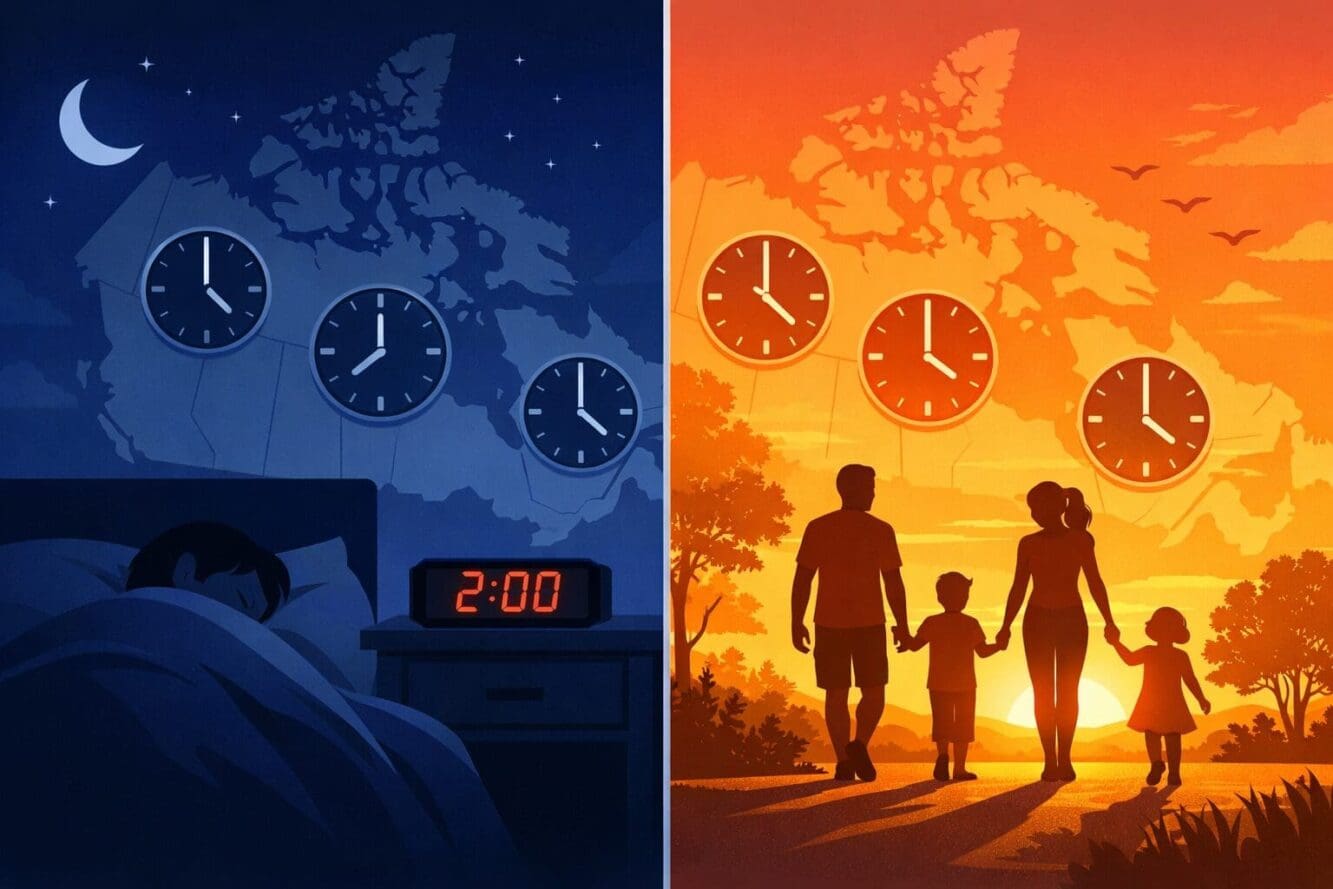
Daylight Saving Time begins on Sunday, March 8, 2026, at 2:00 a.m. local time. At that moment, clocks jump ahead to 3:00 a.m., and Canadians lose one hour of sleep. [1][2]
💡 Pro tip: Set analog clocks forward on the evening of Saturday, March 7 before going to bed. Smartphones, tablets, and most smart-home devices will update automatically. [1]
On March 8, sunrise and sunset will both shift roughly one hour later compared to March 7. That means darker mornings but brighter evenings—a welcome change for anyone craving after-work daylight. [2][3]
Fall Back — November 1, 2026
DST ends on Sunday, November 1, 2026, at 2:00 a.m., when clocks move back to 1:00 a.m. Canadians gain an extra 60 minutes that night. [2][4]
| Event | Date | Time | Clock Direction | Net Effect |
|---|---|---|---|---|
| Spring Forward | March 8, 2026 | 2:00 a.m. → 3:00 a.m. | ⏩ Forward 1 hour | Lose 1 hour |
| Fall Back | November 1, 2026 | 2:00 a.m. → 1:00 a.m. | ⏪ Back 1 hour | Gain 1 hour |
DST spans roughly eight months—from early March through early November—covering the majority of the calendar year. [1]
Which Canadian Provinces and Territories Observe DST?
Not all of Canada changes clocks twice a year. Here is a quick breakdown:
Provinces and territories that observe DST in 2026:
- British Columbia (most areas)
- Alberta
- Manitoba
- Ontario
- Quebec (most areas)
- New Brunswick
- Nova Scotia
- Prince Edward Island
- Newfoundland and Labrador
- Northwest Territories
- Nunavut (most areas)
Regions that do NOT change clocks: [2][3]
- 🟢 Saskatchewan — stays on Central Standard Time year-round
- 🟢 Yukon — adopted permanent DST in 2020
- 🟢 Parts of B.C. — Creston, Dawson Creek, Fort Nelson, Fort St. John, and Chetwynd
- 🟢 Parts of Quebec — areas east of 63° W longitude, including Blanc-Sablon
- 🟢 Southampton Island, Nunavut
Since 2007, every Canadian province and territory that uses DST has aligned its start and end dates with the United States, keeping cross-border schedules consistent. [2][3]
🇨🇦 Fun fact: The world’s first recorded DST period took place in Port Arthur, Ontario (now Thunder Bay) on July 1, 1908. Canada has observed DST for 114 years between 1908 and 2026. [2][3]
Health Tips for the Switch: Managing Clock Change Impacts on Sleep and Safety
The spring clock change is more than an inconvenience. Health researchers warn that shifting clocks forward forces body clocks out of sync with the natural day-night cycle and work schedules, compelling people to wake, work, and attend school an hour earlier than their biology expects. [1]
Sleep Disruption 😴
Losing even one hour of sleep can:
- Reduce alertness during the first workweek after the change
- Increase irritability and lower mood
- Impair memory and concentration, especially in children and older adults
Understanding the science behind quality rest is crucial. Experts like Dr. Cheri Mah discuss how sleep optimization affects performance at every level—from professional athletes to everyday Canadians adjusting to a time shift.
Driving Safety 🚗
Studies consistently show a spike in traffic accidents on the Monday following the spring-forward change. Darker mornings combined with drowsy drivers create a dangerous mix. Consider:
- Leaving 10–15 minutes earlier for morning commutes during the first week
- Using headlights longer in the morning
- Avoiding distractions like phones behind the wheel
Community safety matters year-round. Municipalities like Collingwood are already conducting speed limit reviews to make roads safer for everyone—an effort that becomes even more important during the groggy post-DST period.
Practical Health Tips for the Spring Switch
- Shift bedtime gradually — Move bedtime 15 minutes earlier each night for four nights before March 8.
- Get morning sunlight — Exposure to natural light helps reset the internal clock faster.
- Limit caffeine after noon — Avoid stimulants that can delay sleep onset.
- Exercise early in the day — Physical activity supports circadian adjustment, but late-night workouts can backfire.
- Practice calming routines — Breathing exercises and mindfulness can ease the transition. Learning techniques for finding calm through breathing can be especially helpful during the adjustment window.
Emerging developments in healthcare using artificial intelligence may soon offer personalized sleep-adjustment recommendations based on individual circadian data—an exciting frontier for managing future time changes.
Will Canada Ever Stop Changing Clocks?
The debate over ending DST is gaining momentum. Liberal MP Marie-France Lalonde has introduced a private member’s bill to stop the biannual time switch and adopt a single permanent time across the country. [1]
Meanwhile, Ontario unanimously passed the Time Amendment Act in 2020, but implementation remains paused. The province is waiting for alignment with New York and Quebec due to deep trade and commuter interdependencies. [1]
Critics of DST argue that the original rationale—providing extra evening leisure time during long summer days—is no longer relevant. Modern energy-efficient lighting and changed lifestyle patterns have weakened the energy-saving argument. [1]
🗣️ “The original rationale for DST is considered less relevant with modern energy-saving lightbulbs and reduced evening leisure time needs.” — Expert commentary via Global News [1]
The broader conversation around environmental responsibility and energy use connects to ongoing discussions about shifting to cleaner energy and rethinking outdated systems.
Until legislation passes at both provincial and federal levels, Canadians should continue preparing for two clock changes per year.
Apps and Tools for Automatic Clock Adjustments
Busy March schedules leave little room for error. Here are tools that help:
| Device/Tool | Auto-Adjusts? | Action Needed |
|---|---|---|
| Smartphones (iOS/Android) | ✅ Yes | Ensure “Automatic Date & Time” is enabled |
| Smart speakers (Alexa, Google) | ✅ Yes | Connected to internet |
| Laptops & desktops | ✅ Yes | Keep time zone settings on automatic |
| Microwave / oven clocks | ❌ No | Manual change required |
| Wall clocks | ❌ No | Manual change required |
| Car dashboard clocks | ⚠️ Varies | Check owner’s manual |
| Fitness trackers | ✅ Usually | Sync with phone app |
Don’t forget to also check smoke detector batteries when changing clocks—fire departments across Canada recommend this twice-yearly habit.
For parents managing children’s routines during the switch, understanding the difference between a tantrum and a meltdown can help navigate the extra crankiness that often accompanies disrupted sleep in young kids.
Conclusion
Daylight Saving Time 2026 in Canada brings clocks forward on March 8 and back on November 1. While most provinces participate, several regions—including Saskatchewan and Yukon—skip the switch entirely. The health impacts are real: disrupted sleep, increased accident risk, and lower productivity during the transition week.
Actionable next steps:
- 📅 Mark March 7 on the calendar as the night to set analog clocks forward.
- 🛏️ Start adjusting bedtimes four days before the change.
- ☀️ Prioritize morning sunlight during the first week of DST.
- 📱 Verify device settings to confirm automatic time updates.
- 🗳️ Stay informed about federal and provincial legislation that could end clock changes for good.
A little preparation goes a long way. By planning ahead, Canadians can protect their sleep, stay safe on the roads, and make the most of those longer spring evenings.
References
[1] Daylight Saving Time 2026 Canada Begins – https://globalnews.ca/news/11708243/daylight-saving-time-2026-canada-begins/
[2] Canada – https://www.timeanddate.com/time/change/canada
[3] When Is The Time Change In Canada 2026 021726 – https://www.timeout.com/montreal/news/when-is-the-time-change-in-canada-2026-021726
[4] Dst 2026 Clocks Fall Back 6 – https://nt-drisc.org/dst-2026-clocks-fall-back-6/
Content, illustrations, and third-party video appearing on GEORGIANBAYNEWS.COM may be generated or curated with AI assistance or reproduced pursuant to the fair dealing provisions of the Copyright Act, R.S.C. 1985, c. C-42. Attribution and hyperlinks to original sources are provided in acknowledgment of applicable intellectual property rights. Such referencing is intended to direct traffic to and support the original rights holders’ platforms.
Much Appreciate You Sharing This Post - It Helps MUCH!!!