

















VIDEO | New Hantavirus Outbreak Transmission Risks: What You Need to Know in 2026
Last updated: May 8, 2026
Quick Answer: A cluster of hantavirus cases linked to the cruise ship MV Hondius has alarmed global health authorities in 2026, with 7 confirmed or suspected cases and 3 deaths as of May 4. The Andes virus (ANDV) strain involved is one of the only hantaviruses capable of spreading person-to-person, making the new hantavirus outbreak transmission risks significantly more serious than typical rodent-borne cases. WHO issued an urgent briefing on May 7, 2026, calling for active monitoring of all 147 passengers and crew.
Key Takeaways
- 🚨 7 cases (2 confirmed, 5 suspected), 3 deaths linked to the MV Hondius cruise ship as of May 4, 2026 [3]
- 🐀 Hantavirus is normally spread through rodent droppings, urine, or saliva — not person-to-person contact
- ⚠️ The Andes virus (ANDV) strain is a rare exception: it can spread between people through close, prolonged contact [5]
- 🚢 At least one passenger was infected on land in Argentina before boarding; subsequent cases may reflect onboard transmission [6]
- 🌡️ Symptoms include fever, gastrointestinal illness, rapid progression to pneumonia and ARDS [3]
- 🌍 Argentina has reported over 100 hantavirus cases since late 2025 — nearly double its historical average [5]
- 🌡️ Climate-driven rodent migration is expanding human exposure to infected animals [5]
- 🏥 All 147 people aboard the MV Hondius are being treated as close contacts under the precautionary principle [3][4]
- ✅ WHO recommends 45 days of symptom monitoring for all passengers and crew [3]
- 🧼 Prevention focuses on hand hygiene, proper ventilation, and wet-cleaning (never dry sweeping near rodent areas)
What Is Hantavirus and Why Is the 2026 Outbreak Different?
Hantavirus is a family of viruses carried by rodents. Humans typically get infected by breathing in air contaminated with infected rodent droppings, urine, or nesting materials. Most strains do not spread from person to person.
The 2026 outbreak is different because the strain involved — Andes virus (ANDV) — is one of the only documented hantaviruses capable of human-to-human transmission [5]. According to WHO epidemiologist Maria Van Kerkhove, person-to-person spread of ANDV has only been documented after close and prolonged contact, and this cruise ship cluster may represent one of those rare cases [1][2].
That distinction matters enormously. Standard hantavirus outbreaks are contained by removing rodent exposure. ANDV outbreaks in enclosed environments — like a ship — require a completely different response.
How Did the MV Hondius Outbreak Begin?
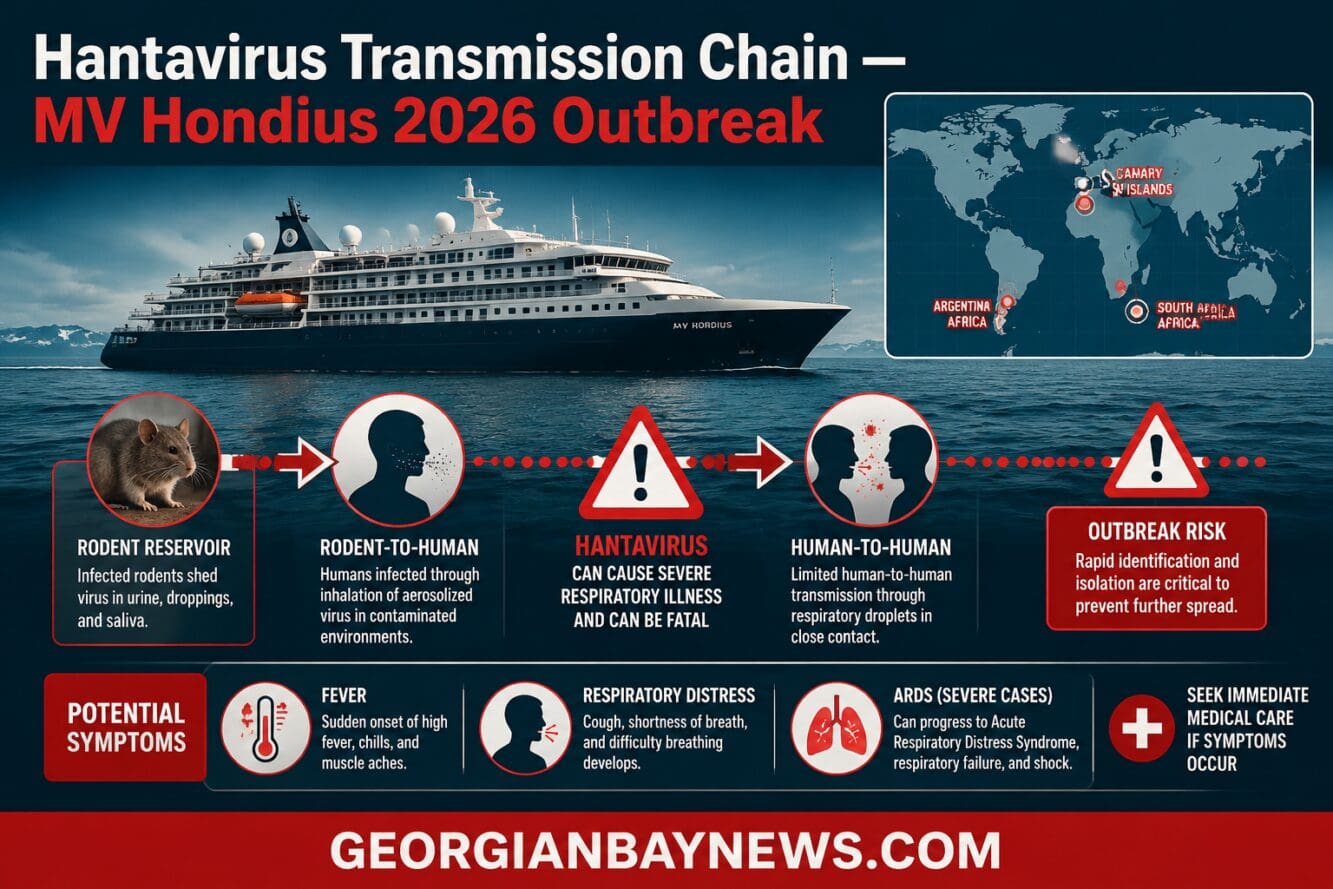
The MV Hondius departed Ushuaia, Argentina, on March 20, 2026, heading for the Canary Islands via Cabo Verde. Illness onset among cases occurred between April 6 and April 28, 2026 [3].
Investigators determined that at least one person was infected on land in Argentina — where ANDV is endemic — before boarding the ship [6]. Subsequent cases aboard the vessel may represent person-to-person transmission within the ship’s closed environment [2].
Timeline at a glance:
| Date | Event |
|---|---|
| March 20, 2026 | MV Hondius departs Ushuaia, Argentina |
| April 6–28, 2026 | Illness onset window among cases [3] |
| May 1, 2026 | Three patients medically evacuated; one critically ill in South Africa [1] |
| May 4, 2026 | WHO reports 7 cases (2 confirmed, 5 suspected), 3 deaths [3] |
| May 7, 2026 | WHO issues urgent briefing on new hantavirus outbreak transmission risks [2] |
Because the ship carries 147 passengers and crew in a shared, enclosed space, everyone aboard is being treated as a close contact [3][4].
Understanding New Hantavirus Outbreak Transmission Risks
The core transmission risks in this outbreak fall into two categories.
1. Rodent-to-human (classic route)
Breathing in dust contaminated with infected rodent droppings, urine, or saliva. This is how the initial case(s) on the MV Hondius likely acquired the virus in Argentina [6]. ANDV is endemic to South America, particularly Argentina and Chile.
2. Human-to-human (rare, ANDV-specific)
Close and prolonged contact with an infected person — likely through respiratory secretions. This is the route that makes the current new hantavirus outbreak transmission risks so unusual and concerning [5][1].
Common mistake: Many people assume hantavirus behaves like influenza and spreads easily through casual contact. ANDV human-to-human transmission requires sustained close exposure — but in a cruise ship setting, that threshold is easily met through shared cabins, dining areas, and social spaces.
What Are the Symptoms and How Severe Is This Strain?
Hantavirus Pulmonary Syndrome (HPS) caused by ANDV progresses quickly. Early symptoms can look like a common illness, which delays diagnosis.
Symptom progression:
- Early (days 1–5): Fever, fatigue, muscle aches, gastrointestinal symptoms (nausea, vomiting, diarrhea) [3]
- Late (days 5–10): Rapid progression to pneumonia, acute respiratory distress syndrome (ARDS), and shock [3]
- Outcome: Case fatality rates for HPS range from 30–40% historically (CDC estimate); this cluster has already seen 3 deaths from 7 cases [3]
Seek emergency care immediately if fever follows potential exposure to rodents or to a confirmed ANDV case, especially if respiratory symptoms develop within days.
Why Are Cases Surging in Argentina in 2026?
Argentina has reported over 100 hantavirus cases since late 2025 — nearly double its historical average [5]. Two factors are driving this.
First, climate-related rodent migration: warming temperatures and extreme weather are pushing infected rodent populations into new territories, increasing the chance of human contact [5]. This “spillover” effect is a growing concern for global health security.
Second, increased outdoor activity in endemic regions, including ecotourism and adventure travel in Patagonia — the exact region where MV Hondius passengers spent time ashore.
For context on how environmental changes affect disease spread, biodiversity loss and ecosystem disruption are increasingly recognized as upstream drivers of zoonotic disease emergence.
What Is WHO Recommending Right Now?
WHO’s May 7, 2026 urgent briefing outlined clear guidance for passengers, crew, and health authorities [2][3]:
For passengers and crew of MV Hondius:
- ✅ Active symptom monitoring for 45 days from last potential exposure
- ✅ Frequent hand hygiene
- ✅ Maintain proper ventilation in all shared spaces
- ✅ Wet-clean surfaces — never dry sweep in areas with potential rodent contamination
- ✅ Report any fever or respiratory symptoms to a healthcare provider immediately
For healthcare providers:
- Treat any symptomatic passenger or crew member as a potential ANDV case
- Use appropriate PPE for suspected HPS patients
- Report cases to national health authorities
How Can Travelers Protect Themselves From Hantavirus?
The general public faces very low risk from this outbreak. However, travelers visiting South America, particularly Argentina and Patagonia, should take precautions.
Practical steps:
- Avoid rodent contact — don’t handle live or dead rodents
- Ventilate enclosed spaces (cabins, sheds, storage areas) before entering
- Wet-mop or use disinfectant spray rather than dry sweeping dusty areas
- Seal food in rodent-proof containers when camping or staying in rural areas
- Wear gloves and a mask when cleaning areas with visible rodent activity
Travelers who develop fever, muscle aches, or breathing difficulty within 6 weeks of visiting endemic areas should tell their doctor about potential exposure.
Staying informed through credible sources is essential. Monitoring updates from health authorities — similar to how communities track public health and care developments locally — helps individuals respond quickly.
FAQ: Hantavirus and the 2026 Outbreak
Q: Can I catch hantavirus from another person?
Most hantavirus strains cannot spread person-to-person. The Andes virus (ANDV) is a rare exception, documented to spread through close, prolonged contact. Casual contact carries no known risk [5].
Q: Is the general public at risk from this cruise ship outbreak?
Risk to the general public is currently low. WHO assesses the risk as low for people with no connection to the MV Hondius or travel to endemic areas in Argentina [3].
Q: How long does it take for symptoms to appear after exposure?
The incubation period for hantavirus is typically 1 to 8 weeks, though most cases appear within 2 to 4 weeks of exposure.
Q: Is there a vaccine or treatment for hantavirus?
No approved vaccine exists for hantavirus. Treatment is supportive — managing symptoms, oxygen therapy, and intensive care for severe cases. Early hospitalization improves survival odds.
Q: Why is a cruise ship a high-risk environment for ANDV?
Enclosed spaces, shared ventilation, and close social contact create conditions where the rare human-to-human transmission route of ANDV becomes more likely. All 147 aboard are considered close contacts [3][4].
Q: Should I cancel travel to Argentina?
WHO has not issued a travel ban for Argentina. However, travelers should avoid high-risk rodent exposure activities, particularly in rural Patagonia, and monitor for symptoms for 6 weeks after returning.
Q: How is this different from past hantavirus outbreaks?
Past outbreaks were almost entirely rodent-to-human. This 2026 cluster is unusual because it involves a strain capable of person-to-person spread in a closed, multi-national setting — a scenario that complicates contact tracing across multiple countries [1][4].
Q: What should I do if I was on the MV Hondius?
Contact your local health authority immediately, follow the 45-day monitoring protocol, and seek emergency care if fever or respiratory symptoms develop [3].
Conclusion: What to Do With This Information
The 2026 MV Hondius cluster has put the new hantavirus outbreak transmission risks into sharp focus for global health authorities. Three deaths, a critically ill patient, and the rare involvement of a human-transmissible strain in a closed environment are serious warning signs — but this is not a reason for widespread public panic.
Actionable next steps:
- If you were aboard the MV Hondius: Contact your national health authority today and begin the 45-day monitoring protocol [3]
- If you traveled to Argentina recently: Watch for fever or respiratory symptoms and mention your travel history to any healthcare provider
- For everyone else: Stay informed through WHO and your national health agency; avoid handling rodents; practice basic hygiene when in rural or wooded areas
- Healthcare providers: Familiarize yourself with ANDV symptom progression and PPE protocols for suspected HPS cases
Hantavirus is not new — but the conditions enabling its spread are changing. Climate-driven rodent migration, increased adventure travel in endemic zones, and the unique transmission profile of ANDV mean that awareness and early action are the most effective tools available right now.
References
[1] Hantavirus Outbreak What Journalists Should Know – https://healthjournalism.org/blog/2026/05/hantavirus-outbreak-what-journalists-should-know/
[2] WHO Urgent Briefing on Hantavirus (YouTube) – https://www.youtube.com/watch?v=09h0LH37CNI
[3] WHO Disease Outbreak News 2026-DON599 – https://www.who.int/emergencies/disease-outbreak-news/item/2026-DON599
[4] ECDC Assessment: Hantavirus-Associated Cluster on Cruise Ship – https://www.ecdc.europa.eu/en/publications-data/hantavirus-associated-cluster-illness-cruise-ship-ecdc-assessment-and
[5] Hantavirus: What You Need To Know About The 2026 Global Surge – https://www.woodsidemd.com/post/hantavirus-what-you-need-to-know-about-the-2026-global-surge
[6] Africa CDC Statement on Multi-Country Hantavirus Cluster – https://africacdc.org/news-item/statement-on-multi-country-hantavirus-cluster-associated-with-cruise-ship-travel/
Content, illustrations, and third-party video appearing on GEORGIANBAYNEWS.COM may be generated or curated with AI assistance or reproduced pursuant to the fair dealing provisions of the Copyright Act, R.S.C. 1985, c. C-42. Attribution and hyperlinks to original sources are provided in acknowledgment of applicable intellectual property rights. Such referencing is intended to direct traffic to and support the original rights holders’ platforms.