





















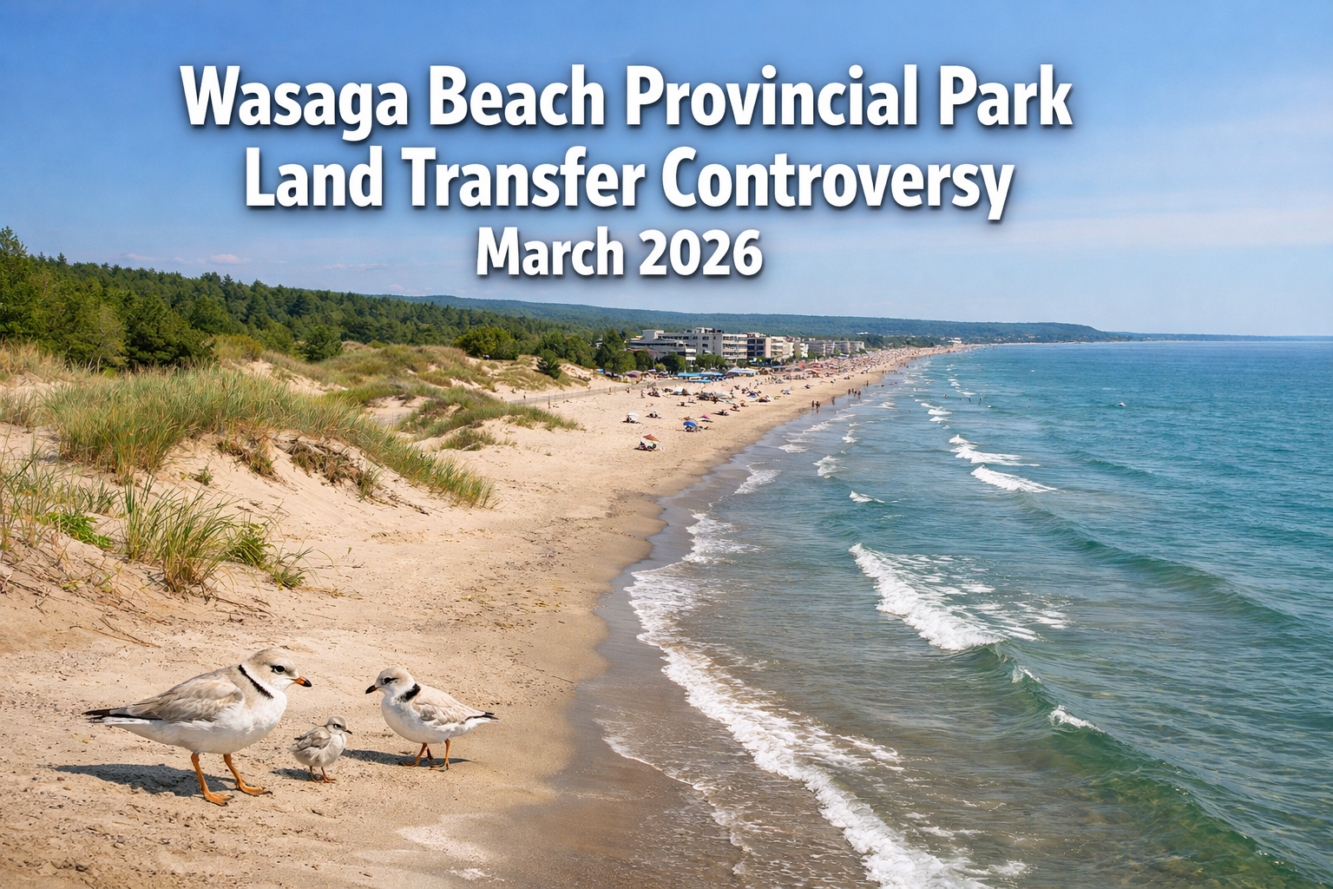
Wasaga Beach Provincial Park Land Transfer Controversy March 2026: Environmental Risks, Plover Protection Plans

Last updated: March 4, 2026
Key Takeaways
- Ontario transferred 60 hectares (60% of beachfront) of Wasaga Beach Provincial Park to town control in January 2026.
- The transferred land contains all critical nesting habitat for the critically endangered piping plover[3]
- The province received 14,233 public comments during consultation, with overwhelming opposition citing environmental risks[1]
- Premier Doug Ford committed $38 million for beachfront redevelopment with conditions that beaches remain public[4]
- Environmental groups warn the transfer sets a dangerous precedent for privatizing protected parklands across Ontario
- Bill 5 weakened species protections just before the transfer announcement, removing key safeguards[2]
- Collingwood visitors will see improved beach access and tourism amenities as part of the redevelopment plan
- Nancy Island Historic Site was separately transferred to provincial tourism ministry management[1]
Quick Answer
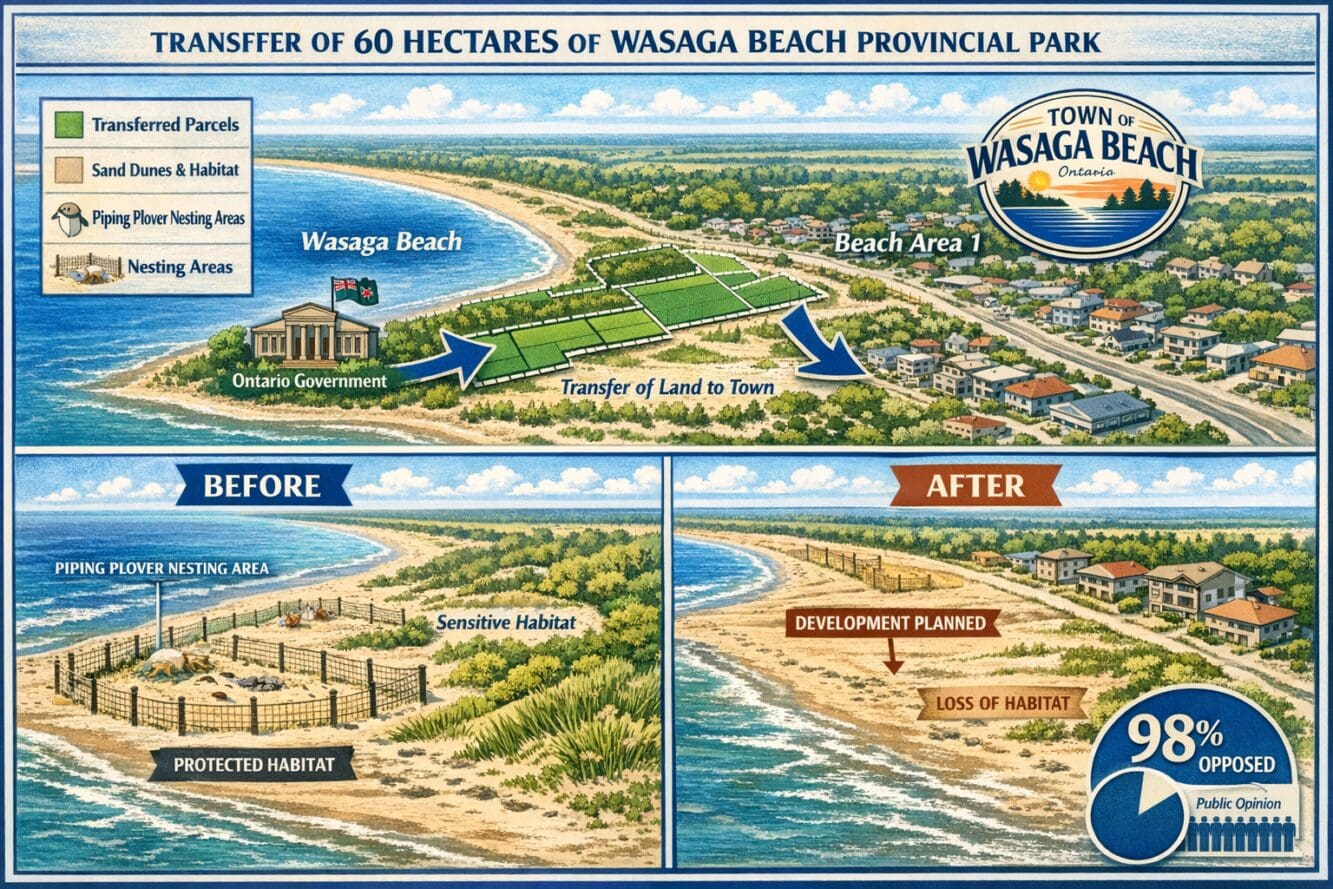
The Wasaga Beach Provincial Park Land Transfer Controversy March 2026 centers on Ontario’s decision to transfer 60 hectares of protected beachfront to municipal control. The transferred land contains irreplaceable piping plover nesting habitat and fragile dune ecosystems that environmental experts say cannot be recreated. While the province promises $38 million in tourism improvements benefiting Collingwood visitors, critics warn the decision prioritizes economic development over species protection and sets a troubling precedent for Ontario’s 340+ provincial parks.
What Exactly Is the Wasaga Beach Provincial Park Land Transfer Controversy March 2026?
The controversy involves Ontario’s January 26, 2026 decision to proceed with transferring 60 hectares of Wasaga Beach Provincial Park to the Town of Wasaga Beach. This represents approximately 60% of the park’s beachfront area and includes all sand dunes and vegetation that serve as critical habitat for the critically endangered piping plover[3].
The transfer required amending the Provincial Parks and Conservation Reserves Act, which governs more than 340 Ontario parks. These amendments were passed in Ontario’s 2025 budget, raising concerns about transparency and the potential for similar transfers at other protected sites[2].
Key aspects of the transfer:
- 60 hectares of prime beachfront removed from provincial park protection
- 2.91 hectares at Nancy Island Historic Site transferred to Ministry of Tourism, Culture and Gaming[1]
- 14,233 public comments submitted during 30-day consultation period
- $38 million provincial investment promised for redevelopment[4]
The province stated it “did not consider any changes to the proposal based on the feedback received,” maintaining that transferred lands would remain subject to Ontario’s species protection and environmental laws[1]. However, critics note that Bill 5 weakened those very protections shortly before the announcement.
Common mistake: Assuming the land will remain protected under the same regulations. The transfer removes Provincial Parks Act protections, leaving only weaker municipal and environmental laws in place.
What Environmental Risks Does the Wasaga Beach Provincial Park Land Transfer Controversy March 2026 Present?
Environmental experts characterize the transferred land as “ecologically irreplaceable” due to rare vegetation communities, dune complexes, and critically endangered species habitat[3]. The environmental risks extend beyond immediate habitat loss to long-term ecosystem degradation.
Tim Gray, Executive Director of Environmental Defense, warned that the affected areas contain dunes that provide critical protection from fall storms, and their loss could increase coastal erosion and flooding risks[3].
Primary environmental concerns:
- Piping plover extinction risk: All nesting habitat for this critically endangered species is within the transferred area
- Dune ecosystem destruction: Fragile sand dune systems take decades to form and cannot be recreated
- Native vegetation loss: Rare plant communities adapted to beach conditions face elimination
- Storm protection reduction: Natural dunes buffer coastal communities from severe weather events
- Precedent for other parks: Sets pattern for removing environmental protections from 340+ Ontario parks
Shortly before announcing the transfer, the Ford government weakened species protections through Bill 5 and exempted certain postings from the environmental registry. This removed the provincial parks legislation as the last remaining strong protection for plover habitat in Wasaga Beach[2].
Edge case to consider: Even if municipal bylaws attempt to protect the habitat, enforcement mechanisms and legal standing differ significantly from provincial park protections, creating gaps in conservation effectiveness.
Visitors to Collingwood and surrounding areas value the region’s natural ecosystems, making these environmental risks particularly concerning for the broader Georgian Bay tourism economy.
How Will Plover Protection Plans Work Under the Wasaga Beach Provincial Park Land Transfer Controversy March 2026?
The piping plover faces heightened extinction risk because the transferred land contains all of its remaining nesting habitat at Wasaga Beach[3]. The province claims transferred lands will remain subject to Ontario’s species protection and environmental laws, but environmental groups dispute the adequacy of these protections.
Current protection framework:
- Federal Species at Risk Act: Provides baseline endangered species protections
- Ontario Endangered Species Act: Offers provincial-level safeguards (recently weakened by Bill 5)[2]
- Municipal bylaws: Town of Wasaga Beach must create and enforce new habitat protections
- Provincial commitments: Government secured promises from town not to build on beaches or sensitive dunes[1]
Critical gap: The Provincial Parks and Conservation Reserves Act previously provided the strongest legal shield for plover habitat. Its removal creates enforcement uncertainties and potential loopholes.
Environmental Defense and other conservation groups argue that municipal-level protections lack the legal teeth and dedicated enforcement resources of provincial park management. Dune restoration, if needed after damage, can take 20-50 years and often fails to recreate the complex ecological conditions endangered species require.
Choose municipal oversight if: You prioritize local control and believe town councils will maintain strict conservation standards despite development pressures.
Choose provincial park status if: You want proven, consistent enforcement backed by dedicated conservation staff and legal frameworks specifically designed for species protection.
The controversy highlights tensions between environmental conservation priorities and local economic development goals that affect communities throughout Georgian Bay.
What Tourism Wins Does the Wasaga Beach Provincial Park Land Transfer Controversy March 2026 Deliver for Collingwood Visitors?
The Ontario government justified the transfer as supporting “the town’s overall strategy for increased tourism and investment”[1]. Premier Doug Ford promised $38 million for Wasaga Beach redevelopment, with conditions that transferred parkland remain public beach[4].
Tourism improvements planned:
- Enhanced beach access: Upgraded pathways and accessibility features
- Improved amenities: Modern washrooms, changing facilities, and concessions
- Better parking infrastructure: Expanded lots to reduce congestion
- Economic revitalization: New restaurants, shops, and entertainment venues near beachfront
- Event hosting capacity: Infrastructure to support festivals and community gatherings
For Collingwood visitors, these improvements mean easier day trips to Wasaga Beach with better facilities and dining options. The 30-minute drive from Collingwood makes Wasaga Beach a popular summer destination, and upgraded infrastructure could reduce crowding issues that have plagued the area.
Tourism benefits comparison:
| Aspect | Before Transfer | After Redevelopment |
|---|---|---|
| Beach Access | Limited parking, basic facilities | Expanded parking, modern amenities |
| Dining Options | Minimal beachfront restaurants | New commercial development encouraged |
| Events | Constrained by park regulations | Greater flexibility for festivals |
| Visitor Experience | Natural but underdeveloped | Enhanced services and infrastructure |
| Economic Impact | Limited local spending | Increased tourism revenue |
Common mistake: Assuming tourism improvements automatically require removing park protections. Many successful provincial parks balance conservation with visitor amenities through careful planning.
The Collingwood tourism economy benefits from regional attractions, making Wasaga Beach improvements potentially valuable for the broader area’s visitor appeal.
What Precedent Does the Wasaga Beach Provincial Park Land Transfer Controversy March 2026 Set for Other Ontario Parks?
The transfer represents the first time Ontario has removed significant portions of a provincial park from protection for municipal development purposes. This precedent concerns conservation groups because it establishes a template that could be applied to any of Ontario’s 340+ provincial parks[2].
Precedent implications:
- Legislative pathway created: Amendments to Provincial Parks Act now provide mechanism for future transfers
- Economic justification accepted: Tourism and investment goals deemed sufficient to override conservation
- Species protection weakened: Bill 5 changes reduce legal barriers to development in sensitive habitats
- Municipal pressure enabled: Towns can now lobby for park land transfers citing economic benefits
Tim Gray of Environmental Defense characterized the decision as opening “Pandora’s box” for Ontario’s protected areas system[3]. If economic development consistently trumps conservation in government decision-making, parks near growing municipalities face particular vulnerability.
Parks potentially at risk using this precedent:
- Waterfront parks near expanding urban areas
- Parks containing commercially valuable land
- Parks where municipalities seek tourism infrastructure improvements
- Parks with species habitat that conflicts with development plans
Choose to support the precedent if: You believe local governments better manage land than provincial agencies and trust municipal councils to maintain conservation standards.
Choose to oppose the precedent if: You value consistent, province-wide protection standards and worry about political pressures on municipal decision-makers.
The controversy has implications for community planning and environmental stewardship throughout the Georgian Bay region.
How Does the Nancy Island Historic Site Factor Into the Wasaga Beach Provincial Park Land Transfer Controversy March 2026?
A separate 2.91-hectare parcel containing Nancy Island Historic Site was transferred from the provincial park to management under the Historical Parks Act, with responsibility shifting to the Ministry of Tourism, Culture and Gaming[1]. This transfer received less attention but raises similar governance questions.
Nancy Island transfer details:
- Size: 2.91 hectares (much smaller than main beachfront transfer)
- New management: Ministry of Tourism, Culture and Gaming
- Legal framework: Historical Parks Act instead of Provincial Parks Act
- Purpose: Align historic site management with tourism development goals
- Public consultation: Included in same process that generated 98% opposition
Nancy Island commemorates the War of 1812 and contains the wreck of the HMS Nancy, making it a significant heritage site. Transferring it to tourism ministry control suggests prioritizing visitor experience and economic development over heritage conservation standards.
Common concern: Heritage sites managed primarily for tourism revenue may face pressure to commercialize in ways that compromise historical integrity.
The dual transfer (beachfront plus historic site) indicates a comprehensive strategy to shift Wasaga Beach from conservation-focused provincial management to development-oriented municipal and tourism ministry control.
What Happens Next in the Wasaga Beach Provincial Park Land Transfer Controversy March 2026?
The transfer was finalized in January 2026, but implementation and its long-term consequences will unfold over coming months and years. Environmental groups have indicated potential legal challenges, while the town must develop management plans for the transferred lands.
Immediate next steps:
- Town planning: Wasaga Beach develops bylaws and management frameworks for transferred land
- Redevelopment begins: $38 million provincial investment starts flowing to infrastructure projects
- Monitoring programs: Species protection and habitat monitoring responsibilities transfer to municipal and provincial environment agencies
- Legal challenges: Environmental groups explore court challenges based on species protection laws
- Public accountability: Citizens track whether town honors commitments not to build on beaches or dunes
Timeline for visible changes:
- 2026: Planning and design phase for redevelopment projects
- 2027-2028: Construction of new amenities and infrastructure
- 2029+: Long-term ecological impacts become measurable
What to watch for:
- Whether piping plover nesting success rates decline under new management
- If development pressures lead to erosion of “no building” commitments
- Whether other municipalities request similar park land transfers
- How courts respond to potential legal challenges on species protection grounds
For Collingwood visitors planning trips to the area, expect construction disruption in 2026-2027 followed by improved facilities if the redevelopment proceeds as promised. However, the natural beach character that attracted visitors may change significantly.
Those concerned about the precedent can engage with local environmental initiatives and conservation organizations working to protect Georgian Bay ecosystems.
FAQ
What land was transferred in the Wasaga Beach Provincial Park controversy?
Ontario transferred 60 hectares (60% of beachfront) from Wasaga Beach Provincial Park to the Town of Wasaga Beach, plus 2.91 hectares containing Nancy Island Historic Site to the Ministry of Tourism, Culture and Gaming[1].
Why did 98% of people oppose the transfer?
Public opposition centered on environmental impacts to critically endangered piping plover habitat, concerns about governance and transparency, fears about eventual privatization, and worry about setting precedent for other Ontario parks[2].
Will the beaches remain public after the transfer?
The province secured commitments from Wasaga Beach that transferred lands will remain public beach and that no building will occur on beaches or environmentally sensitive dunes[1]. However, enforcement depends on municipal bylaws rather than Provincial Parks Act protections.
What is the piping plover and why does it matter?
The piping plover is a critically endangered shorebird whose only remaining nesting habitat at Wasaga Beach is within the transferred land. Environmental experts warn the species faces heightened extinction risk without strong provincial park protections[3].
How much money is Ontario investing in the redevelopment?
Premier Doug Ford promised $38 million for Wasaga Beach redevelopment as part of the transfer agreement[4]. This funding aims to improve tourism infrastructure and amenities.
Can the transfer decision be reversed?
Reversing the transfer would require new legislation amending the Provincial Parks and Conservation Reserves Act again. Environmental groups are exploring legal challenges based on species protection laws, but political reversal appears unlikely given the government’s stated position[2].
How does this affect Collingwood visitors?
Collingwood visitors will benefit from improved beach access, better amenities, enhanced dining options, and upgraded infrastructure at Wasaga Beach, located about 30 minutes away. However, the natural character of the beach may change significantly.
What is Bill 5 and how does it relate to the transfer?
Bill 5 weakened Ontario’s species protections and exempted certain postings from the environmental registry shortly before the transfer announcement. This removed the Provincial Parks Act as the strongest legal protection for piping plover habitat[2].
Will other Ontario parks face similar transfers?
The Wasaga Beach transfer creates a legislative pathway and precedent that could be applied to any of Ontario’s 340+ provincial parks. Environmental groups warn this opens the door to future transfers justified by economic development goals[3].
When will the redevelopment improvements be visible?
Planning and design will occur throughout 2026, with construction expected in 2027-2028. Visitors should expect some disruption during construction before seeing completed improvements in 2029 and beyond.
What can concerned citizens do about the transfer?
Citizens can support environmental organizations pursuing legal challenges, engage with municipal planning processes to ensure strong habitat protections, contact provincial representatives, and participate in monitoring programs to track ecological impacts.
Does the town have experience managing endangered species habitat?
Municipal governments typically lack the specialized conservation staff and enforcement resources of provincial park agencies. The effectiveness of town-managed habitat protection remains untested and represents a significant concern for environmental groups.
Conclusion
The Wasaga Beach Provincial Park Land Transfer Controversy March 2026 represents a watershed moment for Ontario’s protected areas, pitting economic development promises against irreplaceable environmental assets.
For Collingwood visitors, the transfer promises improved amenities and enhanced tourism infrastructure through $38 million in provincial investment[4]. Better beach access, modern facilities, and expanded dining options will make day trips more convenient and comfortable.
However, these tourism wins come at a significant environmental cost. The transferred land contains all piping plover nesting habitat at Wasaga Beach, fragile dune ecosystems that took centuries to form, and rare vegetation communities that experts say cannot be recreated[3]. The precedent set by this transfer threatens Ontario’s entire provincial parks system, potentially exposing 340+ protected areas to similar development pressures.
Actionable next steps:
- For visitors: Plan trips to Wasaga Beach in 2026 before major construction begins; expect improved facilities by 2029
- For conservation supporters: Connect with Environmental Defense and local groups monitoring habitat protection implementation
- For residents: Engage with Town of Wasaga Beach planning processes to ensure strong environmental bylaws
- For everyone: Stay informed about environmental issues affecting Georgian Bay and hold elected officials accountable for species protection commitments
The controversy underscores fundamental questions about how Ontario balances economic growth with environmental stewardship. As climate change and biodiversity loss accelerate, decisions about protected areas carry consequences extending far beyond individual parks or municipalities. Whether the Wasaga Beach transfer proves a cautionary tale or a replicable template will depend on vigilant public engagement and the ecological outcomes that emerge in coming years.
References
[1] Province Proceeds With Wasaga Beach Land Transfer – https://creemore.com/2026/01/26/province-proceeds-with-wasaga-beach-land-transfer/
[2] Ontario Will Sever Wasaga Beach Park Despite 98 Disapproval In Public Comments – https://www.greatlakesnow.org/2026/01/27/ontario-will-sever-wasaga-beach-park-despite-98-disapproval-in-public-comments/
[3] Wasaga Beach Parkland Sale – https://barrie360.com/wasaga-beach-parkland-sale/
[4] Environmental Groups Oppose Transfer of Wasaga Beach Parkland – https://www.youtube.com/watch?v=iNkWoE_oduM
Content, illustrations, and third-party video appearing on GEORGIANBAYNEWS.COM may be generated or curated with AI assistance or reproduced pursuant to the fair dealing provisions of the Copyright Act, R.S.C. 1985, c. C-42. Attribution and hyperlinks to original sources are provided in acknowledgment of applicable intellectual property rights. Such referencing is intended to direct traffic to and support the original rights holders’ platforms.
Much Appreciate You Sharing This Post - It Helps MUCH!!!