



















World Cup 2026 Economic Boost for Toronto and Vancouver: Jobs, Tourism Surge, and Local Business Wins
Last updated: May 13, 2026
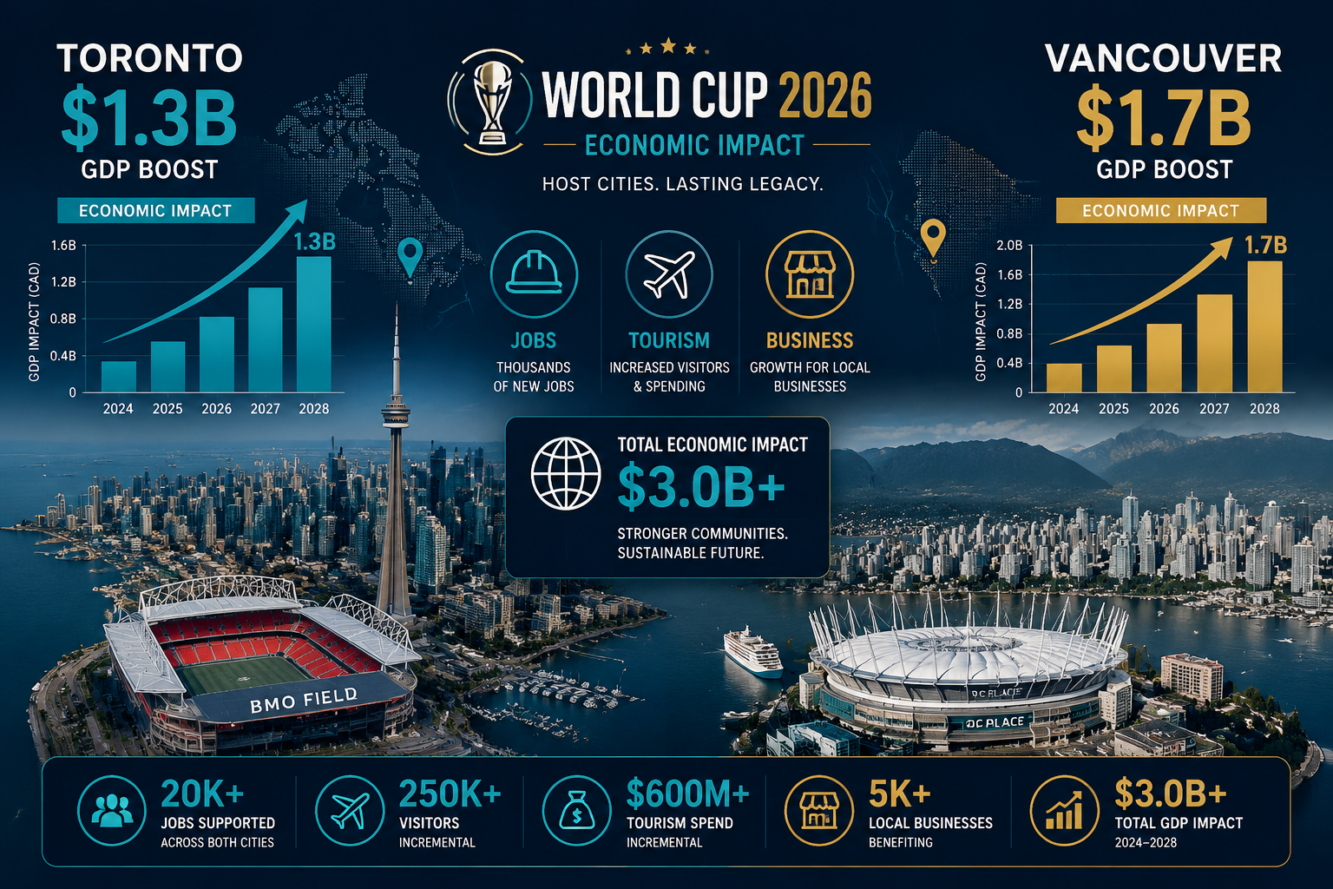
Quick Answer: The FIFA World Cup 2026 is projected to generate $3.8 billion in economic output across Canada, with Toronto and Vancouver leading the way. Toronto’s six matches at BMO Field are expected to produce $1.3 billion in economic output, while Vancouver’s seven matches at BC Place could generate $1.7 billion. The World Cup 2026 economic boost for Toronto and Vancouver spans job creation, tourism surges, and significant wins for local businesses.
Key Takeaways 🏆
- $3.8 billion in total projected Canadian economic output from the 2026 FIFA World Cup [9]
- Toronto’s six matches are forecast to generate $1.3 billion in economic output and $700 million in Ontario GDP [6]
- Vancouver’s seven matches could produce $1.7 billion in output and $980 million in BC GDP [6]
- Canada’s 13 matches are expected to create or sustain 24,100 jobs nationally [9]
- Toronto alone could see 3,500 to 8,700 new or sustained jobs during the tournament period [8]
- Vancouver and BC are projected to add 13,700+ jobs [6]
- Every dollar spent generates an estimated $1.09 in GDP — a measurable multiplier effect [9]
- Destination BC projects $1 billion in tourism revenue for the province over five years post-tournament [1]
- Toronto expects 300,000+ visitors across its six match days [1]
- Small businesses in hospitality, retail, and food services stand to gain the most from fan spending
How Big Is the World Cup 2026 Economic Boost for Toronto and Vancouver?
The numbers are substantial. FIFA’s economic impact assessment projects $3.8 billion in positive economic output across Canada, including $2 billion in GDP contribution and $1.3 billion in labour income between June 2023 and August 2026 [9].
Toronto and Vancouver account for the bulk of this activity:
| City | Matches | Total Economic Output | GDP Contribution | Labour Income | Government Revenue |
|---|---|---|---|---|---|
| Toronto | 6 | $1.3 billion | $700 million | $460 million | $100 million |
| Vancouver | 7 | $1.7 billion | $980 million | $610 million | $120 million |
Source: PanAmerican World [6]
The regional spillover matters too. The Greater Toronto Area is projected to see $940 million in economic output, while Metro Vancouver’s broader region could reach $1.3 billion [6]. These figures reflect how a major sporting event doesn’t just fill stadiums — it activates entire regional economies.
Common mistake: Assuming the economic benefit is limited to match days. In reality, preparation spending, infrastructure investment, and tourism bookings spread impact across months, not just the few weeks of play.
What Does Job Creation Look Like in Each Host City?
Job creation is one of the clearest, most direct benefits of hosting World Cup matches. Nationally, FIFA’s assessment projects 24,100 jobs created or sustained across Canada [9].
Toronto’s job picture:
- Between 3,500 and 8,700 positions are expected during the preparation and hosting period [8]
- Roles span construction, hospitality, event security, transportation, and retail
- Toronto’s GDP projection increased roughly 30% from mid-2022 estimates, reflecting growing confidence in the city’s hosting capacity [1]
Vancouver’s job picture:
- British Columbia is projected to create or sustain more than 13,700 jobs [6]
- The higher number reflects Vancouver’s additional match (seven vs. six) and BC Place’s larger infrastructure footprint
- Jobs in accommodation, food services, and fan experience venues are expected to see the sharpest growth
On average, each of Canada’s 13 matches is expected to sustain approximately 1,850 jobs and contribute $155 million in GDP [6]. For workers in hospitality and service industries, this is a meaningful short-term employment window.
How Will Tourism Surge Benefit Hotels, Restaurants, and Local Shops?
Tourism is where the World Cup 2026 economic boost for Toronto and Vancouver becomes most visible to everyday residents and business owners.
Toronto tourism projections:
- More than 300,000 visitors are expected across the six match days [1]
- Hotel occupancy rates near BMO Field and downtown Toronto are expected to spike significantly in the weeks surrounding matches
- Restaurants, bars, and fan zones will see concentrated spending from international visitors
Vancouver’s long-term tourism opportunity:
- Destination BC projects the tournament could generate $1 billion for BC’s tourism sector when the five years following the games are included [1]
- International visitors who attend matches often return as leisure tourists — a well-documented pattern from past World Cup host cities
For local businesses, the practical wins include:
- Higher foot traffic in entertainment districts
- Increased demand for short-term accommodation (hotels, Airbnb hosts)
- Stronger sales at sports merchandise retailers, souvenir shops, and food vendors
- Fan zones and viewing parties creating secondary revenue streams away from the stadium
How Can Local Businesses and Residents Capitalize on the Influx?
The World Cup 2026 economic boost for Toronto and Vancouver is real, but capturing it requires preparation. Businesses that plan ahead will outperform those that wait.
Actionable steps for local businesses:
- Book up early: Secure any required permits for expanded patios, temporary signage, or extended hours well in advance of match weeks
- Stock for demand: Retailers and food vendors should forecast inventory based on match schedules and expected visitor volumes
- Partner with fan zones: Official and unofficial fan viewing events create high-traffic opportunities for food trucks, merchandise sellers, and nearby bars
- Target international fans: Multi-language menus, social media posts in Spanish and Portuguese (reflecting large fan bases), and clear wayfinding can convert foot traffic into sales
- List on booking platforms: Accommodation hosts should update listings immediately and set competitive pricing for match-week dates
- Hire early: Given the 3,500–13,700 job projections per city, competition for qualified hospitality staff will be high — early hiring gives businesses an edge [8][6]
Choose this approach if your business is within 5 km of BMO Field, BC Place, or major fan zones. Businesses further out should focus on citywide visitor traffic rather than stadium-adjacent foot traffic.
Conclusion: What to Do Now
The World Cup 2026 economic boost for Toronto and Vancouver is not speculative — it’s backed by FIFA’s own economic assessment, city-level planning documents, and provincial projections. With $3.8 billion in national economic output, 24,100 jobs, and 300,000+ visitors expected in Toronto alone, the opportunity is significant for workers, businesses, and the broader community [9][6][1].
Actionable next steps:
- Business owners: Review city permit requirements for temporary expansions and apply now
- Job seekers: Target hospitality, security, and event staffing agencies actively recruiting for World Cup roles
- Accommodation hosts: Update listings and pricing for June–July 2026 match weeks immediately
- Investors and property owners: Monitor short-term rental demand in Toronto’s waterfront and Vancouver’s False Creek neighbourhoods
- Residents: Prepare for increased transit demand and consider flexible commuting options during match days
The economic case is clear. The window to act is now.
FAQ
Q: How many matches will Canada host in 2026? Canada is hosting 13 FIFA World Cup matches, split between Toronto (6 matches at BMO Field) and Vancouver (7 matches at BC Place). [6]
Q: What is the total projected economic output for Canada from the 2026 World Cup? FIFA’s economic assessment projects $3.8 billion in total economic output across Canada, including $2 billion in GDP contribution. [9]
Q: How many jobs will the World Cup create in Toronto? Toronto is projected to create or sustain between 3,500 and 8,700 jobs during the preparation and hosting period. [8]
Q: How many visitors is Toronto expecting for the World Cup? The City of Toronto estimates more than 300,000 visitors will come to the city across its six match days. [1]
Q: What is the economic multiplier effect of the World Cup? Every Canadian dollar spent on tournament preparations or by visitors is expected to generate $1.09 in GDP contribution. [9]
Q: Will the economic benefits last beyond the tournament? Yes. Destination BC projects $1 billion in tourism revenue for the province over the five years following the games. [1]
Q: Which city — Toronto or Vancouver — gets a bigger economic boost? Vancouver’s seven matches are projected to generate more total economic output ($1.7 billion) compared to Toronto’s six matches ($1.3 billion). [6]
Q: What industries benefit most from the World Cup? Hospitality, accommodation, food services, retail, construction, transportation, and event security see the most direct benefits.
Q: How does the GTA benefit beyond Toronto proper? The Greater Toronto Area is projected to see $940 million in economic output from spillover spending and regional visitor activity. [6]
Q: Is Vancouver’s job creation projection higher than Toronto’s? Yes. BC is projected to create or sustain 13,700+ jobs compared to Toronto’s 3,500–8,700 range, partly due to the additional match and BC Place’s larger infrastructure needs. [6][8]
References
[1] World Cup Toronto Vancouver Tourism – https://globalnews.ca/news/10273372/world-cup-toronto-vancouver-tourism/
[3] Vancouver Toronto Montreal Economic Boost 2026 FIFA World Cup – https://dailyhive.com/vancouver/vancouver-toronto-montreal-economic-boost-2026-fifa-world-cup
[6] Canada Prepares For Historic Economic Boost From 2026 FIFA World Cup – https://panamericanworld.com/en/magazine/sports/canada-prepares-for-historic-economic-boost-from-2026-fifa-world-cup/
[7] The Real Economic Stakes Of The 2026 World Cup In Toronto – https://panamericanworld.com/en/magazine/sports/the-real-economic-stakes-of-the-2026-world-cup-in-toronto/
[8] Toronto Planner Discusses Economic Impact Of World Cup Games – https://www.bnnbloomberg.ca/toronto-planner-discusses-economic-impact-of-world-cup-games-1.2030938
[9] FIFA Economic Assessment Sees Positive Numbers Arising From 2026 World Cup – https://www.tsn.ca/fifa-economic-assessment-sees-positive-numbers-arising-from-2026-world-cup-1.2217942