

















✅ What Are Voters Looking For in Ontario’s 2026 Municipal Elections | Rick Crouch

by Rick Crouch | Sep 8, 2026 | Community Issues, Miscellaneous Community News, Municipal Affairs, Political & Economic News
Housing affordability, the cost of living and responsible growth are becoming impossible for municipal politicians to ignore
As Ontario heads toward the 2026 municipal elections, there is no shortage of issues competing for voters’ attention.
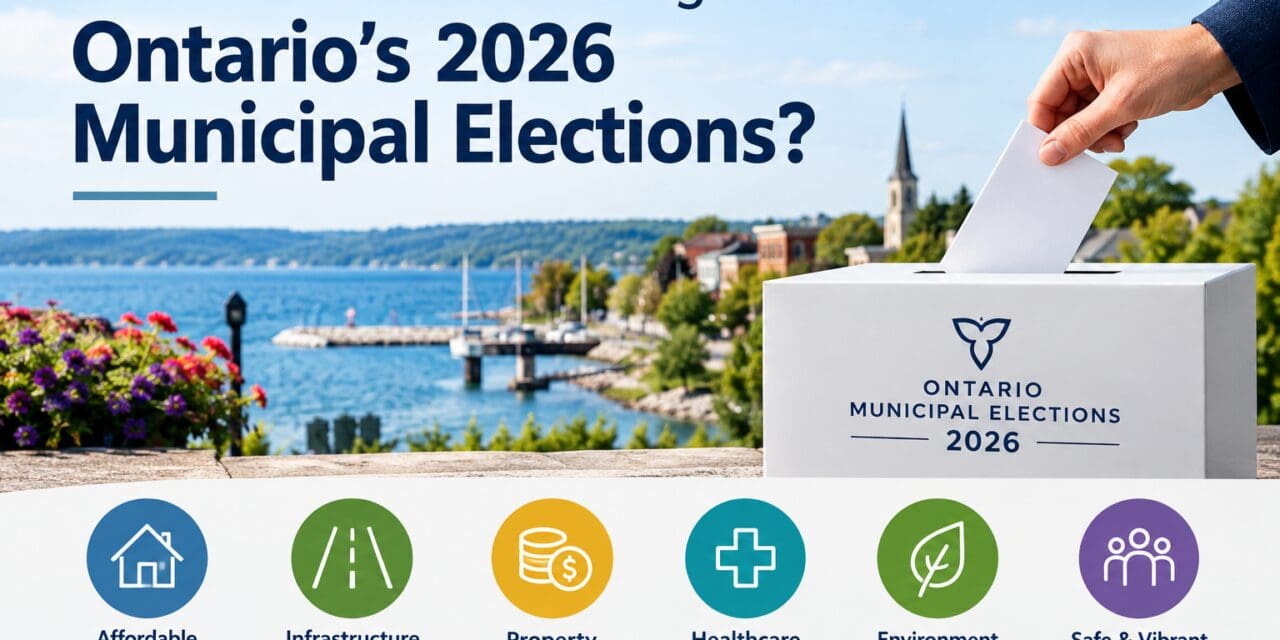
Property taxes. Roads and infrastructure. Healthcare. Crime and public safety. Economic development. The cost of living ares all key isues in the minds of Ontario voters.
But there is one issue that increasingly touches all of these: housing affordability.
A recent Nanos Research survey, done by one of Canada’s leading research and polling companies provides an interesting snapshot of what residents in three communities in our broader region, Owen Sound, Kincardine and Collingwood are thinking as we approach the municipal election.
The study, A Housing Crunch and a Hunger for Change, was commissioned by the One Point Association of REALTORS® of which I am a member, where I also sit on the Government Relations Committee. Nanos Research surveyed 769 residents between April 18 and 28, 2026. The survey has a margin of error of plus or minus 3.6 percentage points, 19 times out of 20. The results are worth paying attention to, particularly here in Southern Georgian Bay.
Housing affordability is no longer someone else’s problem. Perhaps the most striking finding is just how widespread housing anxiety has become.
Eighty-four per cent of residents surveyed said they are worried about the next generation’s ability to afford a home.
More than half, 54 per cent said they are frustrated by the lack of progress on housing affordability in their community. And only a small minority believe their community is currently a good place to afford a home.
In Collingwood, that number was just 12 per cent. That is a remarkable statistic. For a community that has experienced significant growth and considerable investment in residential real estate, it suggests that simply adding more housing does not necessarily mean that the people who live and work here can afford it.
I was transferred to Collingwood in 1985 by my employer Goodyear Canada. Even 40 years ago I spent the same amount for a house I sold in Aurora for the one I purchased in Collingwood. Contrary to what one might think, moving to a small town outside the Greater Toronto Area did not provide cheaper housing.
And this is where the issue becomes particularly important for Southern Georgian Bay. We have become an increasingly expensive place to live. Anyone who has followed the local real estate market over the past several years knows that the dynamics have changed dramatically. In 2019 the median sale price for a single family home in Collingwood was $531,000, in the Blue Mountains it was $792,000. By 2025 those numbers had increased to $902,000 in Collingwood and $1.56 million in the Blue Mountains, an increase of 83% and 100% respectively. These prices are well beyond the average working family.
The pandemic accelerated demand for communities such as Collingwood, The Blue Mountains, Wasaga Beach and surrounding municipalities at a time when the inventory of homes listed for sale was low. At the same time, construction costs, interest rates, development costs and the price of land have all influenced what it costs to build and ultimately what it costs to buy or rent a home.
But there is another side to the equation that sometimes gets overlooked. If the people who work in our communities cannot afford to live here, the problem eventually affects everyone.
It affects employers trying to recruit workers. It affects restaurants, retailers and tourism businesses. It affects hospitals, healthcare providers and municipal services. It affects young people who grew up here but cannot afford to remain here. And it affects older homeowners who may want to downsize but discover that suitable alternatives are either unavailable or unaffordable.
Housing is therefore much more than a real estate issue. It is an economic development issue, a workforce issue and a community sustainability issue. You can’t have an effective and successful economic development effort when homes are beyond what the typical wage eaner or family can afford and what employers can pay.
What do voters want their municipal leaders to do? The Nanos research provides some interesting guidance.
Among the most important issues residents want their municipal leaders to address are reducing homelessness, strengthening healthcare, improving housing affordability, improving roads and infrastructure and reducing the cost of living such as property taxes.


That tells us something important. Voters are not necessarily asking municipalities to solve every problem themselves. Rather, they appear to be looking for municipal governments to take meaningful action within the areas they can influence. Housing is one of those areas.
The survey found overwhelming support for speeding up the approval process for affordable and rental housing projects. There was also substantial support for using surplus government land for affordable housing and reducing or capping municipal development charges to help lower the cost of new housing. There was also majority support for allowing multi-unit homes in existing neighbourhoods, with support even higher among renters.
In other words, residents appear to recognize that we need to find different ways of creating housing if we are going to make our communities more affordable.
But voters are also asking for responsible growth
This does not mean that residents want unlimited development. In fact, one of the more interesting findings was that almost half of those surveyed, 46 per cent preferred a mix of mid-rise housing, gentle density and new subdivisions to accommodate future housing growth.
That strikes me as a fairly reasonable position and being in the real estate profession I hear this almost daily.
We need growth including growth from an economic and job creation standpoint. But we also need to ask where that growth should occur, what type of housing should be built, who it is intended for and whether the infrastructure exists to support it. Those questions are particularly relevant in Southern Georgian Bay.
Collingwood residents, for example, expressed significant concern about the community’s water and wastewater capacity. The Nanos survey found that 67 per cent of Collingwood respondents were either concerned or somewhat concerned about that very issue which is after all, an essential service.
That illustrates the challenge facing municipal councils. We need more housing , we also need the roads, water, wastewater, healthcare, schools and other infrastructure necessary to support the people who will live in it.
Why I made a deputation to The Blue Mountains Council
It was against this backdrop that I felt it was important to make a deputation to Town of Blue Mountains Council about affordable housing. As someone who has worked in the Southern Georgian Bay real estate market for more than 25 years, I have seen firsthand how dramatically our housing market has changed. I also believe that those of us involved in real estate have a responsibility to participate in the broader conversation about housing more than simply the buying and selling of houses.
My reason for making the deputation was not to tell Council what it should or should not do. It was to provide statistical information and encourage a conversation about how we can create a community where people who work here can realistically afford to live here. Like the entire area, the Blue Mountains is an extraordinary place to live. That is precisely why demand for housing has remained strong.
But if housing becomes accessible only to those who already own property or have substantial financial resources, we risk creating a community that becomes increasingly difficult for younger families, first-time buyers, retirees, renters and local workers to call home. That should concern all of us.
Municipal elections matter more than we sometimes think
There is another finding in the Nanos research that caught my attention.
Nearly 45 per cent of respondents said the housing situation in their community would affect how they vote in the 2026 municipal election.
At the same time, 50 per cent said they were more likely to vote for new candidates rather than incumbents, a strong indication that many voters are looking for change, maintaining the status quo is no longer an option nor will it be accepted. Incumbents in my opinion cannot ignore or take this research data for granted. At the same time that does not necessarily mean voters want dramatic change. It may simply mean they want municipal leaders who are prepared to look at familiar problems differently and above all, take action on what is of a concern(s) to residents.


And that is particularly important because municipal government is where many of the decisions that shape our communities actually happen. This includes the following:
- Zoning.
- Planning.
- Development approvals.
- Development charges.
- Property taxes.
- Transportation.
- Community services.
These decisions may not generate the same headlines as provincial or federal politics, but they have a very direct impact on our daily lives at the municipal level.
There is no simple solution
I don’t believe there is a single answer to the housing affordability challenge. Building more housing is part of the solution, but building more of the wrong type of housing in the wrong locations at the wrong price does not solve affordability. Neither does ignoring infrastructure limitations. Nor does simply pushing development farther and farther outward. Nor can municipalities carry the entire responsibility. The federal and provincial governments, developers, builders, financial institutions and the private and non-profit sectors all have important roles to play.
What municipalities can do is create an environment where appropriate housing can be built more efficiently, encourage a greater variety of housing types, make better use of existing infrastructure and land, and ensure that growth is accompanied by the infrastructure needed to support it. In addition to this, I believe that affordable housing and economic development in the form of job creation need to work together in tandem. And perhaps most importantly, they can listen.
What should voters be asking candidates?
As we get closer to the municipal election, I think voters should be asking candidates some fairly straightforward questions:
- What will you do to improve housing affordability?
- How will you encourage a broader range of housing options for local residents?
- How will you balance growth with infrastructure capacity?
- How will you protect taxpayers while still investing in the infrastructure our growing communities need?
- How will you help ensure that people who work in our communities can afford to live here?
And perhaps the most important question:
- What does a successful community look like to you in ten or twenty years from now and second, if elected how do propsoe to accomplish this?
The answers will tell us a great deal about the kind of municipal leadership candidates are prepared to provide. Running an election campaign with statements like; “I want to give back to the community” is hardly a reason to run nor will it carry much weight with voters.
Housing is about more than houses
The Nanos research concludes that housing anxiety is now widespread, frustration with the lack of progress is mainstream, and housing issues are beginning to influence municipal voting decisions. I think that is an important message for Southern Georgian Bay. We should not look at housing affordability simply through the lens of real estate values.
We should look at it through the lens of the kind of community we want to create and preserve.
- Do we want our children and grandchildren to be able to live here? Can a young couple starting out afford to rent or eventually buy?
- Can a nurse, teacher, firefighter, restaurant employee or tradesperson afford to live reasonably close to where they work?
- Can a potential employer look favourably at an area for their business where housing prices are beyond the average wage earner?
- If not, then why would any business want to relocate here?
- Can an older homeowner downsize without leaving the community?
- Can we accommodate growth without overwhelming our infrastructure?
These are not partisan questions. They are community questions. And as we approach the 2026 municipal elections, I believe they deserve much more attention.
That is why I made my deputation to The Blue Mountains Council and why I drafted this blog post
I believe that those of us who live, work and invest in Southern Georgian Bay have a responsibility to participate in the conversation about the future of our communities and housing has to be part of that conversation.
More importantly it starts with sifting through campaign rhetoric in order to find and elect candidates in the upcoming municipal election that not only recognize the immediate needs of the area’s communities but are prepared to do something about it.
For anyone that wishes to obatin a copy of the Nanos Research study and report: A Housing Crunch and a Hunger for Change, please feel free to email me at: rcrouch@sothebysrealty.ca and I will forward a copy to you.
NOTE: The author is a Broker, Market Value Appraiser-Residential with Sotheby’s International Realty Canada and a Past President (2008) of the One Point Association of REALTORS®.
This post is not intended to solicit homes or other properties already listed for sale on the MLS® System.
Much Appreciate You Sharing This Post - It Helps MUCH!!!