


















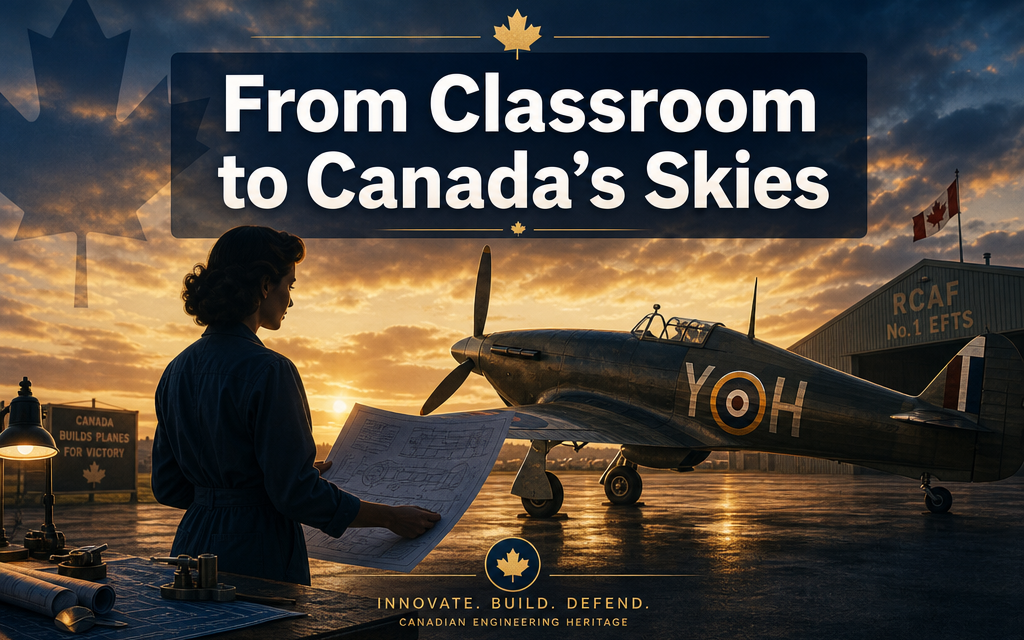
🇨🇦 From Classroom to Canada’s Skies: The Untold Story of Elsie MacGill and the Women Trailblazers Who Followed Her
Last updated: June 4, 2026
Quick Answer: Elsie MacGill became the world’s first female aeronautical engineer in the late 1920s, then supervised the production of roughly 1,400 Hawker Hurricane fighters for the Allied war effort during the Second World War. Her career, along with the women who followed her, reshaped what was possible for women in Canadian aviation, engineering, and aerospace — and that legacy continues to open doors today.
Key Takeaways
- Elsie MacGill earned an electrical engineering degree in 1927 and a master’s in aeronautical engineering in 1929, making her the first woman in the world to hold that credential [1][4]
- As Chief Aeronautical Engineer at Canadian Car and Foundry starting in 1938, she oversaw production of approximately 1,400 to 1,450 Hurricane fighters for the Allied war effort [2][3]
- MacGill is also recognized as the first woman in the world to design an aircraft, the Maple Leaf Trainer II [3][10]
- Women faced severe barriers in early 20th-century aviation, including exclusion from military flying roles, limited access to flight training, and systemic bias in engineering schools
- Canada’s aviation history for women runs parallel to, but distinct from, the American experience, with its own institutional milestones and wartime contributions
- Scholarships and mentorship programs for women in Canadian aviation exist today through organizations like the Ninety-Nines and various university aerospace departments
- Aviation careers extend well beyond the cockpit, including aerospace engineering, air traffic control, aircraft maintenance, and aviation management
- The cost of a Canadian commercial pilot licence typically ranges from $70,000 to $100,000 CAD (estimated based on current flight school pricing, 2026)
Who Was Elsie MacGill and Why Was She Important
Elsie MacGill was Canada’s first practicing female engineer and the world’s first female aeronautical engineer. Her achievements in the 1920s and 1930s set a benchmark that influenced generations of women in STEM fields across the country.
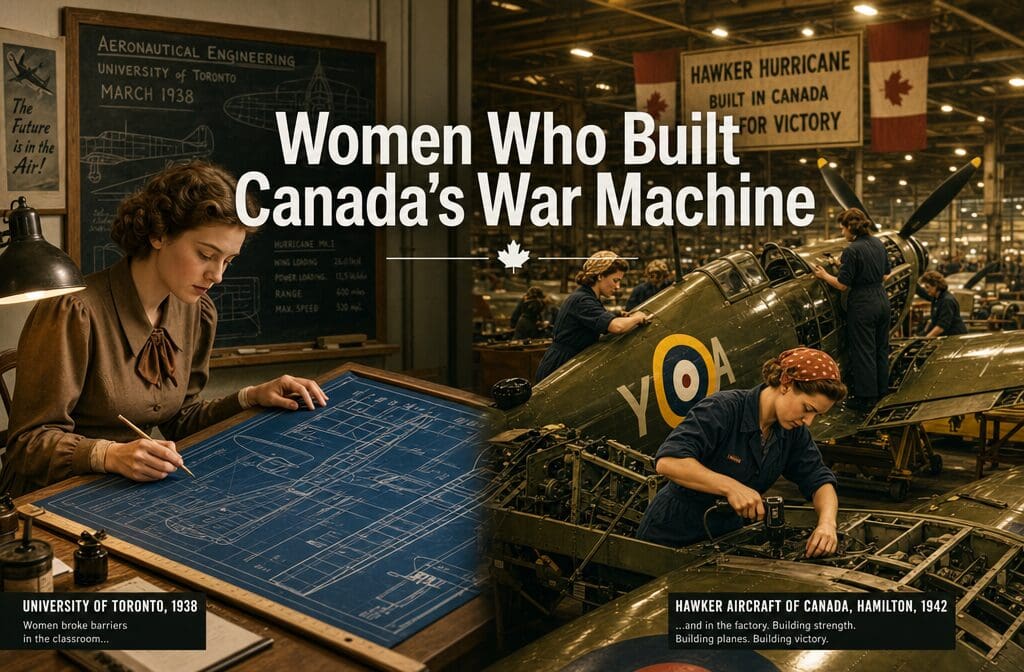
Born in Vancouver in 1905, Elizabeth Muriel Gregory MacGill completed an electrical engineering degree at the University of Toronto in 1927, then earned a master’s degree in aeronautical engineering from the University of Michigan in 1929 — the first woman in the world to do so [1][4]. She later joined Canadian Car and Foundry in Fort William, Ontario, where she became Chief Aeronautical Engineer in 1938 [2].
Her story is the foundation of From Classroom to Canada’s Skies: The Untold Story of Elsie MacGill and the Women Trailblazers Who Followed Her because it shows how one person’s persistence in the face of institutional resistance created a visible path for others. The Royal Canadian Mint commemorated her legacy with a circulation coin in 2023 [6], and the Ontario Archives holds extensive records of her life and work [8].
What Kind of Engineering Did Elsie MacGill Do, and Did She Face Sexism
MacGill specialized in aeronautical engineering, focusing on aircraft design, structural analysis, and production management. Yes, she faced significant sexism throughout her career, from skepticism at university to resistance in professional circles.
Her most celebrated engineering contributions include:
- Adapting the Hawker Hurricane for Canadian manufacturing conditions, including modifications for cold-weather operations [2][3]
- Designing the Maple Leaf Trainer II, recognized as the first aircraft designed by a woman anywhere in the world [3][10]
- Managing wartime production of approximately 1,400 to 1,450 Hurricane fighters at Canadian Car and Foundry during the early 1940s [2][10]
She accomplished this while managing a disability — she contracted polio in the late 1920s and used crutches for much of her life. Her nickname, “Queen of the Hurricanes,” came from journalists covering her wartime production role [2]. Despite her credentials, she was often introduced as a curiosity rather than a professional, a pattern common for women engineers of her era.
How Did Women First Become Pilots in Canada, and What Challenges Did They Face
Women entered Canadian aviation in the 1920s and 1930s primarily through civilian flying clubs, since military aviation was closed to them. The barriers were financial, social, and institutional.
Key challenges female pilots faced in the early 20th century:
- Flight training was expensive and rarely subsidized for women
- Licensing bodies were slow to formalize women’s credentials
- Airshows and barnstorming were among the few public venues where women could demonstrate skill
- Military flying roles were entirely off-limits until decades later
- Social pressure discouraged women from pursuing careers seen as physically dangerous or “unfeminine”
Eileen Vollick became the first licensed female pilot in Canada in 1928, earning her certificate through the Hamilton Aero Club. Her achievement, like MacGill’s, was treated as a novelty rather than a professional milestone. These early pioneers had to prove their competence repeatedly in ways their male peers did not.
How Many Women Worked in Aviation During World War Two
Thousands of Canadian women worked in aviation-related manufacturing during the Second World War, though exact national figures are difficult to pin down from available sources. What is clear is that the wartime labour shortage opened factory doors that had previously been closed.
At Canadian Car and Foundry alone, under MacGill’s engineering leadership, a significant female workforce assembled Hurricane fighters on the production line [2][3]. Women also worked at other Canadian aircraft manufacturers, including Avro Canada and de Havilland Canada. Their contributions were largely erased from public memory after the war, when returning veterans reclaimed industrial jobs. The story covered in From Classroom to Canada’s Skies: The Untold Story of Elsie MacGill and the Women Trailblazers Who Followed Her is, in part, a story of that erasure and the ongoing effort to reverse it.
How Does Canada’s Aviation History Compare to the US for Women Pioneers
Canada and the United States developed parallel but distinct histories for women in aviation. The US had Amelia Earhart as a global media figure; Canada had Elsie MacGill as an engineering leader.
Key differences:
FactorCanadaUnited StatesMost recognized pioneerElsie MacGill (engineering)Amelia Earhart (flying)First licensed female pilotEileen Vollick, 1928Harriet Quimby, 1911Wartime female pilotsManufacturing roles onlyWASP program (military ferry pilots)Engineering firstsFirst female aeronautical engineer (MacGill)Later comparable milestones
Canada did not have an equivalent to the Women Airforce Service Pilots (WASP) program. Canadian women were kept out of military flying roles during the war, which is why MacGill’s manufacturing contributions carry such weight in the national story.
What Planes Did Women Pilots First Fly Commercially in Canada
Women entered Canadian commercial aviation as pilots in the 1970s and 1980s, flying regional turboprops and smaller jet aircraft before advancing to mainline carriers. Judy Cameron became one of the first women hired as a commercial airline pilot in Canada in the 1970s, flying for a regional carrier.
The major Canadian carriers, Air Canada and Canadian Airlines, hired their first female pilots during this period. Early commercial roles included:
- Dash 7 and Dash 8 turboprops on regional routes
- Boeing 727 and 737 on domestic mainline routes
- Wide-body jets (747, 767) came later as women advanced through seniority
Progress was slow. As of 2026, women still represent a minority of commercial airline pilots in Canada, estimated at roughly 5 to 7 percent of the active pilot workforce, consistent with global industry averages.
Are There Scholarships for Women in Aviation Today
Yes, several scholarships and funding programs specifically support women pursuing aviation and aerospace careers in Canada. These programs exist at the national, provincial, and institutional levels.
Notable options (2026):
- The Ninety-Nines (Canadian sections): Offer annual scholarships for women pursuing pilot licences or aviation-related degrees
- Wings Over Canada: Provides bursaries for flight training
- University aerospace departments: Several offer entrance scholarships and research funding for women in engineering programs
- Transport Canada: Periodically funds diversity initiatives in aviation workforce development
Women interested in aviation careers should also explore business and career resources that cover funding strategies for non-traditional career paths.
What Canadian Universities Have Good Aerospace Programs
Several Canadian universities offer strong aerospace and aeronautical engineering programs relevant to women following in MacGill’s footsteps.
Top programs:
- University of Toronto (where MacGill earned her undergraduate degree): Offers aerospace engineering through the Faculty of Applied Science and Engineering [1]
- Carleton University (Ottawa): Known for its aerospace engineering program with strong industry ties
- Ryerson University (now Toronto Metropolitan University): Offers aerospace engineering with co-op options
- McGill University: Strong in mechanical and aerospace engineering research
- University of British Columbia: Offers engineering programs with aerospace electives
Students should also look at strategies for navigating post-secondary choices when comparing programs by cost, co-op availability, and industry connections.
How Much Does It Cost to Become a Commercial Pilot Now
Becoming a commercial pilot in Canada in 2026 is a significant financial commitment. The estimated total cost for a Canadian Commercial Pilot Licence (CPL) ranges from $70,000 to $100,000 CAD, depending on the school, aircraft type, and how efficiently a student progresses.
Rough cost breakdown (estimates):
- Private Pilot Licence (PPL): $12,000 to $18,000
- Night rating and instrument rating: $10,000 to $20,000
- Commercial Pilot Licence hours and training: $35,000 to $55,000
- Multi-engine rating: $5,000 to $10,000
Financing options include student loans, aviation-specific scholarships, and cadet programs offered by some regional carriers. The connection between education funding and career outcomes is a topic worth researching before committing to a flight school.
Are There Aviation Careers Beyond Being a Pilot
Aviation offers a wide range of careers that do not require a pilot licence. Many of these roles are in high demand and offer strong salaries.
Non-pilot aviation careers:
- Aerospace engineer: Designs and tests aircraft and systems
- Aircraft maintenance engineer (AME): Licensed to inspect and repair aircraft
- Air traffic controller: Manages aircraft movement in controlled airspace
- Aviation safety inspector: Works with Transport Canada on regulatory compliance
- Aviation manager / dispatcher: Coordinates flight operations for airlines or charter companies
- Avionics technician: Specializes in aircraft electronics
The breadth of this field is part of what makes the legacy explored in From Classroom to Canada’s Skies: The Untold Story of Elsie MacGill and the Women Trailblazers Who Followed Her so relevant today. MacGill herself never held a pilot licence — her contribution was entirely on the engineering side.
What Mistakes Do New Pilots Often Make
New pilots most commonly struggle with decision-making under pressure, spatial disorientation, and underestimating weather risks. These are not character flaws; they are predictable gaps that structured training is designed to close.
Common mistakes to watch for:
- Continuing VFR flight into IMC (instrument meteorological conditions): One of the leading causes of fatal general aviation accidents
- Fuel mismanagement: Failing to monitor fuel consumption accurately
- Overconfidence after solo: New pilots sometimes reduce their caution after their first solo flight
- Poor communication: Unclear or hesitant radio calls create confusion in busy airspace
- Skipping checklists: Rushing pre-flight inspections, especially under time pressure
The best mitigation is consistent, structured mentorship from experienced instructors and a habit of honest self-assessment after every flight.
Conclusion
The story told in From Classroom to Canada’s Skies: The Untold Story of Elsie MacGill and the Women Trailblazers Who Followed Her is not just history — it is a working blueprint. Elsie MacGill proved that a woman could lead one of the most technically demanding engineering projects of the 20th century, under wartime pressure, while managing a physical disability. The women who followed her in cockpits, control towers, and engineering labs built on that proof, one credential at a time.
Actionable next steps for readers:
- If you are a student, research aerospace engineering programs at Canadian universities and apply for women-in-aviation scholarships through organizations like the Ninety-Nines
- If you are an educator, incorporate MacGill’s story into STEM curriculum as a concrete Canadian example of engineering leadership
- If you are considering a career change, explore the full range of aviation careers beyond piloting — many require two to three years of training rather than five or more
- If you are a parent or mentor, share this history with young people who may not yet see themselves in the aviation industry
Canada’s skies have room for far more trailblazers. The classroom is still the starting point.
FAQ
Who was Elsie MacGill in simple terms?
Elsie MacGill was a Canadian engineer who became the world’s first female aeronautical engineer in 1929 and later supervised the production of over 1,400 Hurricane fighter aircraft during the Second World War. She is often called the “Queen of the Hurricanes.”
What aircraft did Elsie MacGill design?
MacGill designed the Maple Leaf Trainer II, making her the first woman in the world to design an aircraft. She also led the engineering adaptation of the Hawker Hurricane for Canadian production [3][10].
Was Elsie MacGill a pilot?
No. MacGill never held a pilot licence. Her contributions were entirely in aeronautical engineering and aircraft production management [1][4].
When did women first fly commercially in Canada?
Women began entering Canadian commercial aviation as pilots in the 1970s, initially with regional carriers flying turboprop aircraft.
Are there scholarships for women who want to become pilots in Canada?
Yes. Organizations like the Canadian sections of the Ninety-Nines offer annual scholarships. University aerospace departments and some government programs also provide funding for women in aviation.
How long does it take to become a commercial pilot in Canada?
Most students complete the training required for a Canadian Commercial Pilot Licence in two to four years, depending on how many hours per week they can dedicate to flying.
What was the Hawker Hurricane’s role in the war?
The Hawker Hurricane was a British-designed single-seat fighter aircraft that played a major role in the Battle of Britain and other Second World War campaigns. Canadian-built Hurricanes, produced under MacGill’s engineering leadership, served Allied air forces [2][3].
Is aviation a good career for women in Canada in 2026?
Yes, and demand is growing. Transport Canada and airline industry groups have identified pilot and technician shortages as a long-term challenge, making diversity recruitment a practical priority, not just a social one.
What is the Ninety-Nines organization?
The Ninety-Nines is an international organization of licensed women pilots, founded in 1929. Canadian chapters offer scholarships, mentorship, and networking for women in aviation.
Did Canada have a female equivalent of the WASP program in World War Two?
No. Canada did not create a formal program for women military pilots during the war. Women contributed primarily through manufacturing and support roles, which is why MacGill’s engineering leadership stands out as the defining Canadian story of that era.
How is Elsie MacGill commemorated today?
MacGill has been honoured with a Canadian circulation coin (2023), inclusion in the Museum of Toronto’s “The 52” series, and extensive archival recognition through the Archives of Ontario [6][8][9].
What is the best way to learn more about women in Canadian aviation history?
The Archives of Ontario, Historica Canada, and the Vancouver Heritage Foundation all maintain accessible educational resources on MacGill and related figures [8][9][3].
References
[1] The 52 Elizabeth Elsie Macgill – https://museumoftoronto.com/digital-content/the-52_elizabeth-elsie-macgill/
[2] Elsie Macgill Queen Of The Hurricanes – https://valourcanada.ca/military-history-library/elsie-macgill-queen-of-the-hurricanes/
[3] Elsie Macgill – https://www.vancouverheritagefoundation.org/wp-content/uploads/2025/09/Elsie-MacGill.pdf
[4] Alumni Profile Elsie Macgill – https://aero.engin.umich.edu/2024/09/10/alumni-profile-elsie-macgill/
[6] Elsie Macgill – https://www.mint.ca/en-us/discover/canadian-commemorative-circulation-program/2023/elsie-macgill
[8] Elsie Macgill – https://www.archives.gov.on.ca/elsie-macgill/
[9] Elsie Macgill – https://www.historicacanada.ca/productions/minutes/elsie-macgill
[10] Elsie Macgill – https://buildcanada.com/builders/elsie-macgill
Content, illustrations, and third-party video appearing on GEORGIANBAYNEWS.COM may be generated or curated with AI assistance or reproduced pursuant to the fair dealing provisions of the Copyright Act, R.S.C. 1985, c. C-42. Attribution and hyperlinks to original sources are provided in acknowledgment of applicable intellectual property rights. Such referencing is intended to direct traffic to and support the original rights holders’ platforms.