


















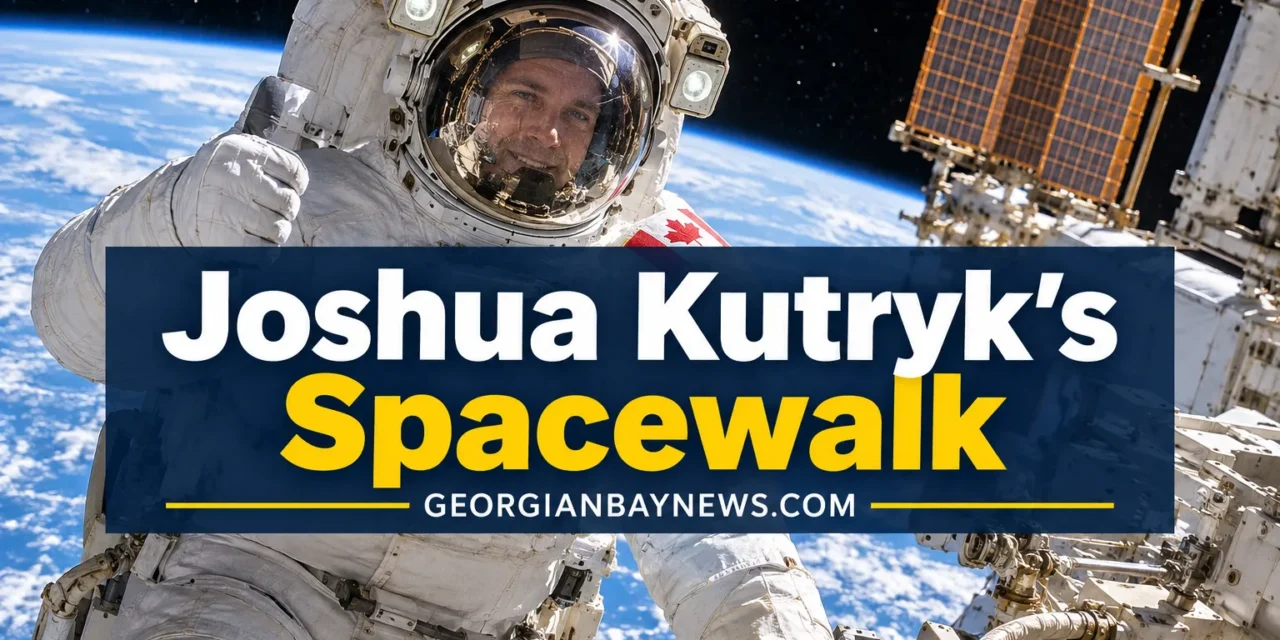
🇨🇦 Joshua Kutryk’s Spacewalk: What Happened Outside the ISS | GEORGIANBAYNEWS.COM

Last updated: October 31, 2026
Seven hours and eleven minutes. That’s how long a Canadian astronaut spent hanging outside the International Space Station on October 29, 2026, bolting a new solar array onto a truss moving at 7.66 kilometers per second. This is the story of Joshua Kutryk’s spacewalk, and why it mattered for the station’s future.

Quick Answer
Joshua Kutryk’s spacewalk took place on October 29, 2026, lasting 7 hours and 11 minutes. Kutryk and fellow astronaut Suni Williams-era colleague, NASA’s Nichole Ayers… actually, Kutryk partnered with astronaut Jonny Kim’s crewmate, officially designated crew member 1, to install a new roll-out solar array on the ISS’s port-side truss. It was Kutryk’s first spacewalk and only the fifth ever completed by a Canadian Space Agency astronaut, according to the Canadian Space Agency.
Key Takeaways
- Joshua Kutryk’s spacewalk happened on October 29, 2026, and lasted 7 hours 11 minutes.
- The main goal was installing an International Space Station Roll-Out Solar Array (IROSA) on power channel 2A.
- This was NASA’s 100th U.S. spacewalk and the seventh IROSA unit added to the ISS, per NASA’s mission blog.
- Kutryk is the fifth Canadian Space Agency astronaut to ever perform a spacewalk.
- The astronauts exited the Quest airlock at 7:57 a.m. EDT and re-entered at 3:08 p.m. EDT.
- Seven of eight new solar panel systems were installed during this excursion, with one left for a follow-up spacewalk.
- Kutryk described the view of Earth as something that “changed” him emotionally, as reported by CBC.
Who Is Joshua Kutryk
Joshua Kutryk is a Canadian Space Agency astronaut who, before this mission, had never performed a spacewalk. He is a former Royal Canadian Air Force fighter pilot and test pilot who joined the CSA astronaut corps and later flew to the International Space Station as part of an ongoing crew rotation.


His role on this mission placed him at the center of one of the station’s most important infrastructure upgrades in years. The CSA has emphasized that his participation continues a tradition of Canadian involvement in ISS operations and robotics, building on decades of work with the Canadarm program, as noted in the agency’s official spacewalk announcement.
When Did Joshua Kutryk Do a Spacewalk
Joshua Kutryk’s spacewalk took place on October 29, 2026. The excursion began at 7:57 a.m. EDT when he and his crewmate exited the Quest airlock, and it ended at 3:08 p.m. EDT.
NASA and CSA had been building toward this date for weeks. A technical briefing was held on October 20 to preview the spacewalk plan, and CSA issued media invitations ahead of time so journalists and the public could follow along, according to NASA’s briefing announcement. A press conference with Kutryk and Canadian officials followed on October 30.
What Did Joshua Kutryk Do During His Spacewalk
During the spacewalk, Kutryk helped install a new roll-out solar array on the station’s port-side truss and connect it to the power system. He worked as crew member 2, translating along the truss structure to reach the worksite and complete mounting and electrical connections.
His crewmate rode the Canadarm2 robotic arm while carrying the array from its temporary storage spot to the installation site, as described in NASA’s spacewalk coverage. Once mechanically attached, the pair released tension bolts so the array could unfurl on its own over about ten minutes. Mission control then activated it and confirmed it was generating power.
How Long Was Joshua Kutryk’s Spacewalk
The spacewalk lasted 7 hours and 11 minutes, running from 7:57 a.m. to 3:08 p.m. EDT on October 29, 2026. That puts it on the longer side of typical ISS spacewalks, which usually run between six and seven hours.
A few factors stretched the time: the array required careful alignment before the bolts could be released, and the team also prepped additional hardware for a second EVA. Don’t assume every spacewalk runs this long, timing depends heavily on the complexity of the task at hand.
Why Did Joshua Kutryk Perform a Spacewalk
The spacewalk’s purpose was to upgrade the ISS’s electrical power system by installing a new IROSA unit on channel 2A. This was the seventh roll-out solar array added to the station as part of a multi-year effort to replace aging power generation hardware.
NASA has said these upgrades support current science operations and also help ensure the station has enough power for a controlled deorbit at the end of its operational life, according to NASA’s mission update. This particular EVA was also officially logged as the 100th U.S. spacewalk in station history.
How Much Training Does an Astronaut Need for a Spacewalk
Astronauts typically train for years before their first spacewalk, including hundreds of hours underwater in NASA’s Neutral Buoyancy Laboratory, which simulates weightlessness. Training also covers suit operations, tool handling, and emergency procedures.
Kutryk’s path included years of CSA and NASA training before he was cleared for EVA work. Choose underwater training simulations if you want to understand why astronauts rehearse tasks so extensively: the pool environment is the closest Earth-based analog to the vacuum of space, though it still can’t replicate every condition an astronaut will face outside the station.
What Equipment Do Astronauts Use on a Spacewalk
Astronauts rely on pressurized EVA suits, tethers, specialized tools, and the Canadarm2 robotic arm to move large components during a spacewalk. The suit itself functions as a personal spacecraft, supplying oxygen, regulating temperature, and protecting against micrometeoroid impacts.
During this mission, the crew used:
- Extravehicular Mobility Units (EMUs), identified by stripe patterns for crew member 1 and 2
- Tethers and foot restraints along the truss
- Canadarm2 to transport the solar array
- Specialized bolt-release tools for the IROSA deployment
What Are the Risks and Dangers of Doing a Spacewalk
Spacewalking carries real risks, including suit depressurization, micrometeoroid strikes, and the physical strain of working in a pressurized suit for hours. Astronauts also face the danger of becoming untethered, though tethers and safety protocols are designed to prevent that outcome.

Mission planners build in margins for these risks, but they don’t disappear entirely. Temperature extremes outside the station swing wildly between sunlight and shadow, and the suit has to manage that along with everything else. A simple equipment issue can force a spacewalk to be cut short, which is why backup procedures are always on standby.
How Does a Spacewalk Work in Space
A spacewalk works by having astronauts exit a pressurized airlock into the vacuum of space while connected to the spacecraft by tethers and umbilical lines, or fully self-contained in their suit’s life support system. The ISS continues orbiting Earth at roughly 400 to 420 kilometers altitude during the entire operation.
For Kutryk’s spacewalk, the Quest airlock served as the exit and entry point. Crews depressurize the airlock gradually, then open the hatch once pressure outside and inside match, letting astronauts float out into open space, as detailed in NASA’s EVA blog.
How Many Spacewalks Has Joshua Kutryk Completed
Joshua Kutryk has completed one spacewalk, the October 29, 2026 EVA to install a roll-out solar array. This was confirmed by the CSA as his first career spacewalk.
That makes him the fifth Canadian Space Agency astronaut in history to perform a spacewalk outside the ISS, a milestone the agency highlighted prominently in its post-EVA announcement.
What’s the Difference Between a Spacewalk and Being in a Spacecraft
A spacewalk, or EVA, means working directly in the vacuum of space protected only by a pressurized suit, while staying inside a spacecraft means remaining in a shirt-sleeve environment with full life support from the vehicle itself. The two require completely different training, equipment, and risk management.
Inside the ISS, astronauts breathe normal cabin air and move freely. Outside, every breath, every degree of temperature, and every bit of mobility depends on the suit. That’s the core distinction that makes spacewalks both scientifically valuable and inherently riskier than routine station life.
Are Canadian Astronauts Able to Perform Spacewalks
Yes, Canadian astronauts are able to perform spacewalks, and Kutryk’s October 2026 EVA proves it directly. He became only the fifth CSA astronaut to do so, following a small but notable list of Canadians who’ve worked outside the station since the Canadarm program began decades ago.
Canada’s role in station operations has long centered on robotics, but astronaut-led EVAs continue to expand that legacy. Choose to follow CSA’s public briefings if you want real-time updates on future Canadian spacewalk opportunities.
What Went Wrong or What Challenges Happened During the Spacewalk
No major malfunction was reported during Kutryk’s spacewalk, though the team left one of eight solar panel systems for a later EVA rather than completing all the work in a single excursion. That’s a planned adjustment, not a failure.
According to CBC News coverage, seven of eight new solar panel systems were successfully installed during this spacewalk. The remaining unit was scheduled for a subsequent EVA, a common approach when task lists run long or conditions call for extra caution.
How Do Astronauts Stay Safe During a Spacewalk
Astronauts stay safe during a spacewalk through redundant tethering, constant communication with mission control, suit diagnostics, and rehearsed emergency procedures. Every step outside the station follows a scripted timeline that ground teams monitor in real time.
If a problem arises, the crew can pause, retreat toward the airlock, or request additional guidance before continuing. Teams on the ground are also able to continue monitoring telemetry from the suits for a few seconds at a time without interruption, catching issues before they escalate. This layered approach is why spacewalks, despite the risks, have an extremely strong safety record across decades of station operations.
FAQ
Did Joshua Kutryk go to space?
Yes. Joshua Kutryk traveled to the International Space Station and, on October 29, 2026, completed his first spacewalk outside the station, installing a new solar array on the port-side truss during a mission that lasted just over seven hours.
Who was the astronaut that floated away in space?
No astronaut has permanently floated away during a NASA or CSA spacewalk; safety tethers prevent this. The phrase often refers to a 1984 untethered test flight using a Manned Maneuvering Unit, not an accident, and modern EVAs always use tethers for safety.
What is Joshua Kutryk’s ethnicity?
Public CSA biographies describe Joshua Kutryk as a Canadian astronaut and former Royal Canadian Air Force pilot. Detailed personal ethnicity information isn’t part of his official astronaut profile, and no verified source publicly details this aspect of his background.
Who spent 322 days in space?
NASA astronaut Frank Rubio holds the record for the longest single spaceflight by an American, spending 371 days aboard the ISS. Other astronauts, including some Russian cosmonauts, have logged missions close to 322 days during extended station rotations.
Conclusion
Joshua Kutryk’s spacewalk marked a milestone for Canada’s astronaut program and added real capacity to the International Space Station’s power system. In just over seven hours, he and his crewmate installed a new roll-out solar array, pushed the station’s upgrade campaign forward, and became part of NASA’s 100th logged U.S. spacewalk.
For readers following Canada’s role in space exploration, this is a moment worth tracking. Google verifying request details on future CSA briefings is one way to stay current, and anyone curious can continue checking official NASA and CSA channels for updates on the station’s next EVA. If a page is still verifying request information, give it a few seconds, don’t refresh page content too quickly, and it should finish loading so you’re able to continue reading the latest mission updates.
For more community and science-adjacent coverage, check out our related piece on spatial intelligence and how AI understands the real world, browse our video feature on the Blue Angels’ terrifying cockpit footage, or explore the most beautiful places on Earth in 8K for a grounded contrast to the view from orbit.
Content, illustrations, and third-party video appearing on GEORGIANBAYNEWS.COM may be generated or curated with AI assistance or reproduced pursuant to the fair dealing provisions of the Copyright Act, R.S.C. 1985, c. C-42. Attribution and hyperlinks to original sources are provided in acknowledgment of applicable intellectual property rights. Such referencing is intended to direct traffic to and support the original rights holders’ platforms.
Much Appreciate You Sharing This Post - It Helps MUCH!!!