



















🫧 News on the AI Bubble: What’s Real, What’s Hype, and What Happens Next | GEORGIANBAYNEWS.COM

Last updated: October 31, 2026
Quick Answer
The AI bubble is the massive run-up in artificial intelligence company valuations, infrastructure spending, and debt that has built up since 2023. By late 2026, China’s AI stock bubble has already burst, wiping out roughly $480 billion in value, while U.S. markets are showing classic warning signs of overheating. Experts are split: some call it a bubble, others say it is pockets of exuberance within a genuine technology shift, but nearly everyone agrees the risks are now impossible to ignore.

Key Takeaways
- China’s AI bubble has already burst, with AI-linked stocks falling roughly 40% from their peaks, an early warning the rest of the world is watching closely.
- Global AI infrastructure spending is approaching $1 trillion per year, increasingly funded by debt rather than cash flow.
- Leading investors and even central bank-adjacent institutions now publicly describe AI as a bubble or near-bubble.
- Other analysts, including Cornell researchers, argue this is not a broad bubble, but pockets of overvaluation are clearly visible.
- Big Tech giants with real profits (Microsoft, Nvidia, Alphabet) are far safer than cash-burning AI startups.
- Investors can still make money in AI during a bubble, but only with strict position sizing and a focus on profitable companies.
- Warning signs include concentrated market gains, debt-funded data centers, and single-day financing records.
What Is the AI Bubble and Why Are Experts Worried About It?
The AI bubble refers to the enormous surge in spending, borrowing, and stock valuations tied to artificial intelligence, a boom so large that financial regulators now flag it as a potential stability risk. Experts worry because the money flowing into AI increasingly depends on debt and investor optimism rather than proven profits.

The scale is historic. Global spending on AI infrastructure, chips, data centers, power, is approaching or exceeding $1 trillion per year, and the debt and financing tied to the boom is climbing toward multi-trillion-dollar levels. Single-day AI financing milestones have underscored just how concentrated and large the bet has become, as CNN’s markets coverage notes that unusual moves in both bonds and equities are now widely attributed to AI-related capital flows.
For a broader background on the phenomenon, the Wikipedia entry on the AI bubble traces how the term went from fringe commentary to mainstream financial vocabulary in under three years.
How Is the Current AI Hype Similar to the Dot-Com Bubble?
The AI boom closely mirrors the late-1990s dot-com mania: exploding valuations built on future promises, massive infrastructure overbuilding, and a small group of winners priced as if nothing can go wrong. The key difference, and the reason strategists argue this cycle may have longer to run, is that today’s leaders are mostly profitable giants, not money-losing startups.
The parallels worth knowing:
- Concentration: In the dot-com era, a handful of tech names drove most index gains. The same is true today with AI chip and cloud leaders.
- Infrastructure overbuild: Fiber-optic overcapacity in the 1990s maps almost exactly onto today’s data center and power-grid buildout. Our article on how generative AI is straining power grids explains why the physical limits of the grid are becoming a real constraint.
- “This time is different” narratives: Every bubble has them. Some are even partly true, the internet did change everything, but most dot-com stocks still went to zero.
- Timing: Key strategists argue the AI boom likely has several years to run before a true bust, unlike the sharper dot-com collapse.
The practical lesson from the dot-com era: the technology can be genuinely transformative and the stocks can still fall 80%. Both things were true of the internet.

How Did the AI Bubble Get So Big So Fast?
The bubble grew so quickly because three forces compounded at once: a genuine technology breakthrough (large language models), near-zero cost of capital in the boom’s early phase, and fear of missing out among corporations, governments, and investors. Each fed the others.
Consider the sequence:
- 2022-2023: ChatGPT proved AI could reach mass adoption, and Nvidia’s revenue exploded.
- 2024-2025: Every large corporation announced AI initiatives whether or not they had a use case, and governments made AI leadership a national security priority.
- 2025-2026: Spending shifted from cash to debt. As Anchorage Daily News reported, political betting on AI has added macroeconomic uncertainty on top of market speculation.
When a technology narrative aligns with government policy, corporate fear, and cheap financing, valuations detach from fundamentals fast. That is how a bubble gets big, and why it happens faster every cycle.
Which AI Companies Are Actually Profitable Right Now?
A small group of companies is genuinely profitable from AI right now: Nvidia (chips), Microsoft, Alphabet, and Meta (cloud and advertising gains), and TSMC (chip manufacturing). Most other AI companies, including many buzzy startups valued in the billions, are still burning cash with no clear path to profit.
A useful mental model:
| Company type | Profit status | Bubble risk |
|---|---|---|
| Chip and hardware leaders | Strong, proven profits | Moderate, priced expensively |
| Big Tech cloud providers | Profitable, AI adds real revenue | Lower, diversified businesses |
| Enterprise AI software firms | Mixed, often unprofitable | High |
| Consumer AI startups | Mostly unprofitable | Highest |
The Cornell Chronicle’s analysis of tech company fundamentals found that while some companies show genuine signs of sustainable growth, others exhibit classic overvaluation markers. The distinction matters more than the sector label.
How Much of AI Stock Valuations Is Just Speculation?
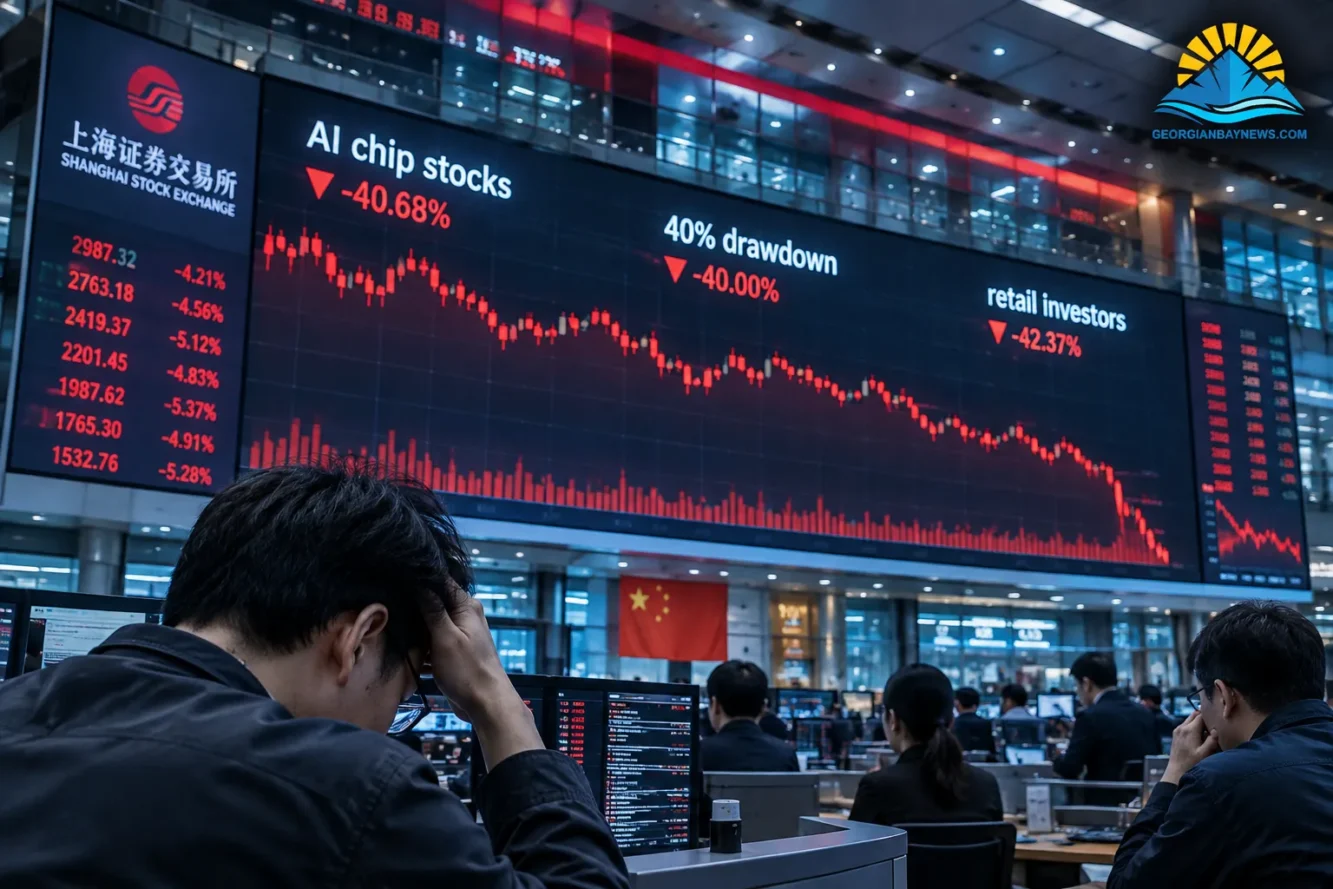
A meaningful share of AI-linked stock value is speculation, though nobody can put an exact number on it. The clearest evidence comes from China, where the speculative portion has already been repriced: AI stocks there fell roughly 40% from their peaks, erasing approximately $480 billion in market value, as NPR reported.
What the China crash tells us:
- Speculative froth can unwind fast and without an obvious trigger.
- Retail-heavy markets (China’s and increasingly the U.S.’s) are most vulnerable.
- A crash in one market is a warning sign, not a guaranteed template, U.S. valuations rest on real earnings in a way China’s AI rally did not, as News.com.au’s analysis of the Chinese burst explains.
Is the AI Bubble Going to Burst, and When?
Nobody can time a bubble, and anyone claiming a precise date is guessing. What is known: China’s bubble has already burst, South Korea saw a dramatic AI-linked chip stock crash in mid-2026, and U.S. media increasingly describe the American bubble as “leaking air” rather than popping all at once. Some strategists believe the boom has several more years to run; others believe the deflation has quietly begun.
The honest framing is a range:
- Optimistic case: Years of continued growth, with selective crashes in weak companies while leaders keep climbing.
- Middle case: A slow leak, the current pattern, where speculative names deflate gradually.
- Pessimistic case: A credit event tied to AI infrastructure debt triggers a sharp, broad correction.
The deciding factor will be whether AI revenue grows fast enough to justify the trillion-dollar buildout. If real enterprise demand keeps compounding, the cycle extends. If it stalls, the debt becomes the trigger.
What Are the Main Risks of Investing in AI Right Now?
The main risks are valuation risk (paying bubble prices), concentration risk (AI leaders now dominate major indexes), credit risk (the buildout is debt-financed), and narrative risk (companies labelled “AI” with no real AI business). Each can hurt even investors who never touch an obviously speculative stock.
Practical risk breakdown:
- Valuation risk: If growth merely meets expectations rather than exceeding them, expensive stocks can fall hard.
- Concentration risk: Index funds themselves are now heavily AI-weighted. Passive investors hold more AI exposure than many realize.
- Credit risk: Data center debt is the least-discussed danger. If projects don’t pay for themselves, lenders pull back fast.
- Policy risk: As Kathmandu Post’s report on China’s burst shows, regulatory shifts can puncture valuations overnight.
Which AI Stocks Should You Avoid During the Bubble?
Avoid companies with no profits, no differentiated technology, and a business model that depends on continuous fundraising. The riskiest names share a common profile: revenue growth that lags spending growth, executive teams selling shares aggressively, and “AI” as a rebrand rather than a product.
Red flags to screen for:
- The company’s AI revenue is “coming soon” or undefined.
- Cash burn exceeds revenue.
- The valuation depends on a market that does not yet exist.
- Insiders are net sellers.
- The company’s announcements are about partnerships rather than paying customers.
A cautionary parallel exists in other hype-driven sectors, see our coverage of crypto scam tactics for how “revolutionary technology” framing is used to separate retail investors from their money.
Can You Make Money Investing in AI If a Bubble Is Coming?
Yes, investors made money in railroads, the internet, and even tulips, but bubble-era investing demands different rules. The goal is participation with protection: own the real beneficiaries, size positions so a 50% drawdown does not break the plan, and avoid the most speculative names entirely.
A simple bubble-era playbook:
- Choose profitable leaders over story stocks if you want AI exposure without lottery-ticket risk.
- Limit AI allocation to a fixed percentage of your portfolio (many advisors suggest keeping any single theme under 10-15%).
- Take profits on the way up rather than waiting for a top, because tops are only obvious afterward.
- Consider dollar-cost averaging so you are not fully invested at any single price.
- Expect volatility as the price of admission, not a sign you picked the wrong stocks.
For perspective on how fast the underlying technology is genuinely advancing, our piece on GPT-5 and the future of AI explains why even bubble skeptics concede the technology itself is real.
What’s the Difference Between Real AI Innovation and Hype?
Real AI innovation shows up as measurable outcomes: revenue, cost savings, and products people pay for repeatedly. Hype shows up as press releases, demo videos, and valuations disconnected from any revenue line. The test is simple, follow the money, not the narrative.
Signals of genuine innovation:
- Customers renew and expand their contracts.
- The product solves a specific, expensive problem (code generation, document analysis, customer support).
- Unit economics improve as scale grows.
Signals of hype:
- The value proposition is “AI-powered” with no before-and-after numbers.
- Growth comes from free users who never convert.
- The roadmap promises capabilities that current models cannot deliver, a concern echoed in our report on an ex-OpenAI employee’s warnings about AI’s future.
Are Big Tech Companies Safe From an AI Bubble Crash?
Big Tech is safer than startups but not immune. Microsoft, Alphabet, Meta, and Nvidia have real profits that can absorb losses, diversified revenue, and balance sheets built for downturns. However, if AI spending expectations collapse, even these giants could see their stock prices fall sharply while their businesses survive.
The distinction that matters: business failure versus investment failure. Cisco’s business survived the dot-com crash fine; Cisco shareholders waited over a decade to break even. Big Tech’s fundamentals offer protection the startups lack, but the stocks still carry bubble-level expectations. As CBS News’ coverage of AI bubble investors notes, even quality names can be dangerously overpriced at the wrong moment.
What Warning Signs Show an AI Bubble Is Forming?
The clearest warning signs are already visible: concentrated market gains in a handful of AI names, record debt financing for data centers, retail investors piling in on hype, and single-day financing records that reveal how speculative the flows have become. Policy institutions flagging AI as a financial-stability risk is itself a late-stage signal.
The checklist of late-bubble markers:
- Concentration: A small group of stocks drives most index gains.
- Leverage: The buildout shifts from cash to debt, already underway.
- Retail frenzy: Everyday investors borrow to buy the hot theme.
- Valuation by narrative: Companies are valued on stories, not earnings.
- Denial phase: Warnings are dismissed because “the technology is different.”
If five of five sound familiar, that is the pattern. South Korea’s mid-2026 chip-stock crash, covered in charter97’s market report, showed how quickly the pattern can resolve once confidence cracks.
What Happens to Startups If the AI Bubble Pops?
If the bubble pops, AI startups face a brutal sequence: funding rounds shrink or vanish, valuations drop in “down rounds,” layoffs follow, and only companies with real revenue survive. The startup layer is always the most fragile because it depends entirely on investor enthusiasm rather than earnings.
The likely stages of a startup shakeout:
- Funding freezes: New rounds stall; existing investors push for profitability.
- Down rounds: Startups raise at lower valuations, diluting founders heavily.
- Consolidation: Strong companies acquire weak ones cheaply.
- Survivor sorting: Only startups with actual paying customers reach the other side.
The Week’s analysis of whether soaring AI can avoid a crash landing makes the key point: a shakeout that removes weak players may actually strengthen the survivors, much as the dot-com crash cleared the field for Google and Amazon.
Who Benefits From the AI Bubble and Who Loses?
The beneficiaries are chip makers, cloud providers, power companies, and early investors who cash out before the peak. The losers tend to be late retail investors, debt-financed startups, lenders to marginal projects, and workers at companies built on permanent easy money.
The ledger looks roughly like this:
- Winners: Hardware suppliers with real orders, utilities and grid operators, founders who sold early, and, potentially, the long-term economy, if the infrastructure built during the boom remains useful (as fiber from the 1990s eventually did).
- Losers: Retail buyers at the top, unprofitable startups and their employees, bondholders of failed data center projects, and communities left with stranded infrastructure.
FAQ
What is the AI bubble in simple terms?
The AI bubble is the huge gap between what AI companies are worth and what they actually earn. Investors are paying tomorrow’s prices today, betting AI profits will eventually catch up.
Has an AI bubble already burst somewhere?
Yes. China’s AI stock bubble burst in 2026, with AI-linked stocks falling roughly 40% and about $480 billion in value erased, according to NPR.
Is the U.S. AI bubble going to crash like China’s?
Not necessarily. China’s crash is a warning sign, but U.S. AI leaders have real profits, which gives their valuations more support than China’s speculative rally had.
How much money is being spent on AI infrastructure?
Global AI infrastructure spending is approaching or exceeding $1 trillion per year, with financing tied to the boom climbing toward multi-trillion-dollar levels.
Are Nvidia and Microsoft safe AI investments?
They are among the safest AI-exposed names because they are profitable and diversified, but “safer” is not “safe”, their stock prices still price in years of flawless growth.
Should I sell my AI stocks before a crash?
Selling everything is market timing, which rarely works. A more reliable approach is capping your AI allocation, favoring profitable companies, and taking partial profits on the way up.
What makes AI different from previous bubbles?
The leading companies have genuine earnings and the technology has proven adoption, which the dot-com leaders mostly lacked. That can extend the cycle, though it does not repeal valuation math.
Who loses the most when a bubble pops?
Late retail investors, debt-dependent startups, and lenders to marginal projects typically lose the most, while profitable incumbents usually recover.
Conclusion
The news on the AI bubble in 2026 is mixed but clear-eyed: China has already had its crash, the U.S. market is leaking air rather than popping, and the trillion-dollar bet on AI infrastructure continues to grow on borrowed money. The technology is real. The profits are partial. The speculation is undeniable. Anyone invested in this theme, directly or through an index fund, should take three steps now: check how much AI exposure actually sits in the portfolio, favor profitable leaders over story stocks, and set rules for taking profits before they are needed. Bubbles do not announce their peaks in advance, but they always leave clues, and most of those clues are already on the table.
For deeper context, explore our coverage of Fei-Fei Li’s TED talk on spatial intelligence and Sundar Pichai on AI regulation and what’s next for Google.
Content, illustrations, and third-party video appearing on GEORGIANBAYNEWS.COM may be generated or curated with AI assistance or reproduced pursuant to the fair dealing provisions of the Copyright Act, R.S.C. 1985, c. C-42. Attribution and hyperlinks to original sources are provided in acknowledgment of applicable intellectual property rights. Such referencing is intended to direct traffic to and support the original rights holders’ platforms.
Much Appreciate You Sharing This Post - It Helps MUCH!!!