





















💡 The Case for a Regional Services Corporation | Ron Shulman


Preamble
A short while ago we put a simple question to the community: knowing what you know today, where do you stand on The Blue Mountains joining a Simcoe County Municipal Services Corporation? One hundred and eighty-three of you answered.
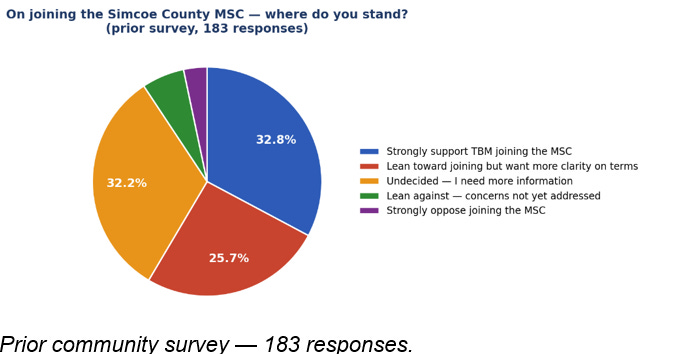
The result was clear, and on its face it was encouraging. Barely nine per cent were opposed. The other ninety per cent were either in favour or open to the idea. But look closer at where that openness sits. Almost a third — thirty-two per cent — told us plainly that they are undecided and need more information. Another quarter said they lean toward joining but want more clarity on the terms. Add those two groups together and well over half the community is saying the same thing: we are not against this; we simply do not yet understand it well enough to commit.
Two Towns, One Failure is a reader-supported publication. To receive new posts and support my work, consider becoming a free or paid subscriber.
That is the most important lesson of the survey, and it confirms what an earlier survey already suggested: a large share of people do not yet know what a Municipal Services Corporation actually is, what it would do, or what it would mean for their water, their wastewater, and their tax bill. The opposition is small. The information gap is large. And an information gap is a problem with a solution.
This document is that solution. It sets out, in plain language and backed by the public record, what is happening to water and wastewater across our four municipalities — Collingwood, The Blue Mountains, Clearview, and Wasaga Beach — and exactly how a Municipal Services Corporation would address it. No jargon. No spin. The facts as they stand, and the case as it is.
And then one request. When you have read it, please take a few minutes to complete the short follow-up survey linked below. The first survey captured how people felt before they had the full picture. This one will capture where the community stands once it does — and that informed voice, yours, is what will carry this forward.
Read it. Then tell us where you stand.
Take the survey:https://forms.gle/nsYUzcMMdTJQJ1QA7
Introduction
It is fair to say we are all frustrated with government — at every level. Service that is slow when it should be fast. Costs that climb when they should fall. And too often, an inability to deliver even the basic things we are already paying for. Many of us are simply fed up.
And then, once in a while, something cuts through. A flash of brilliance — instead of asking us to clean up the mess after we are inundated, a solution is offered that gets ahead of the problem before it overwhelms us. That is rare in public life.
That is what is on the table now. Working under the direction of the Minister of Municipal Affairs and Housing, the Honourable Rob Flack, our MPP Brian Saunderson has advanced exactly that kind of solution. It is called a Municipal Services Corporation — an MSC.
A note before we begin. While none of this has yet been announced, we are going to take some literary licence and proceed on a set of assumptions. We will assume that a Municipal Services Corporation will be created in the County of Simcoe, that it will be established in the fourth quarter of 2026, and that it will allow the Town of The Blue Mountains — though it lies in Grey County — to be bound to it. Everything that follows is built on those assumptions.
We have a regional water and wastewater problem. Wasaga Beach, Collingwood, The Blue Mountains, and Clearview Township each plan their own utilities, approve their own growth, and assume the pipes will keep up. They have not. They will not. And what matters most is that we are headed for huge tax bills our politicians insist will never come.
The idea behind an MSC is simple, and once you see it you cannot unsee it. The concept is based on recognizing that water does not follow municipal boundaries. Neither does sewage. The systems that move and treat them need to be built around geography — a watershed, a shoreline, a single bay — not around the lines politicians drew on a map.
Yet we govern that one interconnected system as if it were four.
This paper makes three arguments, and backs each with the public record.
First, that this is one system, not four — a single regional network of plants, pipes, wells, and outfalls that four governments happen to own in fragments.
Second, these four municipalities, acting alone, consistently make bad decisions — expensive ones, wasteful ones, and in some cases dangerous ones. Costs that triple. Plants that bypass raw sewage into Georgian Bay, wells that run dry and pipes that break in the winter because the systems have not been properly maintained, and what is most important, create future debt to pay for huge infrastructure that no small tax base can carry.
Third, that a Municipal Services Corporation is the mechanism that fixes this — a single, professionally run utility with the engineering depth, the financial scale, and the mandate to plan and manage this infrastructure properly, and at lower cost for the people who pay for it.
In the second week of June 2026, MPP Brian Saunderson made his case to the community across several local outlets, explaining the benefits of a Municipal Services Corporation for the region’s water and wastewater. It was clear, well written and should have generated applause from our politicians and bureaucrats.
What is an MSC?
● An MSC is a public utility, regionally structured within a natural geographic boundary such as the County of Simcoe and owned directly by the taxpayers who live within it.
● It develops a single regional plan — mapping every asset, assessing every failure point, and sequencing the investment needed to fix what is broken and build what the region needs.
● It is run by experienced professionals who manage contractors and deliver complex infrastructure on time and on budget,,
● As a public utility, it can finance capital projects at lower interest and over longer terms than any single municipality.
For you, the taxpayer, the result is one regional structure delivering higher quality, better management, and lower cost.
Unfortunately, not everyone is on board. As you will see we have created both a political culture and a bureaucracy prepared to misuse the trust that they have been given, spending public money to protect themselves rather than to serve the people who provided it.
Collingwood
The Rosy Picture
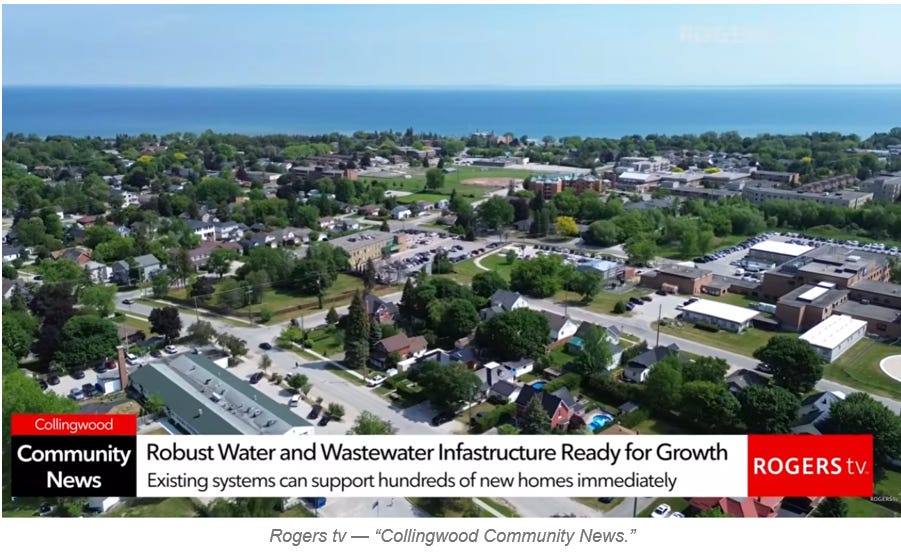
Not twenty-four hours after MPP Saunderson’s proposal reached the public, a video appeared on YouTube — a polished segment under the banner “Collingwood Community News.” Drone footage of the town on a perfect summer day. And a headline stretched across the bottom of the screen: “Robust Water and Wastewater Infrastructure Ready for Growth,” with the reassurance beneath it that “existing systems can support hundreds of new homes immediately.”
And in Collingwood Today, the response from the Mayor and Deputy Mayor to the idea of a regional Municipal Services Corporation was not engagement, not curiosity, not relief that someone was finally proposing a solution to problems they should be intimately aware of. Instead we received an icy petulance: “they had not been consulted”.
So let us ask the obvious question. Why do politicians present a rosy picture when the picture is anything but rosy? Do they think we are too dumb to understand the problem? Too weak to handle it? Too frightened to be told the truth? Unfortunately, the problem is more insidious.
Here is the truth. Collingwood is not capable of managing this water and wastewater infrastructure on its own. It has not done so, it is not doing so, and on its current path it will not do so. What this town needs — urgently — are people on council supported by the managing bureaucracy with the capability to steer us through what is, and what will increasingly be, an environmental and financial reckoning unless we choose the path toward Saunderson’s proposal.
What Goes Into the Bay
I have presented this analysis before and I will do so again by presenting the undisputed facts regarding what went into our bay this spring. The facts do not present a pretty picture.
Between 2020 and 2025 there were at least six bypass events at the Collingwood Wastewater Treatment Plant — six occasions on which sewage, untreated or partially treated, was discharged into Georgian Bay because the plant could not cope. Each one was larger than the last.
Here is some news…global warming is creating bigger storms and more flooding every year.
On April 3, 2026, a single full bypass lasting over twelve hours sent 21,161 cubic metres of untreated wastewater into Collingwood Harbour. An Olympic swimming pool holds 2,500 cubic metres. That is more than eight of them — raw — in twelve hours.
And here is the part that should stop you cold. Collingwood draws its drinking water from Georgian Bay, at an intake off Sunset Point roughly one kilometre along the same shoreline as the plant’s outfall. Provincial source-water-protection modelling identifies the wastewater plant as a direct contamination threat to that intake — currents can carry bypass discharge eastward, toward where the town draws its drinking water, within hours.
Do you think this is a problem?
Collingwood’s Response: Check Your Sump Pump
So how did the Town respond to its sewage entering the bay?
Immediately after my article screaming that this needs to be addressed, the Town responded. Collingwood Today carried the official message.
The Town’s advice to residents: check your sump pump. Make sure your roof leaders drain to your lawn. Limit your showers. Hold off on the laundry. Watch your backwater valve.
No kidding.
A sixty-eight-year-old plant is discharging raw sewage into Georgian Bay, and the public-facing solution is a household hygiene checklist. That is not a plan. It is a deflection — a way of converting an infrastructure failure into a personal responsibility, so that the institution that owns the plant does not have to own the problem.
This Pollution Is Not Benign
It is tempting to treat all of this as an accounting matter — cubic metres, capacity thresholds, line items. It is not. What goes into the bay does not stay in the bay, and it does not stay abstract.
Is there anyone reading this paper who has not been touched by cancer? Who is not, or does not love, someone who has faced it? That is not rhetoric. It is the lived experience of nearly every family in this community.
The water carries more than bacteria. It carries pharmaceuticals, hormones, heavy metals, microplastics, and the class of industrial compounds known as PFAS — the “forever chemicals” — none of which conventional treatment removes, and none of which provincial testing is even required to look for. These are precisely the exposures that research increasingly ties to chronic disease.
Consider Parkinson’s. It is the fastest-growing neurological disease in the world. And the research is increasingly clear that it is overwhelmingly environmental in origin — studies attribute as much as 90 per cent of cases not to genetics but to environmental exposure: pesticides, industrial solvents, and contaminants of exactly the kind that move through water systems. We are not discharging an inconvenience into Georgian Bay. We are discharging a long-term threat to human health into the source of our own drinking water.
This is why “check your sump pump” is not merely inadequate. It is an insult.
The $300 Million Question
Suppose we accept all of this. Suppose Collingwood resolves, on its own, to build the new plant it needs. Two problems arrive immediately — and the first is the one nobody wants to say out loud: even if we could afford it, where would we put it? There is no site within Collingwood’s boundaries that works. A real plant needs land, and an outfall reaching well out into open Nottawasaga Bay, far from the drinking-water intake. That alone pushes this beyond Collingwood’s borders. It is, by its very nature, a regional project.
But set the site problem aside and look only at the money, because the money is decisive on its own.
A new wastewater treatment plant is, at the very minimum, a $300 million undertaking. Finance $300 million over 25 years at 4.5 per cent and the bill is roughly $20 million every year. Collingwood, on its own, is about 30,000 people — call it 15,000 households. Divide it out and every home in this town carries roughly $1,350 a year — that is an extra $112 a month — on top of your current water bill, for twenty-five years. And that is the optimistic figure. It pays for the plant alone: not the outfall pipe, not the forcemain network, not a single day of operating the thing.
The Water Treatment Plant: “It Will Cost You Nothing”
If the wastewater plant is the failure you can see, the water treatment plant is the one being hidden — behind an accounting story so tidy it should make you angry.
Here is what we were told. Collingwood’s drinking-water plant — the Raymond A. Barker Water Treatment Plant — is being expanded at a total cost of about $270 million. The province is covering roughly $150 million of it through the Housing-Enabling Water Systems Fund. New Tecumseth, which buys Collingwood water, carries about 63 per cent of the remaining net cost. Collingwood’s own share is about $44.4 million. And that $44.4 million, we were assured, would cost ratepayers nothing — because it would be paid for entirely by development charges. Growth pays for growth. No debenture. No tax levy. A minimum increase to your water bill (18%). The Town’s existing long-term debt would be retired by 2034, and not a dollar of new debenture debt was issued in 2024 or 2025.
It is a beautiful story, but it is smoke. The Town’s own numbers destroy it. Three of them, in particular.
1. The development charges that are not coming
The entire promise rests on one assumption: that development charges — the fees builders pay on new construction — will roll in fast enough to cover the $44.4 million. So look at what those fees have actually done.
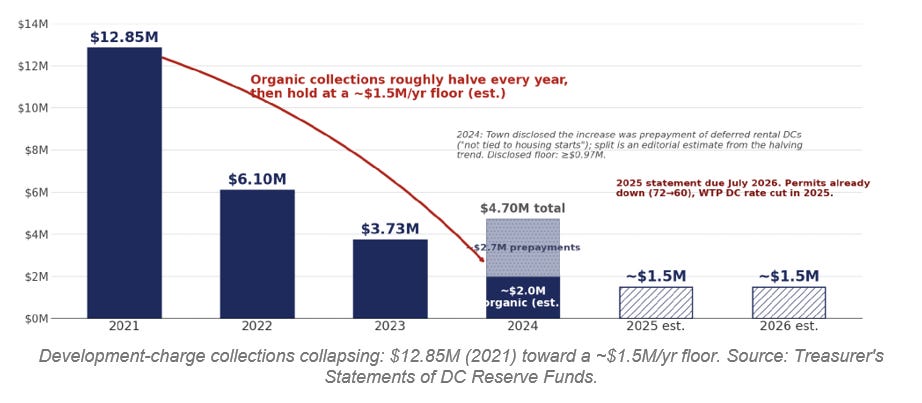
In 2021, Collingwood collected $12.85 million in development charges. In 2022, $6.10 million. In 2023, $3.73 million. By 2024, organic collections — the real fees on real new construction, stripped of one-time rental prepayments — had fallen to roughly $2 million. That is a collapse of about 84 per cent in three years, settling toward a floor of perhaps $1.5 million a year. Building permits are already down. And in 2025, the Town actually cut its water-treatment-plant development-charge rates — lowering the very revenue it claims will fund the plant.
Take a drive around town and try to find the vast wave of development that is supposed to pay for all this. It is not there. We have no significant new land to bring on, and we are in a building recession. The development-charge engine the entire plan depends on has stalled. To make matters worse, the reserve is draining far faster than it fills — $11.9 million flowed out of the development-charge reserve in 2024 against just $4.7 million coming in. Two and a half times as much out as in.
2. The debt the Town does not call debt
When development charges don’t cover the bill, the bill does not vanish. It just stops being called a development charge and becomes something else: debt.
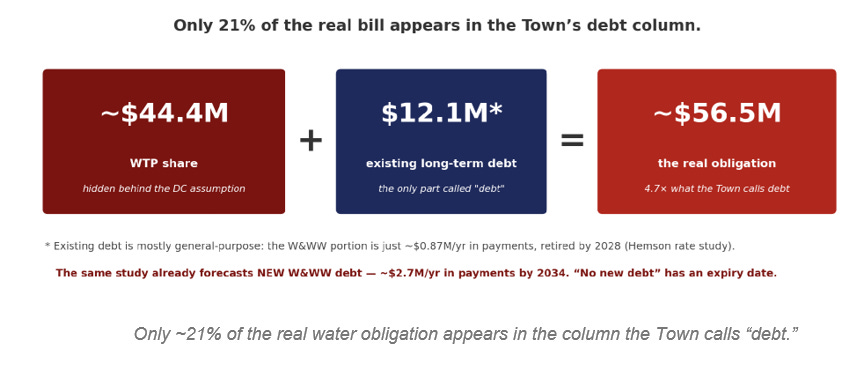
Only about 21 per cent of Collingwood’s real water obligation shows up in the column the Town labels “debt.” The $44.4 million water-plant share sits off to the side, hidden behind the development-charge assumption. Add it to the $12.1 million the Town does acknowledge, and the real obligation is roughly $56.5 million — about 4.7 times what the Town calls its debt.
3. The bill that lands on you
So who actually pays? You do. It arrives, as it always does, on your water bill.
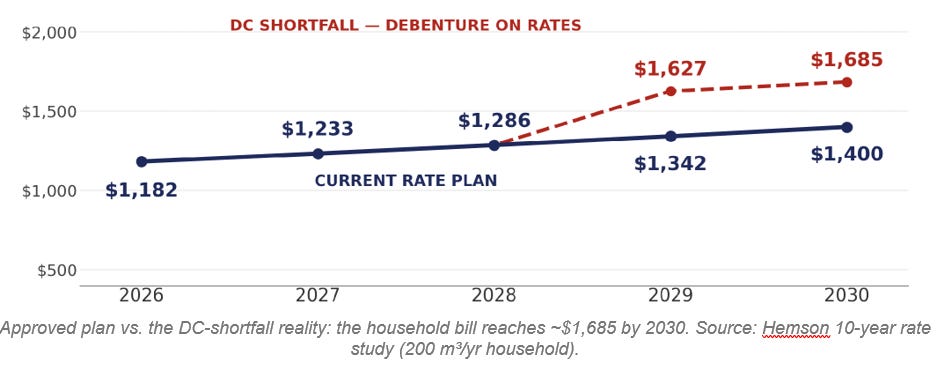
Under the Town’s approved rate plan, the typical household water-and-wastewater bill already climbs from about $1,182 in 2026 to $1,400 in 2030 — an 18 per cent increase. But when the development-charge fantasy collapses and the $44.4 million is financed as a debenture on the rate base — which is exactly what the numbers above say will happen — that same bill rises to about $1,685 by 2030. That is a 43 per cent increase in five years: roughly $503 more per household, every year, beginning in 2029 when the plant comes online and the development-charge reserve has already run dry, which is forecasted to be around 2028.
One more fabricated picture
This is the pattern, again. We are told the plant will cost us nothing. We are shown good management, and growth that pays for itself. And then, quietly, the bill arrives — because the growth was never coming, the reserve was always draining, and the debt was always going to be ours.
Where the Resistance Really Comes From
So who is actually against this MSC? The easy answer is the politicians — the mayors and councilors who bristled at not being “consulted.” But that is the wrong answer. Councilors come and go, they are the talking heads; we can replace every one of them in October.
Look instead at this chart. This is the Town of Collingwood — and it is a masterpiece of bureaucracy.
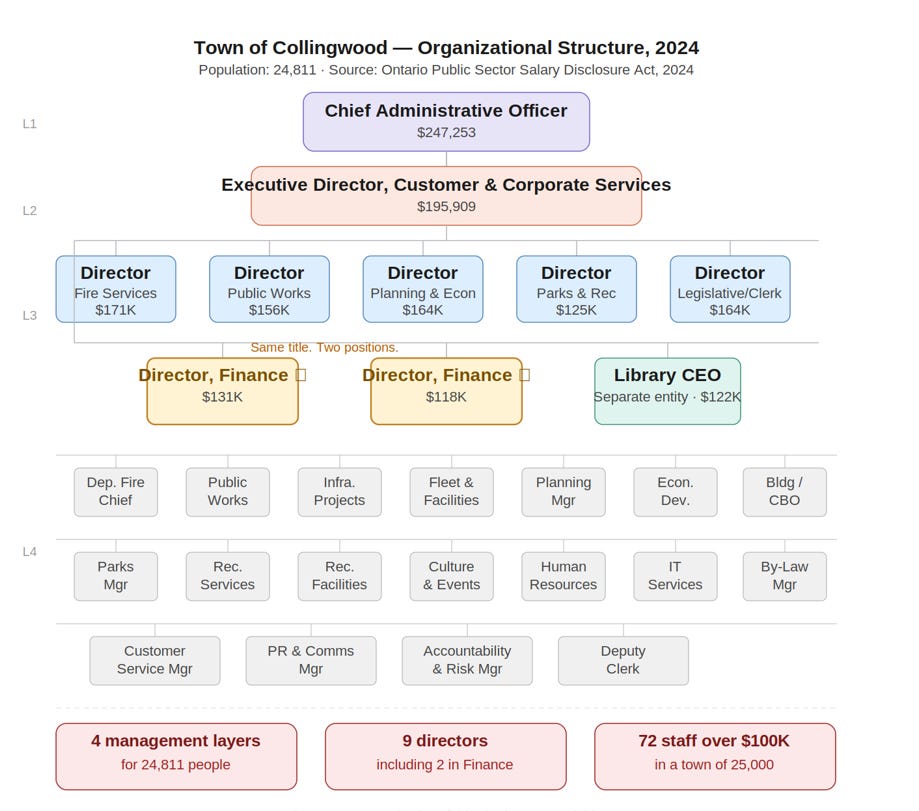
A community of fewer than 25,000 people, administered through four layers of management and nine directors — including, remarkably, two separate Directors of Finance, and a fire service carrying both a chief and a deputy chief on six-figure pay. A workforce of 270 full-time-equivalent positions — 352 people counting seasonal and part-time — of whom 72 earn more than $100,000 a year, under a Chief Administrative Officer paid more than a quarter of a million dollars. No private-sector organization of this size would ever be built this way, because no private sector organization could afford to be built this way.
This is an organization closed to change and resistant to innovation. You find this only in government — and there is a reason. In a business, money, efficiency, optimization, and accountability are the measures of success. In a structure like this one, they are not measured at all. Nothing in the design rewards doing more with less, because nothing in the design has to.
That is why the opposition will never announce itself honestly. It will not say “this will cost us positions.” It will say the process was rushed, the consultation inadequate, the jurisdiction unclear, the timing wrong. It will commission a study. It will run out the clock. The language will always be procedural. The motive will always be preservation.
Understand this and the whole pattern snaps into focus. The rosy video. The “we weren’t consulted.” The fourth environmental assessment. The sump-pump checklist. None of it is stupidity. All of it is an institution protecting itself.
People say: government is not a business. It is the reflexive defence, and it is nonsense. No one is asking the Town to turn a profit. But the Town of Collingwood is a $198-million-a-year organization — $71 million in operating costs and $127 million in capital in 2026 alone — and its entire reason to exist is to deliver one thing: the most efficient, effective services your tax dollars can buy. Water, sewage, roads, recreation, safety. That is the job. “Not a business” is not a licence to be unaccountable — it is the opposite.
And here is the final point, and it is the simplest one. You could remove a hundred people from this organization — a hundred positions out of three hundred and fifty — and the only thing you would lose is bureaucracy. At a fully loaded cost of roughly $100,000 each, that is $10 million a year.
And here is the hardest part. There is no one to blame but us. We elect the councils. We nod at the rosy videos. We let the studies pile up and the bills arrive, and we look away. The structure survives because we permit it to.
The question for me is what do we as a community have to do to change this self-perpetuating paradigm because it is ugly?
The Town of The Blue Mountains: A Water and Wastewater Basket Case
Last week, Peter Bordignon — the current Deputy Mayor of The Blue Mountains, and a candidate for Mayor this fall — sat down with me and a group of concerned and informed community members for a candid discussion of how an MSC would address the Town’s financial and engineering problems. It was a positive, intelligent and very thoughtful dialogue.
That meeting points to the one real difference between the two communities at the center of this crisis. Collingwood is still telling its residents that everything is under control. The Blue Mountains has stopped pretending. Its wastewater problem is now so plainly beyond what the town can carry on its own that the conversation here has already turned to the solution — a Municipal Services Corporation.
A Pattern of Overruns, Not an Accident
TBM is a very small town trying to address very big, complex problems and the result has been a history of poor decision making and nonexistent project management. Examples include…
● The Thornbury Wastewater Treatment Plant Phase 1A expansion was approved at $18 million. It was delivered at $34.5 million — a 92 per cent overrun.
● The Craigleith Lift Station and Bay Street Forcemain bundle was approved at $34.79 million. At approximately $32 million council was told only two plants were completed
● Mill street, the 3rd plant is now projected to cost an estimated $19 to $20M more.
Plants That Are Out of Room
TBM owns and operates two wastewater treatment plants, plus twelve sewage pumping stations across the municipality.
The Craigleith plant serves the resort corridor. A $45 million upgrade is on the table — and TBM has paused it, because it cannot afford the bill. The plant itself still has room; this is a town stopping to think because the money isn’t there.
The Thornbury plant was expanded to 5,330 cubic meters — a project just completed in 2026, on budget and under cost estimate. But it was a short-term fix, not a solution. The plant had already reached 74 per cent of design capacity in 2024, and it exceeds its design peak flows in wet weather. The next phase, Phase 1B, which would lift it toward 7,080 cubic metres a day, remains unfunded and still in engineering. Again, the issue is money.
The Verdict
Serial wastewater overruns, a debt line heading for $72 million on a tax base under 13,000, driven first and foremost by wastewater. One plant already past 74 per cent of capacity with its next phase unfunded, and another whose upgrade the town has paused because it cannot afford it. To make matters worse there is a collection network leaking an unknown volume of sewage into the ground. This is not a town with a manageable wastewater problem. It is a town that cannot, on its own, manage wastewater at all.
The difference — and it matters — driven under the leader of Peter Bordignon, is that The Blue Mountains is taking control. Its leadership is at the table, working through the implications, looking squarely at the one mechanism that can carry infrastructure of this scale: a regional Municipal Services Corporation. That is exactly the posture this crisis requires.
Clearview Township: A System With No System
Clearview is where the argument stops being theoretical. More than any municipality in this region, Clearview proves that the water and wastewater here already function as one regional system — supplied, operated, and drained straight across every municipal boundary — while being governed as four separate islands. Trace where Clearview’s water comes from and where its sewage goes, and the map of pipes makes a mockery of the map of governments. Clearview does not really run its own water and wastewater. It depends on Collingwood, on Wasaga Beach, on a developer, and on the province — and nobody is responsible for the whole.
Stayner: A Town That Ran Out of Water
In March 2023, Clearview told every landowner in the Stayner settlement area that the municipal water supply had reached capacity. Building permits were frozen. They remain frozen — and will until a new plant is commissioned, expected in early 2027. Stayner, the township’s largest and fastest-growing community, has been effectively shut to new homes for over two years.
The fix is the Klondike Park Road well project — about $70 million. Clearview could not finance it alone. It took a provincial grant, a mortgage-secured County loan, and, remarkably, a requirement that the township pre-sell its future water by getting developers to pre-pay their charges before it could even apply.
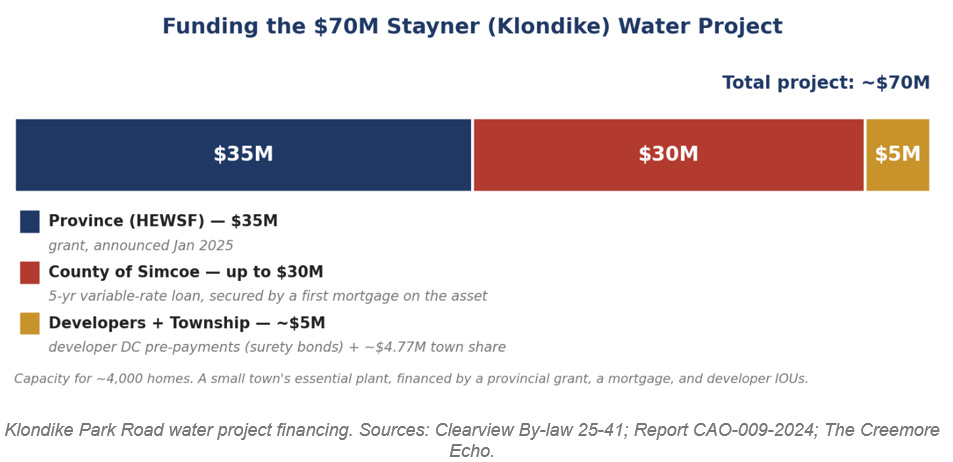
Read the structure and the fragility is obvious. The County loan is short and variable-rate, secured by a first mortgage on the plant itself — default and the County has first claim on the asset. Repayment leans on developer pre-payments arriving on schedule, in the middle of a building slowdown. And because water is funded by rates and development charges rather than property tax, it is the ratepayer who ultimately backstops the whole thing.
The Pipeline That Passes Them By
Now look north. A ~60-kilometre pipeline carries treated Collingwood drinking water across Clearview to New Tecumseth — built in 1999 specifically to supply Honda’s expansion in Alliston. It crosses the township to serve somewhere else. Within Clearview, only the small New Lowell system is connected to it; Stayner and almost everything else runs on groundwater wells — the same wells that ran dry.
So treated Collingwood water flows straight through Clearview to Alliston, while Stayner runs out and spends $70 million drilling for more. And the demand case behind Collingwood’s own $270-million plant expansion — of which New Tecumseth carries 63 per cent — leans heavily on Alliston’s growth, which was to be supercharged by Honda’s $15-billion EV expansion. That project was indefinitely suspended in 2025–26. The pipes are being sized for growth that is, right now, evaporating.
Nottawa: The Whole Crisis in One Village
And then there is Nottawa — a single village that contains the entire regional failure in miniature.
For fifteen years, across councils in 2006, 2010, 2011, 2016 and 2020, Nottawa residents were told the same thing: a large subdivision (the DelZotto lands, now Georgian Communities) would finally bring municipal water and sewer to the whole village. Councillors called servicing the village “the responsible thing to do.” A Ministry-of-Environment-approved Environmental Assessment recommended watering Nottawa by tapping the Collingwood pipeline — and a connection was installed near the village back in the late 1990s. The plan was clear, endorsed, and physically half-built.
Then, in April 2024, it was quietly reversed. Report PW-009-2024 made two decisions. First, the development would no longer draw Collingwood water from the pipeline at all; instead, Clearview would drill new local wells (expanding the McKean system) — pulling more from the very aquifer beneath a village that residents say already has dry and contaminated wells. Second: Council resolved “to not proceed with servicing the remaining Village of Nottawa with full municipal services” — citing the financial burden. The sewage would go to Collingwood’s wastewater plant; the existing village would be bypassed.
For the people who were promised those pipes for fifteen years, the cost of the broken promise is precise:
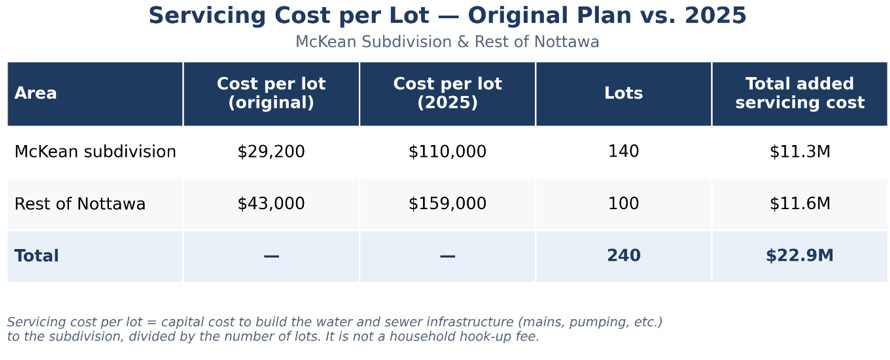
The per-house cost to existing residents jumps from roughly $43,000 to $159,000 (and in McKean, $29,200 to $110,000) — because the trunk pipes are re-routed around the village toward Batteaux instead of through it. Nearly $23 million of promised “community benefit” simply vanishes. Residents who held off replacing aging wells and septics for fifteen years because “pipes were coming” are now told they are on their own — and may face Ministry orders to remediate failing private systems.
So What Is the Motivation?
It looks like madness. It is not. It is what happens when every party optimizes its own narrow interest and the costs are pushed onto whoever has the least power to refuse.
The developer wants a water source it controls, cheaply and quickly — its own wells, rather than a contested, capital-heavy allocation negotiated out of Collingwood’s constrained plant. The township wants the growth and the development charges, but not the cost of servicing existing residents, so it keeps the profitable new subdivision and sheds the expensive village. Collingwood gets a paying sewage customer, with the developer covering the upgrades. Every party at the table comes out ahead. The losers are the people not at the table: the existing villagers, left on failing wells, and the shared aquifer, asked to give up still more water.
None of it is irrational for the individual actor. It is only insane for the region — because no one is optimizing the whole system, and no one’s job is the existing ratepayer rather than the next subdivision. So a village sits beside a pipe full of clean water and is told to drill into its own failing aquifer, a fifteen-year promise is erased on a spreadsheet, and the sewage is shipped to a plant that already overflows into Georgian Bay.
The Plants Clearview Does Not Run
The pattern holds on the wastewater side, and it gives the game away. Clearview owns two sewage treatment plants — Stayner (1984) and Creemore (2000) — and both are operated under contract by the Town of Collingwood. The regional utility this paper calls for is not hypothetical: a working fragment of it already exists, with Collingwood staff running a neighbour’s plants. These are aging facilities, too — the Stayner plant logged effluent-flowmeter failures in 2023 and an effluent-quality exceedance in 2024.
And Stayner’s growth has already outrun its own plant — so much so that Clearview is contractually committed to piping 2,500 cubic metres a day of its sewage into Wasaga Beach’s plant (more on the consequences when we reach Wasaga). One township’s growth, parked on another township’s plant.
The System View
Now total it up. New Lowell drinks Collingwood water. Stayner and Nottawa drink from a stressed local aquifer the Province had to spend $35 million to expand. Clearview’s two sewage plants are run by Collingwood. Nottawa’s sewage will be piped to Collingwood. Stayner’s overflow sewage is dumped on Wasaga Beach. The rescue cheques are written by Queen’s Park.
That is not a township managing its own water and wastewater. It is a node in a regional system that no one governs as a system — supplied by one neighbour, operated by another, drained into a third, and bailed out by the Province. Every actor optimizes its own fragment, and the collective result is duplicated cost, stranded infrastructure, broken promises, and sewage in the bay.
This is the case for a Municipal Services Corporation, written by one township — a single body that would water Nottawa from the pipe that already passes it. Today, no one is responsible for making that decision.
Wasaga Beach: A Problem Yet to Unfold
Drinking Water: A Plan to 2063
Wasaga Beach draws its water from seven wells in two fields, Jenetta Street and Veterans Way, tapping a deep, confined aquifer protected by low-permeability layers above. Supply is 31,415 cubic metres a day; 2022 maximum-day demand was 18,888 — about sixty per cent of capacity — and per-household demand has fallen for two decades. Sitting on a major aquifer, Wasaga’s fresh water supply is simply not in question.
Sources: Water Supply System Expansion Class EA Addendum (Ainley Group, 2023); WPCP Performance Report (OCWA, 2024).
Wastewater: The Same Trap as Everyone Else
Turn to sewage, and Wasaga rejoins the regional pattern. Its single Water Pollution Control Plant on Woodland Drive is rated at 15,433 cubic metres a day. On dry months it runs comfortably, but in wet weather the peaks climb fast — in April 2024, after 196 millimetres of rain, the daily peak hit roughly 78 per cent of rated capacity — and raw flows are rising year over year. The plant exceeded its rated capacity once already.
The plant as with all the others in the region is being patched, not expanded: a long list of capital repairs — UV system, biosolids, barscreen, pumps — keeps an aging facility running.
Wasaga Beach is committed to receiving an additional 2,500 cubic metres a day of Stayner’s sewage once development targets are reached; the forcemains between the two towns are already contracted.
Stayner’s input won’t take a decade to bite — it will consume essentially all of the plant’s remaining wet-weather margin on connection. After that, Wasaga’s own rising flows erase what little average-day room is left.
The upgrades Wasaga’s plant will need to absorb those flows have not been engineered or funded by either municipality.
Wasaga sits on a shallow, sensitive shoreline — a 14- kilometre swimming beach over a surface sand aquifer. Once capacity is reached there are no practical and environmentally acceptable options for expansion.
Let’s Do the Math: The Province’s Bill
Step back from the individual files and add up one number: what the Province of Ontario has had to put in just to keep this region’s water and wastewater functioning and growing. Not the municipalities’ own spending — only the provincial cheques, and only the recent, traceable ones.
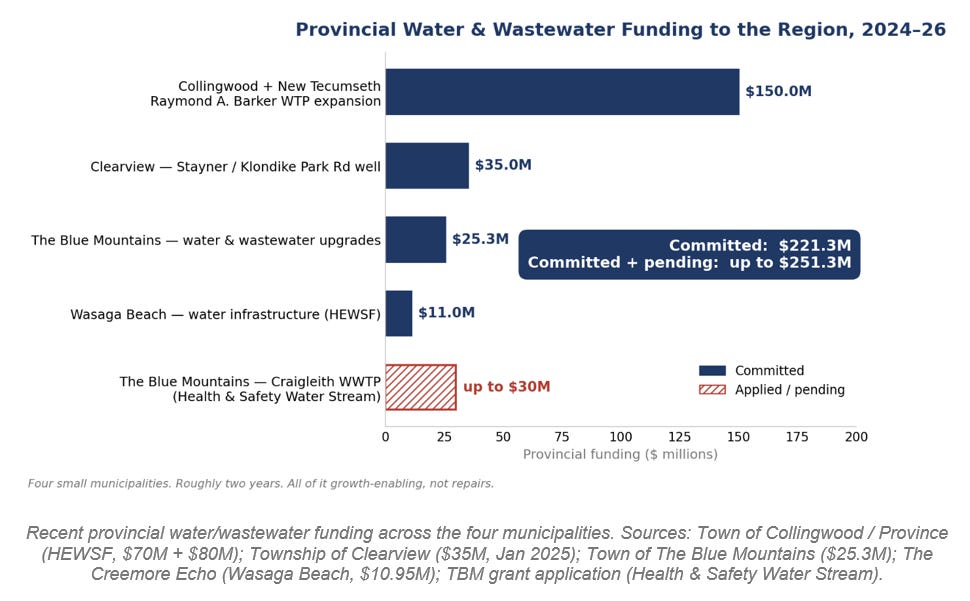
More than $220 million in committed provincial funding — heading past a quarter of a billion dollars with the next application in the queue — for water and wastewater in four small municipalities, in roughly two years. That is not strategic investment. It is serial rescue: the Province stepping in, file by file, because four municipalities cannot plan or finance this infrastructure on their own. Every grant was applied for separately, justified separately, and announced separately. The reality for the province is that this is not feasible in the long term. The lack of planning, the waste, the overlapping and competition for scarce resources simply cannot continue.
You Don’t Build a Water Plant for Ten Years
There are two fundamental problems with how the government is funding these projects across the region.
- You do not build water and wastewater infrastructure on a ten-year horizon. Major treatment plants are engineered for twenty-five to fifty years — that is the entire point of building at scale. You size a plant for a generation precisely so you are not back in the ground, and back at the bank, every decade. A plant built for ten years is not an investment. It is a down payment on the next emergency.
- The second issue is the obvious lack of a regional systemic approach. The hard facts are that some of these projects would not be built at all if there was a regional plan that optimized need, technology, location, geography and environmental management.
Today, none of these issues are being managed. The provincial money catalogued earlier is being spent a decade at a time — each town funding a small increment of growth capacity, on its own, with the next expansion already looming before the concrete has cured.
This is not speculation. It is what the municipalities’ own documents and consultants say, plant by plant — and the wall they are heading for is the early-to-mid 2030s, on both dimensions that matter: capacity and physical space.
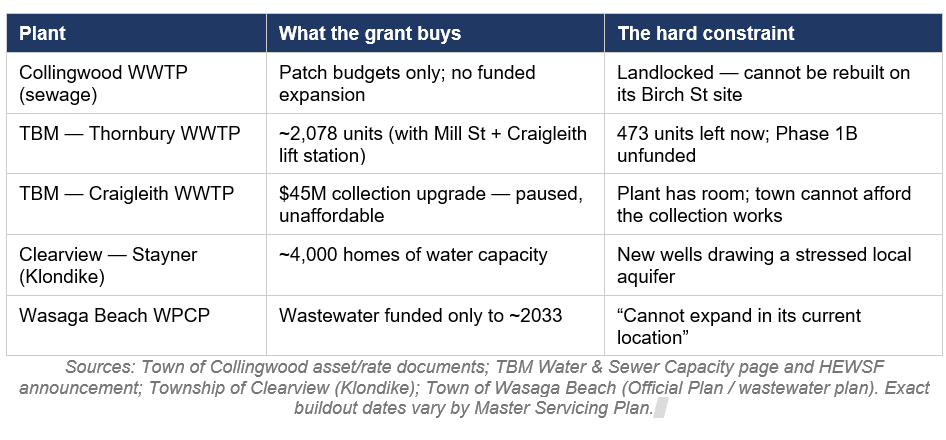
Read down that table and the failure is twofold, and each half is fatal on its own.
The first failure is horizon. Each municipality plans and funds project by project, to the next council term or the next grant deadline — never to the real thirty- to fifty-year demand curve a treatment plant is supposed to serve. So the money buys a decade, the plant fills, and the cycle restarts. By the mid-2030s, on their own numbers, all four are back where they started — except more is owed, more has been spent, and the sewage has kept flowing into Georgian Bay the entire time.
The second failure is space, and it is the one no cheque can fix. Even if these towns had the money to build a proper long-horizon plant, they have nowhere to put it. Collingwood’s wastewater plant is boxed in by the harbour, the escarpment, and built-out residential — it cannot be rebuilt where it stands. TBM’s Craigleith plant is pinned between Georgian Bay and development. Wasaga Beach’s plant cannot expand in its current location. You physically cannot build a generational facility on a landlocked site, so each town is forced into small patches on dead-end land — paying premium prices for solutions that were obsolete before they opened.
Part Two — What an MSC Is, and Why It Will Address Our Needs
3 Driving Forces
Force 1. Scalability and Regional Infrastructure
Wastewater Systems
Municipal councils do not think about infrastructure. They defer it, underfund it, and hope the problem belongs to the next council. The evidence across this region is unambiguous — overruns, bypasses, aging pipes, and treatment plants running at capacity while the population keeps growing. There is no plan.
The first mandate of an MSC is to fix that. It builds a ten-year regional infrastructure plan that maps every asset, assesses every failure point, and sequences the investment required to repair what is broken and build what the region needs. Not a study. Not a report for a shelf. A plan with capital commitments, engineering timelines, and accountability to a board whose only job is to execute it.
Apply that discipline to wastewater and the scale of what we are facing comes into focus. Across the region we are running, in effect, six wastewater treatment plants on life support.
Each one is up against a different wall:
- Collingwood’s plant is physically boxed in, harbour to the north, escarpment to the south, neighbourhoods on either side, with nowhere left to grow. Even if a new site could be found, the treated effluent would still have to be carried past the harbour spit and out into the deep water of Nottawasaga Bay — a marine outfall several kilometres long that, on its own, would run on the order of $100 million or more.
- Wasaga’s WPCP discharges its treated effluent to the Nottawasaga River, which empties into Georgian Bay beside Beach Area 1 — the main beachfront at the heart of the town, and the busiest stretch of the 14 km beach that drives the local economy.
- Thornbury (TBM) was just expanded to 5,330 m³/day at a cost of roughly $34.5 million — yet the next phase, to 7,080 m³/day, is already needed and remains unfunded.
- Craigleith (TBM) — the problem is its collection system, not the plant. A $45-million program of lift-station, trunk-sewer and forcemain upgrades is needed to handle wet-weather flows (sewage backed up into Craigleith homes during a 2023 storm) and to service the resort corridor’s growth. It has been paused because the town can’t afford the bill.
- Stayner (Clearview) is a 41-year-old inland plant whose growth flows have already outrun it — so much that Clearview is committed to piping 2,500 cubic metres a day of its sewage to Wasaga Beach rather than expand it.
- Creemore (Clearview) is a small inland plant on the Mad River, with the limited headroom of a village system and no funded plan for the growth the township keeps approving.
This is precisely what no single municipality can solve on its own, and exactly what an MSC is built to do. Planning at regional scale, it does not patch six dying plants one budget cycle at a time. It asks the question none of the four towns is structured to ask: where, across the whole region, should treatment capacity actually be — on a site with the land to grow and the deep water to discharge — and how do we sequence the move there. One regional plan, one set of decisions, sized to the next generation rather than the next election.
The Status Quo: A Bill That Will Never Be Paid
Start by doing the arithmetic on the path we are on. If each of these plants is rebuilt on its own — the only option available to four municipalities acting separately — the minimum price today is roughly $300 million per plant, and as we have already seen, that is a conservative number. Add them up across the region and you are looking at something on the order of $2 billion.
No municipality here, or all of them combined, can carry $2 billion. For the go-it-alone approach to work, the Ontario government would have to cover the overwhelming majority of it — on the order of 80 to 90 per cent, or somewhere between $1.6 and $1.8 billion. And remember: this is one small corner of the province. The same crisis — aging plants, broken pipes, growth outrunning capacity — is playing out in dozens of regions across Ontario at the same time.
So ask the honest question: does anyone realistically believe a cheque of $1.6 to $1.8 billion is coming for this region alone? It is not. Which means the true outcome of going it alone is not a row of rebuilt plants. It is nothing — more studies, more bypasses, more patching, while the bill compounds and Georgian Bay keeps paying the price.
The Regional Solution: One Plant, Not Six
This is the second question an MSC exists to ask, and no single town is structured to ask it: what does a genuine regional solution actually look like?
Instead of six aging plants on six constrained sites, imagine one. A single, purpose-built regional treatment plant on a properly chosen site in deep water north of Thornbury — with the region’s wastewater conveyed to it and discharged safely into deep, open water, far from any drinking-water intake or swimming beach. One modern plant, with the most modern technology and screening that exists, sized for the next fifty years, doing the work that six failing ones cannot.
The numbers move decisively in the region’s favour. Against the roughly $2 billion it would cost to rebuild six plants separately, a single regional facility could save somewhere between $500 million and $1 billion. And the result would not merely be cheaper — it could be world-class: modern treatment, real capacity, and a deep-water outfall that finally takes the discharge out of the harbours, rivers, and beaches it now fouls.
The timing is achievable. With an MSC formed and planning begun, construction could start around 2030 — roughly the moment the existing plants hit the wall.
That is the whole choice in a sentence. The status quo is a fantasy that depends on a cheque no one will ever write. The MSC is a plan the region can actually build.
Part B — Water Systems
If we set out to design a system to be more inept, more disentangled, more suboptimized we would still fall below the bar that has been set for how fresh water is managed in this region.
The Need for a Regional Water Plan
Everything said about wastewater applies to drinking water — and on the water side the case is even stronger, because here the regional system already physically exists. A region’s drinking water should be planned as one system: a single assessment of every source, every plant, every pipe and booster station, and every community’s demand to full build-out, with one sequenced plan to supply it.
That is not what we have. Four municipalities plan their water in isolation — one expands a plant, one opts out of paying for it, one freezes building permits, one drills its own wells — and no one is responsible for the whole. The first mandate of an MSC on the water side is the same as on wastewater: build a single regional water plan that maps every source and asset, projects demand to a real horizon, and sequences supply so that no community runs dry and no plant is oversized, stranded, or duplicated.
The Current Mess
Start with what is already true. Collingwood’s Raymond A. Barker Water Treatment Plant is not, in any meaningful sense, a Collingwood plant. It is a regional plant. It already supplies New Tecumseth through a roughly 60-kilometre pipeline, The Blue Mountains through the Mountain Road Booster Station, and Clearview’s New Lowell community. The pipes already cross every municipal boundary in this region.
And yet it is governed as four disconnected decisions, each made in isolation:
Collingwood identified a capacity problem in 2019, did nothing for two years, ran the plant past 80 per cent of capacity, and was forced to freeze development with an Interim Control Bylaw. And what is now underway is not really an “expansion” at all — at $270 million, up from a first estimate of about $65 million, it is effectively the construction of an entirely new plant. Even that proceeded only because the province stepped in with roughly $150 million.
The Blue Mountains is connected to that same plant and buys Collingwood drinking water — up to 1,250 cubic metres a day, with provision for more — through the Mountain Road Booster Station. Yet in January 2024 it opted out of the expansion, paying none of the $270 million. A customer, not a partner. Its own system is nearly out of room — about 2,900 connection units left of 16,357 system-wide, and the fast-growing resort corridor down to roughly 345 — and when a Collingwood water main broke in December 2025, TBM had to isolate its system to protect its supply. The infrastructure connecting the two towns exists. The shared planning does not.
Clearview lives the contradiction most sharply. Its New Lowell community drinks Collingwood water off the regional pipeline, while a few kilometres away Stayner runs on its own municipal wells — wells that hit capacity in March 2023, froze building permits across the town, and forced a $70-million well project that, again, only proceeded with a provincial rescue of $35 million.
Wasaga Beach is the exception that proves the point. Drawing on a deep, protected aquifer, it has planned its water supply all the way to 2063 — proof that long-horizon water planning is entirely possible in this region when someone chooses to do it.
So here is the conclusion, and it is almost embarrassing in its simplicity. The regional water infrastructure already exists — a regional plant, sixty kilometres of pipeline, booster stations, and supply agreements spanning four municipalities. What is missing is not pipe. And it is not even, strictly, the will —the problem is that every town is working hard at its own water problem trying to optimize within its own boundaries. One town expands the plant and carries the cost; its neighbour buys the water and opts out of the bill; a third drills its own wells while drinking the first town’s supply. Every one of those decisions might seem rational within strictly defined borders but the sum of them leaves the region fractured and in pain.
To be clear, full integration cannot happen overnight. The new Collingwood plant will not be operational until 2029, and a unified regional water system can only be built around it once it is running. But that is exactly why the planning must begin now. The MSC, the regional water plan, and the integration framework all have to be in place before the plant comes online — not cobbled together afterward. That is the gap a regional water plan, executed by an MSC, is built to close, and the time to start closing it is now.
Force 2. Long-Term Capital Financing
The second fundamental benefit of a major utility like the MSC is its capacity to finance infrastructure over the long term — to spread the cost of assets built to last fifty years across the decades that actually use them.
Ontario law limits municipal debentures to a maximum term of 15 to 20 years. An MSC, structured as a utility corporation, can issue infrastructure debentures over 40 years. That difference is decisive.
And this is what changes everything about who pays. Under the go-it-alone approach, the region waits, hat in hand, for a provincial cheque that will never come — and so nothing happens. Under an MSC, the region does not wait. It finances each project itself, at utility scale and over the long term, and pays for it directly through water and wastewater rates.
One of the concerns people voiced was losing control of their water system. In fact, it is exactly the opposite. We don’t have control of our water system. By removing the Ontario government from the equation, for the first time the region controls its own destiny instead of pleading for a rescue that is not coming.
These towns have already committed to upgrading their systems, and that committed water and wastewater debt will be transfered to the MSC to be financed over the long term:
- Collingwood — about $44 million, its share of the Raymond A. Barker Water Treatment Plant expansion.
- The Blue Mountains — about $32 million for the Craigleith lift station and Bay-Grey works now in execution.
- Clearview — about $35 million for the Klondike well project, net of the provincial grant.
- Wasaga Beach — nothing today; its upgrade is a future need that has not yet been incurred.
In all, roughly $111 million in already-committed water and wastewater debt — each town’s own — moves onto the MSC’s balance sheet, where it can be financed over 40 years instead of 20. Let me say this one more time, because it is at the essence of everything we are talking about. The debt moves from the town to the utility, from a short term debenture to a long term… the result is you will pay less.
Force 3. Professional Talent, Quality, and Focus
Finally and critically, what sets an MSC apart from the small, stretched teams in each town is what it brings to the table.
None of these municipalities — not one of the four — can attract, afford, or retain the calibre of engineering and project-management talent that water and wastewater infrastructure demands. What each gets instead is a young engineer learning on the job — practising, on a $50 million capital project, skills they have never applied before. The overruns are not surprising. They are inevitable.
An MSC changes that equation entirely. A regional utility serving all four communities recruits differently. It attracts the fifty-year-old project manager who has built treatment plants, managed contractors, and delivered complex infrastructure a dozen times over. It creates the conditions for mentorship — where junior engineers learn from seasoned professionals rather than from their own expensive mistakes. Talent follows the mandate, and the mandate of an MSC is singular: run the infrastructure competently, and nothing else.
There is one more thing that sets an MSC apart, and it may matter most of all: who runs it. An organization of this size and complexity is led by people who have run a major utility before — people with the education, the skill, and the experience to oversee an operation on this scale. That is leadership a single small town cannot attract, cannot afford, and could not keep busy enough to justify. Four towns competing for it separately will lose. One regional utility offering it a real mandate will win.
And above the management sits a board built for the task: professional experts in engineering, finance, and investment, working alongside representatives of the owners — the member towns and townships. The expertise to run the system and the accountability to the communities that own it, in the same room. That is not how any of the four municipalities is governed today. It is how infrastructure of this magnitude has to be.
Let’s Grasp this Opportunity
We have now walked through four towns, and the striking thing is how alike their troubles are. Collingwood insists everything is under control while raw sewage reaches the bay and a $300-million plant looms. The Blue Mountains is carrying overruns and debt a town of 13,000 cannot absorb. Clearview cannot supply its own water, run its own sewage plants, or treat its own growth. Wasaga Beach faces the same trap, just a few years behind. Four towns, one crisis, repeated four times.
And the cause is not the one people assume. It is not a lack of money — the province is already writing the cheques, $35 million here, $70 million there. The problem is structural. Four municipalities, each attempting to optimize their resources within their borders unable to solve a problem that does not respect those borders. The water and the sewage already move across the map as one system. Only the governance pretends otherwise.
A Municipal Services Corporation ends the pretence. It builds to a regional scale, one right-sized system instead of six undersized plants. It finances infrastructure over the decades recognizing the tenure of the assets, rather than cramming the cost onto one town’s tax bill in a fraction of the time. And it puts the work in the hands of people who have done it before — seasoned management and a professional board — instead of young engineers and a council with a 4 year vision. Scale, financing, talent. Each town is short on all three. One regional utility has all three by design.
None of this is theoretical any longer. The bills are already arriving, and they will keep arriving. The Ontario Government has come up with a plan that is timely, capable, and provides us with not just financial relief, but the technical, managerial, and organizational relief that we need to address our environmental and infrastructure crisis before it deepens any further. A Municipal Services Corporation is that plan. So, Brian kudos to you.
Read this. Then tell us where you stand. I have enclosed a survey that will take you one minute to fill and the results are important and they will be shared.
Take the follow-up survey
https://forms.gle/jQYz8CWvmELTKZUNA
Two Towns, One Failure is a reader-supported publication. To receive new posts and support my work, consider becoming a free or paid subscriber.
This work is funded entirely by private subscriptions.
No advertising. No municipal grants. No developer money. No editorial strings. The South Georgian Bay Project runs on one thing: readers who believe accountability journalism matters in this region.
To the subscribers who already fund it — thank you. Genuinely.
Much Appreciate You Sharing This Post - It Helps MUCH!!!