
















Last updated: August 16, 2026
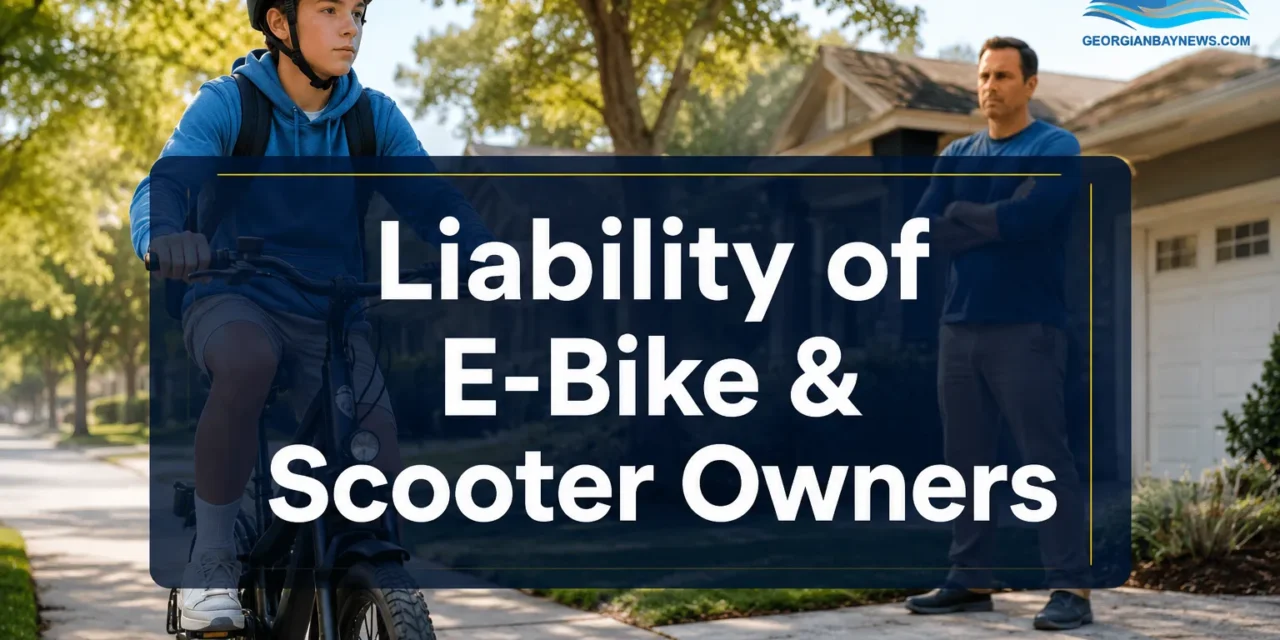
Parents in Ontario, across Canada, and in the United States can be held legally and financially responsible when their child causes an accident on an e-bike or scooter. The liability of e-bike and scooter owners extends beyond the rider to the adults who permitted, purchased, or supervised the activity. Understanding the rules before an accident happens is far cheaper than dealing with a lawsuit after.
If your child is injured on an e-bike, you as the parent may bear responsibility under a legal concept called parental negligence. Courts in Ontario and across the U.S. can find that a parent failed in their duty of care by allowing a child to ride a vehicle that was unsafe, too fast, or used without proper protective gear.
Key areas of parental responsibility include:
Common mistake: Many parents treat e-bikes like regular bicycles and assume no special rules apply. A Surron Light Bee, for example, can reach stock speeds of 80 km/h (50 mph), far beyond what Ontario’s e-bike rules permit on public roads. Allowing a child to ride one without understanding its legal classification is a significant liability risk.
For more on road safety topics in the region, see coverage of staying safe in Georgian Bay News.
Yes. Under both Canadian and U.S. law, parents can be sued when a minor child causes injury to a third party. In Ontario, the Parental Responsibility Act allows victims to sue parents directly for damages caused by a child’s intentional act. For negligent acts (like a collision), standard tort law applies and a court will assess whether the parent was negligent in supervising or equipping the child.
In the U.S., most states have parental liability statutes that cap damages, but civil suits beyond those caps are still possible under general negligence principles.
The liability of e-bike and scooter owners is not limited to the child. If you bought the vehicle, gave permission to ride it, or failed to enforce safety rules, you are exposed.
The minimum age varies by jurisdiction and by the type of vehicle.
| Jurisdiction | Standard E-Bike | High-Speed / Motorized |
|---|---|---|
| Ontario, Canada | 16 (no licence required) | Licence + registration required |
| British Columbia | 16 | Licence required above 32 km/h |
| Most U.S. States | 14-16 (Class 1/2) | 16+ with licence (Class 3 / moped) |
| Federal U.S. (CPSC) | No federal age minimum | State law governs |
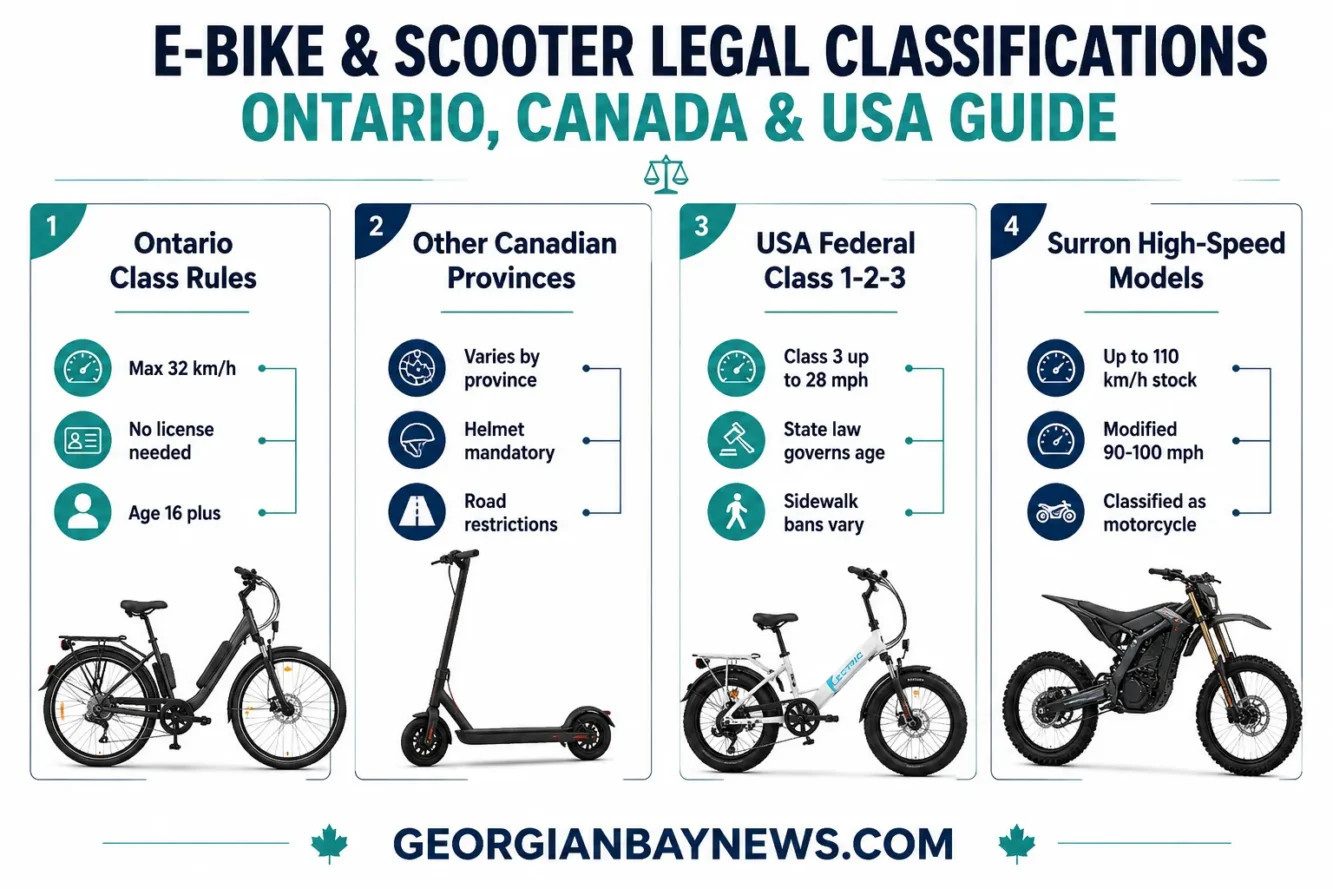
In Ontario, a standard e-bike must have a maximum speed of 32 km/h and a motor no larger than 500 watts. Any vehicle exceeding those limits, including most Surron models, is not legally an e-bike under the Highway Traffic Act. It is classified as a motor vehicle or motorcycle, requiring a licence, registration, and insurance.
The liability of e-bike and scooter owners escalates sharply when the vehicle involved is a high-performance model. Standard e-bikes carry moderate risk. High-speed models like the Surron Ultra Bee or Storm Bee, with stock speeds of 80-110 km/h and modified builds pushing 145-160 km/h (90-100 mph), carry risk comparable to a motorcycle accident.
Courts will consider:
A parent who purchases a modified Surron for a 14-year-old and allows unsupervised street riding faces potential civil liability for all damages, medical bills, lost income, and pain and suffering, with no cap in many jurisdictions.
For standard e-bikes in Ontario, insurance is not legally mandatory, but it is strongly advisable. For any e-bike that exceeds Ontario’s 32 km/h / 500W threshold, insurance is legally required because the vehicle is classified as a motor vehicle.
In the U.S., requirements vary by state and by e-bike class. Class 3 e-bikes (up to 28 mph / 45 km/h) may require registration and insurance in some states.
Options for parents:
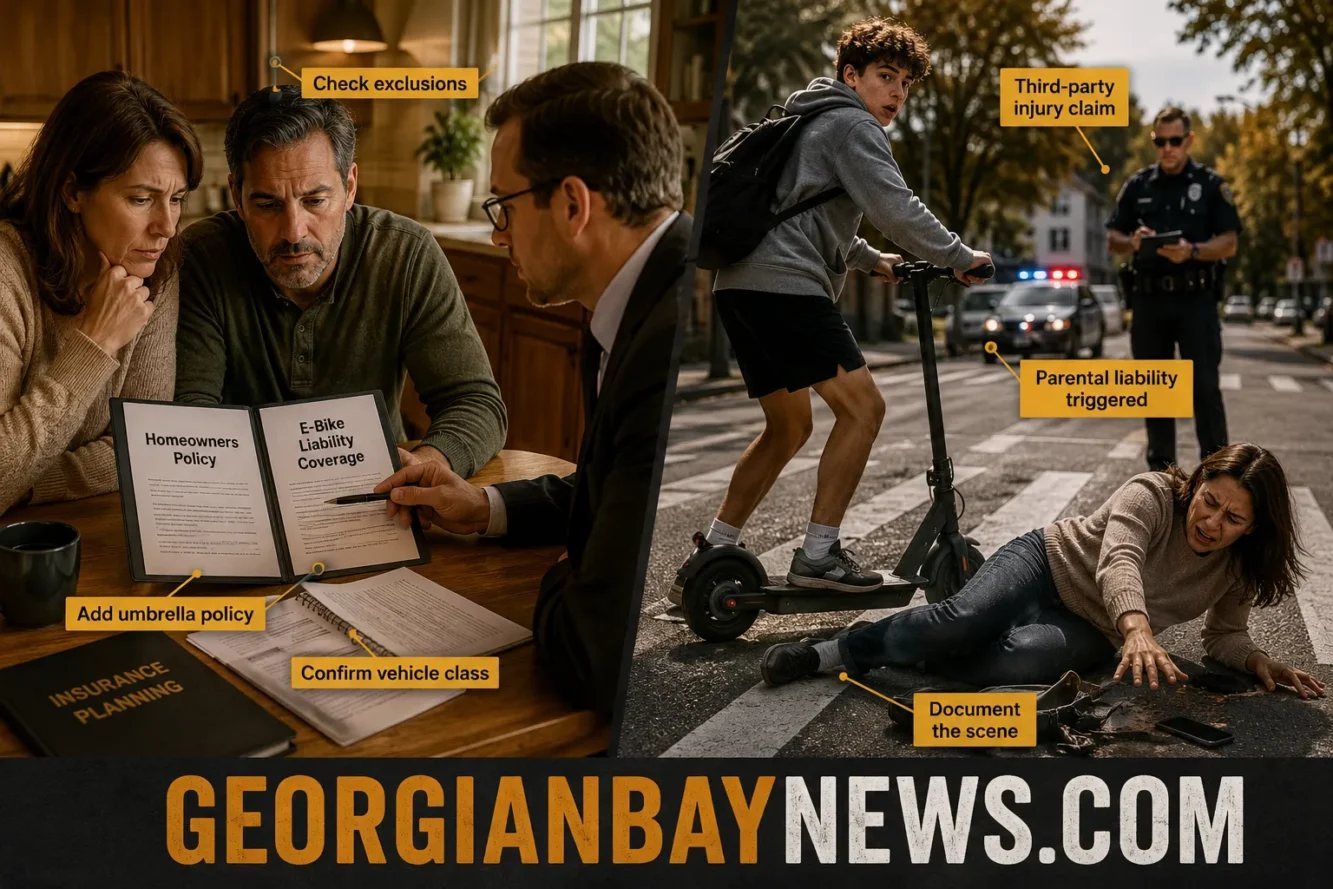
Homeowners insurance may cover some e-bike incidents, but most policies explicitly exclude motorized vehicles from liability coverage. A standard pedal-assist e-bike might fall under a policy’s personal liability section, but a Surron or any high-speed model almost certainly will not.
Steps to verify your coverage:
Do not assume. Assuming coverage and being wrong could mean paying a six-figure judgment out of pocket.
In Ontario, riders under 18 must wear an approved helmet by law. In many U.S. states, similar rules apply. Failing to comply with helmet laws does two things legally: it can result in a fine, and it can be used as evidence of contributory negligence in a civil lawsuit.
If your child is injured while not wearing a helmet, the opposing party’s lawyer will argue that the injury was worsened by the parent’s failure to enforce the law. This can reduce any damages your family recovers, or increase your exposure if your child injured someone else and the court views the overall situation as reckless supervision.
Bottom line: Helmets are not optional. They are a legal requirement and a liability shield.
Act immediately and methodically. The steps you take in the first 24 hours matter enormously for both the injured person’s welfare and your legal position.
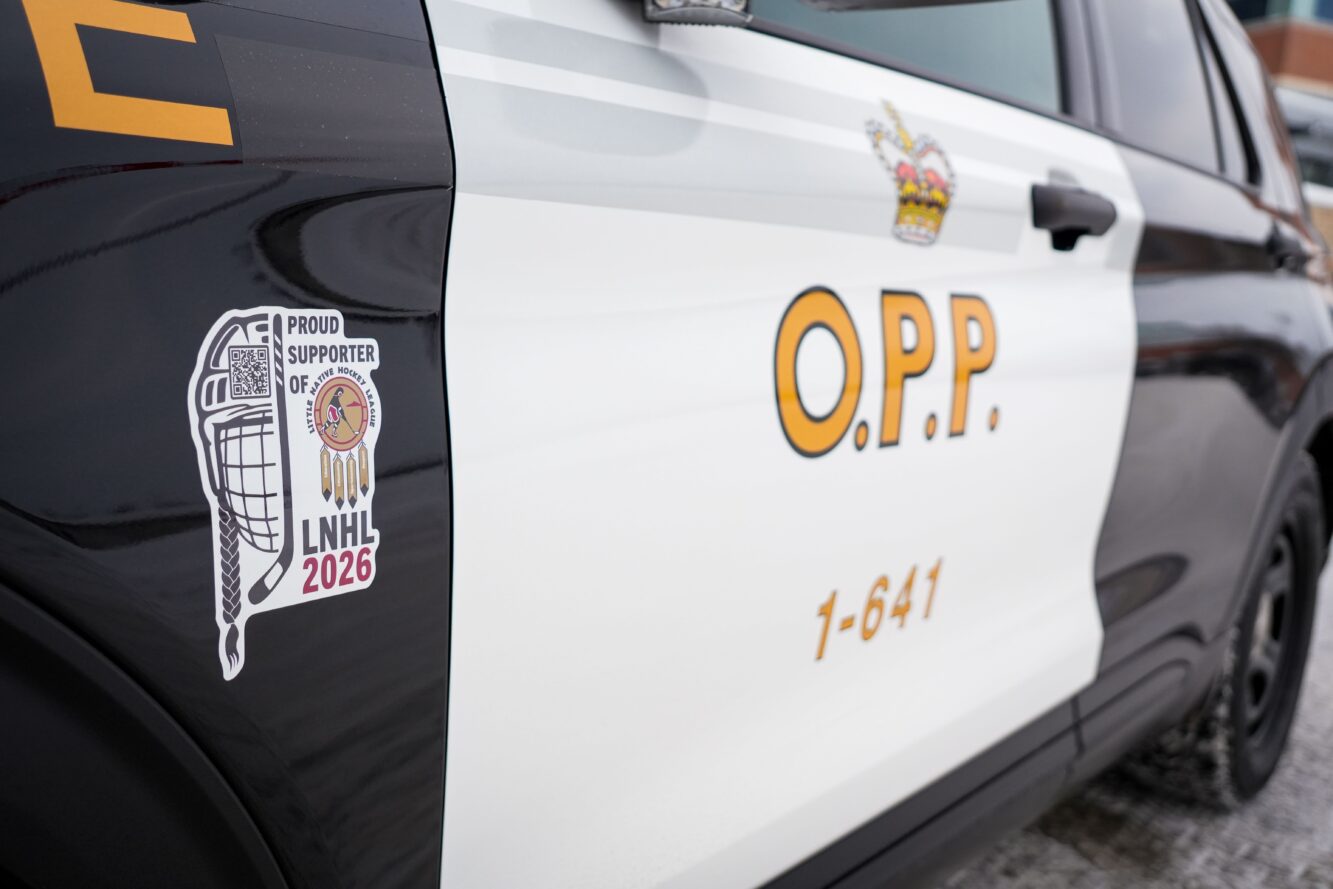
Local OPP involvement is likely for any serious injury. The Southern Georgian Bay OPP Detachment covers incidents in the region and will investigate accidents involving injury on public roads.
A regular bicycle is not a motor vehicle. If a child on a regular bike causes an accident, liability is assessed purely under negligence law, and the damages, while real, are typically lower because speeds are lower.
An e-bike changes the equation in three ways:
The liability of e-bike and scooter owners is therefore structurally different from bicycle liability, closer to moped or motorcycle liability for high-speed models.
Proactive steps reduce risk more effectively than reactive ones. Parents who follow these practices are in a far stronger legal position if an accident occurs.
For broader community safety perspectives, Georgian Bay News covers society topics including road safety and community responsibility.
The most costly mistakes tend to be the most avoidable ones.
The bikes coverage at Georgian Bay News tracks local cycling and e-bike developments, including regulatory changes that affect riders in the region.
Q: Can a parent be criminally charged if their child causes a serious e-bike accident?
In rare cases, yes. If a parent knowingly allowed a child to operate an unregistered, uninsured, high-speed vehicle and a fatality resulted, criminal negligence charges are possible under the Criminal Code of Canada or equivalent U.S. statutes.
Q: Are electric scooters (e-scooters) treated the same as e-bikes legally?
Not always. In Ontario, e-scooters are currently in a pilot program with specific rules. In many U.S. cities, e-scooters are regulated separately from e-bikes. Always check the specific rules for your municipality.
Q: Does my child need their own liability coverage?
Minors cannot hold insurance policies independently. Coverage must come through a parent’s homeowners, auto, or umbrella policy, or through a policy the parent purchases on the child’s behalf.
Q: What if the accident happens on private property?
Liability can still apply on private property if a third party is injured. Homeowners liability coverage is more likely to apply in this scenario, but verify with your insurer.
Q: Is a Surron legal for a teenager to ride in Ontario?
A stock Surron that exceeds 32 km/h or 500W is classified as a motor vehicle in Ontario, requiring a licence, registration, and insurance. Most Surron models exceed these thresholds. Riding one without meeting those requirements is illegal regardless of age.
Q: What if my child damages someone’s car or property with a scooter?
Property damage claims follow the same liability principles as injury claims. Your homeowners policy’s liability section may cover this if the vehicle qualifies, but verify before assuming.
Q: Do speed limit reductions in my area affect e-bike rules?
Local speed limit reductions can affect where certain e-bike classes are permitted to operate, particularly in school zones and residential areas. Check municipal bylaws.
Q: Can I be sued even if my child was following all the rules?
Yes. A lawsuit can be filed regardless of fault. Whether it succeeds depends on the evidence. Following all rules is your strongest defense, not a guarantee against being sued.
Q: Is there a difference between liability in Ontario versus other Canadian provinces?
Yes. Each province has its own Highway Traffic Act equivalent and e-bike regulations. British Columbia, Quebec, and Alberta each have distinct rules on speed limits, age, and licensing for e-bikes.
Q: What does an umbrella policy actually cover?
A personal umbrella policy provides liability coverage above and beyond your homeowners or auto policy limits. It typically covers bodily injury and property damage claims, including those arising from recreational vehicle incidents, subject to the policy’s exclusions.
The liability of e-bike and scooter owners is a serious, growing legal issue for families across Ontario, Canada, and the United States. As e-bikes become faster, more powerful, and more accessible, the gap between what parents assume and what the law actually requires has never been wider.
Actionable next steps for parents in 2026:
The cost of getting this right before an accident is a phone call and a policy premium. The cost of getting it wrong after an accident can be a lifetime of financial consequences.
Content, illustrations, and third-party video appearing on GEORGIANBAYNEWS.COM may be generated or curated with AI assistance or reproduced pursuant to the fair dealing provisions of the Copyright Act, R.S.C. 1985, c. C-42. Attribution and hyperlinks to original sources are provided in acknowledgment of applicable intellectual property rights. Such referencing is intended to direct traffic to and support the original rights holders’ platforms.