



















🇨🇦 Captain Ship Shepherd: Did Trump Order 5,000 Troops Into Iran? What the Evidence Actually Shows
Last updated: May 23, 2026
Quick Answer
No confirmed order was ever issued to send 5,000 troops into Iran. However, during Trump’s first term, the U.S. came dangerously close to open military conflict with Iran — and reports in late 2020 confirmed that Trump did ask advisors about military strike options against Iranian nuclear sites. The question of whether Trump ordered 5,000 troops into Iran reflects a very real pattern of aggressive military posturing that alarmed allies and military experts alike.
Key Takeaways
- No verified order to deploy 5,000 ground troops into Iran was ever confirmed by the Pentagon or credible news sources.
- Trump’s administration killed Iranian General Qasem Soleimani in January 2020, bringing the U.S. to the edge of war.
- Iran retaliated with ballistic missile strikes on U.S. bases in Iraq, injuring over 100 American troops.
- Trump reportedly asked senior advisors in November 2020 about options for striking Iranian nuclear facilities (reported by The New York Times, 2020).
- Congress repeatedly pushed back on Trump’s Iran military posturing, citing the War Powers Act.
- U.S. allies, including NATO members, refused to support military escalation against Iran.
- Military experts warned that any ground troop deployment into Iran would trigger a regional war.
- As of 2026, U.S. forces remain stationed in the broader Middle East region, including in Iraq and the Persian Gulf.
Did Trump Actually Send Troops to Iran in 2020?
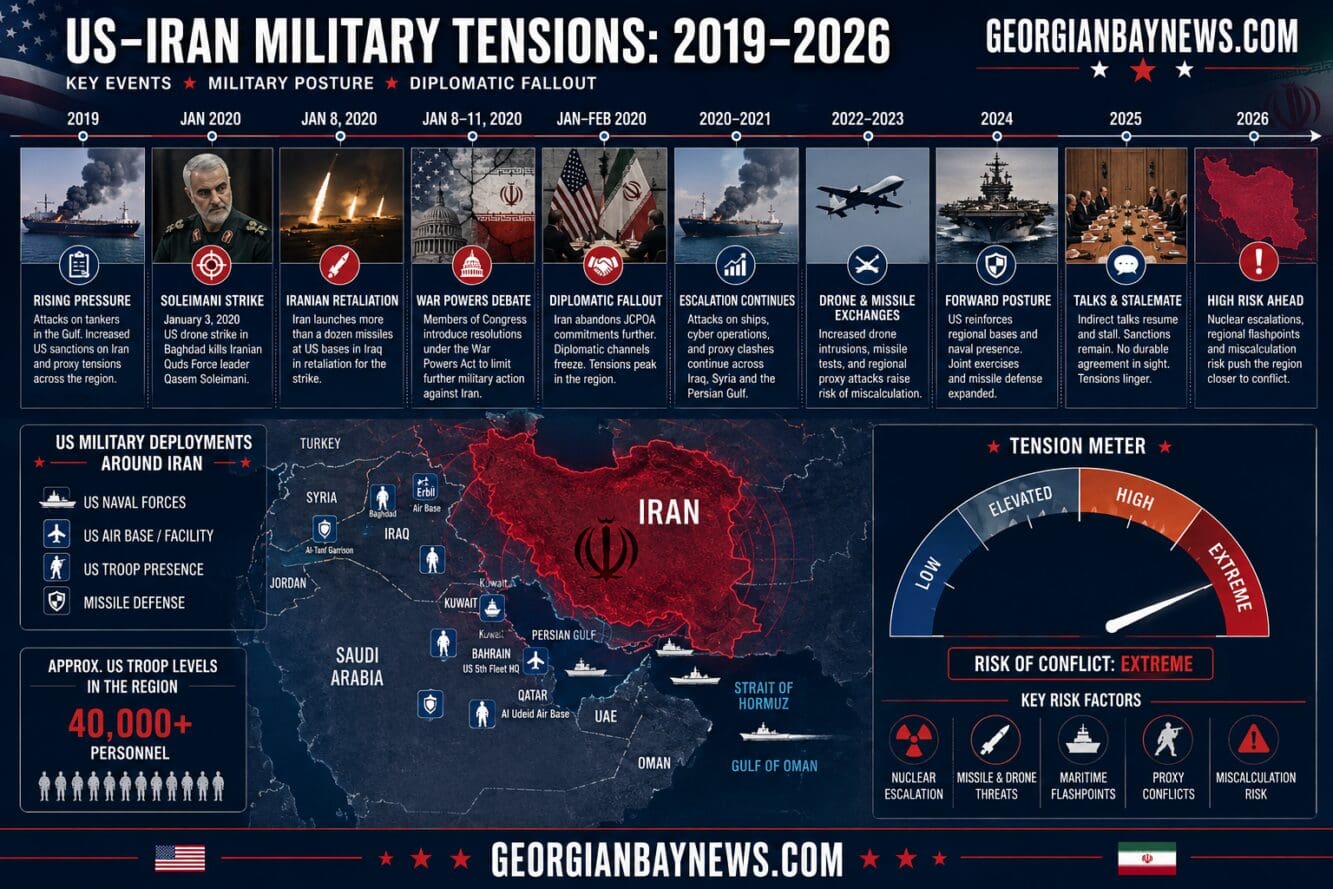
No, Trump did not send troops into Iran in 2020. What did happen was a dramatic escalation: the U.S. killed Iran’s top military commander, Qasem Soleimani, in a drone strike near Baghdad’s airport on January 3, 2020. This was not a troop deployment into Iran — it was a targeted assassination on Iraqi soil.
Following the strike, Trump authorized the deployment of roughly 3,500 additional troops to the Middle East as a defensive measure, according to reporting by The Associated Press (2020). These troops were sent to Kuwait and the broader Gulf region — not into Iran.
Common mistake: Many people conflate troop movements near Iran with troops being sent into Iran. These are very different military actions with very different legal and strategic implications.
How Close Did Trump Come to Military Conflict with Iran?
Extremely close — closer than most people realize. The New York Times reported in November 2020 that Trump asked senior military and intelligence advisors whether he had options to strike Iran’s main nuclear enrichment facility at Natanz. Advisors, including Vice President Pence and Secretary of State Pompeo, reportedly talked him out of it, warning the action could lead to a broader regional war.
Key escalation moments during Trump’s presidency:
- June 2019: Iran shot down a U.S. surveillance drone. Trump approved retaliatory strikes, then pulled back with 10 minutes to spare, later saying he was told 150 Iranians would die.
- January 2020: Soleimani assassination. Iran launched 16 ballistic missiles at U.S. bases in Iraq.
- November 2020: Trump asked about striking Natanz nuclear site. Advisors urged restraint.
“The United States came closer to war with Iran during the Trump years than at any point since the 1979 hostage crisis.” — Assessment widely shared by foreign policy analysts, 2020–2021.
For more context on military escalation and states of emergency that shaped this period, the broader geopolitical picture matters deeply.
Why Would Trump Consider Sending Troops to Iran?
Trump’s Iran policy was driven by a “maximum pressure” strategy — heavy sanctions, military threats, and withdrawal from the 2015 nuclear deal (JCPOA) — aimed at forcing Iran to renegotiate terms more favorable to the U.S. and Israel.
Reasons cited by the Trump administration for aggressive posturing:
- Iran’s continued uranium enrichment beyond JCPOA limits
- Iranian support for proxy militias in Iraq, Syria, Lebanon, and Yemen
- Iran’s ballistic missile program
- Domestic political pressure to appear tough on perceived adversaries
The problem: Maximum pressure without a diplomatic off-ramp pushed Iran to accelerate its nuclear program rather than abandon it. By 2021, Iran was enriching uranium to 60% purity — well above the 3.67% limit set by the JCPOA. This is a direct consequence of the policy’s failure to produce results.
Are U.S. Troops Currently Near Iran in 2026?
Yes. As of 2026, the U.S. maintains a significant military presence in the broader region, including:
- Approximately 2,500 troops in Iraq
- Naval assets in the Persian Gulf and the Strait of Hormuz
- Air Force assets at bases in Qatar and Bahrain
These forces are not in Iran, but they are positioned close enough that any miscalculation could escalate rapidly. The FBI and intelligence agencies have also flagged ongoing Iranian-linked threats on U.S. soil, adding another layer of tension to the relationship.
What Would Happen If U.S. Troops Went Into Iran?
Military experts are nearly unanimous: a ground troop deployment into Iran would be catastrophic. Iran has a population of roughly 88 million people, a large standing army, and an extensive network of proxy forces across the Middle East.
Likely consequences, according to defense analysts:
Risk FactorLikely OutcomeIranian military responseFull-scale conventional warfareProxy militia activationAttacks on U.S. forces across Iraq, Syria, LebanonStrait of Hormuz closureGlobal oil supply disruption, price spikeRegional spilloverIsrael, Saudi Arabia, Gulf states drawn inInternational condemnationNear-universal diplomatic isolation of the U.S.
No NATO ally has indicated willingness to participate in a ground war against Iran. The lack of international support for such action is not a minor detail — it’s a fundamental strategic problem.
What International Laws Govern Troop Movements Near Iran?
Under international law, deploying troops into a sovereign nation without its consent or a UN Security Council mandate constitutes an act of war. The UN Charter, Article 2(4), prohibits the threat or use of force against the territorial integrity of any state.
Any U.S. military action inside Iran would also trigger the U.S. War Powers Resolution of 1973, which requires the President to notify Congress within 48 hours of committing armed forces to hostilities and limits unauthorized military engagement to 60 days.
Congress has been deeply divided on this issue, with some members arguing that Trump’s 2020 actions already violated the War Powers Act.
How Did Congress React to Potential Iran Military Action?
Congress pushed back hard. In January 2020, the House passed a War Powers Resolution directing Trump to end military operations against Iran without congressional approval. The Senate also debated similar measures, though a binding resolution failed to pass with a veto-proof majority.
Key congressional reactions:
- House Resolution (January 2020): Passed 224–194, largely along party lines, directing Trump to cease Iran hostilities without congressional approval.
- Senate debate: Several Republican senators, including Mike Lee and Rand Paul, broke with Trump and supported limiting his Iran war powers.
- Briefings controversy: Senators from both parties described a classified briefing on the Soleimani strike as “insulting” and lacking in legal justification.
The speech Trump gave justifying the Soleimani strike was widely criticized for overstating the imminence of the threat Soleimani posed.
How Did Iran Respond to U.S. Military Threats?
Iran responded with a combination of direct military action, proxy escalation, and nuclear acceleration. After the Soleimani killing, Iran fired 16 ballistic missiles at two U.S. bases in Iraq — Al-Asad and Erbil — on January 8, 2020. Over 100 U.S. service members were later diagnosed with traumatic brain injuries from the blasts.
Iran also:
- Accelerated uranium enrichment, reaching 60% purity by 2021
- Increased support for Houthi rebels in Yemen, who attacked Saudi oil infrastructure
- Activated proxy groups to target U.S. contractors in Iraq
Iran’s message was clear: military pressure would not produce concessions — it would produce escalation. This is a pattern that business and geopolitical risk analysts flagged repeatedly as a fundamental flaw in the maximum pressure strategy.
Was There Real Risk of War Between the U.S. and Iran?
Yes — and that risk has not fully disappeared. The combination of the Soleimani assassination, Iran’s missile retaliation, and Trump’s reported interest in striking Natanz placed the two countries closer to direct war than at any point in decades.
The risk was real for several reasons:
- Both sides had demonstrated willingness to use lethal force
- Miscalculation in a high-tension environment is historically common
- Iran’s proxy network created multiple potential flashpoints simultaneously
- Trump’s decision-making style — impulsive, advisor-resistant — increased unpredictability
The question of whether Trump ordered 5,000 troops into Iran may not have a “yes” answer today, but the conditions that could produce such an order have not been permanently resolved.
What Stopped Trump from Sending Troops to Iran?
A combination of advisor pushback, military caution, and political reality. When Trump asked about striking Natanz in November 2020, senior advisors — including the Chairman of the Joint Chiefs, General Mark Milley — reportedly warned that such action risked triggering a wider war. Milley, according to multiple reports, was deeply concerned about Trump’s Iran impulses in the final weeks of his first term.
Additional factors that prevented escalation:
- No allied support: No major U.S. ally was willing to join a military campaign against Iran
- Congressional resistance: Bipartisan opposition to unauthorized military action
- Military advice: Pentagon leadership consistently warned against ground operations
- Public opinion: American public showed little appetite for another Middle East ground war after Iraq and Afghanistan
The states of emergency and domestic pressures Trump faced in late 2020 also divided his attention and political capital.
How Do Military Experts View Potential Iran Troop Deployment?
Uniformly negative. No serious military analyst or former senior commander has publicly advocated for a ground troop deployment into Iran. The consensus view is that such an operation would be strategically disastrous.
Former Defense Secretary James Mattis, who served under Trump before resigning, repeatedly cautioned against military adventurism in Iran. His departure from the administration in 2018 was partly driven by disagreements over exactly this kind of impulsive decision-making.
The broader concern among experts: Trump’s foreign policy decisions — from withdrawing from the JCPOA to the Soleimani strike — consistently lacked the international coalition-building that makes military pressure effective. Acting unilaterally, without allies, without a diplomatic strategy, and without clear objectives is a formula for strategic failure. For ongoing coverage of related strike Iran developments, staying informed is essential.
Conclusion: What Should Readers Do With This Information?
The question of whether Trump ordered 5,000 troops into Iran does not have a simple “yes” answer — but the underlying concern is entirely legitimate. The U.S. came genuinely close to open war with Iran during Trump’s presidency, and the structural conditions that created that risk remain in place.
Actionable steps for informed citizens:
- Follow credible sources — Track reporting from established outlets and think tanks like the Council on Foreign Relations or the Brookings Institution on U.S.-Iran relations.
- Contact elected representatives — If you believe Congress should have a stronger role in authorizing military action, the War Powers Act debate is the right place to focus that advocacy.
- Understand the stakes — A military conflict with Iran would affect global oil prices, regional stability, and American lives. Staying informed is not optional.
- Demand diplomatic accountability — Push for coverage and political attention on diplomatic alternatives to military escalation.
- Stay skeptical of escalatory rhetoric — Whether it comes from Washington or Tehran, inflammatory statements about military action deserve scrutiny, not amplification.
The world does not need another Middle East ground war. The evidence suggests that most military experts, most U.S. allies, and most Americans agree. The challenge is ensuring that agreement translates into policy.
FAQ
Q: Did Trump order 5,000 troops into Iran?
No confirmed order was ever issued. Reports indicate Trump asked advisors about military strike options against Iran, but no ground troop deployment into Iran was ordered or executed.
Q: How many troops did Trump send to the Middle East after the Soleimani strike?
Approximately 3,500 additional U.S. troops were deployed to Kuwait and the broader Gulf region following the January 2020 Soleimani assassination, according to AP reporting.
Q: Did Iran attack U.S. troops after Soleimani was killed?
Yes. Iran launched 16 ballistic missiles at U.S. bases in Iraq on January 8, 2020. Over 100 U.S. service members were later diagnosed with traumatic brain injuries.
Q: What is the War Powers Act and how does it apply to Iran?
The War Powers Resolution of 1973 requires the President to notify Congress within 48 hours of committing forces to hostilities and limits unauthorized engagement to 60 days. Any Iran troop deployment would trigger this law.
Q: Did any U.S. allies support military action against Iran?
No major U.S. ally publicly supported military action against Iran during the Trump years. NATO allies and Gulf states urged de-escalation.
Q: Why did Trump pull back from striking Iran in June 2019?
Trump reportedly approved retaliatory strikes after Iran downed a U.S. drone, then called them off with 10 minutes to spare, stating he was told approximately 150 Iranians would be killed — a toll he described as disproportionate.
Q: Is Iran currently a nuclear threat?
As of 2026, Iran has enriched uranium to levels well above JCPOA limits. It is not confirmed to possess a nuclear weapon, but its enrichment capacity has grown significantly since the U.S. withdrew from the nuclear deal in 2018.
Q: What did Congress do about Trump’s Iran military actions?
The House passed a War Powers Resolution in January 2020 directing Trump to cease Iran hostilities without congressional approval. The Senate debated similar measures, with some Republicans joining Democrats in opposition.
Q: How do military experts assess the risk of sending troops into Iran?
Uniformly negative. Experts warn it would trigger a regional war, activate Iranian proxy networks across the Middle East, and close the Strait of Hormuz — disrupting global oil supplies.
References
- The New York Times — “Trump Sought Options for Attacking Iran to Stop Its Growing Nuclear Program” (2020) — https://www.nytimes.com/2020/11/16/us/politics/trump-iran-nuclear.html
- The Associated Press — “US sends 3,500 more troops to Middle East after Iran strike” (2020)
- U.S. House of Representatives — War Powers Resolution on Iran (January 2020)
- Council on Foreign Relations — “U.S.-Iran Relations” background brief (2021)
- The Washington Post — “Iran fires more than a dozen ballistic missiles at US forces in Iraq” (2020)
Content, illustrations, and third-party video appearing on GEORGIANBAYNEWS.COM may be generated or curated with AI assistance or reproduced pursuant to the fair dealing provisions of the Copyright Act, R.S.C. 1985, c. C-42. Attribution and hyperlinks to original sources are provided in acknowledgment of applicable intellectual property rights. Such referencing is intended to direct traffic to and support the original rights holders’ platforms.