










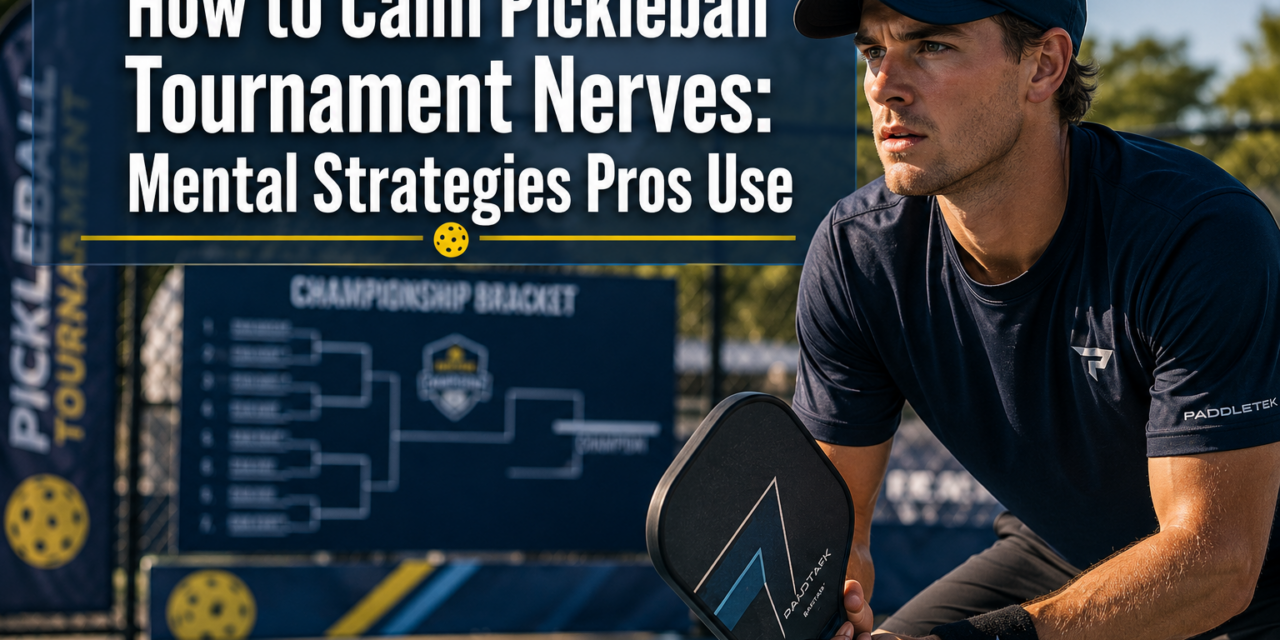
🧠 How to Calm Pickleball Tournament Nerves: Mental Strategies Pros Use That Rec Players Can Steal
Last updated: May 25, 2026
Quick Answer
Tournament nerves affect 70-80% of recreational pickleball players, but professional athletes use specific mental techniques that anyone can adopt. The most effective strategies include controlled breathing patterns (4-7-8 technique), pre-match routines that trigger focus, and process-oriented thinking that shifts attention away from outcomes. These methods work because they address the physiological stress response while building mental resilience through practice.
Key Takeaways
- Pre-match routines create psychological anchors that signal your brain to enter performance mode, reducing anxiety before you step on the court
- Box breathing (4-7-8 pattern) activates the parasympathetic nervous system, lowering heart rate and cortisol within 90 seconds
- Process goals (focus on shot execution) outperform outcome goals (focus on winning) for managing competitive stress
- Stress inoculation training during practice—adding scoring and pressure scenarios—builds tolerance for tournament conditions
- Physical tension release between points (letting your paddle arm hang loose) prevents accumulated stress from affecting shot quality
- Visualization practice 15-30 minutes before matches primes neural pathways for confident execution
- Positive self-talk must be specific and action-oriented rather than generic encouragement
- Normal pre-tournament nerves improve performance up to a point; debilitating anxiety requires different intervention
- Mental toughness development typically requires 8-12 weeks of consistent practice with pressure simulation
- Strategic timeouts serve as mental reset tools, not just physical breaks
What Causes Pickleball Tournament Anxiety
Tournament anxiety stems from three primary sources: fear of judgment from peers and spectators, pressure to validate practice effort through results, and the physiological stress response triggered by competitive environments. The amygdala interprets tournament settings as threats, releasing cortisol and adrenaline that create the familiar symptoms of nervousness.
For recreational players, social anxiety often outweighs performance concerns. The fear of letting down a partner in doubles play or appearing less skilled than expected creates additional mental load. Physical symptoms include:
- Increased heart rate and rapid breathing
- Muscle tension, especially in shoulders and grip hand
- Digestive discomfort or nausea
- Mental fog or difficulty making tactical decisions
- Sweaty palms affecting paddle grip
Common trigger: The 10-15 minutes before your first match of the day produces peak anxiety because your nervous system hasn’t yet calibrated to the competitive environment. Once you complete a few points, symptoms typically decrease as your brain recognizes the situation as manageable rather than threatening.
Are Pre-Tournament Nerves Normal for Amateur Players
Yes, pre-tournament nerves are completely normal and experienced by 70-80% of recreational players regardless of skill level. The difference between amateur and professional players isn’t the absence of nerves but rather how they interpret and manage those sensations.
Pros reframe nervousness as excitement and readiness rather than fear. This cognitive shift—called anxiety reappraisal—changes how the body responds to the same physiological signals. When you tell yourself “I’m excited” instead of “I’m anxious,” your performance improves because your brain interprets arousal as positive preparation.
Key distinction: Healthy nerves create alertness and focus. You should feel energized and slightly on edge. Debilitating anxiety, however, causes avoidance behaviors (wanting to withdraw from the tournament), persistent negative thoughts that interfere with sleep, or physical symptoms that don’t decrease after the first few points.
Choose to embrace mild nervousness—it means you care about your performance and your body is preparing for peak effort.
How Do Pro Pickleball Players Stay Calm Under Pressure
Professional pickleball players use systematic mental preparation that recreational players can replicate. The core strategy involves establishing control over controllable elements while accepting uncertainty about outcomes [4].
Three pillars pros rely on:
- Routine consistency: Pros perform identical pre-serve rituals (number of ball bounces, breathing pattern, visual focus point) that create predictability and trigger trained responses
- Present-moment focus: Attention stays on the current point rather than score implications, using cues like “watch the ball” or “stay low”
- Emotional regulation: Quick reset protocols after errors prevent negative spirals—many pros use a physical gesture (adjusting their hat, tapping their paddle) to signal mental reset
Top players also practice mindfulness meditation regularly, which strengthens the ability to notice anxious thoughts without being controlled by them [2]. This metacognitive awareness—recognizing “I’m having the thought that I might lose” rather than “I’m going to lose”—creates psychological distance from performance anxiety.
Breathing Techniques for Reducing Sports Performance Stress
Controlled breathing directly counteracts the stress response by activating the vagus nerve, which signals safety to your nervous system. The most effective technique for tournament settings is the 4-7-8 pattern: inhale through your nose for 4 counts, hold for 7 counts, exhale through your mouth for 8 counts [7].
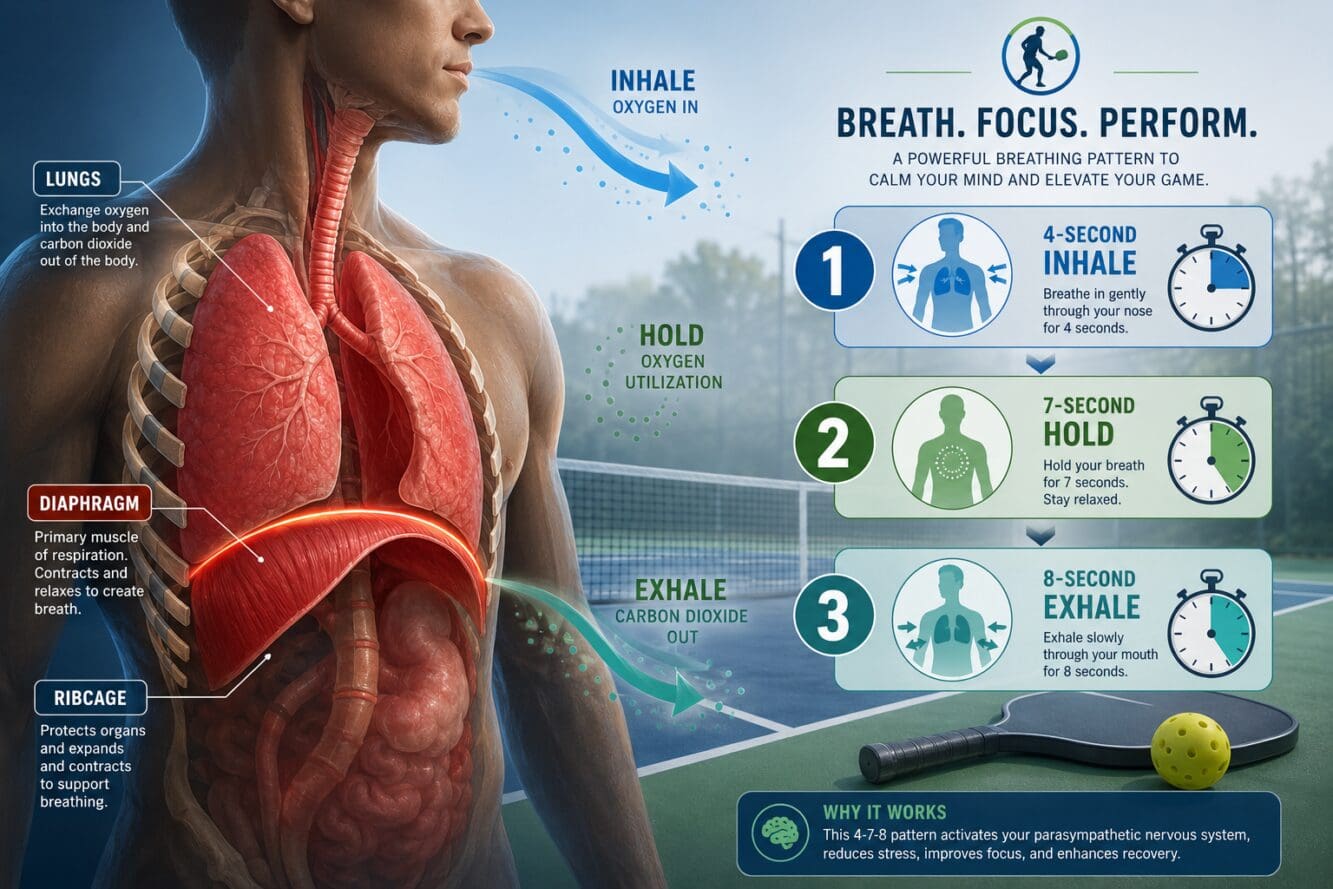
Why this works: The extended exhale activates the parasympathetic nervous system, lowering heart rate and blood pressure within 60-90 seconds. The breath hold increases CO2 tolerance, which reduces the sensation of breathlessness under pressure.
When to use breathing techniques:
- 10 minutes before match start: Complete 5-7 cycles to establish baseline calm
- During timeouts: 2-3 cycles to reset between games
- After errors: One deep exhale before the next serve to prevent tension accumulation
- Before crucial points: Single deep breath during the 10-second serve window
Common mistake: Breathing too rapidly or shallowly, which maintains chest breathing and keeps the stress response active. Focus on belly breathing where your abdomen expands on inhale—this ensures diaphragmatic engagement.
Alternative pattern: Box breathing (4 counts in, 4 hold, 4 out, 4 hold) works well for players who find the 4-7-8 pattern too challenging initially.
Mental Visualization Tricks for Pickleball Tournaments
Visualization primes your motor cortex and builds confidence by mentally rehearsing successful execution before physical performance. Effective visualization includes sensory details (the sound of ball contact, the feel of paddle grip, the visual of ball trajectory) rather than just watching yourself play [1].
Three-step visualization protocol:
- Scenario rehearsal (15 minutes pre-match): Mentally walk through 5-7 common situations (returning serve, kitchen line exchanges, overhead smashes) and visualize yourself executing with perfect form and confident decision-making
- Opponent adaptation: Visualize adjusting to different playing styles—hard hitters, soft game players, lobbers—so your brain has pre-loaded response patterns
- Adversity practice: Mentally rehearse coming back from being down 5-2, or recovering after a double fault, so these situations feel familiar rather than catastrophic
Pro technique: Combine visualization with physical micro-movements. While visualizing a forehand dink, make small paddle movements with your hand. This motor imagery strengthens neural pathways more effectively than pure mental rehearsal.
Choose first-person perspective (seeing through your own eyes) rather than third-person (watching yourself from outside) for motor skill visualization. Research shows first-person creates stronger performance transfer.
Difference Between Healthy Tournament Nerves and Debilitating Anxiety
Healthy nerves enhance performance through increased alertness and energy, while debilitating anxiety impairs decision-making and motor control. The distinction lies in intensity, duration, and functional impact.
Healthy nerves:
- Butterflies in stomach that settle after 2-3 points
- Slight muscle tension that increases readiness
- Racing thoughts that focus on strategy and execution
- Symptoms decrease once competition begins
Debilitating anxiety:
- Persistent worry that interferes with sleep 24+ hours before tournament
- Physical symptoms (nausea, dizziness, trembling) that don’t improve during play
- Catastrophic thinking (“I’ll embarrass myself,” “Everyone will judge me”)
- Avoidance urges or consideration of withdrawing
Threshold indicator: If anxiety prevents you from executing skills you perform easily in practice, or if symptoms persist beyond the first game, you’ve crossed into debilitating territory. At this point, cognitive-behavioral techniques or consultation with a sports psychologist becomes valuable rather than optional.
For recreational players, the Yerkes-Dodson law applies: moderate arousal optimizes performance, while too little or too much impairs it. Your goal isn’t zero nerves—it’s finding your optimal activation zone.
What Physical Symptoms Indicate Tournament Stress Is Too High
Excessive tournament stress manifests through specific physical markers that signal your nervous system has moved from optimal arousal into fight-or-flight overdrive. Recognizing these symptoms early allows intervention before performance deteriorates significantly.
Red flag symptoms:
- Grip tension: White knuckles or hand cramping from over-gripping the paddle
- Shallow rapid breathing: Chest breathing at 20+ breaths per minute (normal is 12-16)
- Visual narrowing: Tunnel vision where peripheral awareness disappears
- Muscle rigidity: Shoulders elevated toward ears, locked knees, stiff movement
- Coordination loss: Unforced errors on routine shots you make 90% of the time in practice
- Decision paralysis: Hesitation or second-guessing on shot selection
Immediate interventions when symptoms appear:
- Take your paddle out of your dominant hand and shake your arm loosely for 10-15 seconds [7]
- Execute one complete 4-7-8 breath cycle
- Look at a distant object beyond the court to reset visual focus
- Use a verbal cue (“reset” or “breathe”) to interrupt the stress spiral
When to use a timeout: If symptoms persist for three consecutive points, call a timeout even if you’re winning. The strategic pause prevents cumulative stress from snowballing into complete performance collapse.
How to Calm Pickleball Tournament Nerves: Practice-Based Mental Strategies
The gap between practice performance and tournament performance narrows when you deliberately introduce pressure into training sessions. Stress inoculation training—gradually exposing yourself to competitive stress in controlled doses—builds mental resilience more effectively than any pre-match ritual [4].
Pressure simulation methods:
- Scoring consequences: Every drill includes scoring with penalties (burpees, sprints) for losing
- Audience practice: Invite friends to watch practice matches and provide commentary
- Tournament simulation: Play practice matches with bracket format, keeping score publicly on a whiteboard
- Time pressure: Add shot clocks or serve timers to create urgency
- Fatigue training: Practice decision-making when physically tired (end of session) to simulate late-tournament conditions
Progressive exposure: Start with low-stakes pressure (practice games with friends) and gradually increase intensity (club tournaments, then regional events). Each exposure teaches your nervous system that competitive stress is manageable, reducing the threat response over time.
Mistake recovery drills: Deliberately create errors during practice, then immediately execute the next shot with full commitment. This trains the mental reset skill that prevents one mistake from cascading into multiple errors.
Developing a Pre-Match Routine to Manage Tournament Nerves
A consistent pre-match routine creates psychological predictability that reduces anxiety by giving your brain a familiar sequence to follow. Professional players use routines lasting 60-90 minutes that address physical, mental, and tactical preparation [1].
Effective pre-match routine structure:
90 minutes before: Light meal (easily digestible carbs and protein) with hydration
60 minutes before: Dynamic stretching sequence (same exercises, same order every time)
45 minutes before: Light practice rallies focusing on rhythm rather than power (10-15 minutes)
30 minutes before: Visualization session (15 minutes) reviewing key situations and successful execution
15 minutes before: Breathing exercises (5 minutes) followed by tactical review with partner
5 minutes before: Physical activation (jumping jacks, practice swings) to match arousal level to competition demands
At court: Three-part ritual before first serve: bounce ball twice, take one deep breath, focus eyes on target zone
Why routines work: They occupy working memory with procedural tasks, leaving less cognitive capacity for anxious rumination. The routine becomes a psychological anchor—when you execute the familiar sequence, your brain recognizes “this is what we do before performing well.”
Common mistake: Creating overly complex routines that add stress if disrupted. Keep it simple enough that you can execute even if tournament scheduling runs late or warm-up time is limited.
Focus Strategies: Process Over Outcome Thinking
Shifting attention from results (winning, rating points, avoiding embarrassment) to process (shot execution, positioning, strategy implementation) dramatically reduces performance anxiety. Process goals are controllable; outcome goals depend partly on opponent performance and luck [5].
Process-focused self-talk examples:
- Instead of “I need to win this point” → “Stay low and watch the ball”
- Instead of “Don’t double fault” → “Smooth motion, target the backhand”
- Instead of “We’re losing” → “Move my feet and get to the kitchen line”
Implementation technique: Identify 3-5 process cues before the match that represent optimal execution for your game. Write them on your water bottle or paddle cover. Between points, glance at these cues to redirect attention from score to execution.
The paradox: When you stop trying to control outcomes and focus exclusively on process, outcomes typically improve because anxiety no longer interferes with skill execution. Your practice-level ability emerges when your mind isn’t cluttered with result-oriented worry.
Post-point reset ritual: After each point (won or lost), physically turn toward the baseline or your partner. This kinesthetic cue signals mental reset and prevents dwelling on the previous point [7]. The best players have amnesia—they genuinely don’t remember the last point once it’s over.
How Long Does It Take to Build Mental Toughness in Pickleball
Mental toughness development follows a predictable timeline, though individual variation exists based on baseline anxiety levels and practice consistency. Most recreational players see measurable improvement in 8-12 weeks of deliberate mental skills training combined with pressure exposure [5].
Development phases:
Weeks 1-3: Learning phase where you practice breathing techniques, visualization, and self-talk in low-pressure settings (recreational play). Skills feel awkward and require conscious effort.
Weeks 4-6: Integration phase where mental skills become more automatic. You begin applying techniques in practice matches and notice reduced anxiety in familiar competitive situations.
Weeks 7-9: Transfer phase where skills work in actual tournaments, though not consistently. You’ll have breakthrough moments of calm execution mixed with relapses to old anxiety patterns.
Weeks 10-12: Consolidation phase where mental skills become reliable even under high pressure. Tournament performance begins matching practice performance more consistently.
Maintenance: Mental toughness requires ongoing practice. Even pros continue daily mental training (meditation, visualization) to maintain their psychological edge.
Accelerators: Working with a sports psychology coach, maintaining a performance journal to track mental patterns, and seeking progressively challenging competitive experiences all speed development.
Realistic expectation: You won’t eliminate nerves entirely—nor should you want to. The goal is managing nerves so they enhance rather than impair performance, and developing quick recovery when anxiety spikes.
Cheap Ways to Work With a Sports Psychology Coach for Pickleball
Professional sports psychology coaching typically costs $100-200 per session, but affordable alternatives exist for recreational players seeking mental game improvement.
Budget-friendly options:
Online group coaching ($20-50/month): Many sports psychologists offer group programs via Zoom where multiple athletes learn mental skills together. Less individualized but covers core techniques effectively.
Mental performance apps ($10-15/month):
- Headspace or Calm for meditation fundamentals
- Champion’s Mind for sport-specific mental training
- Mindfulness Coach (free, from VA) for anxiety management
University sport psychology programs (free-$25/session): Graduate students in sport psychology programs need supervised practice hours. Contact local university psychology departments to inquire about low-cost clinics.
Books and self-guided programs ($15-30 one-time): “The Inner Game of Tennis” by Timothy Gallwey and “10-Minute Toughness” by Jason Selk provide structured mental training programs you can implement independently.
Pickleball-specific resources: Some pickleball coaching platforms include mental game content as part of broader skill development subscriptions ($20-40/month).
DIY approach: Create accountability by partnering with another player to practice mental skills together. Share visualization scripts, practice pressure drills, and debrief mental performance after tournaments.
When to invest in individual coaching: If anxiety prevents tournament participation entirely, causes panic attacks, or persists despite self-guided efforts for 3+ months, individual professional support becomes worthwhile.
Common Mental Mistakes Recreational Pickleball Players Make in Tournaments
Recreational players repeatedly make predictable mental errors that compound tournament stress. Recognizing these patterns allows targeted correction.
Top mental mistakes:
1. Catastrophizing single errors: Treating one missed shot as evidence of complete failure rather than normal variance. Fix: Develop a 10-second rule—you get 10 seconds to feel frustrated, then mandatory mental reset.
2. Comparing yourself to others: Watching other matches and feeling inadequate about your skill level. Fix: Focus exclusively on your court and your process during tournament days.
3. Apologizing excessively to partners: Constant “sorry” after errors increases anxiety for both players. Fix: Replace apologies with “next point” or “shake it off” to maintain forward focus.
4. Outcome fixation during matches: Checking the score constantly and calculating what needs to happen to win. Fix: Designate your partner as score-keeper so you can focus purely on execution.
5. Neglecting physical fundamentals: Skipping meals, inadequate hydration, or insufficient sleep before tournaments. Fix: Treat physical preparation as non-negotiable mental performance support [6].
6. Rigid game plans: Refusing to adjust strategy when it’s clearly not working. Fix: Build “if-then” contingencies into pre-match planning (if strategy A fails after 5 points, switch to strategy B).
7. Social comparison anxiety: Worrying about who’s watching or what others think of your play. Fix: Reframe spectators as supporters rather than judges—most are focused on their own matches anyway.
8. Ignoring warm-up quality: Treating warm-up as obligation rather than mental preparation. Fix: Use warm-up to establish rhythm, confidence, and connection with your body’s current state.
Frequently Asked Questions
What should I eat before a pickleball tournament to help with nerves?
Eat easily digestible carbohydrates with moderate protein 90-120 minutes before play—examples include oatmeal with banana, whole grain toast with peanut butter, or a smoothie with fruit and protein powder. Avoid high-fat or high-fiber foods that can cause digestive discomfort, which amplifies anxiety sensations.
Can meditation apps really help with tournament performance?
Yes, meditation apps that teach mindfulness skills (Headspace, Calm, Insight Timer) improve emotional regulation and attention control when used consistently for 10-15 minutes daily over 4-8 weeks. The skill transfers to tournament settings by strengthening your ability to notice and release anxious thoughts.
Should I talk to my partner about my tournament nerves?
Briefly, yes—let your partner know you experience pre-match nerves so they understand if you seem quiet or tense initially. However, avoid extended discussion of anxiety, which can amplify it. Instead, focus conversation on strategy and process goals you’ll both execute.
How do I stop overthinking during matches?
Use external focus cues that direct attention to the environment rather than internal states. Examples: “watch the seams of the ball,” “aim for the sideline tape,” or “move to the kitchen line.” External cues prevent the analysis paralysis that comes from monitoring your own technique.
Is it normal to feel more nervous in doubles than singles?
Yes, doubles adds social pressure from not wanting to disappoint your partner. Counter this by establishing pre-match agreements: both players commit to encouraging communication only, no criticism or blame, and shared responsibility for all outcomes regardless of who made the error.
What if breathing techniques make me feel lightheaded?
You’re likely breathing too deeply or too rapidly. Reduce the breath depth to 75% of your maximum capacity and slow the pace. The 4-7-8 pattern should feel calming, not depleting. If lightheadedness persists, switch to simple belly breathing without the extended hold.
How can I practice mental toughness without tournament access?
Create pressure in practice through consequences (winner stays on court, loser does burpees), public scoring (whiteboard visible to others), or challenge matches with small stakes (loser buys coffee). The key is introducing evaluation and consequences that trigger mild stress responses.
Should I avoid caffeine before tournaments if I’m already nervous?
Moderate caffeine (100-200mg, equivalent to 1-2 cups of coffee) 60 minutes before play can enhance focus without excessive jitters if you’re a regular caffeine user. If you rarely consume caffeine, tournament day isn’t the time to start—stick with your normal routine to avoid adding physiological unpredictability.
What’s the fastest way to calm down during a match?
The fastest physiological reset is a strong exhale (blow out forcefully like extinguishing candles) followed by one complete 4-7-8 breath cycle. This takes 20 seconds and can be done between points without drawing attention.
How do I handle trash talk or gamesmanship from opponents?
Reframe opponent behavior as evidence they’re trying to compensate for their own anxiety. Use it as fuel: “They’re worried enough about my game to try mental tactics.” Respond with silence and consistent play—your composure becomes the most effective counter-strategy.
Can tournament nerves actually improve my performance?
Yes, moderate anxiety (the “butterflies” sensation) enhances reaction time, focus, and energy mobilization. The goal isn’t eliminating nerves but keeping them in the optimal zone where they sharpen rather than impair performance. Think of nerves as performance fuel that needs proper channeling.
What if my partner is the one who’s extremely nervous?
Project calm confidence through your body language and communication. Use reassuring process statements (“Let’s focus on getting to the line together”) rather than outcome pressure (“We need to win this”). Your steadiness can regulate your partner’s nervous system through emotional contagion.
Conclusion
Learning how to calm pickleball tournament nerves using mental strategies pros rely on transforms recreational players’ competitive experience. The techniques outlined—controlled breathing patterns, pre-match routines, process-focused thinking, stress inoculation training, and visualization—work because they address both the physiological stress response and the cognitive patterns that amplify anxiety.
Immediate action steps:
- This week: Implement the 4-7-8 breathing pattern for 5 minutes daily to build familiarity before your next tournament
- Next practice session: Add scoring and consequences to at least one drill to begin stress inoculation training
- Before your next tournament: Create a written pre-match routine timeline and execute it completely, even if it feels awkward initially
- During competition: Choose one process cue (“watch the ball” or “stay low”) and redirect attention to it after every point
Mental toughness isn’t an innate trait—it’s a learnable skill that develops through consistent practice. The gap between your practice performance and tournament performance will narrow as these strategies become automatic. Start with the techniques that feel most accessible, then gradually expand your mental skills toolkit.
The pros you admire experience nerves too. Their advantage lies in systematic preparation and proven techniques for managing competitive stress. Those same strategies are now yours to implement. Your next tournament is an opportunity to perform closer to your practice level by applying the mental game that separates good players from great ones.
References
[1] Pickleball Tournament Strategy – https://www.pickletip.com/pickleball-tournament-strategy/?utm_source=openai
[2] The Mental Game Of Pickleball Tips For Staying Focused – https://royalpickleball.com/blogs/pickleball-gameplay/the-mental-game-of-pickleball-tips-for-staying-focused?utm_source=openai
[4] How To Manage Pickleball Tournament Nerves – https://www.thedinkpickleball.com/how-to-manage-pickleball-tournament-nerves/?utm_source=openai
[5] Pickleball Mindset Mental Toughness – https://picklepedia.org/picki/pickleball-mindset-mental-toughness/?utm_source=openai
[6] The Pickleball Athletes Guide To Mental Stamina Staying Sharp Through Marathon Matches – https://pickleball.com/blogs/the-pickleball-athletes-guide-to-mental-stamina-staying-sharp-through-marathon-matches?utm_source=openai
[7] How To Tackle Tournament Nerves In Pickleball – https://pickleballunion.com/how-to-tackle-tournament-nerves-in-pickleball/?utm_source=openai