














Why You Should TOUCH a Tree Every Day — The Science Nobody Talks About
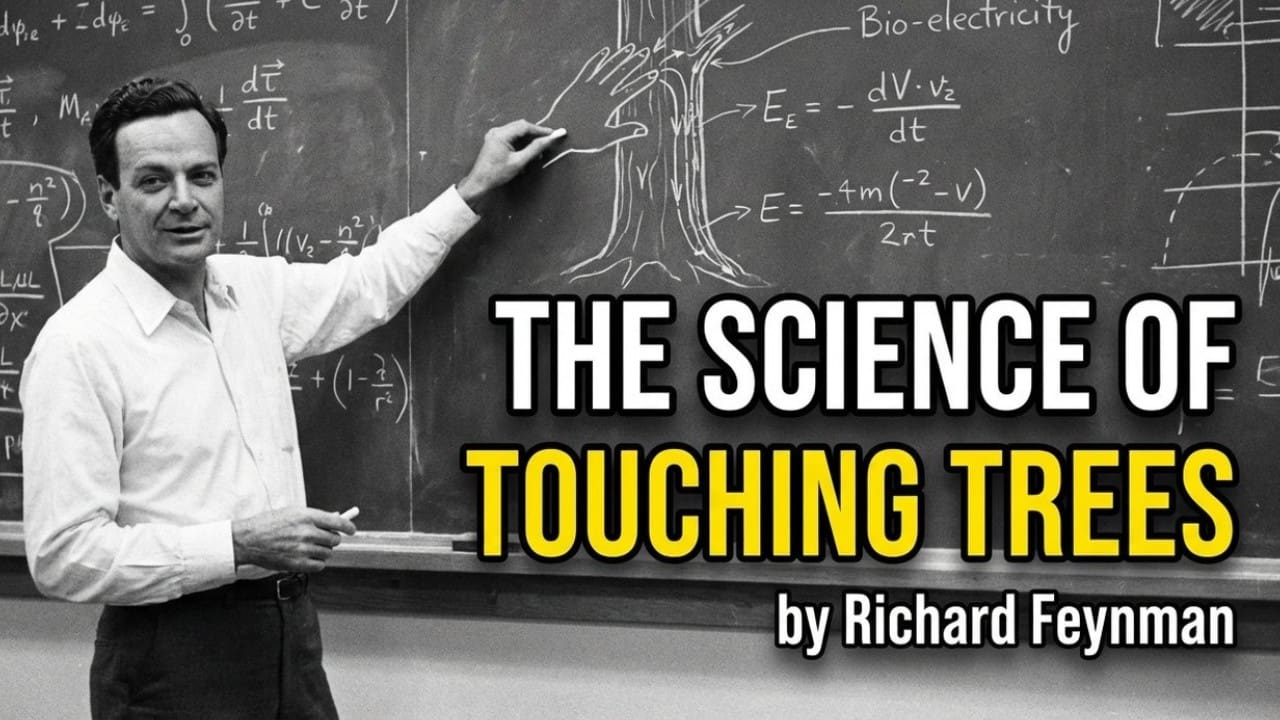
Discover why touching a tree changes your body for seven days — and why the tree itself is solidified air.
This video explores phytoncides, mycorrhizal networks, and Van Helmont’s experiment that proved trees don’t grow from soil. Learn how electromagnetic force creates the illusion of touch and find out why the oldest living organisms on Earth have never aged a single day. Whether you’re fascinated by physics, curious about the hidden networks beneath forests, or wondering where a 10,000-pound oak actually comes from, this will transform how you understand every tree you’ve ever walked past.
Richard Phillips Feynman (/ˈfaɪnmən/; May 11, 1918 – February 15, 1988)[1] was an American theoretical physicist. He shared the 1965 Nobel Prize in Physics with Julian Schwinger and Shin’ichirō Tomonaga “for their fundamental work in quantum electrodynamics (QED), with deep-ploughing consequences for the physics of elementary particles”.[2] He is also known for his work in the path integral formulation of quantum mechanics, the theory of the physics of the superfluidity of supercooled liquid helium, and the parton model. Feynman developed a pictorial representation scheme for the mathematical expressions describing the behavior of subatomic particles, which later became known as Feynman diagrams and is widely used.
Watch now to see trees the way physicists do. The Feynman Way
📩 Get our stories in your inbox → https://the-feynman-way.kit.com/e6e22…
☕ Support the channel: https://buymeacoffee.com/thefeynmanway
He assisted in the development of the atomic bomb during World War II and became known to the wider public in the 1980s as a member of the Rogers Commission, the panel that investigated the Space Shuttle Challenger disaster. Along with his work in theoretical physics, Feynman has been credited with having pioneered the field of quantum computing and introducing the concept of nanotechnology. He held the Richard C. Tolman professorship in theoretical physics at the California Institute of Technology. In a 1999 poll of 130 leading physicists worldwide by the British journal Physics World, he was ranked the seventh-greatest physicist of all time.[3]
Feynman was a keen physics popularizer through books and lectures, including a talk on top-down nanotechnology, “There’s Plenty of Room at the Bottom” (1959) and his undergraduate lectures, The Feynman Lectures on Physics (1961–1964). He delivered lectures for lay audiences, recorded in The Character of Physical Law (1965) and QED: The Strange Theory of Light and Matter (1985). Feynman also became known through Ralph Leighton‘s collections of his anecdotes, Surely You’re Joking, Mr. Feynman! (1985) and What Do You Care What Other People Think? (1988). Leighton covered his dream of travelling to Tannu Tuva in Tuva or Bust!. He has been the subject of several biographies, starting with Genius: The Life and Science of Richard Feynman by James Gleick.
Early life
Feynman was born on May 11, 1918, in New York City,[4] to Lucille (née Phillips), a homemaker, and Melville Arthur Feynman, a sales manager.[5] Feynman’s father was born into a Jewish family in Minsk, Russian Empire,[6] and immigrated with his parents to the United States at the age of five. Feynman’s mother was born in the United States into a Jewish family. Lucille’s father had emigrated from Poland, and her mother also came from a family of Polish immigrants. She trained as a primary school teacher but married Melville in 1917, before taking up a profession.[4][5] Richard was a late talker and did not speak until after his third birthday. As an adult, he spoke with a New York accent[7][8] strong enough to be perceived as an affectation or exaggeration,[9][10] so much so that his friends Wolfgang Pauli and Hans Bethe once commented that Feynman spoke like a “bum”.[9]
The young Feynman was heavily influenced by his father, who encouraged him to ask questions to challenge orthodox thinking, and who was always ready to teach Feynman something new. From his mother, he gained the sense of humor that he had throughout his life. As a child, he had a talent for engineering,[11] maintained an experimental laboratory in his home, and delighted in repairing radios. This radio repairing was probably the first job Feynman had, and during this time he showed early signs of an aptitude for his later career in theoretical physics, when he would analyze the issues theoretically and arrive at the solutions.[12] When he was in grade school, he created a home burglar alarm system while his parents were out for the day running errands.[13]
When Richard was five, his mother gave birth to a younger brother, Henry Phillips, who died at age four weeks.[14] Four years later, Richard’s sister Joan was born and the family moved to Far Rockaway, Queens.[5] Though separated by nine years, Joan and Richard were close, and they both shared a curiosity about the world.[15] Though their mother thought women lacked the capacity to understand such things, Richard encouraged Joan’s interest in astronomy, taking her to see the aurora borealis in Far Rockaway.[16] As an astrophysicist, Joan would help to explain what caused the northern lights.[17][15]
Religion
Feynman’s parents were both from Jewish families,[5] and his family went to the synagogue every Friday.[18] However, by his youth, Feynman described himself as an “avowed atheist“.[19][20] Many years later, in a letter to Tina Levitan, declining a request for information for her book on Jewish Nobel Prize winners, he stated, “To select, for approbation the peculiar elements that come from some supposedly Jewish heredity is to open the door to all kinds of nonsense on racial theory”, adding, “at thirteen I was not only converted to other religious views, but I also stopped believing that the Jewish people are in any way ‘the chosen people‘”.[21]
Later in life, during a visit to the Jewish Theological Seminary, Feynman encountered the Talmud for the first time. He saw that it contained the original text in a little square on each page, and surrounding it were commentaries written over time by different people. In this way, the Talmud had evolved, and everything that was discussed was carefully recorded. Despite being impressed, Feynman was disappointed with the lack of interest in nature and the outside world expressed by the rabbis, who cared about only those questions which arise from the Talmud.[22]
Education
Feynman attended Far Rockaway High School, which was also attended by fellow Nobel laureates Burton Richter and Baruch Samuel Blumberg.[23] Upon starting high school, Feynman was quickly promoted to a higher math class. An IQ test administered in high school estimated his IQ at 125—high but “merely respectable”, according to biographer James Gleick.[24][25] His sister Joan, who scored one point higher, later jokingly claimed to an interviewer that she was smarter. Years later he declined to join Mensa International, saying that his IQ was too low.[26]
When Feynman was 15, he taught himself trigonometry, advanced algebra, infinite series, analytic geometry, and both differential and integral calculus.[27] Before entering college, he was experimenting with mathematical topics such as the half-derivative using his own notation.[28] He created special symbols for logarithm, sine, cosine and tangent functions so they did not look like three variables multiplied together, and for the derivative, to remove the temptation of canceling out the 

Read More: Source – WIKI