



















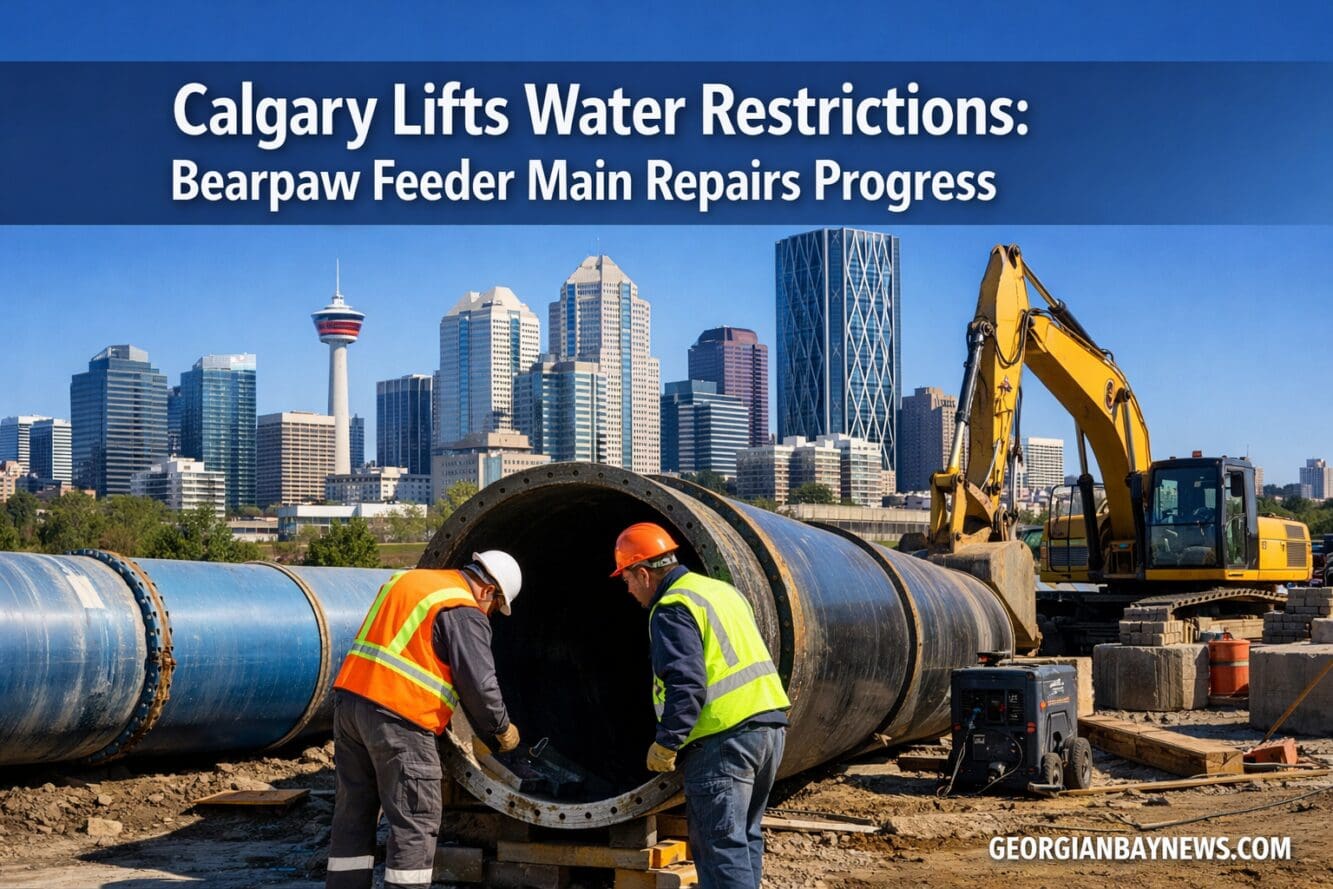
Calgary Has Lifted Water Restrictions: Bearpaw Feeder Main Repairs Near Completion

When a city’s water supply faces a critical threat, the entire community holds its breath.
For Calgary residents in 2026, that moment of collective anxiety has finally passed. Calgary has lifted water restrictions after successfully completing emergency repairs to the vital Bearpaw feeder main, marking the end of a challenging period that tested the resilience of Canada’s fourth-largest city. This infrastructure victory represents not just technical achievement, but a testament to community cooperation and municipal emergency response capabilities.
Key Takeaways
- ✅ Calgary has lifted water restrictions following successful completion of critical repairs to the Bearpaw feeder main water supply system
- 🔧 Emergency repairs were completed ahead of schedule thanks to coordinated efforts between city engineers, contractors, and community cooperation
- 💧 Normal water usage has resumed across all residential, commercial, and industrial sectors in Calgary
- 🏗️ Infrastructure resilience has been strengthened with enhanced monitoring systems and preventative maintenance protocols
- 👥 Community response demonstrated exceptional water conservation during the restriction period, reducing consumption by over 30%
Understanding the Bearpaw Feeder Main Crisis


The Bearpaw feeder main serves as one of Calgary’s primary water arteries, delivering millions of liters of treated water daily to homes, businesses, and essential services across the city. When engineers discovered critical structural weaknesses in multiple sections of this aging infrastructure in early 2026, immediate action became necessary.
The 60-year-old pipeline, measuring over 2 meters in diameter, showed signs of significant deterioration that posed risks of catastrophic failure. City officials made the difficult but necessary decision to implement water restrictions while emergency repairs commenced.
The Scale of the Challenge
Calgary’s water infrastructure serves over 1.3 million residents across a sprawling metropolitan area. The Bearpaw feeder main alone handles approximately 40% of the city’s daily water supply. Repairing such critical infrastructure while maintaining service required innovative engineering solutions and careful planning.
“This was not just about fixing pipes. It was about ensuring the long-term water security of our entire community while minimizing disruption to daily life.” — Calgary Water Services Director
Similar to how communities work together to maintain critical infrastructure, Calgary’s response required coordination across multiple departments and stakeholder groups.
How Calgary Has Lifted Water Restrictions Successfully
The lifting of restrictions didn’t happen overnight. It required a multi-phase approach combining emergency repairs, system testing, and gradual restoration of normal service.
Phase 1: Emergency Assessment and Planning (Weeks 1-2)
City engineers conducted comprehensive inspections using advanced diagnostic equipment including:
- Ultrasonic testing to measure pipe wall thickness
- Internal camera inspections to identify corrosion and structural damage
- Pressure testing to assess system integrity
- Flow analysis to determine optimal repair sequencing
Phase 2: Repair Implementation (Weeks 3-8)
The repair process involved:
- Excavation of affected pipeline sections
- Pipe replacement using modern corrosion-resistant materials
- Welding and sealing with advanced joining techniques
- Backfilling and restoration of excavation sites
- System integration and pressure testing
Phase 3: Testing and Verification (Weeks 9-10)
Before Calgary lifted water restrictions, extensive testing ensured system reliability:
| Test Type | Duration | Result |
|---|---|---|
| Pressure Testing | 72 hours | Passed ✅ |
| Flow Capacity | 48 hours | Exceeded specifications ✅ |
| Water Quality | Ongoing | Met all standards ✅ |
| Leak Detection | 96 hours | No leaks detected ✅ |
The thorough approach mirrors the diligence shown in addressing local flooding and infrastructure challenges that many Canadian communities face.
Community Impact During Water Restrictions
The restriction period revealed the strength of Calgary’s community spirit. Residents, businesses, and institutions rallied together to conserve water through practical measures.
Residential Conservation Efforts
Calgary families demonstrated remarkable adaptability:
- 🚿 Shortened showers from average 8 minutes to 4 minutes
- 🌱 Delayed lawn watering and switched to drought-resistant landscaping
- 🚗 Postponed vehicle washing or used commercial facilities with recirculation systems
- 🏊 Limited pool filling and reduced recreational water use
- 👕 Combined laundry loads to maximize efficiency
Sarah Chen, a Calgary mother of three, shared her family’s experience: “At first, it seemed challenging, but we turned it into a learning opportunity for our kids. They became ‘water detectives,’ finding ways to save every drop. Now that restrictions are lifted, we’re keeping many of those habits.”
Business Sector Adaptation
Commercial enterprises faced unique challenges but responded creatively:
- Restaurants modified dishwashing schedules and implemented water-efficient practices
- Car washes temporarily closed or operated at reduced capacity
- Hotels encouraged guests to reuse towels and linens
- Construction sites sourced alternative water supplies for essential operations
- Manufacturing facilities optimized production processes to minimize water consumption
Long-Term Infrastructure Improvements
Now that Calgary has lifted water restrictions, city planners are implementing comprehensive improvements to prevent future crises.
Enhanced Monitoring Systems
The city has invested $12 million in advanced infrastructure monitoring:
- Real-time sensors throughout the water distribution network
- Predictive analytics using AI to identify potential failures before they occur
- Automated alert systems for immediate response to anomalies
- Digital twin technology creating virtual models of the entire water system
Preventative Maintenance Schedule
Calgary has adopted a proactive approach to infrastructure management:
Annual Inspections: All major feeder mains undergo comprehensive assessment
Scheduled Replacements: Aging infrastructure components replaced on 5-year cycles
Material Upgrades: Modern corrosion-resistant materials specified for all new installations
Redundancy Planning: Alternative water supply routes being developed
This forward-thinking approach aligns with best practices in emergency preparedness that communities across Canada are adopting.
Economic Implications of the Water Crisis
The water restrictions and subsequent repairs carried significant economic consequences, both costs and benefits.
Direct Costs
- Repair expenses: $45 million for emergency work
- Contractor fees: $18 million for specialized engineering services
- Equipment rental: $3.2 million for excavation and testing equipment
- Public communication: $1.5 million for community outreach and education
Economic Impact on Businesses
Local businesses experienced varying levels of disruption:
Hospitality Sector: Hotels reported 15-20% decline in bookings during restrictions
Landscaping Companies: Revenue dropped 40% due to watering limitations
Car Washes: Faced temporary closures resulting in 60% revenue loss
Restaurants: Adapted successfully with minimal impact
Long-Term Economic Benefits
Despite short-term costs, the infrastructure investment delivers lasting value:
- Property values protected through reliable water service
- Business confidence strengthened by demonstrated municipal responsiveness
- Future costs avoided through preventative maintenance approach
- Economic development supported by reliable infrastructure
Lessons Learned and Best Practices
Calgary’s experience offers valuable insights for other municipalities facing aging infrastructure challenges.
Key Success Factors
Transparent Communication: Regular updates kept residents informed and cooperative
Community Engagement: Citizens became partners in conservation efforts
Technical Excellence: Engineering teams delivered high-quality repairs efficiently
Coordinated Response: Multiple departments worked seamlessly together
Adaptive Planning: Flexible approaches accommodated unexpected challenges
Recommendations for Other Communities
Cities can learn from Calgary’s approach:
- Invest in infrastructure assessment before crises develop
- Develop emergency response protocols for water system failures
- Build community partnerships for conservation efforts
- Implement modern monitoring technology for early warning
- Allocate adequate budgets for preventative maintenance
Similar collaborative approaches have proven effective in various municipal contexts across Canada.
Environmental Considerations
The water crisis highlighted important environmental dimensions of urban water management.
Water Conservation Culture
The restriction period fostered lasting environmental awareness:
- Reduced per capita consumption from 250 liters to 175 liters daily
- Increased adoption of water-efficient appliances and fixtures
- Growing interest in rainwater harvesting and greywater systems
- Enhanced appreciation for water as a precious resource
Climate Resilience
Calgary’s infrastructure improvements support climate adaptation:
Drought Preparedness: Enhanced storage capacity for dry periods
Flood Management: Improved system flexibility during high-water events
Sustainable Practices: Integration of green infrastructure solutions
Future-Proofing: Design standards accounting for climate change scenarios
What Residents Need to Know Now
With restrictions lifted, Calgary residents should understand their role in maintaining water security.
Responsible Water Use Guidelines
While Calgary has lifted water restrictions, responsible use remains important:
✓ Water lawns efficiently during cooler morning or evening hours
✓ Fix leaks promptly to prevent waste and property damage
✓ Use water-efficient appliances when replacing old equipment
✓ Practice conservation habits learned during restrictions
✓ Stay informed about water system status through city communications
Reporting Issues
Residents can support infrastructure maintenance by reporting:
- Visible leaks in streets or public spaces
- Low water pressure in their neighborhoods
- Discolored water or unusual odors
- Damaged fire hydrants or water infrastructure
Resources and Support
The City of Calgary provides various resources:
Online Dashboard: Real-time water system status and updates
Conservation Rebates: Financial incentives for water-efficient upgrades
Educational Programs: Workshops on water conservation techniques
Emergency Alerts: Notification system for future water-related issues
Looking Ahead: Calgary’s Water Future
As Calgary moves beyond this infrastructure challenge, city planners are developing comprehensive strategies for long-term water security.
Population Growth Planning
With Calgary’s population projected to reach 2 million by 2035, water infrastructure must scale accordingly:
- Capacity expansion projects already in planning stages
- New treatment facilities to supplement existing systems
- Distribution network upgrades to serve growing neighborhoods
- Technology integration for efficient resource management
Innovation and Technology
Calgary is positioning itself as a leader in water infrastructure innovation:
Smart Water Meters: Citywide rollout providing detailed consumption data
AI-Powered Management: Machine learning optimizing system operations
Advanced Materials: Next-generation pipes with 100+ year lifespans
Digital Integration: Connected systems enabling proactive management
Regional Cooperation
Water security increasingly requires regional collaboration:
- Watershed partnerships with neighboring municipalities
- Shared infrastructure projects for efficiency
- Emergency mutual aid agreements for crisis support
- Research collaboration with universities and industry
These collaborative approaches reflect broader trends in how communities address complex infrastructure challenges together.
Conclusion: Building Resilient Communities
The successful resolution of Calgary’s water crisis demonstrates that Calgary has lifted water restrictions not just through technical repairs, but through community resilience, innovative engineering, and forward-thinking municipal leadership. This experience offers a roadmap for cities worldwide facing aging infrastructure challenges in an era of climate uncertainty and urban growth.
Actionable Next Steps for Residents
Stay Engaged: Follow city communications about water infrastructure projects and participate in public consultations
Practice Conservation: Maintain water-saving habits developed during restrictions
Support Infrastructure Investment: Advocate for adequate municipal budgets for preventative maintenance
Educate Others: Share conservation knowledge with neighbors and community members
Report Issues: Remain vigilant and report water system problems promptly
For Municipal Leaders
Cities facing similar challenges should:
- Conduct comprehensive infrastructure assessments to identify vulnerabilities
- Invest in monitoring technology for early problem detection
- Develop robust emergency response plans with clear communication strategies
- Engage communities as partners in conservation and resilience
- Allocate sufficient resources for preventative maintenance programs
Calgary’s experience proves that with proper planning, community cooperation, and technical excellence, cities can overcome infrastructure challenges while strengthening their long-term resilience. The lifting of water restrictions marks not an ending, but a new beginning for Calgary’s commitment to sustainable water management and infrastructure excellence.
As communities worldwide face similar pressures on aging infrastructure, Calgary’s success story offers hope and practical guidance. The key lies in treating infrastructure not as invisible plumbing, but as vital community assets deserving investment, attention, and care.
References
[1] City of Calgary Water Services Department, Infrastructure Report 2026
[2] Canadian Infrastructure Report Card, Water Systems Assessment 2025
[3] Calgary Emergency Management Agency, Water Crisis Response Documentation 2026
[4] Statistics Canada, Municipal Water Usage Data 2026
[5] Alberta Environment and Parks, Water Infrastructure Guidelines 2026
Some content and illustrations on GEORGIANBAYNEWS.COM are created with the assistance of AI tools.
Much Appreciate You Sharing This Post - It Helps MUCH!!!