

















Canada’s Military Rethinks Armor as Drones Reshape Tank Warfare in 2026
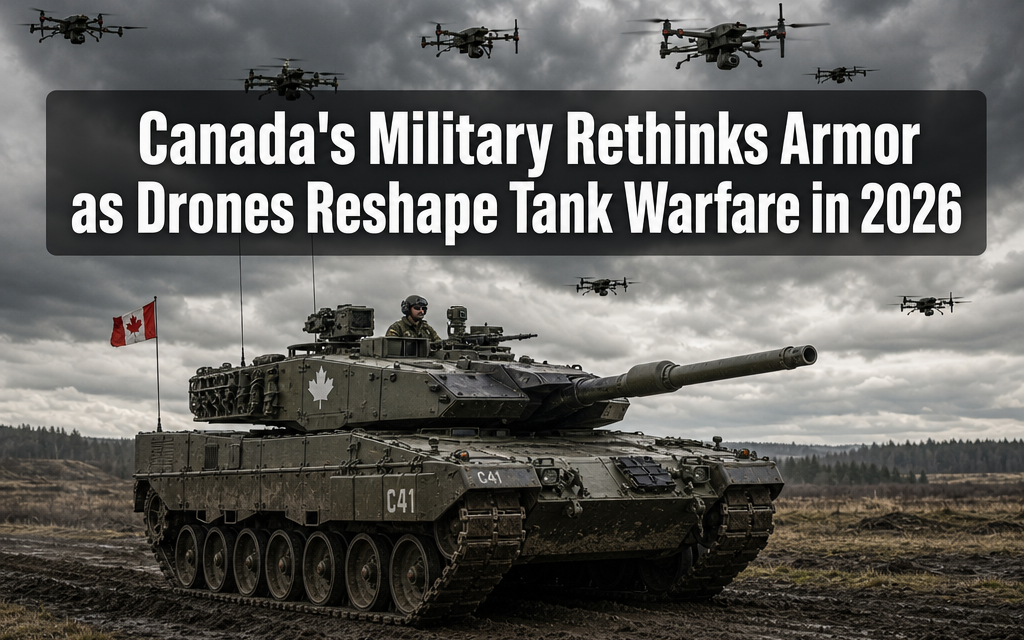
Last updated: June 7, 2026
Quick Answer: Canada’s military is actively reassessing its armored vehicle strategy in 2026 after battlefield evidence from Ukraine and other conflicts showed that drones can destroy tanks at a fraction of the cost. The Canadian Armed Forces are pursuing counter-drone systems, exploring tank fleet upgrades or replacement, and investing in new aerial surveillance tools to keep pace with NATO allies facing the same challenge.
Key Takeaways
- Canada’s Leopard 2 tank fleet is aging, and in May 2026 the Department of National Defence issued a formal request for information to explore upgrade or replacement options [7]
- In July 2025, Canada awarded over $169 million in contracts to integrate counter-uncrewed aircraft systems onto light-armored tactical vehicles [1]
- Canada committed $227.5 million in February 2024 to acquire air defence and anti-drone systems for troops deployed with NATO in Latvia [4]
- In December 2023, Canada announced a $2.49 billion investment to acquire 11 MQ-9B surveillance drones, with deliveries expected from 2028 [3]
- Canadian firm Roshel unveiled a dedicated counter-drone armored vehicle at CANSEC 2025, signaling growing domestic industry capacity [2]
- In July 2024, Canada became the fifth NATO country to successfully test over-the-horizon laser technology for neutralizing drones [6]
- Drone swarms represent the most serious emerging threat to conventional armored vehicles, as demonstrated repeatedly in the Russia-Ukraine conflict
- NATO allies including the U.S. are already mounting counter-drone turrets on Abrams tanks and Bradley fighting vehicles [8]
- Tank crews in the drone era need new training in electronic warfare awareness, counter-UAS procedures, and dispersed operations
- Tanks are not obsolete, but their survival now depends on layered protection systems and combined-arms integration
What Are Canadian Tanks Currently Being Used For
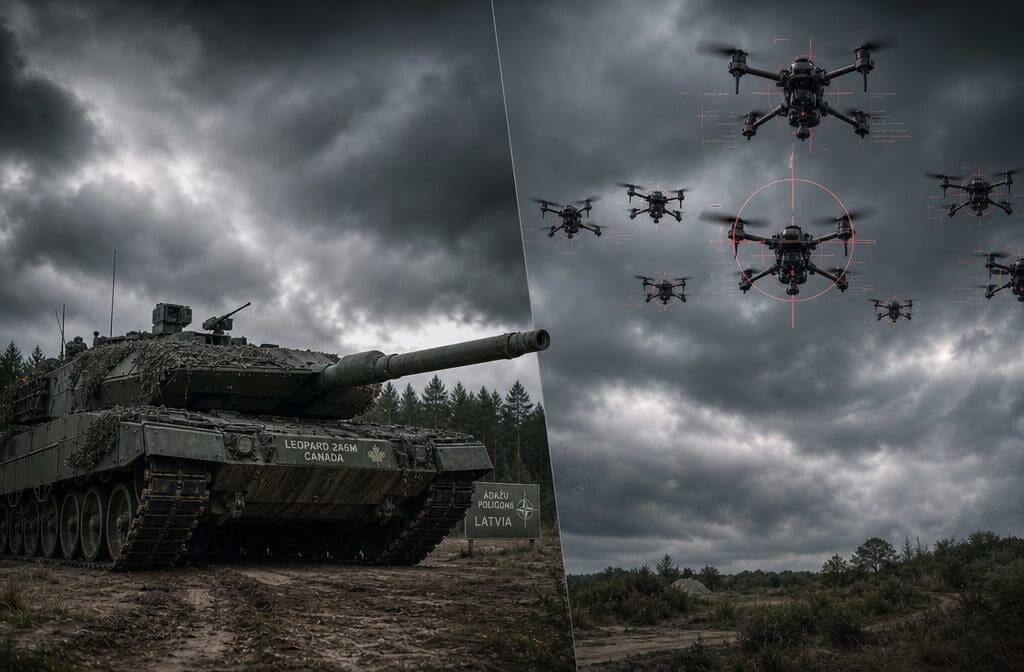
Canada’s Leopard 2 tanks are primarily used for NATO collective defence commitments, domestic training, and combined-arms exercises. The Canadian Army operates the Leopard 2A4M CAN and Leopard 2A6M CAN variants, which are deployed in support of Operation REASSURANCE, Canada’s contribution to NATO’s enhanced Forward Presence in Latvia.
In Latvia, Canadian tanks serve as a deterrent against potential Russian aggression, operating alongside infantry, artillery, and allied armored units. At home, they support training at CFB Gagetown in New Brunswick, where armored crews develop combined-arms tactics. The tanks are not currently deployed in active combat zones, but lessons from Ukraine are directly shaping how Canada plans to use and protect them going forward.
How Do Drones Change Modern Tank Combat
Drones fundamentally change tank warfare by giving cheap, expendable platforms the ability to locate, track, and destroy expensive armored vehicles from above. A first-person view (FPV) attack drone costing a few hundred dollars can, under the right conditions, disable a tank worth millions.
Key ways drones shift the equation:
- Top-attack vulnerability: Tank armor is thinnest on the roof. Drones exploit this by diving onto the turret or engine deck.
- Persistent surveillance: Even small commercial drones can spot tank formations and relay coordinates to artillery or other strike assets.
- Swarm tactics: Multiple drones attacking simultaneously can overwhelm a crew’s ability to respond.
- Low cost, high volume: Drone production is fast and cheap compared to replacing armored vehicles.
The Russia-Ukraine conflict has provided the clearest real-world evidence of this shift, with hundreds of tanks destroyed or disabled by drone attacks on both sides. Canada’s military is watching these lessons closely as it rethinks its own armor posture.
How Much Does a Canadian Military Tank Cost
A single Leopard 2 main battle tank costs roughly $6 to $10 million USD to procure, depending on the variant and configuration. Upgrading or replacing Canada’s fleet would represent a multi-billion-dollar commitment.
In May 2026, the Department of National Defence issued a request for information to the defence industry to assess options for upgrading or replacing its aging tank fleet [7]. This step does not confirm a purchase, but it signals that planners are seriously weighing the cost of modernization against the risk of fielding outdated armor.
For context, the broader armored vehicle modernization picture includes:
- $169 million in counter-drone integration contracts awarded in July 2025 [1]
- $227.5 million committed for anti-drone systems in Latvia in February 2024 [4]
- $2.49 billion for MQ-9B drone acquisition announced in December 2023 [3]
These figures show that Canada is spending across multiple lines simultaneously, balancing fleet upgrades with new capabilities.
What Drone Technologies Are Threatening Traditional Tanks
Several categories of drone technology now pose direct threats to armored vehicles. Canada’s military planners are tracking all of them.
Loitering munitions (sometimes called “kamikaze drones”) circle a target area autonomously until they identify and strike a vehicle. The Lancet and Shahed-series drones used in Ukraine fall into this category.
FPV attack drones are small, fast, and piloted in real time by an operator wearing goggles. They are cheap to produce and increasingly fitted with shaped-charge warheads capable of penetrating armor.
Reconnaissance drones do not attack directly but feed targeting data to artillery, missiles, or other strike systems. A tank spotted by a drone is a tank at risk.
Drone swarms use coordinated numbers to overwhelm defensive systems. Even if most are intercepted, a single successful hit can disable or destroy a vehicle.
Canada’s interest in counter-UAS technology, including the laser testing conducted at the Defence Research and Development Canada Suffield Research Centre in July 2024, reflects the urgency of finding answers to these threats [6].
Are Canadian Tanks Outdated Compared to European Models
Canada’s Leopard 2 variants are not obsolete by design, but they lack the modern active protection and counter-drone systems now being added to European and American fleets. Germany’s latest Leopard 2A7 variant, for example, includes improved situational awareness systems and is being evaluated for active protection system integration. Canada’s A4M and A6M variants are older configurations.
The May 2026 request for information signals that Ottawa recognizes this gap [7]. Without upgrades, Canadian tanks deployed with NATO could be at a disadvantage in a high-drone-threat environment compared to allied vehicles with more current electronics and protection suites.
Who Manufactures Tanks for the Canadian Military
Canada does not manufacture its own main battle tanks. The Leopard 2 is produced by Krauss-Maffei Wegmann (KMW) of Germany. Any future tank procurement or upgrade would likely involve KMW or a consortium of European and North American defence contractors.
On the domestic side, Canadian firm Roshel has emerged as a relevant player in the armored vehicle space. At CANSEC 2025, Roshel unveiled the Senator Counter-UAS Vehicle, an armored platform built on its combat-proven Senator MRAP that integrates the Falcon Shield detection and neutralization system [2]. While not a tank replacement, this kind of vehicle represents the growing Canadian industrial capacity to build drone-aware armored platforms.
The geopolitical dimension of procurement decisions is also worth noting. For more on how global tensions shape Canadian defence and energy spending, see Georgian Bay News coverage of geopolitical fallout affecting Canadian policy.
What Armor Upgrades Are Being Considered to Counter Drone Warfare
Canada is exploring several upgrade paths, and as of 2026, the options being assessed include both vehicle-level and system-level changes.
Counter-UAS integration on armored vehicles: The July 2025 contracts with CACI, Inc. – FEDERAL specifically target integrating C-UAS sensors and effectors onto light-armored tactical vehicles, with up to 10 years of in-service support [1]. This is the most concrete upgrade program underway.
Active protection systems (APS): These radar-guided systems detect and intercept incoming projectiles, including drone-delivered munitions. Israel’s Trophy system and other APS options are being evaluated by multiple NATO armies.
Laser-based neutralization: Canada’s successful test of over-the-horizon laser technology in July 2024 demonstrated that directed-energy weapons can reliably neutralize drones [6]. Scaling this to vehicle-mounted systems is the next challenge.
Electronic warfare (EW) suites: Jamming drone communications and GPS signals can neutralize many commercial and military drones before they reach their targets. EW integration on armored vehicles is a growing priority across NATO.
Can Tanks Survive Against Advanced Drone Swarm Attacks
Tanks can survive drone swarm attacks, but only with layered defenses and proper tactics. No single system provides complete protection. The answer is combined-arms integration: tanks operating with dedicated counter-drone vehicles, electronic warfare assets, and air defence units nearby.
The U.S. Army’s November 2025 testing of the Bullfrog counter-drone weapon station, mounted directly on Abrams tanks and Bradley infantry fighting vehicles, shows one approach to the problem [8]. By giving the vehicle itself a point-defence capability, crews gain a last-resort option when other layers fail.
Canada is watching these developments closely. The CACI contracts and the Roshel Senator Counter-UAS vehicle both point toward a similar philosophy: protect armored formations with dedicated anti-drone assets rather than relying solely on the tank’s own armor.
What Military Roles Will Tanks Still Have in Future Conflicts
Tanks are not going away, but their role is narrowing to situations where their firepower and protection advantage still outweighs the drone threat. In 2026 and beyond, tanks are expected to remain relevant for:
- Breaching fortified positions where infantry alone cannot advance
- Urban combat in environments that limit drone effectiveness (tight spaces, signal interference, building cover)
- Deterrence as a visible symbol of military capability in standoff situations like NATO’s Latvia deployment
- Combined-arms operations where tanks are protected by layered air defence and counter-drone systems
The key shift is that tanks can no longer operate independently. A tank without drone protection is a liability. A tank inside a well-defended combined-arms formation remains a powerful asset.
How Are Other NATO Countries Adapting Tanks to Drone Threats
NATO allies are moving fast. The U.S. Army’s Bullfrog counter-drone turret tests on Abrams tanks and Bradley IFVs in November 2025 represent one of the most direct responses [8]. Germany is integrating active protection systems on Leopard 2A7 variants. The United Kingdom is evaluating drone-detection systems for its Challenger 3 fleet.
Canada’s donation of over 800 SkyRanger R70 drones to Ukraine in February 2024, valued at over $95 million, also reflects a broader understanding that drone capability is now a core military asset [5]. Observing how Ukraine uses these systems in combat is generating real-time lessons for Canadian planners.
Canada’s investment in small modular energy and defence technology reflects a broader national push toward advanced capabilities. Readers interested in Canada’s technology investment landscape can explore Georgian Bay News coverage of small modular reactors as a parallel example of strategic long-term planning.
What Training Do Canadian Tank Crews Need for Drone-Era Combat
Canadian tank crews need updated training that goes well beyond traditional gunnery and vehicle operation. In the drone era, effective armored warfare requires:
- Drone threat recognition: Identifying the type, range, and likely intent of unmanned systems in the area
- Counter-UAS procedures: Coordinating with dedicated anti-drone assets and knowing when to move, halt, or disperse
- Electronic warfare awareness: Understanding how jamming affects both enemy drones and friendly communications
- Dispersed operations: Avoiding the massed formations that make easy targets for drone surveillance and strikes
- Camouflage and concealment: Using terrain, netting, and thermal masking to reduce signature
NATO exercises in Latvia and elsewhere are already incorporating these elements. Canada’s commitment of $227.5 million for air defence and anti-drone systems for troops in Latvia includes training and support components [4], reflecting recognition that equipment alone is not enough.
What Are the Biggest Vulnerabilities of Current Tank Designs
Current tank designs, including Canada’s Leopard 2 variants, share several structural vulnerabilities that drones exploit effectively.
VulnerabilityWhy It MattersThin top armorDrone top-attack munitions target the weakest pointLimited 360-degree awarenessCrews struggle to detect small drones in all directions simultaneouslyThermal signatureEngine heat makes tanks visible to infrared sensors from aboveCommunications relianceJamming can disrupt crew coordination and navigationSlow response timeTanks cannot quickly reposition to avoid a drone strike once detected
Addressing these vulnerabilities is expensive and technically complex. It requires not just new hardware but changes to doctrine, tactics, and crew training.
How Expensive Is It to Modify Existing Canadian Tank Fleets
Modifying Canada’s existing Leopard 2 fleet to meet drone-era threats is estimated to cost hundreds of millions of dollars, though no official total figure has been publicly released as of June 2026. The May 2026 request for information is specifically designed to gather industry input on what upgrade or replacement would cost and how long it would take [7].
For comparison:
- Counter-UAS integration on light-armored vehicles: $169 million for phase 2 contracts [1]
- Anti-drone systems for Latvia deployment: $227.5 million [4]
- Full drone surveillance fleet (MQ-9B): $2.49 billion [3]
Full tank fleet modernization, including active protection systems, electronic warfare suites, and counter-drone turrets, would likely exceed these figures. The alternative, replacing aging tanks entirely with a new platform designed for the drone era, carries an even higher price tag but potentially a longer service life.
Canada’s broader defence technology investments, including interests in EV technology and advanced energy systems, suggest a national posture of investing in future-ready capabilities rather than maintaining legacy systems indefinitely.
FAQ
Q: Does Canada still use Leopard 2 tanks?
Yes. Canada operates Leopard 2A4M CAN and Leopard 2A6M CAN variants. They are used for NATO commitments in Latvia and for domestic training at CFB Gagetown.
Q: Are Canadian tanks deployed in active combat in 2026?
No. Canadian tanks are deployed in a deterrence role with NATO’s enhanced Forward Presence in Latvia, not in active combat operations.
Q: What is Canada doing about the drone threat to its tanks?
Canada has awarded counter-drone integration contracts, committed funds for anti-drone systems in Latvia, tested laser neutralization technology, and issued a request for information on tank fleet upgrades or replacement as of May 2026.
Q: How much did Canada spend on counter-drone capabilities?
Key figures include $169 million for C-UAS integration on armored vehicles (July 2025), $227.5 million for anti-drone systems in Latvia (February 2024), and $2.49 billion for MQ-9B surveillance drones (December 2023).
Q: Can a drone actually destroy a modern tank?
Yes. FPV attack drones and loitering munitions have destroyed modern tanks in Ukraine by targeting thin top armor. The threat is real and well-documented.
Q: What is the Roshel Senator Counter-UAS Vehicle?
It is a Canadian-built armored vehicle unveiled at CANSEC 2025 that integrates the Falcon Shield detection and neutralization system to detect, track, and defeat hostile drones. It is based on the Senator MRAP platform.
Q: Is Canada behind NATO allies on counter-drone tank protection?
Canada is behind some allies, particularly the U.S. and Germany, in integrating counter-drone systems directly onto tank platforms. However, Canada is actively investing and closing the gap.
Q: What is a loitering munition?
A loitering munition is a drone that circles a target area autonomously until it identifies a target, then dives and detonates. It combines surveillance and strike capability in one low-cost platform.
Q: Will Canada replace its tank fleet entirely?
No decision has been made. The May 2026 request for information is an early-stage assessment, not a procurement announcement. Both upgrade and replacement options are being evaluated.
Q: What laser technology did Canada test for drone defence?
In July 2024, Canada became the fifth NATO country to test over-the-horizon laser technology for neutralizing drones. The tests were conducted at the Defence Research and Development Canada Suffield Research Centre with Boeing and AIM Defence.
Conclusion
Canada’s military is rethinking armor at a pace that would have seemed unnecessary just five years ago. The evidence from Ukraine is clear: tanks without drone protection are at serious risk, and the cost of ignoring that lesson is measured in lives and equipment. In 2026, Canada is moving on multiple fronts simultaneously, from counter-drone vehicle contracts and laser testing to a formal industry consultation on tank fleet modernization.
Actionable next steps for those following this issue:
- Track the outcome of Canada’s May 2026 request for information on tank fleet options, which will shape procurement decisions for the next decade [7]
- Watch for updates on the CACI C-UAS integration program, which is the most active current armored vehicle modernization effort [1]
- Follow NATO exercises in Latvia for signals about how Canadian tank doctrine is evolving in practice
- Monitor domestic defence industry developments, including Roshel’s counter-drone vehicle program, for signs of Canadian-made solutions entering the procurement pipeline [2]
The tank is not finished. But the tank that survives the next conflict will look very different from the one that entered the last one. Canada’s military knows this, and the race to adapt is already underway.
For more on Canada’s strategic investments in advanced technology, explore Georgian Bay News coverage of small nuclear reactors and Canada’s energy future as a parallel story of national capability building.
References
[1] Contract Awarded For Phase 2 Of Counter Uncrewed Aircraft Systems Capability In Support Of Operation Reassurance – https://www.canada.ca/en/department-national-defence/news/2025/07/contract-awarded-for-phase-2-of-counter-uncrewed-aircraft-systems-capability-in-support-of-operation-reassurance.html?utm_source=openai
[2] Roshel Unveils New Senator Counter Uas Vehicle With Falcon Shield System At Cansec 2025 – https://www.thedefensenews.com/news-details/Roshel-Unveils-New-Senator-Counter-UAS-Vehicle-with-Falcon-Shield-System-at-CANSEC-2025/?utm_source=openai
[3] Canada Acquiring Remotely Piloted Aircraft Systems For The Canadian Armed Forces – https://www.canada.ca/en/department-national-defence/news/2023/12/canada-acquiring-remotely-piloted-aircraft-systems-for-the-canadian-armed-forces.html?utm_source=openai
[4] Canada Acquiring Air Defence And Anti Drone Capabilities For Canadian Armed Forces Members Deployed With Nato In Latvia – https://www.canada.ca/en/department-national-defence/news/2024/02/canada-acquiring-air-defence-and-anti-drone-capabilities-for-canadian-armed-forces-members-deployed-with-nato-in-latvia.html?utm_source=openai
[5] Defence Minister Bill Blair Announces Canadian Donation Of Over 800 Drones To Ukraine – https://www.canada.ca/en/department-national-defence/news/2024/02/defence-minister-bill-blair-announces-canadian-donation-of-over-800-drones-to-ukraine.html?utm_source=openai
[6] Canada Devient Cinquieme Pays Mettre Lessai Technologie Lasers Dessus Lhorizon Pour Neutraliser – https://science.gc.ca/site/science/fr/blogues/science-pour-defense-securite/canada-devient-cinquieme-pays-mettre-lessai-technologie-lasers-dessus-lhorizon-pour-neutraliser?utm_source=openai
[7] Ottawa Asks Defence Industry Options 173043497 – https://ca.finance.yahoo.com/news/ottawa-asks-defence-industry-options-173043497.html?utm_source=openai
[8] Us Army Tests Bullfrog Counter Drone Turret On Abrams Tank And Bradley Ifv For Combat Defense – https://www.armyrecognition.com/news/army-news/2025/us-army-tests-bullfrog-counter-drone-turret-on-abrams-tank-and-bradley-ifv-for-combat-defense?utm_source=openai