




















Chinese EVs Arrive in Canada: How 49,000 Vehicles at 6.1% Tariffs Will Disrupt the Auto Market and Create Manufacturing Jobs

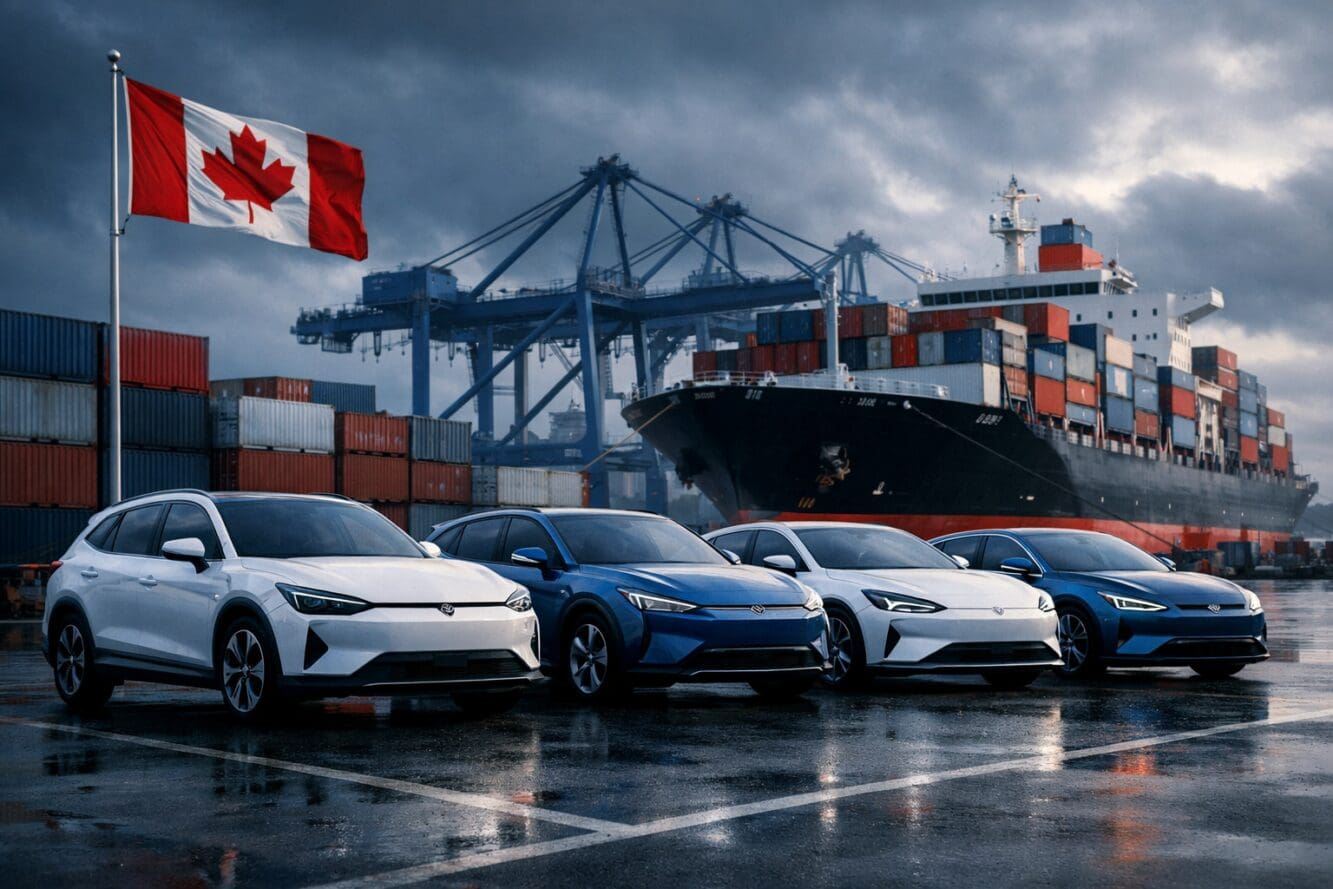
Canada’s auto market is about to experience its biggest shakeup in decades. In January 2026, the federal government introduced a tariff-quota system allowing 49,000 Chinese-built electric vehicles into the country annually at just 6.1 percent duty—a dramatic reversal from the 100 percent tariff imposed under former Prime Minister Justin Trudeau in 2024 [5]. The story of Chinese EVs arriving in Canada and how 49,000 vehicles at 6.1% tariffs will disrupt the auto market and create manufacturing jobs is unfolding in real time, and the implications for consumers, domestic automakers, and the broader economy are enormous.

With demonstration units expected by mid-2026 and retail availability projected for late 2026, this policy shift promises affordable electric vehicles for everyday Canadians while laying the groundwork for new manufacturing investment [2].
Key Takeaways
- 🚗 49,000 Chinese EVs per year can enter Canada at 6.1% tariffs, rising to 70,000 units by 2030 [5]
- 💰 Half the quota must be priced at $35,000 CAD or less by 2030, making EVs accessible to middle-income buyers [5]
- 🏭 Joint-venture manufacturing investments are expected to follow, creating Canadian jobs in EV supply chains
- 🌾 China rolled back counter-tariffs on Canadian agricultural exports as part of the trade deal [5]
- 📊 70% of EV-intending Canadians say they would consider a Chinese-built vehicle, up from just 39% in 2024 [5]

Understanding the Tariff-Quota System: How 49,000 Vehicles at 6.1% Tariffs Will Reshape Pricing
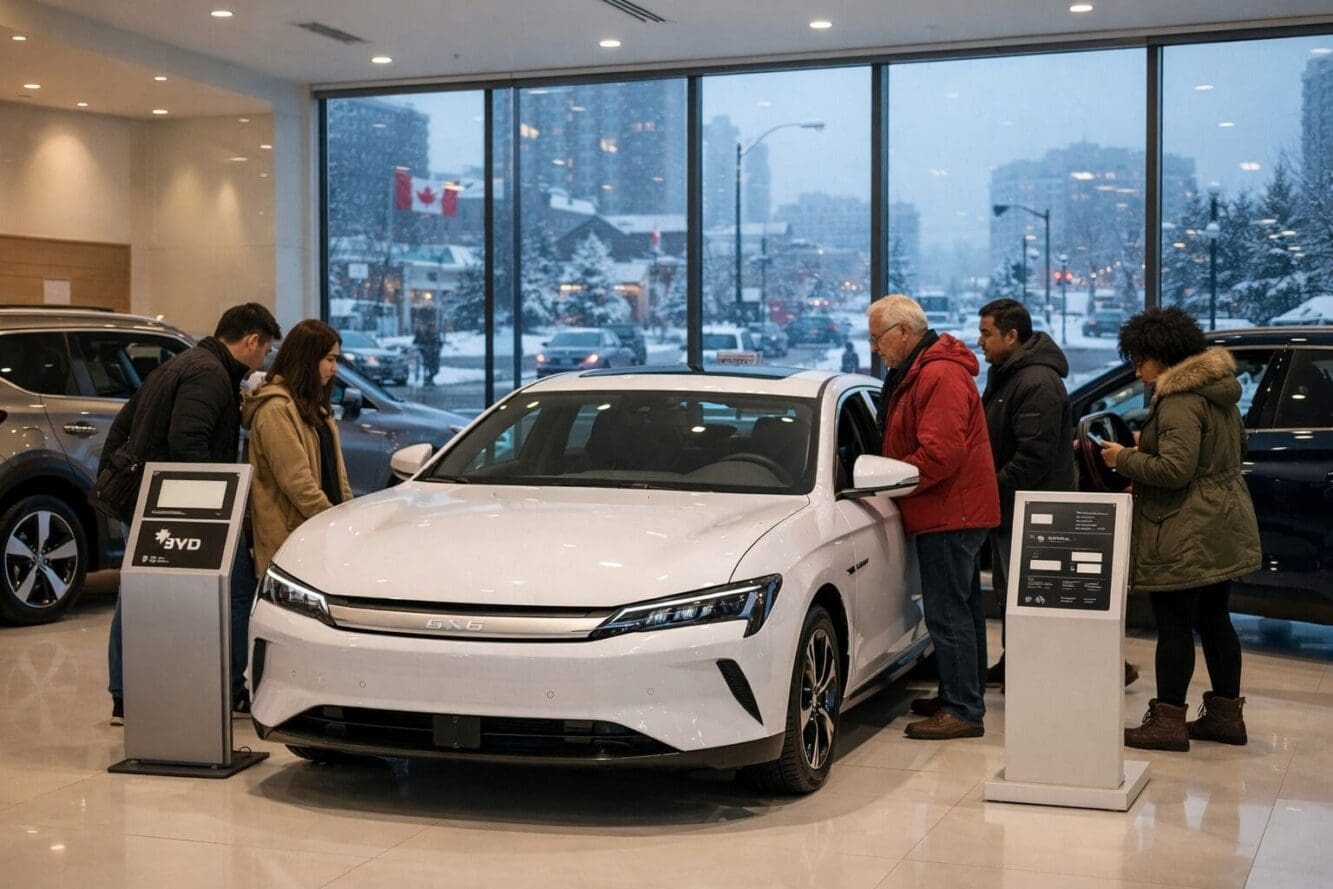
The new framework replaces what was essentially a trade wall. Under the previous 100 percent tariff, Chinese EVs were priced out of the Canadian market entirely. The current system takes a more strategic approach.
Here’s how it works:
| Feature | Details |
|---|---|
| Annual Quota (2026) | 49,000 vehicles |
| Annual Quota (2030) | 70,000 vehicles |
| Tariff Rate | 6.1% |
| Affordability Mandate | 50% of quota ≤ $35,000 CAD by 2030 |
| Consumer Incentive | Up to $5,000 per EV purchase |
The affordability mandate is particularly significant. By requiring that half of all imported Chinese EVs be priced at or below $35,000 CAD, the government is ensuring that these vehicles serve middle-income Canadians—not just early adopters with deep pockets [5].
Combined with the reinstated $5,000 federal purchase incentive, a Chinese EV could cost a Canadian buyer as little as $30,000 out the door [5]. That’s roughly $15,000 less than the average new car sold in Canada today.
💡 “This isn’t just about cheaper cars. It’s about making the electric transition possible for families who’ve been priced out.”
For context on how gas fuels the climate problem, affordable EVs represent a concrete step toward reducing Canada’s transportation emissions.

Which Chinese Automakers Will Enter Canada?
Not all 132 Chinese EV manufacturers will make the leap. Analysts project a clear hierarchy of market entrants based on scale, compliance expertise, and product readiness [3].
BYD: The Dominant Player 🏆
BYD is expected to capture roughly 33 percent of the quota—about 16,170 vehicles annually [2][3]. The company’s advantage is its vertical integration. BYD manufactures its own batteries, power electronics, and even processes raw materials. This matters enormously in Canada, where cold-weather battery performance is non-negotiable.
BYD is readying four models for the Canadian market, though its specific distribution strategy—direct sales, dealership partnerships, or a hybrid model—has not yet been confirmed [2].
SAIC/MG: The Experienced Contender
SAIC, primarily through its MG brand, is projected to secure around 9,800 units annually (roughly 20 percent of the quota) [3]. MG’s advantage lies in institutional compliance expertise built through decades of joint ventures with Volkswagen and General Motors. The brand achieved 1.08 million overseas sales in 2024, proving it can navigate complex regulatory environments [3].
XPENG and Niche Players
XPENG targets the technology-focused segment with advanced driver assistance and fast-charging architecture, though it faces challenges with Canada’s dispersed geography. The company is projected to capture approximately 2,450 vehicles annually [3]. Its recent global sales fluctuations highlight the competitive pressures in this space [1].
Other credible entrants include:
- Changan Automobile (~1,470 units) — mainstream positioning
- GAC Aion (~1,470 units) — manufacturing discipline
- Great Wall Motors (~1,470 units) — SUV expertise
- Jiangling Motors (~490 units) — commercial fleet focus [3]
Those interested in how Tesla reinvented the supercomputer will recognize that Chinese automakers are bringing similar levels of technological ambition to the EV space.
How Chinese EVs Arriving in Canada Will Create Manufacturing Jobs and Disrupt the Auto Market
The quota system isn’t just about imports. It’s designed as a bridge to domestic manufacturing investment. Here’s the strategic logic:
The Joint-Venture Investment Pipeline
Chinese automakers seeking long-term access to the Canadian market face strong incentives to establish local operations. The quota cap creates a ceiling on imports, meaning any company wanting to sell beyond its allocation must manufacture in Canada.
This mirrors the playbook used successfully in other markets:
- Battery gigafactories — BYD and CATL have already explored North American production sites
- Assembly partnerships — Existing Canadian auto plants in Ontario could host joint-venture production lines
- Supply chain localization — Battery component manufacturing, from cathode processing to cell assembly
The Collingwood economic development grant program illustrates how communities across Canada are already positioning themselves for new industrial investment.
Impact on Domestic Automakers
Traditional automakers face a two-front challenge:
- Price pressure — Chinese EVs at $35,000 or less undercut most domestic offerings by thousands of dollars
- Technology pressure — Advanced features like BYD’s Blade Battery and XPENG’s driver assistance systems raise consumer expectations
However, domestic manufacturers also benefit from the arrangement. Tighter industry-wide emission standards included in the deal push all automakers toward electrification, while the quota system prevents an uncontrolled flood of imports [5].
🔑 The quota creates competitive pressure without market destruction—a calibrated disruption.
Consumer Sentiment and Market Readiness
Perhaps the most striking data point in this story is the dramatic shift in Canadian consumer attitudes.
According to Abacus Data polling from early 2026, 70 percent of Canadians intending to buy an EV said they would consider a Chinese-built vehicle [5]. This represents a remarkable reversal from 2024, when 61 percent actively opposed purchasing Chinese EVs.
What changed? Three factors stand out:
- Price sensitivity — With inflation and housing costs squeezing budgets, a $35,000 EV is genuinely appealing
- Quality perception — Chinese EVs winning awards in Europe and Australia shifted public opinion
- Policy legitimacy — Government endorsement through the tariff-quota system signals regulatory confidence
Where Will These Vehicles Appear First?
Industry observers expect initial retail availability to concentrate in Quebec and British Columbia, where EV adoption rates are already highest [2]. These provinces offer:
- ✅ Existing charging infrastructure
- ✅ Provincial EV incentives that stack with federal rebates
- ✅ Consumer familiarity with electric vehicles
Readers following developments in Tesla’s Full Self-Driving technology will note that Chinese competitors are entering a market where autonomous driving features increasingly influence purchase decisions.
Regulatory Hurdles Still Ahead
Despite the policy framework, significant regulatory uncertainty remains. Transport Canada paused new intake under its Appendix G framework for passenger vehicles in 2025, forcing Chinese manufacturers to pursue slower case-by-case authorizations [2].
This creates a bottleneck. Even with the tariff-quota system in place, vehicles cannot be sold until they receive full regulatory approval covering:
- Safety standards compliance
- Emissions certification
- Cybersecurity requirements (increasingly important for connected vehicles)
- Cold-weather performance validation
The timeline gap between policy announcement and actual vehicle availability underscores that this transition, while inevitable, will unfold gradually. For those concerned about staying safe from internet and phone scams, connected vehicle cybersecurity represents a related area of consumer protection.
The Agricultural Trade Dimension 🌾
An often-overlooked aspect of this deal is the agricultural concession. China agreed to roll back counter-tariffs on Canadian agricultural products—tariffs imposed in retaliation for the previous 100 percent EV levy [5].
This matters enormously for Canadian farmers and exporters. The previous trade tensions threatened billions in agricultural exports, including canola, wheat, and pork. The new arrangement effectively trades controlled EV market access for restored agricultural trade flows.
Understanding how nature-directed stewardship benefits communities provides additional context for why sustainable trade policies matter to Canadian rural economies.
Conclusion
The arrival of Chinese EVs in Canada under the 49,000-unit quota at 6.1% tariffs represents a carefully engineered market disruption. It balances consumer affordability, domestic industry protection, and long-term manufacturing investment in a single policy framework.
Here’s what to watch for in the months ahead:
- 📅 Mid-2026 — Demo units from BYD and MG arriving in Quebec and BC [2]
- 🏗️ Late 2026–2027 — Joint-venture manufacturing announcements
- 💵 2027–2030 — Quota expansion to 70,000 units and affordability mandates kicking in [5]
- 🗳️ Ongoing — Transport Canada regulatory approvals that will determine actual availability timelines [2]
For Canadian consumers, the actionable step is simple: start researching. Compare incoming Chinese models against domestic offerings. Factor in the $5,000 federal incentive. And watch for provincial stacking opportunities that could bring total costs even lower.
The auto market disruption has begun. The only question is how fast it accelerates.
References
[1] Xpengs Global Sales Halve In February To Lowest Since August 2024 – https://eletric-vehicles.com/xpeng/xpengs-global-sales-halve-in-february-to-lowest-since-august-2024/
[2] Byd Readies Four Models For Canadian Market Entry – https://globalchinaev.com/post/byd-readies-four-models-for-canadian-market-entry
[3] Which Of The 132 Chinese Ev Automakers Will Enter Canada – https://cleantechnica.com/2026/02/08/which-of-the-132-chinese-ev-automakers-will-enter-canada/
[4] Watch – https://www.youtube.com/watch?v=NV5RmQFA4xU
[5] Polls Find Canadians Open To Buying Chinese Electric Vehicles – https://electricautonomy.ca/policy-regulations/trade-agreements/2026-02-25/polls-find-canadians-open-to-buying-chinese-electric-vehicles/
Content, illustrations, and third-party video appearing on GEORGIANBAYNEWS.COM may be generated or curated with AI assistance or reproduced pursuant to the fair dealing provisions of the Copyright Act, R.S.C. 1985, c. C-42. Attribution and hyperlinks to original sources are provided in acknowledgment of applicable intellectual property rights. Such referencing is intended to direct traffic to and support the original rights holders’ platforms.
Much Appreciate You Sharing This Post - It Helps MUCH!!!