






















FDA and Health Canada on AI Medical Devices: A Plain-Language Guide for Canadian Patients

Last updated: June 4, 2026
Quick Answer: Both Health Canada and the U.S. Food and Drug Administration (FDA) regulate AI-powered medical devices to make sure they are safe and effective before reaching patients. This guide on FDA and Health Canada on AI Medical Devices: A Plain-Language Guide for Canadian Patients breaks down how approvals work, what labels mean, how safety is monitored after a device is in use, and what Canadian patients should know before relying on AI tools for their health care.
Key Takeaways
- As of April 1, 2026, Health Canada released comprehensive pre-market guidance specifically for machine learning-enabled medical devices (MLMDs), covering design, testing, clinical validation, and post-market monitoring [1]
- Over 1,200 AI-enabled medical devices have received FDA marketing authorization as of November 2025 [6]
- Both agencies require manufacturers to prove a device is safe and effective before it can be sold or used in a clinical setting
- Health Canada and the FDA jointly developed Good Machine Learning Practice (GMLP) principles in 2021 alongside the UK’s MHRA to set global standards [5]
- Predetermined Change Control Plans (PCCPs) allow approved AI devices to be updated safely without full re-review each time [3]
- Privacy protections for patient data collected by AI devices are governed by both health regulations and privacy law
- AI medical devices cannot replace physicians; they are tools that support clinical decision-making
- Patients have the right to ask their care provider whether an AI tool has been authorized and what it was tested on
What Exactly Are AI Medical Devices and How Do They Work
AI medical devices are software or hardware tools that use machine learning algorithms to analyze health data and assist with diagnosis, treatment, or monitoring. Instead of following fixed rules, these devices learn patterns from large datasets, such as thousands of medical images, and use those patterns to flag findings or suggest actions.
Common examples include:
- Radiology AI tools that scan chest X-rays or MRIs for signs of cancer or stroke
- Digital therapeutics (software-based treatments) for conditions like anxiety, insomnia, or diabetes management
- Wearable monitors that track heart rhythm and alert users to irregularities
- Clinical decision support software that helps doctors choose medications based on a patient’s history
The key difference from a calculator or basic diagnostic tool is that the AI component can improve its performance over time as it processes more real-world data.
How Are AI Medical Devices Different From Traditional Medical Equipment
Traditional medical equipment follows predictable, fixed logic. An AI medical device, by contrast, uses statistical models that can produce different outputs depending on the data it has seen. This creates unique regulatory challenges because the device’s behavior can change, even after it has been approved.
For example, an X-ray machine produces an image the same way every time. An AI tool analyzing that image might perform differently on patients from populations that were underrepresented in its training data. Regulators must account for this variability when setting safety standards.
Are AI Medical Devices Approved and Safe for Use in Canada
Yes, AI medical devices sold in Canada must be licensed under the Medical Devices Regulations before they can be marketed or used clinically [7]. Health Canada classifies devices by risk level (Class I through IV), and higher-risk AI tools require more rigorous evidence before approval.
On April 1, 2026, Health Canada released detailed pre-market guidance for MLMDs, requiring manufacturers to demonstrate good machine learning practices, thorough clinical validation, and a clear plan for monitoring the device after it goes to market [1]. As of January 1, 2026, Health Canada also gained expanded authority to impose or amend conditions on device licenses at any point in the product’s lifecycle, including requiring post-market studies [2].
Choose to ask your doctor: “Is this AI tool licensed by Health Canada, and what class of device is it?”

How Do Health Canada and FDA Regulations Protect Patients Using AI Medical Tech
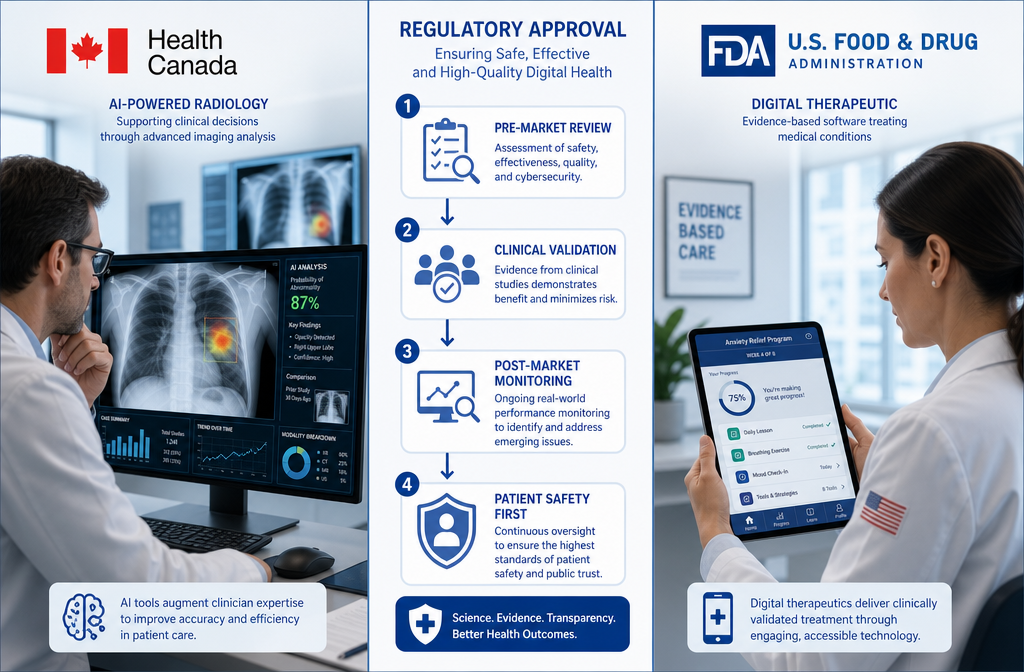
This is a core question in any FDA and Health Canada on AI Medical Devices: A Plain-Language Guide for Canadian Patients discussion. Both agencies require pre-market review, but their frameworks differ in structure.
FeatureHealth CanadaFDAPre-market review requiredYes (Class II-IV)Yes (510(k), De Novo, PMA)Post-market monitoringMandatory under 2026 guidanceRequired via MDR/MDD reportingAI-specific guidanceReleased April 1, 2026 [1]Ongoing; 1,200+ devices authorized [6]Change management (PCCP)Supported [3]SupportedJoint international principlesYes, with FDA and MHRA [5]Yes, with Health Canada and MHRA
Health Canada’s 2026 guidance specifically requires transparency, meaning manufacturers must clearly communicate how a device works and what its limitations are, to both clinicians and patients [4]. The FDA’s approach mirrors this, requiring labeling that discloses the AI’s intended use and the populations it was validated on.
For local health services in the South Georgian Bay region, patients can consult resources through the South Georgian Bay Community Health Clinic for guidance on new technologies being introduced into care settings.
What Types of Medical Conditions Can AI Devices Help Diagnose or Treat
AI devices are currently most established in imaging-heavy specialties and chronic disease management. Approved and authorized tools are being used across several areas:
- Radiology and pathology: Detecting tumors, diabetic retinopathy, and pneumonia in imaging scans
- Cardiology: Identifying atrial fibrillation from ECG or wearable data
- Mental health: Digital therapeutics for cognitive behavioral therapy delivery
- Diabetes: Continuous glucose monitors with predictive alerts
- Dermatology: Skin lesion classification tools to assist dermatologists
It is worth noting that most AI tools in clinical use today assist specialists rather than operate independently. The FDA’s semantic search tool for authorized AI devices allows clinicians and patients to look up specific products and their approved indications [6].
Who Shouldn’t Use AI Medical Devices or Might Be at Higher Risk
AI devices carry higher risk for certain patient groups, particularly those whose demographics were underrepresented in the training data used to build the algorithm. This is a known limitation regulators are actively addressing.
Higher-risk situations include:
- Patients from racial or ethnic groups underrepresented in the device’s training dataset
- Elderly patients, if the device was validated primarily on younger populations
- Patients with rare or complex conditions that fall outside the device’s tested scope
- Anyone using a consumer-grade AI health app that has not been reviewed by Health Canada or the FDA
Common mistake: Assuming that an AI app available in the App Store has been reviewed by a regulator. Most consumer wellness apps are not classified as medical devices and carry no regulatory approval.
What Are the Most Common Mistakes Patients Make When Using AI Medical Devices
Understanding this topic is central to any FDA and Health Canada on AI Medical Devices: A Plain-Language Guide for Canadian Patients resource. The most frequent errors include:
- Treating AI output as a diagnosis. AI tools provide decision support, not final diagnoses. A clinician must interpret the results.
- Using unregulated apps for serious health decisions. Many apps marketed as “AI health tools” are not licensed medical devices.
- Not disclosing AI tool use to their doctor. Clinicians need to know what tools a patient is using to avoid conflicting information.
- Ignoring software update notifications. Updates to AI devices can change how they perform; staying current matters.
- Assuming the AI knows their full history. Most AI tools analyze only the data they are given and have no access to a patient’s complete medical record.
For broader context on how digital tools and social media regulation and content moderation intersect with health information, Georgian Bay News has covered the evolving regulatory landscape in 2026.
What Happens If an AI Medical Device Malfunctions or Gives Incorrect Information
If an AI medical device produces an incorrect result or malfunctions, the consequences depend on how the device is used. A missed cancer diagnosis on an AI radiology tool, for example, could delay life-saving treatment.
Patients and clinicians in Canada can report problems with medical devices directly to Health Canada through the Medical Device Problem Reporting program. Manufacturers are required to investigate complaints and report serious incidents to the regulator. Under Health Canada’s expanded 2026 authority, the agency can impose new conditions on a device license or suspend it if post-market evidence reveals safety concerns [2].
The FDA operates a similar system through its MedWatch reporting program and the Medical Device Reporting (MDR) requirements.
Are There Any Privacy Concerns With AI Medical Devices Collecting Patient Data
Yes, and this is one of the most significant concerns for Canadian patients. AI devices often require access to large volumes of personal health data to function, including imaging files, genetic data, wearable sensor readings, and electronic health records.
In Canada, this data is protected under provincial privacy laws and the federal Personal Information Protection and Electronic Documents Act (PIPEDA). Health Canada’s 2026 guidance requires manufacturers to address data governance as part of their pre-market submission [1].
Key questions patients should ask:
- Where is my data stored (Canada, the U.S., or elsewhere)?
- Who has access to it?
- Can I request that my data be deleted?
- Is the data used to retrain the AI model?
This is especially relevant given the cross-border nature of many AI platforms. A device authorized by the FDA may be used in Canadian clinics, meaning patient data could flow across jurisdictions. Staying informed about smart technology and data practices is increasingly important for patients.
What Training Do Doctors Need to Use AI Medical Devices Effectively
Physicians and other health professionals need specific training to use AI medical devices responsibly. A clinician who does not understand an AI tool’s limitations may over-rely on its outputs or fail to catch errors.
Health Canada’s 2026 guidance and the joint GMLP principles emphasize that manufacturers must provide clear documentation and training materials [5]. Responsibilities include:
- Understanding the population the device was validated on
- Knowing the device’s false positive and false negative rates
- Recognizing when a result falls outside the device’s tested scope
- Reporting adverse events through proper channels
Medical schools and continuing education programs are beginning to incorporate AI literacy into curricula, but this is still developing across Canada. Local health professionals in areas like South Georgian Bay communities are navigating these changes alongside their urban counterparts.
Can AI Medical Devices Replace Human Medical Professionals Completely
No. AI medical devices are designed to assist clinicians, not replace them. This is a regulatory requirement, not just a philosophical position. Both Health Canada and the FDA classify most AI diagnostic tools as decision-support systems, meaning a qualified human must remain in the decision-making loop.
There are practical reasons for this beyond regulation. AI tools can fail in ways that are difficult to predict, particularly when they encounter data that differs from their training set. A physician brings contextual judgment, patient history, and ethical accountability that no current AI system can replicate.
The more useful question is: “Is my doctor using AI tools appropriately, with proper oversight?” Patients are encouraged to ask their care providers how AI tools factor into their assessments.
What Are the Limitations of Current AI Medical Device Technologies
Current AI medical devices have real and well-documented limitations that patients should understand:
- Dataset bias: If a device was trained mostly on data from one demographic group, it may perform poorly on others
- Lack of explainability: Many AI models cannot clearly explain why they produced a particular result, which complicates clinical review
- Regulatory lag: The technology evolves faster than regulatory frameworks, meaning some devices in use may predate current standards
- Connectivity dependence: Cloud-based AI tools require reliable internet access, which can be a barrier in rural areas like South Georgian Bay
- Scope limitations: A device validated for one condition cannot be assumed to work accurately for related conditions
Health Canada’s introduction of Predetermined Change Control Plans (PCCPs) addresses one key limitation: it allows manufacturers to pre-authorize specific future updates to their AI models, so the device can improve without requiring a full new review each time [3]. In October 2023, Health Canada, the FDA, and the UK’s MHRA jointly established five guiding principles for PCCPs to ensure this process remains safe [3].
Conclusion
The regulatory landscape for AI medical devices is maturing quickly. Health Canada’s April 2026 guidance for machine learning-enabled medical devices, combined with the FDA’s growing library of authorized AI tools and shared international principles, gives Canadian patients a stronger safety net than existed just a few years ago.
Actionable next steps for Canadian patients:
- Before using any AI health tool, ask your care provider whether it is licensed by Health Canada or authorized by the FDA
- Check Health Canada’s medical device license database to verify a product’s approval status
- Report any concerns about AI device performance to Health Canada through its online reporting tool
- Ask your provider about data storage and privacy practices before consenting to AI-assisted care
- Stay informed through trusted sources, including local health resources at the South Georgian Bay Community Health Clinic and updates from Georgian Bay News
AI in medicine holds genuine promise, but informed patients who ask the right questions are the best safeguard against its current limitations.
FAQ
Q: Does Health Canada approve every AI medical device separately?
A: Yes. All Class II, III, and IV medical devices, including AI-powered ones, require a medical device license from Health Canada before they can be sold or used in Canada [7].
Q: Is an AI health app on my phone considered a medical device?
A: Only if it is intended to diagnose, treat, or monitor a medical condition. General wellness apps typically are not regulated as medical devices. When in doubt, check Health Canada’s device license database.
Q: How is the FDA involved in Canada’s AI medical device approvals?
A: The FDA does not approve devices for Canadian use, but Health Canada and the FDA share research, develop joint guidance principles, and align standards to reduce duplication for manufacturers operating in both countries [5].
Q: What is a Predetermined Change Control Plan (PCCP)?
A: A PCCP is a pre-approved plan that allows an AI device manufacturer to make specific updates to their algorithm after market authorization without requiring a full new review. It keeps the device current while maintaining safety oversight [3].
Q: Can I find out if my hospital is using an AI diagnostic tool?
A: Yes. You can ask your care team directly. Transparency is a requirement under Health Canada’s 2026 guidance, meaning providers should be able to tell you if AI tools are part of your care [4].
Q: What should I do if I think an AI device gave my doctor wrong information?
A: Speak with your doctor first. If you believe a device malfunction contributed to a health problem, you or your provider can file a report with Health Canada through the Medical Device Problem Reporting program.
Q: Are AI medical devices more expensive for patients?
A: The cost to patients depends on how the device is integrated into care. Many AI tools are used by hospitals and clinics as part of standard services, with no direct charge to the patient. Some consumer-facing AI health tools carry subscription fees.
Q: Do rural Canadian patients have equal access to AI medical devices?
A: Not always. Cloud-based AI tools require reliable internet, which remains a challenge in some rural and remote areas. This is an equity gap that health policy advocates are actively raising.
References
[1] Pre Market Guidance Machine Learning Enabled Medical Devices – https://www.canada.ca/en/health-canada/services/drugs-health-products/medical-devices/application-information/guidance-documents/pre-market-guidance-machine-learning-enabled-medical-devices.html?utm_source=openai
[2] Health Canada Machine Learning Medical Device MLMD Pre Market Guidance 2026 Guide – https://meddeviceguide.com/blog/health-canada-machine-learning-medical-device-mlmd-pre-market-guidance-2026-guide?utm_source=openai
[3] Predetermined Change Control Plans Machine Learning Enabled Medical Devices – https://www.canada.ca/en/health-canada/services/drugs-health-products/medical-devices/good-machine-learning-practice-medical-device-development/predetermined-change-control-plans-machine-learning-enabled-medical-devices.html?utm_source=openai
[4] Transparency Machine Learning Guiding Principles – https://www.canada.ca/en/health-canada/services/drugs-health-products/medical-devices/transparency-machine-learning-guiding-principles.html?utm_source=openai
[5] Good Machine Learning Practice Medical Device Development – https://www.canada.ca/en/health-canada/services/drugs-health-products/medical-devices/good-machine-learning-practice-medical-device-development.html?utm_source=openai
[6] FDA AI Search Tool Research – https://arxiv.org/abs/2602.00006?utm_source=openai
[7] Medical Devices Regulations (SOR-98-282) – https://laws.justice.gc.ca/eng/regulations/SOR-98-282/FullText.html?pedisable=true&wbdisable=false&utm_source=openai
Content, illustrations, and third-party video appearing on GEORGIANBAYNEWS.COM may be generated or curated with AI assistance or reproduced pursuant to the fair dealing provisions of the Copyright Act, R.S.C. 1985, c. C-42. Attribution and hyperlinks to original sources are provided in acknowledgment of applicable intellectual property rights. Such referencing is intended to direct traffic to and support the original rights holders’ platforms.
Much Appreciate You Sharing This Post - It Helps MUCH!!!