





















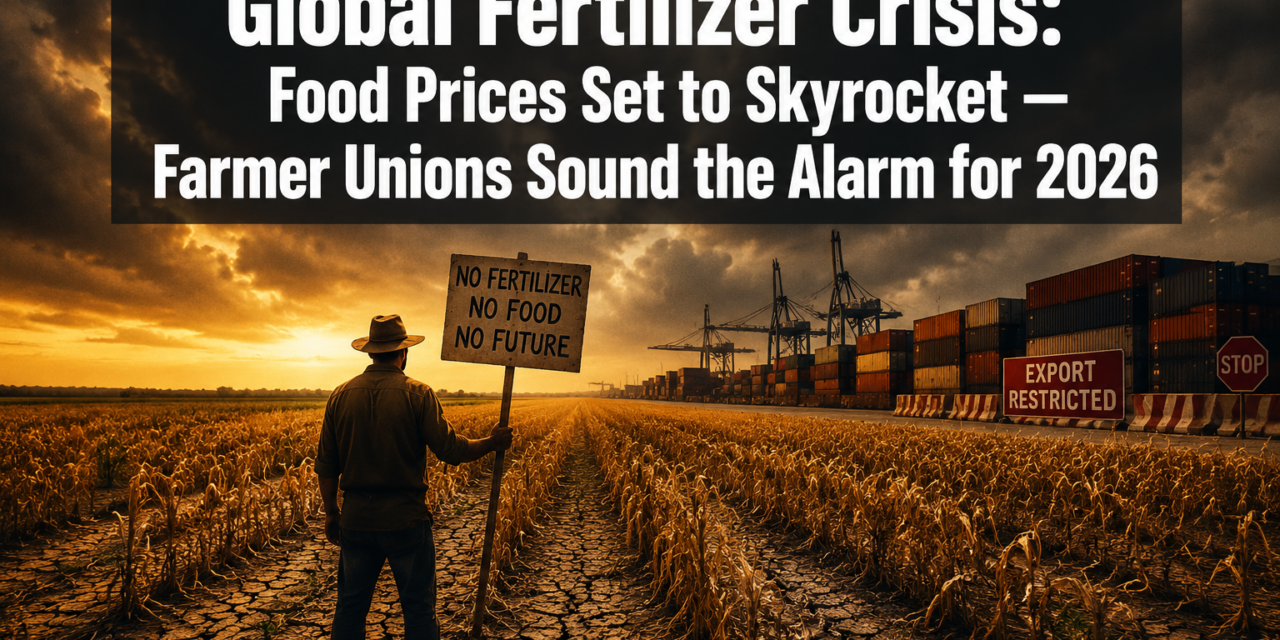
Global Fertilizer Crisis Threatens Food Price Skyrocket: Farmer Unions’ Urgent Warnings for 2026

Last updated: May 13, 2026
Quick Answer: A military conflict affecting the Strait of Hormuz has blocked roughly 30% of globally traded fertilizers, sending urea prices up 50% in under three weeks during early 2026. Farmer unions worldwide issued urgent alerts in May 2026, warning that spring planting decisions made right now will determine whether food prices spike sharply later this year — and there is no second chance once the planting window closes.
Key Takeaways
- 🚢 Maritime traffic through the Strait of Hormuz collapsed by an estimated 95% following U.S.-Israeli strikes on Iran in late February 2026, stranding critical fertilizer shipments [4]
- 📈 Urea prices surged from roughly $450/ton to over $700/ton between late February and mid-March 2026 — a 50% jump in less than three weeks [2]
- 🌾 Approximately 30% of all internationally traded fertilizers, including 30–35% of global urea exports, move through the Strait of Hormuz [2][5]
- ⚠️ Ammonia shipments through the Strait collapsed from 395,000 metric tons in March 2025 to just 30,000 metric tons in March 2026 [3]
- 🌍 FAO projects global fertilizer prices could average 15–20% higher throughout the first half of 2026 if the crisis persists [1]
- 🌱 The crisis coincides directly with the spring 2026 planting window — missing it means no crop recovery is possible this cycle [2]
- 💰 Nitrogenous fertilizer costs had already risen 22% from February 2025 to February 2026, before the conflict escalated [2]
- 🏛️ Farmer unions globally issued coordinated alerts on May 12, 2026, calling for emergency government intervention and strategic reserve releases
What Triggered the 2026 Global Fertilizer Crisis?
The immediate trigger was military action. U.S.-Israeli strikes on Iran beginning February 28, 2026 effectively shut down commercial shipping through the Strait of Hormuz. Maritime traffic through this narrow chokepoint dropped from approximately 130 ships per day to single digits by early March — a collapse of roughly 95% [4].
The Strait of Hormuz is not just an oil corridor. Around 30% of all internationally traded fertilizers move through it, including 30–35% of global urea exports and 20–30% of ammonia exports [2][5]. When that route closed, the fertilizer supply chain broke almost immediately.
Key contributing factors:
- Geopolitical conflict blocking the world’s most critical fertilizer shipping lane
- Pre-existing price pressure: nitrogenous fertilizer costs had already climbed 22% in the year before the strikes [2]
- Rising fuel costs affecting irrigation, transport, and production across the agricultural value chain [1]
- Climate-related disruptions already straining crop output in several major growing regions — a pattern covered in depth by researchers tracking the biodiversity crisis and its agricultural consequences
How Bad Are the Fertilizer Price Spikes in 2026?

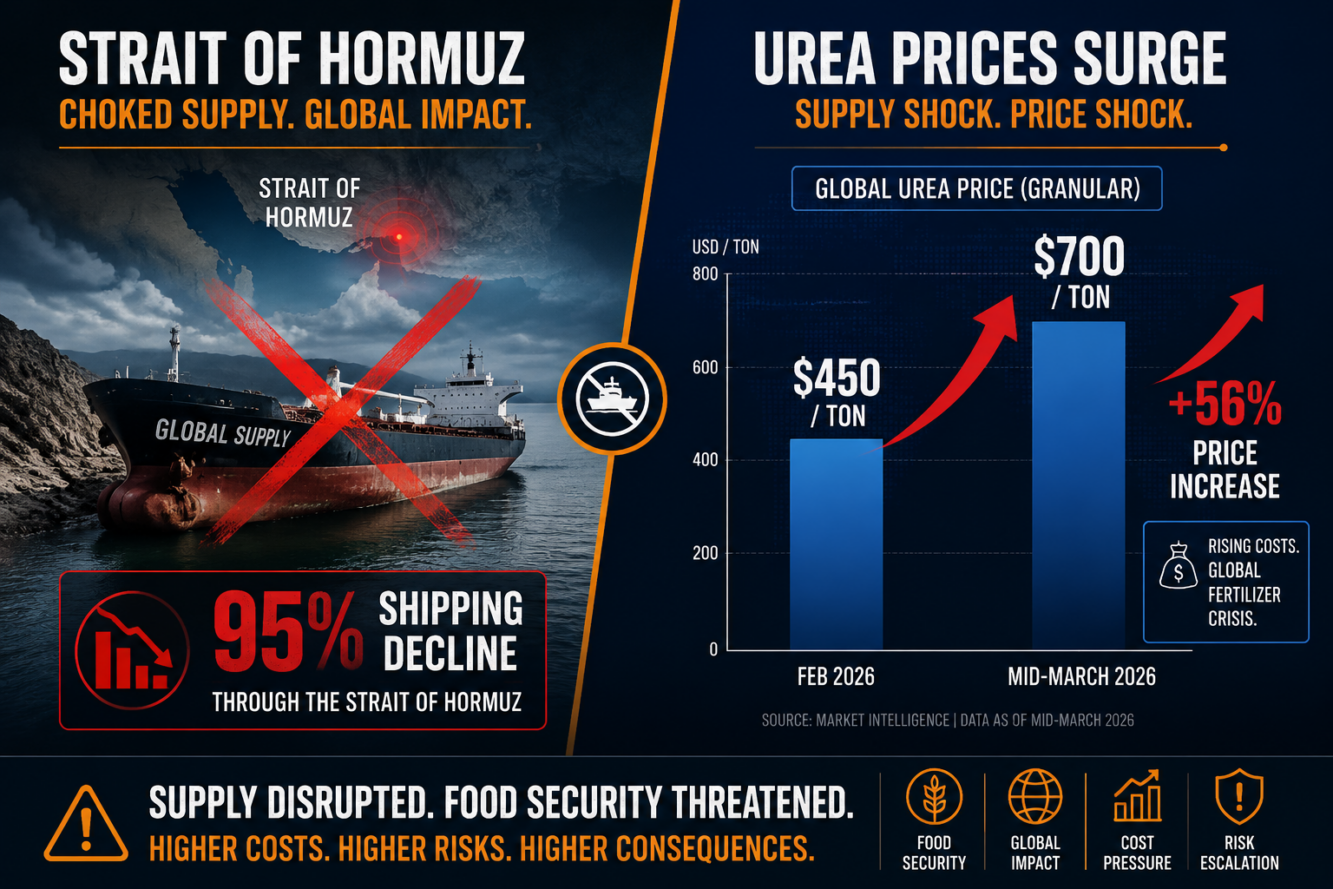
The price moves have been severe and fast. Urea prices jumped from above $450 per ton on February 27 to over $700 per ton by mid-March 2026 — a 50% increase in under three weeks [2][3]. Ammonia spot prices pushed toward $800–$1,000 per ton in key import markets during the same period [2].
Regional data tells a sharper story:
| Region | Price Change (Early March 2026) |
|---|---|
| Middle East granular urea | +19% in the first week of March [1] |
| Egyptian urea | +28% surge [1] |
| Global urea average | +50% vs. late February [2] |
| Ammonia (March 2025 → March 2026) | Shipments collapsed 92% by volume [3] |
FAO’s chief economist warned that global fertilizer prices could average 15–20% higher throughout the first half of 2026 if the disruption continues [1]. That sustained elevation — not just a short spike — is what farmer unions say will translate directly into higher food prices at supermarkets by late 2026.
Why Are Farmer Unions Sounding the Alarm Now?
Farmer unions issued coordinated urgent warnings in May 2026 because the planting window is closing. Fertilizer decisions for the 2026 crop cycle must be made, purchased, and applied during a narrow spring window. Missing it means no recovery is possible for this growing season [2].
The Global Fertilizer Crisis Threatens Food Price Skyrocket: Farmer Unions’ Urgent Warnings for 2026 framing is not alarmist — it reflects a structural timing problem. Farmers who cannot afford fertilizer at current prices face two bad choices:
- Apply less fertilizer and accept lower yields
- Switch to less input-intensive crops (such as soybeans) that generate lower revenue per acre
Both outcomes reduce food supply. FAO anticipates reduced yields for fertilizer-intensive crops including wheat, rice, and maize under medium-term disruption scenarios, alongside crop substitution toward nitrogen-fixing crops and increased competition from biofuel production [1].
Farmers also face a dual cost shock: fertilizer prices are up sharply, and fuel costs for irrigation and transport have risen simultaneously [1]. The combination squeezes margins to the point where some producers in lower-income regions may exit production entirely this season.
The carbon cycle implications of large-scale crop substitution and reduced yields are also drawing attention from environmental researchers, as soil health and carbon sequestration patterns shift with farming decisions.
Which Countries and Crops Face the Highest Risk?
Countries that import most of their fertilizer and rely heavily on nitrogen-intensive crops face the greatest exposure. South Asia, Sub-Saharan Africa, and parts of Latin America are particularly vulnerable because they have limited domestic fertilizer production and thin foreign currency reserves to absorb price shocks [3][8].
Highest-risk crop categories:
- Wheat and rice — heavily nitrogen-dependent; yield losses from reduced fertilizer application are disproportionately large, especially in regions with low baseline fertilizer use [1]
- Maize — a staple and biofuel feedstock; higher oil prices simultaneously increase biofuel demand, intensifying competition [1]
- Vegetables and cash crops — smaller farms with no hedging capacity absorb full spot-price exposure
Even modest reductions in fertilizer application can produce disproportionately large crop yield declines, particularly where soil fertility is already marginal [1]. This asymmetry is what makes the Global Fertilizer Crisis Threatens Food Price Skyrocket: Farmer Unions’ Urgent Warnings for 2026 credible rather than speculative.
Discussions around biodiversity loss are increasingly intersecting with food security concerns, as monoculture farming systems under fertilizer stress show reduced resilience.
What Can Governments and Farmers Do Right Now?
Direct, actionable responses exist — but the window is short.
For governments:
- Release strategic fertilizer reserves where available
- Negotiate emergency import agreements with non-Hormuz suppliers (Russia, Canada, Morocco for potash)
- Provide targeted subsidies or credit guarantees to smallholder farmers who cannot absorb spot-price increases
- Accelerate diplomatic efforts to reopen shipping lanes
For farmers:
- Lock in forward contracts for fertilizer immediately if cash flow allows
- Consult agronomists about precision application techniques that maintain yield with 10–15% less input
- Consider nitrogen-fixing cover crops or legume rotations as partial substitutes
- Monitor carbon tax policy changes that could affect input cost calculations
For food supply chains:
- Diversify sourcing away from single-origin fertilizer suppliers
- Build 60–90 day buffer stocks for the most exposed commodities
- Engage with business development resources available in agricultural communities for financial planning support
FAQ
Q: What is the Strait of Hormuz, and why does it matter for food prices? The Strait of Hormuz is a narrow waterway between Iran and Oman. About 30% of internationally traded fertilizers pass through it. When shipping stopped in early 2026, global fertilizer supply dropped sharply, pushing prices up and threatening crop yields worldwide [2][5].
Q: How much have fertilizer prices risen in 2026? Urea prices rose roughly 50% in under three weeks, from above $450/ton in late February to over $700/ton by mid-March 2026. Ammonia spot prices approached $800–$1,000/ton in key markets [2][3].
Q: When did farmer unions issue their 2026 warnings? Major farmer union coalitions issued coordinated urgent warnings on May 12, 2026, calling for emergency government intervention before the spring planting window closes permanently for this crop cycle.
Q: Which fertilizers are most affected? Urea (the most widely used nitrogen fertilizer) and ammonia are most directly affected. Ammonia shipments through the Strait fell from 395,000 metric tons in March 2025 to just 30,000 metric tons in March 2026 [3].
Q: Will food prices definitely rise because of this crisis? FAO projects fertilizer prices could average 15–20% higher in the first half of 2026 if disruptions persist. Reduced yields from lower fertilizer use typically translate into higher food prices within one to two growing seasons [1].
Q: Are there fertilizer suppliers outside the Hormuz corridor? Yes. Russia, Canada, and Morocco are significant suppliers of nitrogen, potash, and phosphate respectively, with export routes that bypass the Strait. However, redirecting global supply chains takes months, not weeks.
Q: What crops are most at risk? Wheat, rice, and maize face the highest yield risk because they are nitrogen-intensive. Even a modest reduction in fertilizer application produces disproportionately large yield losses, particularly in regions with already-low soil fertility [1].
Q: Can farmers switch to organic alternatives quickly? Not at scale within a single season. Organic nitrogen sources (compost, manure, legume rotation) require planning cycles of one to three years to replace synthetic fertilizer effectively at commercial yields.
Q: What is the role of the war in Iran in this crisis? U.S.-Israeli strikes on Iran beginning February 28, 2026 triggered the shipping collapse. The conflict effectively blocked the world’s most critical fertilizer trade corridor at the worst possible time — the start of the spring planting season [4][7].
Conclusion
The Global Fertilizer Crisis Threatens Food Price Skyrocket: Farmer Unions’ Urgent Warnings for 2026 is not a future risk — it is an active emergency with a closing window for intervention. Urea prices have already surged 50%, ammonia shipments through the Strait of Hormuz have collapsed by over 90% year-on-year, and FAO has formally warned of sustained price elevation through mid-2026 [1][2][3].
Actionable next steps for stakeholders:
- Farmers: Secure fertilizer contracts now, consult agronomists on precision application, and explore crop rotation options that reduce nitrogen dependency
- Governments: Activate strategic reserves, fast-track alternative supplier agreements, and deploy targeted support for smallholder farmers before planting decisions are finalized
- Consumers and food businesses: Expect food price pressure on wheat, rice, and maize products by Q3–Q4 2026 and plan procurement accordingly
- Policymakers: Treat fertilizer supply chain resilience as a food security priority equal to energy security — this crisis has demonstrated they are inseparable
The spring 2026 planting window will not wait for diplomatic resolution. Every week of delay in policy response translates directly into lower yields, tighter food supplies, and higher prices for the world’s most vulnerable populations.
References
[1] FAO Chief Economist Warns of Severe Global Food Security Risks from Disruption to Strait of Hormuz Trade Corridor – https://www.fao.org/newsroom/detail/fao-chief-economist-warns-of-severe-global-food-security-risks-from-disruption-to-strait-of-hormuz-trade-corridor/en
[2] 2026 Global Fertilizer Shortage – https://phycoterra.com/blog/2026-global-fertilizer-shortage/
[3] Fertilizer Crisis Deepens As Middle East Tensions Shake Global Food Markets – https://www.agrolatam.com/news/fertilizer-crisis-deepens-as-middle-east-tensions-shake-global-food-markets-hard-8221/
[4] UN News – Strait of Hormuz Shipping Collapse – https://news.un.org/en/story/2026/03/1167182
[5] Fertilizer Price, Iran War, Food Security, Inflation — Urea, Potash, Nitrogen, Farmers – https://www.cnbc.com/2026/03/25/fertilizer-price-iran-war-food-security-inflation-urea-potash-nitrogen-farmers.html
[7] The War in Iran Sparks a Global Fertilizer Shortage and Threatens Food Prices – https://www.ksat.com/business/2026/03/27/the-war-in-iran-sparks-a-global-fertilizer-shortage-and-threatens-food-prices/
[8] Global Fertilizer Crisis May Push Food Prices Higher – https://www.farmprogress.com/crop-protection/global-fertilizer-crisis-may-push-food-prices-higher
Much Appreciate You Sharing This Post - It Helps MUCH!!!