






















Human Rights Watch Report: Why Three-Quarters of Global Population Lives Under Autocracy in 2026

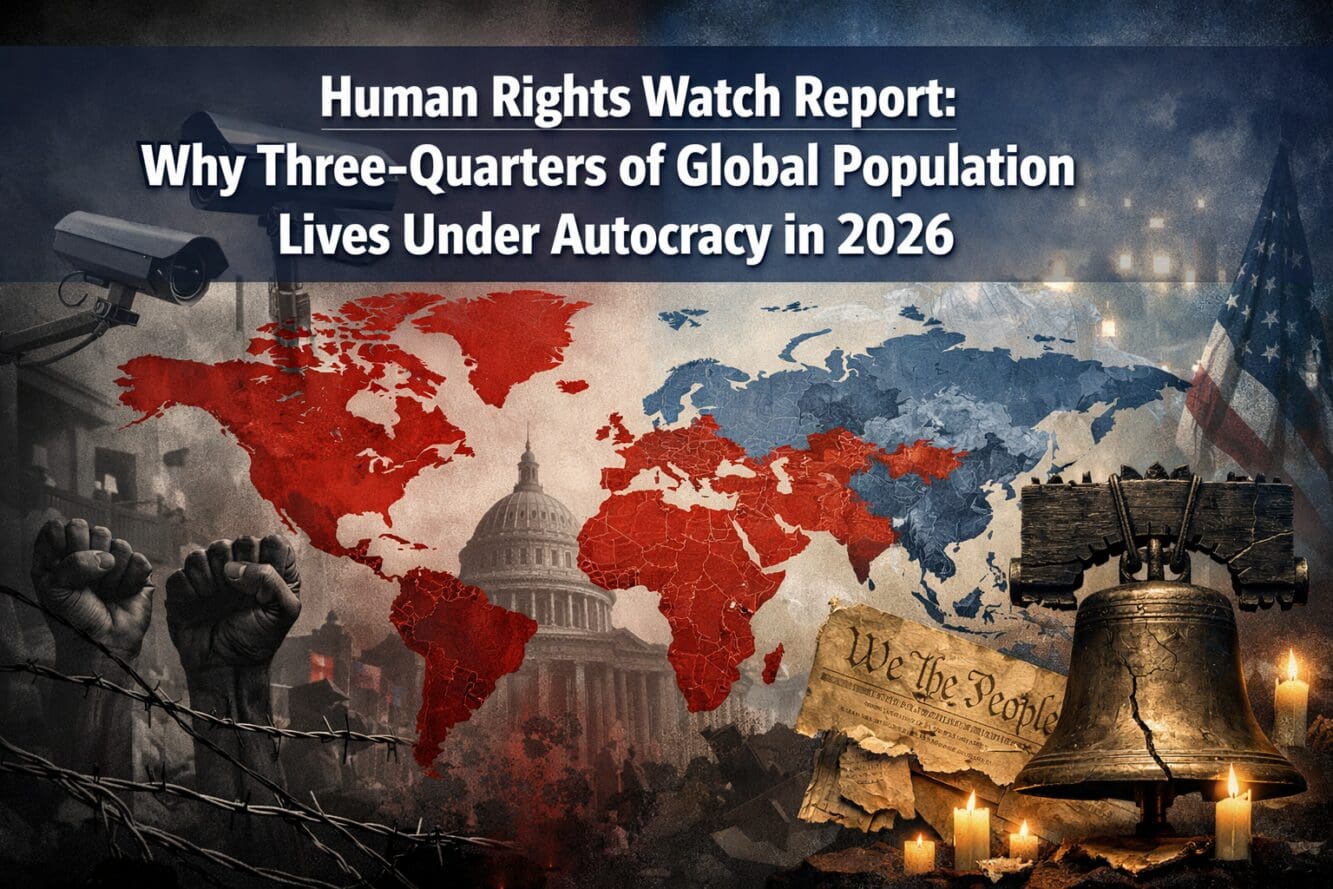
The world stands at a critical crossroads. A sobering new analysis from Human Rights Watch reveals that 72 percent of the world’s population now lives under autocratic rule—a staggering reality that marks the most significant retreat from democracy in four decades. The Human Rights Watch Report: Why Three-Quarters of Global Population Lives Under Autocracy in 2026 exposes how major powers including the United States, China, and Russia are leading a coordinated assault on democratic norms, threatening the very foundations of human rights and global stability.

This isn’t just a statistic—it’s a generational crisis. Democracy has regressed to 1985 levels, erasing decades of progress and plunging billions of people back into systems where freedom, justice, and human dignity hang by increasingly fragile threads.[3]

Key Takeaways
- 72% of the global population now lives under autocratic governments, representing almost three-quarters of humanity and marking democracy’s lowest point since 1985[1][3]
- Democratic backsliding affects all major powers, with Russia, China, and the United States all less free today than 20 years ago[2][3]
- The rules-based international order faces unprecedented threats from coordinated pressure by authoritarian regimes and democratic backsliding in traditional Western powers[3]
- Civil liberties are under systematic attack through government retaliation, dismantling of racial justice programs, restrictions on women’s rights, and suppression of civil society[4][5]
- Violent enforcement tactics previously condemned in authoritarian states are now being deployed domestically in the U.S., including mass raids and enforced disappearances[2]
Understanding the Human Rights Watch Report: Why Three-Quarters of Global Population Lives Under Autocracy in 2026

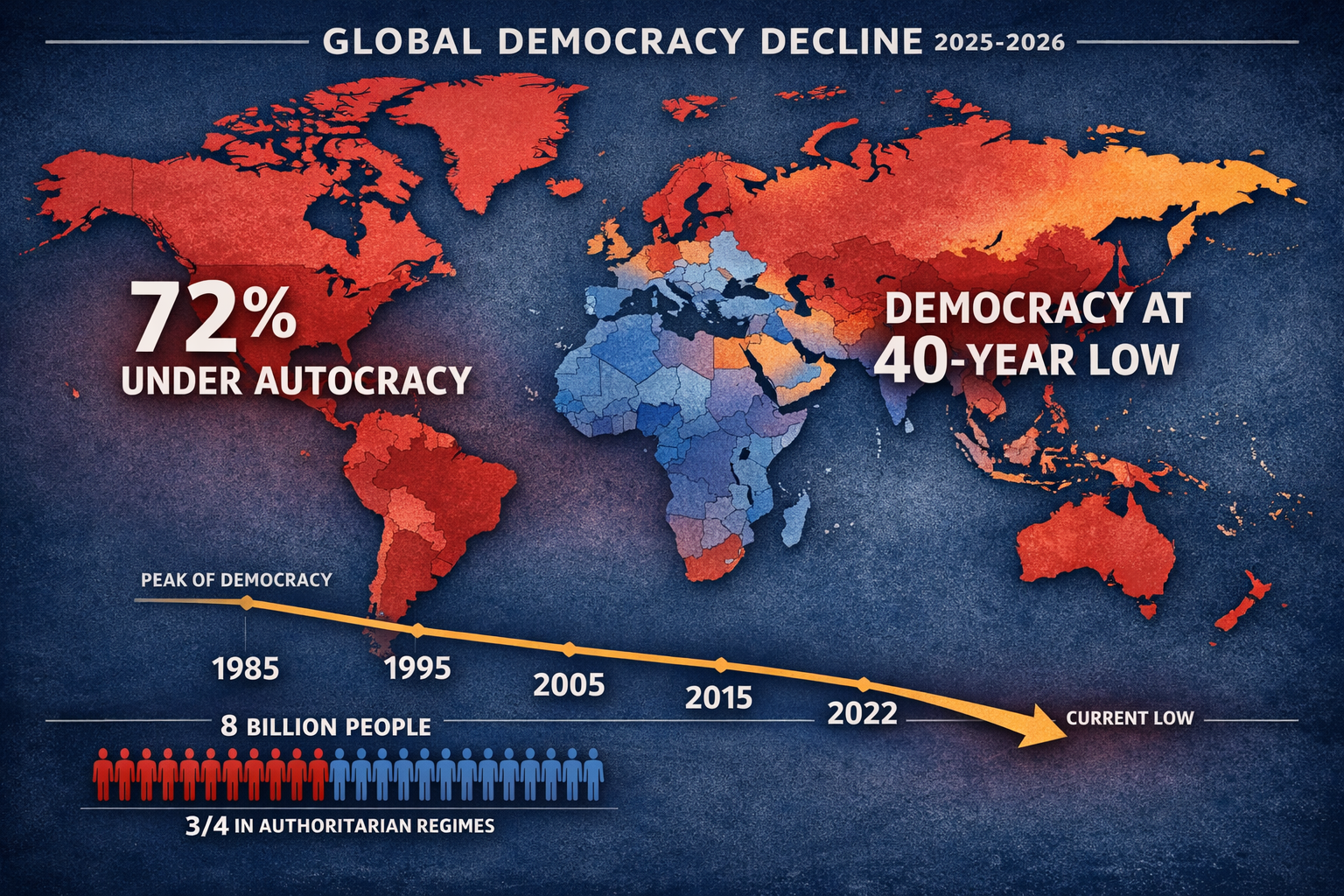
The latest Human Rights Watch World Report 2026 delivers a stark warning: the democratic wave that began over 50 years ago has not just stalled—it has reversed dramatically. What scholars call a “democratic recession” has evolved into something far more dangerous: a coordinated authoritarian advance.[3]
The Numbers Behind the Crisis
When examining the data, the scope becomes clear:
| Metric | Current Status | Historical Comparison |
|---|---|---|
| Population Under Autocracy | 72% | Highest since 1985 |
| Democracy Index Level | 1985 equivalent | 40-year low |
| Major Powers Declining | US, China, Russia | All less free than 2006 |
| Democratic Institutions | Under systematic attack | Unprecedented erosion |
This represents approximately 5.8 billion people living under governments that restrict fundamental freedoms, suppress dissent, and operate without meaningful accountability to their citizens.[1]
The Global Drivers of Democratic Decline
China and Russia: Authoritarian Expansion
Both China and Russia have become significantly less free over the past two decades, consolidating power internally while exporting authoritarian practices globally.[2][3] These nations have:
- ✊ Strengthened surveillance states using advanced technology
- 📉 Eliminated political opposition and independent media
- 🌍 Promoted authoritarian governance models internationally
- 💰 Used economic leverage to silence criticism abroad
The influence of these authoritarian giants extends far beyond their borders, creating what Human Rights Watch describes as “relentless pressure” on the international rules-based order.[3]
The United States: Democracy Under Siege
Perhaps most alarming is the democratic backsliding within the United States itself. The Human Rights Watch Report: Why Three-Quarters of Global Population Lives Under Autocracy in 2026 documents how Trump’s second-term administration has undertaken sweeping attacks on fundamental rights.[3][5]
“The rules-based international order is being crushed under relentless pressure from the Trump administration, China, and Russia, threatening the architecture that human rights defenders have relied upon to advance norms and protect freedoms.”[3]
Systematic Rights Violations in America
The report catalogs disturbing patterns that mirror tactics used by authoritarian regimes:
Undermining Democratic Institutions:
- Attacking the sanctity of elections and reducing government accountability
- Gutting judicial independence and defying court orders
- Using federal agencies to retaliate against political opponents[3][5]
Targeting Vulnerable Populations:
- Immediately terminating all federal diversity, equity, and inclusion programs
- Taking actions to erase Black history and resist accountability for racial injustice
- Obstructing access to abortion care and stripping protections from trans and intersex people[4][5]
Suppressing Civil Society:
- Cutting university research funding through executive orders
- Threatening tax-exempt status of nonprofits
- Using the FCC and Department of Justice to intimidate critics and silence the media[4][5]
Violent Enforcement: A New American Reality
The Human Rights Watch report documents tactics that would typically appear in critiques of authoritarian states, now deployed on American soil. Immigration and Customs Enforcement (ICE) has carried out “hundreds of unnecessarily violent and abusive raids” involving masked, armed agents using tactics previously considered unthinkable in U.S. human rights assessments.[2]
Even more shocking, the administration engaged in enforced disappearances under international law by sending 252 Venezuelan migrants to a maximum-security prison in El Salvador, where documented allegations include torture, beatings, and sexual violence.[2]
These actions represent not just policy failures but fundamental violations of international human rights norms that the United States once championed globally.
The Emboldening of Global Autocrats
The democratic decline in major Western powers has created a permission structure for autocrats worldwide. The current U.S. administration has:
- 🤝 Expressed admiration for Europe’s nativist far right
- 👥 Favored autocrats including Hungary’s Viktor Orban, Turkey’s Recep Tayyip Erdoğan, and El Salvador’s Nayib Bukele
- 💼 Maintained decades-long support for Saudi Arabia’s Mohammed bin Salman and Egypt’s Abdel Fattah al-Sisi[3]
This diplomatic embrace of authoritarian leaders undermines democratic allies and signals that human rights violations will face minimal consequences from traditional democratic powers.
What the Human Rights Watch Report Means for Global Stability
The concentration of three-quarters of humanity under autocratic rule creates cascading risks for international peace, economic development, and human welfare. When democratic accountability disappears, several dangerous patterns emerge:
Increased Conflict Risk
Autocratic governments face fewer domestic constraints on military adventurism and aggressive foreign policies. Without transparent decision-making or public accountability, the risk of miscalculation and conflict rises dramatically.
Economic Instability
Authoritarian systems lack the institutional checks that prevent corruption, ensure property rights, and maintain economic stability. As more of the global economy operates under autocratic control, systemic risks multiply.
Human Rights Catastrophes
Without democratic oversight, vulnerable populations face systematic oppression with limited recourse. The dismantling of international human rights mechanisms means fewer protections for billions of people.[3]
Migration Pressures
As freedoms contract and economic opportunities diminish under autocratic rule, migration pressures intensify, creating humanitarian crises and political tensions globally.
The Path Forward: Breaking the Authoritarian Wave
Despite the grim assessment in the Human Rights Watch Report: Why Three-Quarters of Global Population Lives Under Autocracy in 2026, the organization emphasizes that this represents a generational challenge, not an inevitable outcome.[6]
Strategies for Democratic Renewal
Strengthening Civil Society:
Organizations, activists, and ordinary citizens must build resilient networks that can withstand government pressure and continue advocating for rights and accountability.
International Solidarity:
Democratic nations and civil society groups must coordinate support across borders, recognizing that authoritarian tactics are increasingly globalized and require coordinated responses.
Protecting Independent Institutions:
Universities, courts, media organizations, and nonprofits serve as crucial checks on government power. Defending their independence and funding is essential for democratic survival.
Electoral Engagement:
Where elections still occur, participation becomes more critical than ever. Voter turnout, election monitoring, and protection of voting rights can slow or reverse authoritarian advances.
Economic Accountability:
Leveraging economic tools—including sanctions, investment restrictions, and trade policies—to impose costs on authoritarian behavior while supporting democratic alternatives.
Conclusion: A Defining Moment for Human Rights
The Human Rights Watch Report: Why Three-Quarters of Global Population Lives Under Autocracy in 2026 represents more than an annual assessment—it’s a warning signal that demands immediate attention and action. With 72 percent of humanity now living under autocratic governments, the democratic foundations that protect human rights, enable economic prosperity, and maintain international peace face existential threats.[1][3]
The simultaneous democratic backsliding in the United States, China, and Russia creates a perfect storm where authoritarian practices normalize globally, civil society faces systematic suppression, and the international architecture for protecting human rights crumbles under coordinated assault.
What You Can Do Now
Stay Informed: Regularly review reports from organizations tracking global democracy and human rights to understand evolving threats.
Support Civil Society: Donate to, volunteer with, or amplify organizations defending democratic institutions, press freedom, and human rights in your community and globally.
Engage Politically: Vote in every election, contact representatives about human rights concerns, and hold elected officials accountable for democratic backsliding.
Build Networks: Connect with others committed to democratic values, creating resilient communities that can withstand authoritarian pressure.
Document and Share: When you witness rights violations or democratic erosion, document them safely and share through appropriate channels to maintain public awareness.
The battle for democracy and human rights will define this generation. The question isn’t whether the authoritarian wave can be broken—it’s whether enough people will mobilize with sufficient urgency to turn the tide before democratic institutions erode beyond repair. The time for action is now, while the tools of democratic resistance still exist to be wielded.
References
[1] Human Rights Watch Three Quarters Of The Worlds Population Living Under Autocracy – https://www.democracynow.org/2026/2/5/headlines/human_rights_watch_three_quarters_of_the_worlds_population_living_under_autocracy
[2] Human Rights Watch Warns Us Heading To Authoritarianism 6750121 4 – https://www.lemonde.fr/en/international/article/2026/02/04/human-rights-watch-warns-us-heading-to-authoritarianism_6750121_4.html
[3] hrw – https://www.hrw.org/world-report/2026
[4] United States – https://www.hrw.org/world-report/2026/country-chapters/united-states
[5] Meeting Trumps Challenge To Human Rights – https://www.hrw.org/news/2026/02/04/meeting-trumps-challenge-to-human-rights
[6] Breaking The Authoritarian Wave A Generational Challenge For Human – https://www.hrw.org/video-photos/video/2026/02/04/breaking-the-authoritarian-wave-a-generational-challenge-for-human
Some content and illustrations on GEORGIANBAYNEWS.COM are created with the assistance of AI tools.
GEORGIANBAYNEWS.COM shares video content from YouTube creators under fair use principles. We respect creators’ intellectual property and include direct links to their original videos, channels, and social media platforms whenever we feature their content. This practice supports creators by driving traffic to their platforms.
Much Appreciate You Sharing This Post - It Helps MUCH!!!