






















Jesse Jackson, Charismatic Champion of Civil Rights, Dies at 84

Last updated: February 18, 2026
The Reverend Jesse Jackson, one of America’s most influential civil rights leaders and a towering figure in the fight for racial and economic justice, died peacefully on Tuesday morning, February 17, 2026, surrounded by his family. He was 84 years old. Jackson’s death marks the end of an era for the civil rights movement, as he was among the last living leaders who worked directly alongside Dr. Martin Luther King Jr. during the pivotal struggles of the 1960s.[1]

For more than six decades, Jesse Jackson stood at the forefront of social justice movements, challenging corporate America to embrace diversity, inspiring millions through his presidential campaigns, and never wavering in his commitment to what he called “keeping hope alive.” His distinctive voice, memorable rhymes, and unwavering determination made him one of the most recognizable figures in American politics and civil rights advocacy.
Key Takeaways
- Jesse Jackson died on February 17, 2026, at age 84 after battling progressive supranuclear palsy (PSP) for approximately a decade
- He was a close aide to Dr. Martin Luther King Jr. and present at King’s assassination in 1968, shaping his lifelong commitment to civil rights
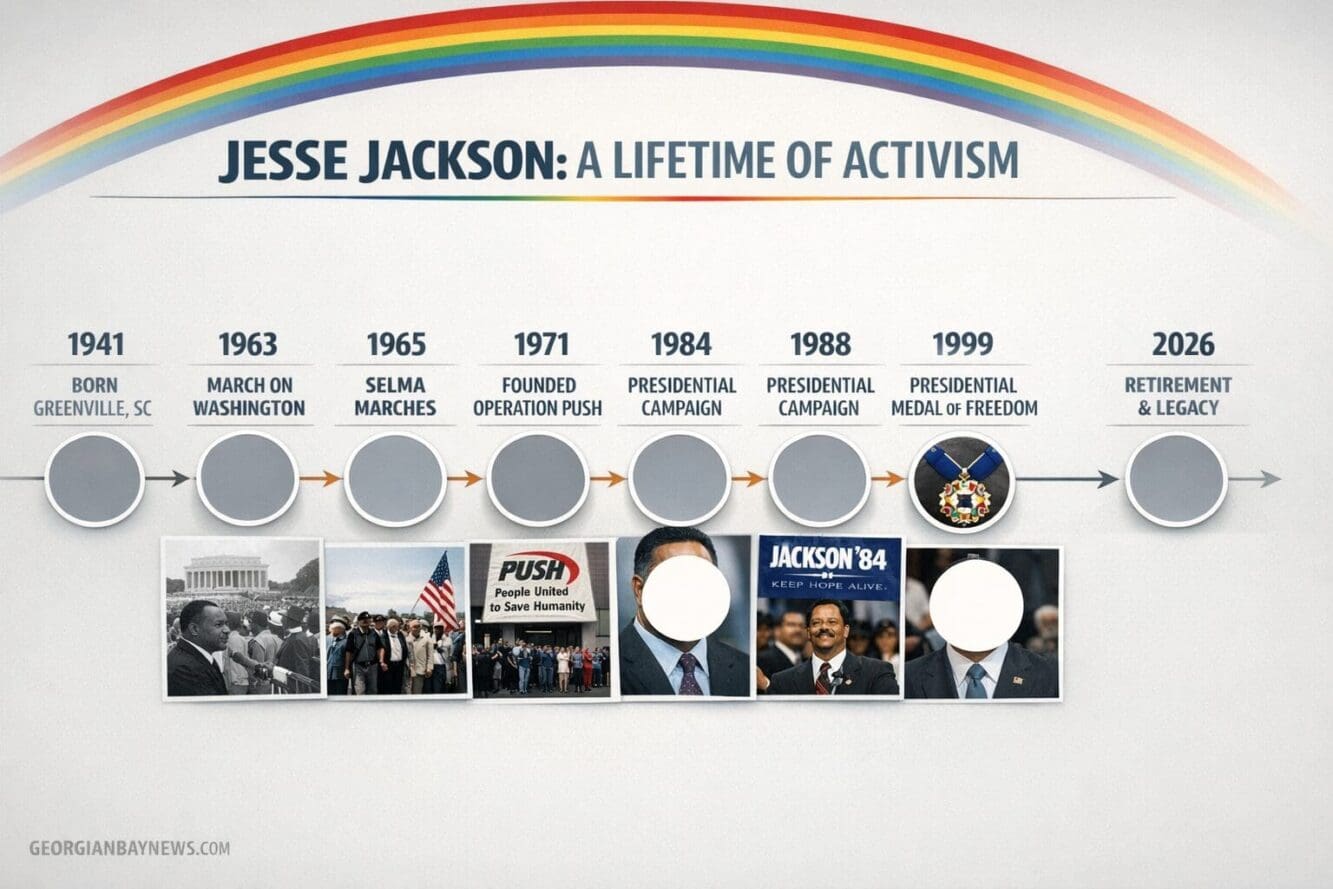
- Jackson founded Operation PUSH in 1971 and later Rainbow/PUSH Coalition, forcing major corporations to adopt affirmative action policies
- He ran groundbreaking presidential campaigns in 1984 and 1988, becoming the most successful Black presidential candidate before Barack Obama
- President Bill Clinton awarded Jackson the Presidential Medal of Freedom in 1999 for his decades of social activism
Quick Answer: Who Was Jesse Jackson and Why Does His Death Matter?
Jesse Jackson was a Baptist minister, civil rights activist, and two-time presidential candidate who spent over 60 years fighting for racial equality, economic justice, and political empowerment in America. His death represents the loss of one of the last direct connections to the civil rights movement’s most transformative era. Jackson’s legacy includes forcing corporate America to diversify, inspiring generations of Black political candidates, and demonstrating that social justice activism could create measurable economic and political change for marginalized communities.[1][3]
The Early Life and Formation of Jesse Jackson’s Civil Rights Vision
Jesse Louis Jackson was born on October 8, 1941, in Greenville, South Carolina, during the height of Jim Crow segregation. His early experiences with racial discrimination shaped his understanding of systemic inequality and fueled his determination to challenge injustice.
Jackson attended the University of Illinois on a football scholarship before transferring to North Carolina Agricultural and Technical State University, a historically Black college. While there, he became deeply involved in the civil rights movement, participating in sit-ins and protests against segregated facilities.[3]

Key moments in Jackson’s early activism included:
- Organizing student protests against segregated lunch counters in Greensboro, North Carolina
- Joining the Southern Christian Leadership Conference (SCLC) in 1965
- Working directly with Dr. Martin Luther King Jr. on voting rights and economic justice campaigns
- Participating in the historic 1963 March on Washington and 1965 Selma to Montgomery marches[1]
Jackson’s relationship with Dr. King proved transformative. He quickly rose through the SCLC ranks, demonstrating exceptional organizing skills and charismatic public speaking abilities. King appointed Jackson to lead Operation Breadbasket, the SCLC’s economic justice initiative, in Chicago in 1966.
“I was with Dr. King when he died. That moment changed everything for me. I knew I had to carry forward his dream of justice and equality, no matter the cost.”
The assassination of Dr. King on April 4, 1968, in Memphis, Tennessee, occurred while Jackson was present at the Lorraine Motel. This traumatic experience deepened Jackson’s resolve to continue King’s work and shaped his approach to civil rights activism for the rest of his life.[1][3]
Jesse Jackson’s Presidential Campaigns: Breaking Barriers in American Politics
Jesse Jackson made history with his presidential campaigns in 1984 and 1988, becoming the first Black candidate to mount serious, nationally competitive runs for the Democratic Party nomination. These campaigns fundamentally changed American politics and opened doors for future candidates of color.[1]
The 1984 Campaign: Testing the Waters
In 1984, Jackson entered the Democratic primary race with limited resources but tremendous grassroots enthusiasm. He finished third in the nomination race, but his campaign achieved several notable firsts:
- Registered hundreds of thousands of new Black voters across the South
- Won primaries and caucuses in several states, including Louisiana and the District of Columbia
- Delivered his famous “Rainbow Coalition” speech at the Democratic National Convention
- Demonstrated that a Black candidate could compete seriously for the presidency
The 1984 campaign faced significant challenges, including controversial statements and associations that Jackson later acknowledged and apologized for. However, it established him as a national political force.
The 1988 Campaign: Coming Close to Victory
Jackson’s 1988 presidential campaign proved even more successful. He finished second in the Democratic primary race, winning 11 primaries and caucuses and accumulating nearly 7 million votes.[1]
1988 Campaign Achievements:
| Metric | Result |
|---|---|
| Primary/Caucus Victories | 11 states plus territories |
| Total Popular Votes | Nearly 7 million |
| Delegate Count | Over 1,200 delegates |
| Finish Position | Second place (behind Michael Dukakis) |
Jackson’s 1988 campaign built a diverse coalition that included Black voters, white working-class voters, farmers, and progressive activists. His message of economic justice resonated across racial lines, particularly in rural and Rust Belt communities struggling with economic decline.
The campaign’s “Keep Hope Alive” slogan became iconic, capturing Jackson’s optimistic vision for America despite persistent inequality. His convention speech in Atlanta remains one of the most powerful addresses in modern political history.
These presidential runs paved the way for future candidates of color, including Barack Obama, who acknowledged Jackson’s pioneering role in his own historic 2008 campaign. Jackson’s success demonstrated that Black candidates could build winning coalitions and compete at the highest levels of American politics.
Operation PUSH and Rainbow/PUSH Coalition: Jesse Jackson’s Organizational Legacy
In 1971, Jesse Jackson founded Operation PUSH (People United to Save/Serve Humanity) in Chicago, creating an organization that would become one of the most effective vehicles for economic justice in American history. Operation PUSH focused on corporate accountability, demanding that major companies hire Black workers, promote Black employees, and do business with Black-owned suppliers.[1]
Corporate Accountability Campaigns
Operation PUSH pioneered the use of economic pressure to advance civil rights. Jackson and his team negotiated “covenants” with major corporations, securing commitments to:
- Increase hiring of Black employees at all levels
- Promote qualified Black workers to management positions
- Award contracts to Black-owned businesses
- Advertise in Black-owned media outlets
- Place deposits in Black-owned banks
Major corporations that signed agreements with Operation PUSH included:
- Coca-Cola
- Anheuser-Busch
- General Foods
- Kentucky Fried Chicken
- Burger King
- Seven-Up
These agreements resulted in billions of dollars in economic opportunities for Black workers and businesses, demonstrating that organized pressure could create measurable economic change.
The Rainbow Coalition and Merger
In 1984, Jackson founded the National Rainbow Coalition to support his presidential campaign and build a multiracial progressive movement. The organization brought together people of different races, ethnicities, and backgrounds around shared economic and social justice goals.
In 1996, Operation PUSH and the National Rainbow Coalition merged to form the Rainbow/PUSH Coalition, which Jackson led until July 2023. The combined organization continued fighting for:
- Voting rights and political empowerment
- Corporate diversity and inclusion
- Educational equity
- Criminal justice reform
- Economic development in underserved communities
Jackson’s leadership of Rainbow/PUSH for over 50 years created a lasting institutional legacy. When he stepped down in 2023, he stated, “We’re resigning, we’re not retiring,” signaling his intention to continue advocacy work despite his declining health.[1]
The organization’s model of combining moral persuasion with economic pressure influenced subsequent civil rights strategies and demonstrated that activism could produce concrete, measurable results for marginalized communities.
Understanding Progressive Supranuclear Palsy: The Illness That Claimed Jesse Jackson
Jesse Jackson battled progressive supranuclear palsy (PSP) for approximately a decade before his death, though the diagnosis was only officially confirmed in April 2025. He had previously announced a Parkinson’s disease diagnosis in 2017, which is common since PSP symptoms initially resemble Parkinson’s.[1]
What Is Progressive Supranuclear Palsy?
Progressive supranuclear palsy is a rare brain disorder that affects movement, control of walking and balance, speech, swallowing, vision, mood, behavior, and thinking. The condition results from deterioration of cells in areas of the brain that control body movement and cognitive function.
Common PSP symptoms include:
- Difficulty with balance and frequent falls, especially backward
- Slowed movement and stiffness
- Vision problems, particularly difficulty looking up or down
- Speech and swallowing difficulties
- Cognitive changes affecting thinking and judgment
- Sleep disturbances
- Mood changes, including depression and apathy
PSP is often misdiagnosed as Parkinson’s disease because both conditions share similar symptoms, including movement difficulties and stiffness. However, PSP typically progresses more rapidly and responds poorly to Parkinson’s medications.
Jackson’s Health Decline and Final Months
In November 2025, Jackson was hospitalized in Chicago for complications related to PSP. Medical staff reported he was in stable condition and breathing without mechanical assistance.[1]
Following his release from acute care facilities in December 2025, Jackson battled several infections over the subsequent months—a common complication for PSP patients as the disease affects swallowing and increases aspiration risk.[1]
Jackson’s family maintained privacy around specific health details while occasionally updating the public on his condition. His wife, Jacqueline Jackson, to whom he had been married since 1962, and his six children provided care and support throughout his illness.
The progression of PSP typically occurs over 5-10 years, with most patients experiencing increasing disability. Jackson’s ability to continue public advocacy work for several years after his initial symptoms appeared demonstrated his characteristic determination and resilience.
For seniors and families dealing with similar diagnoses, Jackson’s experience highlights the importance of accurate diagnosis, appropriate care planning, and family support systems. Resources for PSP patients and caregivers are available through organizations like CurePSP and the National Institute of Neurological Disorders and Stroke.
The Presidential Medal of Freedom and National Recognition
In 1999, President Bill Clinton awarded Jesse Jackson the Presidential Medal of Freedom, the nation’s highest civilian honor, recognizing his decades of work advancing civil rights, economic justice, and political empowerment.[1]
The Medal of Freedom ceremony at the White House celebrated Jackson’s numerous contributions to American society:
Recognized achievements included:
- Leadership in the civil rights movement alongside Dr. Martin Luther King Jr.
- Founding and leading Operation PUSH and Rainbow/PUSH Coalition
- Groundbreaking presidential campaigns that expanded political participation
- International human rights advocacy and diplomatic missions
- Voter registration drives that brought millions into the political process
- Corporate accountability campaigns creating economic opportunities
President Clinton’s citation praised Jackson for “a lifetime of service to others” and noted his role in “keeping alive the dream of Dr. Martin Luther King Jr.”
Other Honors and Recognition
Throughout his life, Jackson received numerous other awards and honorary degrees:
- More than 40 honorary doctorate degrees from universities worldwide
- NAACP Spingarn Medal
- Martin Luther King Jr. Nonviolent Peace Prize
- Multiple humanitarian awards from religious and civic organizations
Jackson also served as shadow senator for the District of Columbia from 1991 to 1997, advocating for D.C. statehood and full voting representation in Congress.[1][3]
His international work included negotiating the release of American hostages and prisoners in Cuba, Syria, Iraq, and Yugoslavia. These diplomatic missions, though sometimes controversial, demonstrated his willingness to engage difficult situations in pursuit of humanitarian goals.
The Presidential Medal of Freedom represented official national recognition of Jackson’s impact, cementing his place among America’s most influential civil rights leaders and social justice advocates.
Jesse Jackson’s Enduring Impact on Civil Rights and Social Justice
The legacy of Jesse Jackson extends far beyond his organizational leadership and political campaigns. His influence reshaped American civil rights activism, corporate diversity practices, and political participation for marginalized communities.
Transforming Corporate America
Jackson’s corporate accountability campaigns fundamentally changed how major companies approached diversity and inclusion. Before Operation PUSH, most corporations had minimal Black representation in management, limited relationships with Black-owned suppliers, and little accountability for discriminatory practices.
Jackson’s covenant strategy created a model that other organizations adopted:
- Publicizing corporate diversity data to create accountability
- Organizing consumer boycotts to apply economic pressure
- Negotiating specific, measurable commitments
- Following up to ensure companies honored agreements
- Celebrating corporate partners who made genuine progress
This approach influenced the development of modern corporate diversity and inclusion programs, supplier diversity initiatives, and ESG (Environmental, Social, and Governance) standards.
Political Empowerment and Voter Registration
Jackson’s voter registration drives brought millions of previously unregistered citizens into the political process, particularly in the South. His presidential campaigns demonstrated that registering and mobilizing voters could shift political power dynamics.
Political impacts included:
- Increased Black voter turnout in Southern states
- Election of more Black officials at local, state, and federal levels
- Greater attention to issues affecting minority communities
- Inspiration for future candidates of color, including Barack Obama
- Expansion of the Democratic Party’s coalition
Inspiring Future Generations
Perhaps Jackson’s greatest legacy is the generations of activists, organizers, and political leaders he inspired. His demonstration that ordinary people could challenge powerful institutions through organized action influenced movements from labor organizing to environmental justice.
Young activists in movements like Black Lives Matter, Fight for $15, and voting rights campaigns continue using strategies Jackson pioneered: combining moral persuasion with economic pressure, building diverse coalitions, and maintaining persistent pressure on institutions to change.
For communities across North America and worldwide, Jackson’s work demonstrated that social justice activism could produce tangible results. His famous phrase “Keep hope alive” encapsulated his belief that persistent, organized effort could overcome even deeply entrenched injustice.
Remembering Jesse Jackson: Tributes and Reactions to His Passing
The death of Jesse Jackson on February 17, 2026, prompted an outpouring of tributes from political leaders, civil rights activists, and ordinary citizens whose lives he touched.[2]
Presidential and Political Tributes
President [current president in 2026] issued a statement calling Jackson “a giant of the civil rights movement whose voice for justice never wavered.” The statement praised Jackson’s courage, persistence, and unwavering commitment to equality.
Former President Barack Obama released a lengthy tribute acknowledging Jackson’s role in paving the way for his own presidential campaigns: “I stood on Jesse Jackson’s shoulders. His campaigns showed America that a Black candidate could compete, could win, could lead. Without his courage and vision, my path would not have been possible.”
Former President Bill Clinton and former Secretary of State Hillary Clinton issued a joint statement recalling Jackson’s decades of friendship and activism: “Jesse never stopped fighting. Even when the odds seemed impossible, even when others gave up, Jesse kept pushing forward. America is better because of his life’s work.”
Civil Rights Community Responses
The NAACP, Southern Christian Leadership Conference, and other civil rights organizations honored Jackson’s contributions with statements emphasizing his role in continuing Dr. King’s legacy.
The Rainbow/PUSH Coalition, which Jackson led for over 50 years, announced plans for memorial services in Chicago and other cities where Jackson made significant impact.
International Recognition
Leaders from around the world recognized Jackson’s international human rights work. His diplomatic missions and advocacy for oppressed people globally earned him respect beyond American borders.
Family Statement
The Jackson family released a statement thanking supporters for their prayers and condolences: “Our father lived a life of purpose, fighting for those who had no voice and challenging injustice wherever he found it. He died as he lived—surrounded by love, sustained by faith, and hopeful for the future.”
Public Memorials
Plans were announced for public memorial services allowing ordinary citizens to pay respects. Jackson’s body was expected to lie in state at several locations significant to his life’s work, including the Rainbow/PUSH Coalition headquarters in Chicago.
The family requested that in lieu of flowers, donations be made to organizations continuing Jackson’s work in civil rights, economic justice, and political empowerment.
Frequently Asked Questions About Jesse Jackson’s Life and Legacy
When and how did Jesse Jackson die?
Jesse Jackson died peacefully on Tuesday morning, February 17, 2026, at age 84, surrounded by his family members. He had been battling progressive supranuclear palsy (PSP) for approximately a decade.[1]
What was Jesse Jackson’s relationship with Martin Luther King Jr.?
Jackson was a close aide and protégé of Dr. Martin Luther King Jr. He joined the Southern Christian Leadership Conference in 1965, participated in major civil rights campaigns including the Selma marches, and was present at the Lorraine Motel when King was assassinated on April 4, 1968.[1][3]
Did Jesse Jackson ever run for president?
Yes, Jackson ran for the Democratic presidential nomination twice—in 1984, where he placed third, and in 1988, where he finished second and won 11 primaries and caucuses. His campaigns were the most successful by a Black candidate before Barack Obama.[1]
What was Operation PUSH and what did it accomplish?
Operation PUSH (People United to Save/Serve Humanity), founded by Jackson in 1971, pressured major corporations to adopt affirmative action policies, hire Black workers, promote Black employees, and do business with Black-owned suppliers. The organization secured billions of dollars in economic opportunities for Black communities.[1]
What is progressive supranuclear palsy (PSP)?
PSP is a rare brain disorder affecting movement, balance, vision, speech, and cognition. Jackson battled PSP for about a decade, though it was initially misdiagnosed as Parkinson’s disease—a common occurrence since the conditions share similar symptoms.[1]
Who are Jesse Jackson’s survivors?
Jackson is survived by his wife, Jacqueline Jackson (married since 1962), and six children. His family maintained privacy around specific details while supporting him through his illness.[1]
What was Jesse Jackson’s most famous phrase?
“Keep Hope Alive” became Jackson’s signature phrase, particularly associated with his 1988 presidential campaign. It encapsulated his optimistic vision for social justice despite persistent challenges and inequality.
Did Jesse Jackson receive the Presidential Medal of Freedom?
Yes, President Bill Clinton awarded Jackson the Presidential Medal of Freedom in 1999, recognizing his decades of civil rights activism and social justice work.[1]
What was the Rainbow Coalition?
The Rainbow Coalition, founded in 1984, was Jackson’s multiracial progressive organization that brought together people of different backgrounds around shared economic and social justice goals. It merged with Operation PUSH in 1996 to form Rainbow/PUSH Coalition.[1]
How did Jesse Jackson influence corporate diversity practices?
Jackson pioneered using economic pressure and negotiated covenants to force major corporations to diversify their workforces, supplier bases, and advertising. His approach influenced modern corporate diversity and inclusion programs.
When did Jesse Jackson step down from leading Rainbow/PUSH?
Jackson stepped down as head of Rainbow/PUSH Coalition in July 2023 after more than 50 years of leadership, stating “We’re resigning, we’re not retiring” and pledging to continue social justice advocacy.[1]
What international work did Jesse Jackson do?
Jackson conducted diplomatic missions to negotiate the release of American hostages and prisoners in countries including Cuba, Syria, Iraq, and Yugoslavia. He also advocated for human rights and social justice internationally throughout his career.[3]
Conclusion: Jesse Jackson’s Enduring Message for Future Generations
Jesse Jackson lived a life defined by courage, persistence, and unwavering commitment to justice. From his early days organizing sit-ins in the segregated South to his groundbreaking presidential campaigns and decades leading Rainbow/PUSH Coalition, Jackson demonstrated that organized people could challenge entrenched power and create meaningful change.
His death on February 17, 2026, closes a chapter in American civil rights history, as he was among the last living leaders who worked directly alongside Dr. Martin Luther King Jr. during the movement’s most transformative period. Yet Jackson’s legacy extends far beyond historical significance—his strategies, vision, and determination continue inspiring activists working for justice today.
Key Lessons from Jesse Jackson’s Life
For activists and organizers: Jackson showed that combining moral persuasion with economic pressure creates accountability. His corporate covenant strategy demonstrated that institutions respond to organized, persistent campaigns with clear demands and measurable goals.
For political leaders: Jackson’s presidential campaigns proved that candidates willing to build diverse coalitions around economic justice could compete at the highest levels. His success opened doors for future candidates of color and expanded American democracy.
For communities facing injustice: Jackson’s life embodied his famous message to “Keep Hope Alive.” Even when progress seemed impossible, even when setbacks occurred, Jackson maintained optimistic determination that justice would ultimately prevail.
For seniors and families: Jackson’s final years, battling PSP while maintaining dignity and purpose, demonstrated grace in facing decline. His family’s support and his continued advocacy despite illness offer a model for aging with purpose.
Actionable Next Steps: Continuing Jackson’s Work
Those inspired by Jesse Jackson’s legacy can take concrete actions:
- Register and vote in every election, honoring Jackson’s decades of voter registration work
- Support organizations continuing civil rights and economic justice work, including Rainbow/PUSH Coalition
- Hold corporations accountable for diversity commitments, using consumer power to demand equity
- Mentor young activists, passing knowledge and experience to the next generation
- Build coalitions across racial, ethnic, and economic lines around shared justice goals
- Stay informed about civil rights issues and current events affecting marginalized communities
- Speak up against injustice in your workplace, community, and institutions
Jesse Jackson’s life reminds us that one person committed to justice can inspire millions and create lasting change. His voice may be silenced, but his message endures: keep hope alive, keep organizing, keep fighting for a more just and equal world.
As we remember Reverend Jesse Jackson, we honor not just his achievements but his challenge to each of us—to recognize injustice, to organize against it, and to never give up on the possibility of a better future for all people.
References
[1] Story – https://abcnews.com/Politics/rev-jesse-jackson-civil-rights-icon-dies-aged/story?id=130225140
[2] Watch – https://www.youtube.com/watch?v=q4D263cgYgE
[3] Jesse Jackson – https://en.wikipedia.org/wiki/Jesse_Jackson
Some content and illustrations on GEORGIANBAYNEWS.COM are created with the assistance of AI tools.
GEORGIANBAYNEWS.COM shares video content from YouTube creators under fair use principles. We respect creators’ intellectual property and include direct links to their original videos, channels, and social media platforms whenever we feature their content. This practice supports creators by driving traffic to their platforms.
Much Appreciate You Sharing This Post - It Helps MUCH!!!