



















Love Across Tongues: Toronto Couples Who Bridged Language Barriers from Poland to Colombia

Imagine stepping onto a crowded dance floor in downtown Toronto. The music is loud, the lights are low, and the person smiling at you from across the room speaks a completely different language. No shared words. No translator app. Just rhythm, eye contact, and a spark that refuses to be silenced. This is the reality for thousands of couples in one of the world’s most linguistically diverse cities — and it is the heart of Love Across Tongues: Toronto Couples Who Bridged Language Barriers from Poland to Colombia. From a Polish dancer who found her match in a Colombian salsa enthusiast to a Dutch mathematician who fell for a Japanese traveler in a Mongolian hostel, Toronto’s love stories prove that connection runs deeper than vocabulary.
Toronto is home to more than three million people and over 200 languages therecord.com. In 2026, the city continues to be a magnet for immigrants, students, and adventurers from every corner of the globe. When these people fall in love across linguistic lines, they create something extraordinary: relationships built on patience, creativity, and a willingness to be vulnerable in a language that belongs to neither partner.
Key Takeaways 📌
- Language barriers don’t stop love. Couples across Toronto prove every day that emotional connection can thrive even when partners share no common mother tongue.
- A third language often becomes the bridge. Many multilingual couples communicate in English — a language native to neither — while slowly learning each other’s first languages over time cbc.ca.
- Shared passions like dance and music fill the gaps. Physical activities, art, and cultural events create non-verbal pathways to intimacy that words alone cannot provide.
- Open communication and flexibility are essential. Research confirms that differences in native language pose significant challenges to emotional expression, but couples who stay curious and adaptable tend to flourish [2].
- Toronto’s diversity makes it a natural incubator for cross-cultural love. Nearly 45 percent of second-generation immigrants in the Toronto metro area marry or live with someone of a different background torontolife.com.
Why Toronto Is Ground Zero for Love Across Tongues

A City Built on Many Languages
Toronto has long been called one of the most multicultural cities on the planet. According to census data, roughly half of the city’s residents were born outside Canada. Walk through Kensington Market on a Saturday morning and you will hear Mandarin, Portuguese, Tagalog, Urdu, Polish, and Spanish — sometimes in a single block.
This linguistic richness creates a unique social environment. People meet at language-exchange meetups, international food festivals, and cultural dance nights. They form friendships and, inevitably, romantic relationships with people whose first language is entirely different from their own.
“Toronto famously blazed the way for same-sex marriage. Today, it turns out to be a Petri dish for innovative people combos.” — Jan Wong, Toronto Life torontolife.com
The statistics back this up. Among third-generation immigrants in the Greater Toronto Area, a stunning 68 percent are in relationships with someone of a different race or ethnicity torontolife.com. When you factor in language differences, the number of couples navigating cross-linguistic love is enormous.
The Dance Floor Connection: From Poland to Colombia
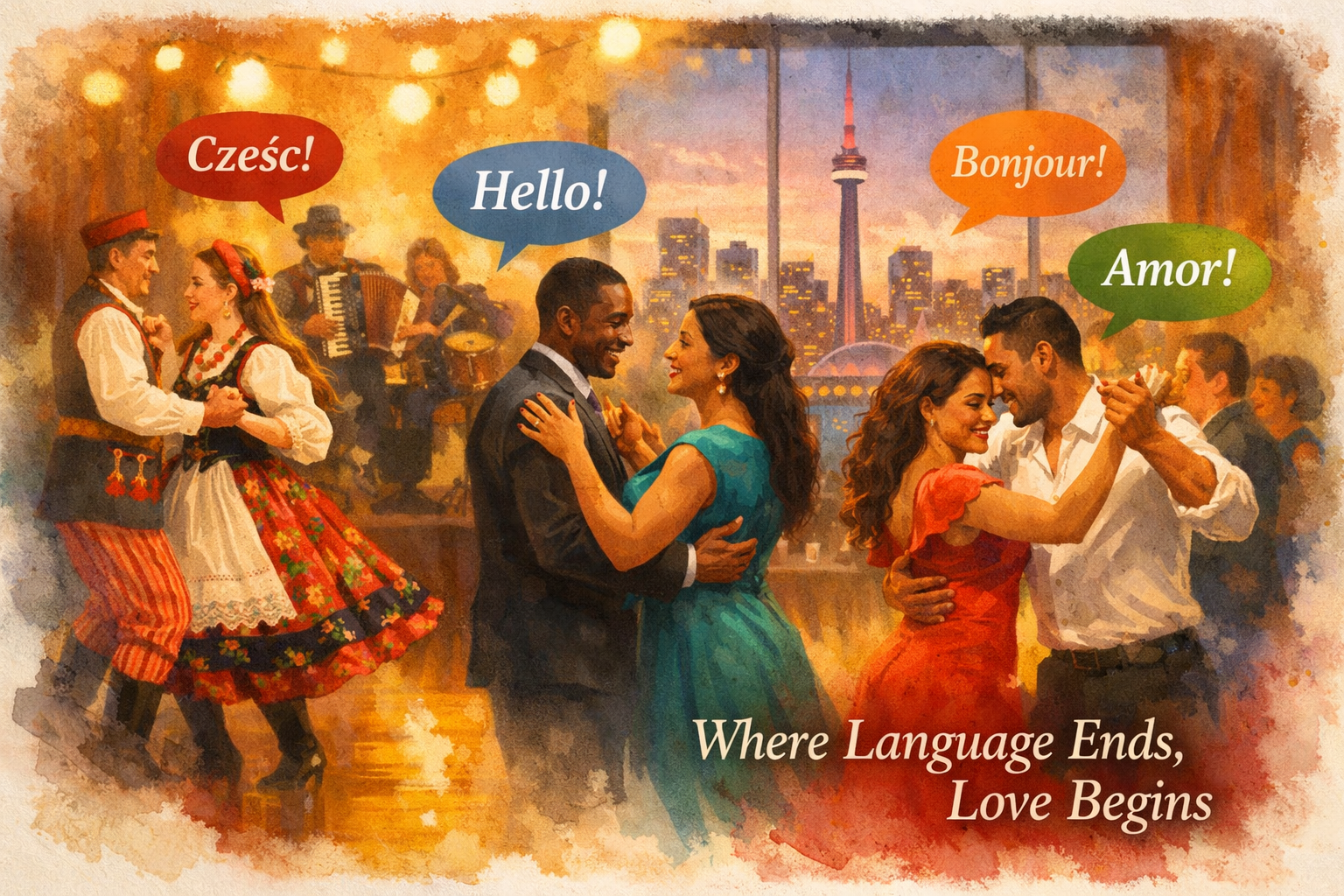
The story of Love Across Tongues: Toronto Couples Who Bridged Language Barriers from Poland to Colombia often begins not with words but with movement. Consider the experience of couples who meet at Toronto’s thriving Latin dance scene. A Polish-born woman who grew up dancing folk mazurkas finds herself at a salsa night in the Distillery District. A Colombian man, freshly arrived and homesick, hears the familiar beat of cumbia and steps onto the floor. Their bodies know the conversation before their mouths can begin it.
Dance is a universal language — a cliché, perhaps, but one grounded in real neuroscience. When two people move in sync, their brains release oxytocin, the same bonding hormone triggered by deep conversation. For couples who cannot yet share deep conversation in words, this physical synchrony becomes the foundation of trust.
Toronto offers dozens of venues and events where these connections happen organically. From bachata workshops in Little Portugal to Polish folk dance nights in Roncesvalles, the city’s cultural calendar is a matchmaker in its own right. If you enjoy stories about how music and performance bring communities together, you might also appreciate this look at a Yiddish love story told through postcards and music.
Real Stories: Love Across Tongues in Toronto Couples Who Bridged Language Barriers from Poland to Colombia
Lennaert and Yoko: Dutch Meets Japanese in Mongolia
One of the most charming examples of cross-linguistic love in Toronto is the story of Lennaert van Veen and Yoko Tanaka. He is Dutch. She is Japanese. They met in a tiny hostel in Ulan Bator, Mongolia, where van Veen chose a random bunk — and ended up sleeping beneath the woman who would become his wife therecord.com.
“I just remember that very first time I laid eyes on her,” van Veen recalled. Tanaka’s hair was standing on end with dust after a trip from the Mongolian desert. Neither spoke the other’s language. English — a tongue foreign to both — became their shared ground.
| Detail | Lennaert | Yoko |
|---|---|---|
| Country of origin | Netherlands 🇳🇱 | Japan 🇯🇵 |
| Native language | Dutch | Japanese |
| Shared language | English | English |
| Where they met | Ulan Bator, Mongolia | Ulan Bator, Mongolia |
| Now live in | Toronto 🇨🇦 | Toronto 🇨🇦 |
| Children’s languages | English, Dutch, Japanese | English, Dutch, Japanese |
Years later, the couple moved to Australia, married, had their first son, and eventually settled in Toronto — all while continuing to improve their English. Today, their children speak three languages fluently: English, Japanese, and Dutch. Their story is a testament to the idea that love does not require perfect grammar. It requires patience, humor, and a willingness to stumble through sentences together.
Lissner and Guy: Spanish Meets French in Quebec City
Another powerful illustration comes from Lissner Orjuela, originally from Bogota, Colombia, and Guy Lampron, a francophone Quebecer. When Orjuela rang Lampron’s doorbell in Quebec City in 2012 — thinking the previous tenant still lived there — she tried to speak French. It did not go well cbc.ca.
“She tried to talk to me in French — or she thought she was speaking in French.” — Guy Lampron
The two switched to English, a language neither spoke well. One hour after their first meeting, Lampron called Orjuela. The rest, as they say, is history. Lampron helped Orjuela learn French, and then he began studying Spanish. Today, they have a daughter who is growing up trilingual.
Their story mirrors the experience of many Toronto couples whose roots stretch from Poland to Colombia and everywhere in between. The common thread? A willingness to be imperfect together.
Sheena and Her Husband: English Meets Portuguese on a London Dance Floor
Writer Sheena Rossiter describes the night she met her future husband at a London nightclub known for Brazilian music. He didn’t speak English. She knew no Portuguese. A Belgian flatmate translated over the blaring samba thewalrus.ca.
He passed her his flip phone. She punched in her number. Neither knew they were about to embark on a cross-continental journey of love, bureaucracy, and language learning. Their story, like so many others, eventually led to Canada — a country that welcomes these multilingual love stories with open arms.
The Science Behind Love Across Tongues: How Language Barriers Affect Relationships
Emotional Communication Gets Harder
A comprehensive scoping review of intercultural love research found that differences in native language posed significant challenges to emotional communication between partners [2]. When you cannot express frustration, joy, or vulnerability in your strongest language, misunderstandings multiply. Sarcasm gets lost. Nuance disappears. Arguments become harder to resolve because the words simply are not there.
Studies examining 117,293 participants across 175 countries on romantic love and mate preferences demonstrate widespread interest in understanding how cross-cultural partnerships work [3]. The data suggests that while attraction is universal, sustaining a relationship across language lines requires deliberate effort.
Jealousy and Attachment Anxiety
New research from the University of Toronto Mississauga reveals that interracial and intercultural couples report experiencing jealousy more often and more intensely than same-race couples. Social disapproval from outsiders can heighten attachment anxiety, making partners more vigilant about perceived threats to the relationship magazine.utoronto.ca.
This finding is important for Toronto couples bridging language barriers from Poland to Colombia. When family members disapprove or strangers stare, the emotional toll can be real. But the same research offers hope: couples who build a strong shared identity — a sense of “us” — are better equipped to weather these pressures.
Coping Strategies That Work
Research highlights several strategies that help multilingual couples thrive [2]:
- Open communication 🗣️ — Even when the words are imperfect, the intention to communicate matters enormously.
- Flexibility 🤸 — Switching between languages, using gestures, drawing pictures, or relying on translation apps are all valid tools.
- Humor 😂 — Laughing at mispronunciations and grammatical errors turns potential embarrassment into bonding moments.
- Cultural curiosity 🌍 — Learning about a partner’s traditions, food, and holidays shows respect and deepens intimacy.
- Shared activities 💃 — Dance, cooking, sports, and music create connection without requiring fluent speech.
For those interested in how communities come together through shared activities and events, check out this piece on breaking down barriers through community fundraising.
Practical Tips for Couples Navigating Language Barriers in 2026
Whether a couple’s roots stretch from Warsaw to Bogota or from Tokyo to Amsterdam, the challenges of cross-linguistic love are remarkably similar. Here are actionable strategies drawn from real couples and current research:
1. Learn Each Other’s Language (Even Slowly) 📚
You do not need to become fluent overnight. Even learning 50 basic phrases in a partner’s native tongue shows commitment and respect. Apps like Duolingo, Babbel, and Tandem make daily practice accessible and fun. Guy Lampron started learning Spanish after helping Lissner Orjuela with her French — and it transformed their relationship cbc.ca.
2. Create a “Language Date Night” 🕯️
Set aside one evening a week where you practice each other’s language. Cook a traditional dish from one partner’s homeland while speaking their language. The next week, switch. This ritual builds vocabulary and creates shared memories. If you’re looking for inspiration on cultural gatherings that bring people together, explore this guide to a world music festival celebrating global traditions.
3. Use Non-Verbal Communication Intentionally 🤝
Body language, facial expressions, and touch communicate volumes. Research shows that couples who maintain physical closeness — holding hands, dancing, cooking side by side — report higher relationship satisfaction, especially when verbal communication is limited.
4. Build a Support Network 👥
Seek out other multilingual couples. Toronto has numerous meetup groups, cultural associations, and community centers where cross-cultural couples gather. Hearing that other people face the same challenges — and have found solutions — is incredibly reassuring.
5. Be Patient with Miscommunication 🧘
Misunderstandings will happen. A word that sounds innocent in one language may carry a completely different meaning in another. The key is to assume good intentions and ask for clarification rather than jumping to conclusions.
| Strategy | Why It Works | Difficulty Level |
|---|---|---|
| Learn basic phrases | Shows respect and effort | ⭐ Easy |
| Language date nights | Builds vocabulary + intimacy | ⭐⭐ Moderate |
| Non-verbal communication | Bypasses language gaps entirely | ⭐ Easy |
| Join multilingual communities | Provides support and validation | ⭐⭐ Moderate |
| Practice patience | Reduces conflict from misunderstandings | ⭐⭐⭐ Challenging |
How Toronto’s Cultural Scene Fuels Love Across Tongues
Toronto’s cultural infrastructure plays a quiet but powerful role in bringing cross-linguistic couples together. The city’s festival calendar reads like a United Nations itinerary: Caribana, Taste of the Danforth, Polish Festival at Roncesvalles, Salsa on St. Clair, and dozens more.
These events create low-pressure environments where people from different linguistic backgrounds can meet, share food, dance, and discover common ground. A Polish immigrant attending a Colombian salsa workshop is not just learning dance steps — she is entering a space where language takes a back seat to rhythm, laughter, and human connection.
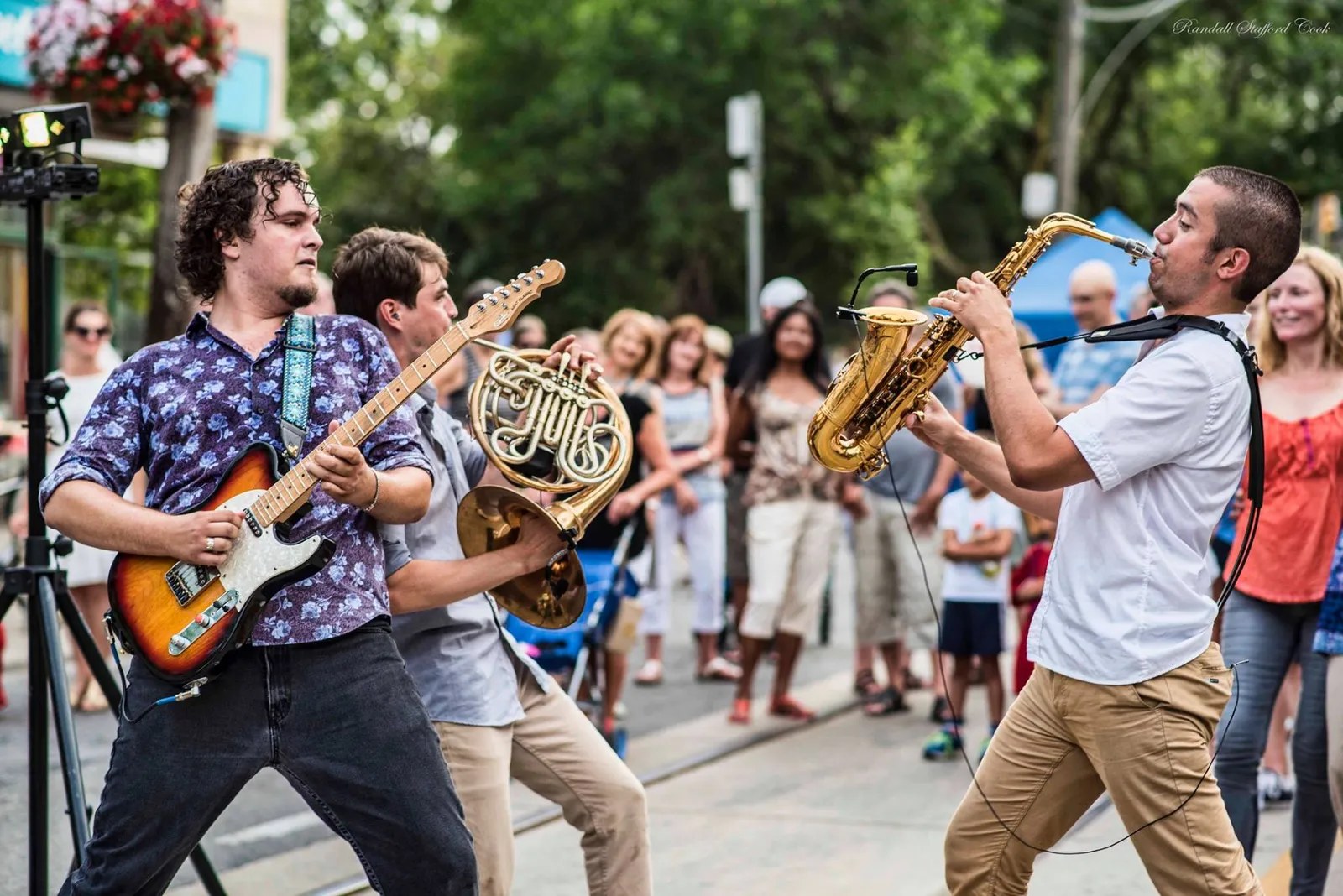
Music, in particular, serves as a powerful bridge. Whether it is the accordion-driven forró that brought Sheena Rossiter and her husband together thewalrus.ca or the folk melodies that echo through Roncesvalles during Polish Heritage Month, sound transcends syntax. For more on how music creates community bonds, see this feature on live music bringing people together locally.
Community pride events also play a role in creating inclusive spaces where all kinds of love — across languages, cultures, and identities — are celebrated. Learn more about pride festivals and their role in community building.
The Children of Love Across Tongues: Growing Up Multilingual in Toronto
One of the most beautiful outcomes of cross-linguistic love is the next generation. Children raised by parents who speak different native languages often grow up trilingual or even quadrilingual. Lennaert and Yoko’s children speak English, Dutch, and Japanese therecord.com. Lissner and Guy’s daughter is growing up with French, Spanish, and English cbc.ca.
Research consistently shows that multilingual children enjoy cognitive advantages, including:
- Better problem-solving skills 🧠
- Greater mental flexibility
- Enhanced empathy and cultural awareness ❤️
- Stronger executive function (the ability to focus, plan, and switch between tasks)
These children are not just the product of love across tongues — they are its greatest ambassadors. They move through the world with an intuitive understanding that communication is about more than words. It is about listening, watching, and caring enough to try.
For families navigating the emotional complexities of raising children across cultures, understanding the difference between a child’s frustration and genuine distress is crucial. This helpful resource on understanding tantrums versus meltdowns offers valuable insight for all parents.
Conclusion: Love Speaks Every Language 💕
The stories of Love Across Tongues: Toronto Couples Who Bridged Language Barriers from Poland to Colombia remind us of something profoundly simple: love does not wait for fluency. It begins with a glance across a hostel room in Mongolia, a doorbell ring in Quebec City, or a hand extended on a London dance floor. It grows through mispronounced words, borrowed dictionaries, and the courage to say “I love you” in a language that still feels foreign on the tongue.
Toronto, with its 200-plus languages and its culture of openness, is the perfect stage for these stories. But the lessons apply everywhere. If you are in a relationship with someone who speaks a different language — or if you are considering one — here are your next steps:
- Start small. Learn five new words in your partner’s language this week.
- Find your shared activity. Dance, cook, hike, or play music together.
- Connect with community. Join a multilingual couples group or attend a cultural festival.
- Be patient with yourself and your partner. Miscommunication is not failure — it is practice.
- Celebrate the richness. Your relationship is not “despite” the language barrier. It is richer because of it.
In a world that sometimes feels divided, these couples offer proof that the deepest human connections do not require perfect words. They require open hearts.
References
[2] journals.sagepub – https://journals.sagepub.com/doi/10.1177/00220021241255615
[3] The 16 Friendliest And 11 Rudest Countries – https://www.mobal.com/blog/travel-talk/the-16-friendliest-and-11-rudest-countries/
[7] Small Groups Poland 13dpld26 – https://www.gate1travel.com/tour/small-groups-poland-13dpld26.aspx?Brand=DISCOVER
Some content and illustrations on GEORGIANBAYNEWS.COM are created with the assistance of AI tools.
GEORGIANBAYNEWS.COM shares video content from YouTube creators under fair use principles. We respect creators’ intellectual property and include direct links to their original videos, channels, and social media platforms whenever we feature their content. This practice supports creators by driving traffic to their platforms.
Much Appreciate You Sharing This Post - It Helps MUCH!!!