



















Oil at $100+ Barrel: Iran Supreme Leader Shock Drives Toronto Pump Prices to $1.50—Driver Tips, Export Wins, and Grocery Ripple Effects

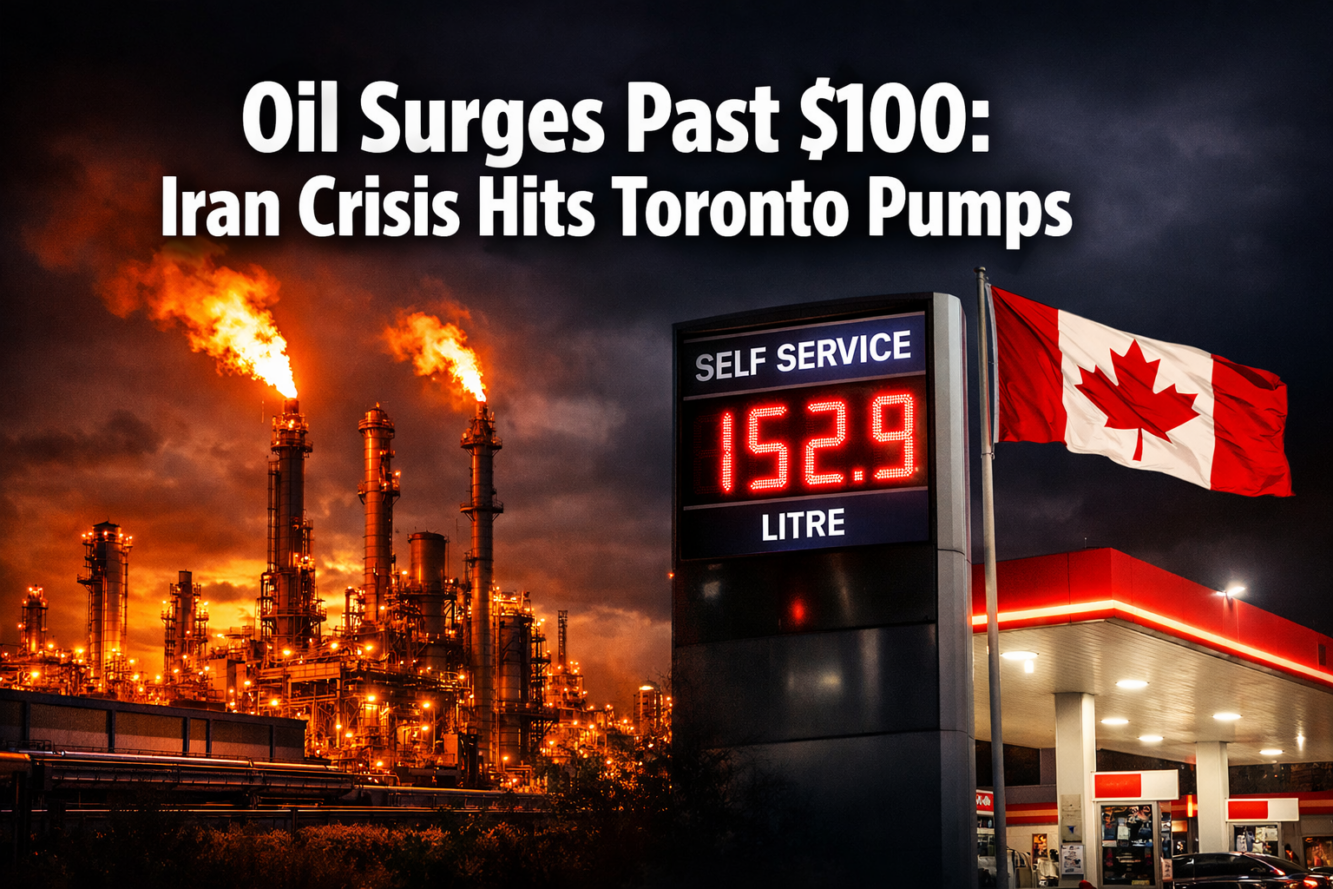
A leadership upheaval in Iran has sent shockwaves through global energy markets in March 2026, and Canadian drivers are feeling every cent. The topic of Oil at $100+ Barrel is dominating headlines as West Texas Intermediate crude surged past $100 per barrel—a jump of more than 10% in days [1]. Toronto gas prices rocketed to $1.529 per liter, climbing 20 cents in a single week [2]. With analysts warning of even steeper increases, the ripple effects are reaching far beyond the fuel pump and straight into grocery aisles across the country.
Key Takeaways 📌
- Crude oil topped $100/barrel after Mojtaba Khamenei was named Iran’s new supreme leader, escalating the U.S.–Israel–Iran conflict [1][4].
- Toronto gas prices hit $1.529/L, a 15% weekly spike, with forecasts pointing toward $1.70/L if the crisis deepens [2].
- Diesel is rising faster than gasoline, which directly inflates food transportation costs and grocery bills [2].
- Canada’s oil export sector stands to benefit from elevated global prices, boosting revenue for Alberta producers.
- Practical driver strategies—from fuel apps to route planning—can soften the blow on household budgets.

How the Iran Supreme Leader Shock Pushed Oil Past $100 a Barrel
The Trigger Event
On March 9, 2026, Mojtaba Khamenei was named Iran’s new supreme leader following the killing of his father, Ayatollah Ali Khamenei [4]. The succession ignited fears of an expanded U.S.–Israel–Iran military confrontation. Within hours, crude oil markets reacted violently.
“Brent crude surged from near $70 in late February to over $92 in barely a week—an extraordinary $22-per-barrel climb.” [2]
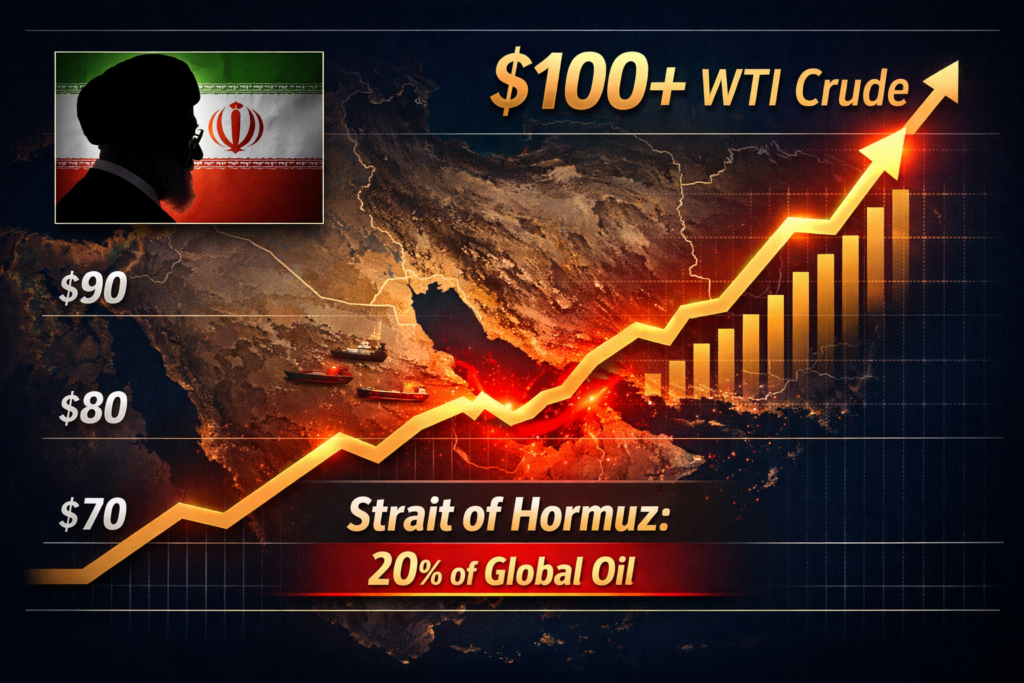
West Texas Intermediate (WTI) crude crossed the $100 threshold for the first time since 2022, representing a 10%+ increase driven almost entirely by geopolitical risk [1]. For deeper context on how Middle East tensions escalate into global crises, see this analysis of potential flashpoints involving Iran and Israel.
Why the Strait of Hormuz Matters
Roughly one-fifth of the world’s oil transits through the Strait of Hormuz, a narrow waterway off Iran’s southern coast [2]. Any disruption—real or perceived—sends traders scrambling. The new supreme leader’s hardline rhetoric has markets pricing in the possibility of shipping blockades or military strikes near this critical chokepoint.
| Benchmark | Late February Price | March 6–9 Price | Change |
|---|---|---|---|
| WTI Crude | ~$70/barrel | $100+/barrel | +43% |
| Brent Crude | ~$70/barrel | $92.69/barrel (briefly $94+) | +33% |
| Toronto Gasoline | $1.329/L | $1.529/L | +15% |
Sources: [1][2][3]
Toronto Pump Prices Hit $1.50—And Could Climb to $1.70
The Numbers at the Pump ⛽
Toronto drivers watched in disbelief as gas prices jumped 6 cents overnight heading into the weekend of March 7, 2026 [2]. The resulting price of 152.9 cents per liter marked a 15% increase in just seven days—levels not seen since the 2022 energy crisis [3].
British Columbia is faring even worse. Vancouver-area stations posted averages of $1.72 per liter as of March 9, making it the most expensive region in Canada [1].
What Analysts Are Saying
Roger McKnight, Chief Petroleum Analyst with En-Pro International Inc., delivered a sobering forecast:
“If this conflict persists, we could see Toronto prices climb to $1.70 per liter.” [2]
South of the border, U.S. average gas prices rose to $3.32 per gallon—an 11.4% weekly increase that mirrors Canada’s surge pattern [2].
Driver Tips to Save Money When Gas Tops $1.50 🚗💰
With prices this volatile, every liter counts. Here are practical strategies to protect household budgets:
Fuel-Saving Habits
- Use gas price apps (GasBuddy, Waze) to find the cheapest station within a reasonable distance.
- Fill up mid-week. Prices tend to spike on Fridays and before long weekends.
- Maintain proper tire pressure. Under-inflated tires can reduce fuel efficiency by up to 3%.
- Drive the speed limit. Fuel consumption increases sharply above 100 km/h.
- Combine errands into a single trip to reduce cold starts and total kilometers.
Alternative Transportation Options
- Electric bikes are a cost-effective commute option—explore top-rated electric bikes under $3K for viable alternatives.
- Cycling infrastructure is expanding in many Ontario communities. Collingwood, for example, has been celebrating bike month with improved routes.
- Carpooling and transit remain the simplest ways to split rising fuel costs.
- Tesla’s Full Self-Driving technology continues to advance, making EVs increasingly practical—read about the latest Tesla FSD updates for 2026.
Export Wins: How Canada’s Oil Sector Benefits
While consumers feel the sting, Canada’s energy producers are enjoying a windfall. Alberta’s oil sands operators see higher margins when WTI trades above $80—at $100+, profitability surges dramatically.
Key Advantages for Canadian Producers
- Higher export revenue: Canada exports roughly 4 million barrels per day, mostly to the U.S. Every $10 increase per barrel translates to approximately $40 million in additional daily revenue for the sector.
- Investment attraction: Elevated prices encourage new drilling and infrastructure spending.
- Government royalties rise: Provincial and federal coffers benefit from increased royalty payments and corporate taxes.
However, these gains come with caveats. Environmental advocates argue that profit-driven expansion inflames environmental concerns, and the long-term push toward clean energy remains a counterbalancing force. Meanwhile, climate action advocates continue pressing for accelerated transition timelines.
Grocery Ripple Effects: Why Your Food Bill Is Rising 🛒
The Diesel Connection
Perhaps the most underappreciated consequence of $100+ oil is its impact on food prices. En-Pro analyst Roger McKnight emphasized that diesel prices are climbing faster than gasoline [2]. Since virtually every item on grocery shelves arrives by diesel-powered truck, the math is straightforward:
- Higher diesel costs → higher transportation costs → higher food prices
What Shoppers Can Expect
| Grocery Category | Expected Price Impact | Reason |
|---|---|---|
| Fresh produce 🥬 | High | Long-distance refrigerated transport |
| Dairy & eggs 🥛 | Moderate–High | Farm-to-store cold chain logistics |
| Packaged goods 📦 | Moderate | Warehouse distribution networks |
| Locally sourced items 🌾 | Low | Shorter supply chains |
Smart Grocery Strategies
- Buy local and seasonal to minimize exposure to long-haul transportation surcharges.
- Stock up on shelf-stable staples before the next round of price increases.
- Use flyer apps and loyalty programs to capture discounts.
- Consider community gardens or farmers’ markets as the growing season approaches.
For families already struggling with cost-of-living pressures, community support programs can help. Organizations like the Ontario SPCA are assisting families with essential needs during difficult economic periods.
What Comes Next? Scenarios for Spring 2026
The trajectory of oil prices depends almost entirely on the geopolitical situation in the Middle East. Three scenarios are worth watching:
- Escalation scenario 🔴 — Military action near the Strait of Hormuz could push oil past $120/barrel and Toronto gas toward $1.80+/L.
- Stalemate scenario 🟡 — Continued tensions without major supply disruption keep oil in the $90–$105 range and gas near $1.50–$1.60/L.
- De-escalation scenario 🟢 — Diplomatic breakthroughs could bring oil back toward $80/barrel and gas below $1.40/L within weeks.
Conclusion
The story of Oil at $100+ Barrel: Iran Supreme Leader Shock Drives Toronto Pump Prices to $1.50—Driver Tips, Export Wins, and Grocery Ripple Effects is still unfolding in 2026. The naming of Mojtaba Khamenei as Iran’s new supreme leader has injected deep uncertainty into global energy markets, and Canadian households are absorbing the consequences at the pump and the checkout counter.
Actionable next steps for readers:
✅ Track gas prices daily using apps and fill up strategically.
✅ Explore alternative transportation—e-bikes, transit, carpooling—to reduce fuel dependence.
✅ Adjust grocery shopping habits by buying local, seasonal, and in bulk where possible.
✅ Monitor the news for developments in the Middle East that could signal price relief—or further escalation.
✅ Consider the bigger picture: Canada’s energy sector benefits from high prices, but long-term energy diversification remains essential for economic stability.
Stay informed, plan ahead, and make every dollar count during this period of extraordinary volatility.
References
[1] Watch – https://www.youtube.com/watch?v=CN276FfOBhY
[2] Gas Prices Latest Iran Conflict Drivers – https://toronto.citynews.ca/2026/03/06/gas-prices-latest-iran-conflict-drivers/
[3] Gasoline Prices – https://www.globalpetrolprices.com/Canada/Toronto/gasoline_prices/
[4] Toronto Gas Prices Skyrocket Heres How Much It Could Cost By Midnight – https://toronto.citynews.ca/video/2026/03/06/toronto-gas-prices-skyrocket-heres-how-much-it-could-cost-by-midnight/
Content, illustrations, and third-party video appearing on GEORGIANBAYNEWS.COM may be generated or curated with AI assistance or reproduced pursuant to the fair dealing provisions of the Copyright Act, R.S.C. 1985, c. C-42. Attribution and hyperlinks to original sources are provided in acknowledgment of applicable intellectual property rights. Such referencing is intended to direct traffic to and support the original rights holders’ platforms.
Much Appreciate You Sharing This Post - It Helps MUCH!!!