






















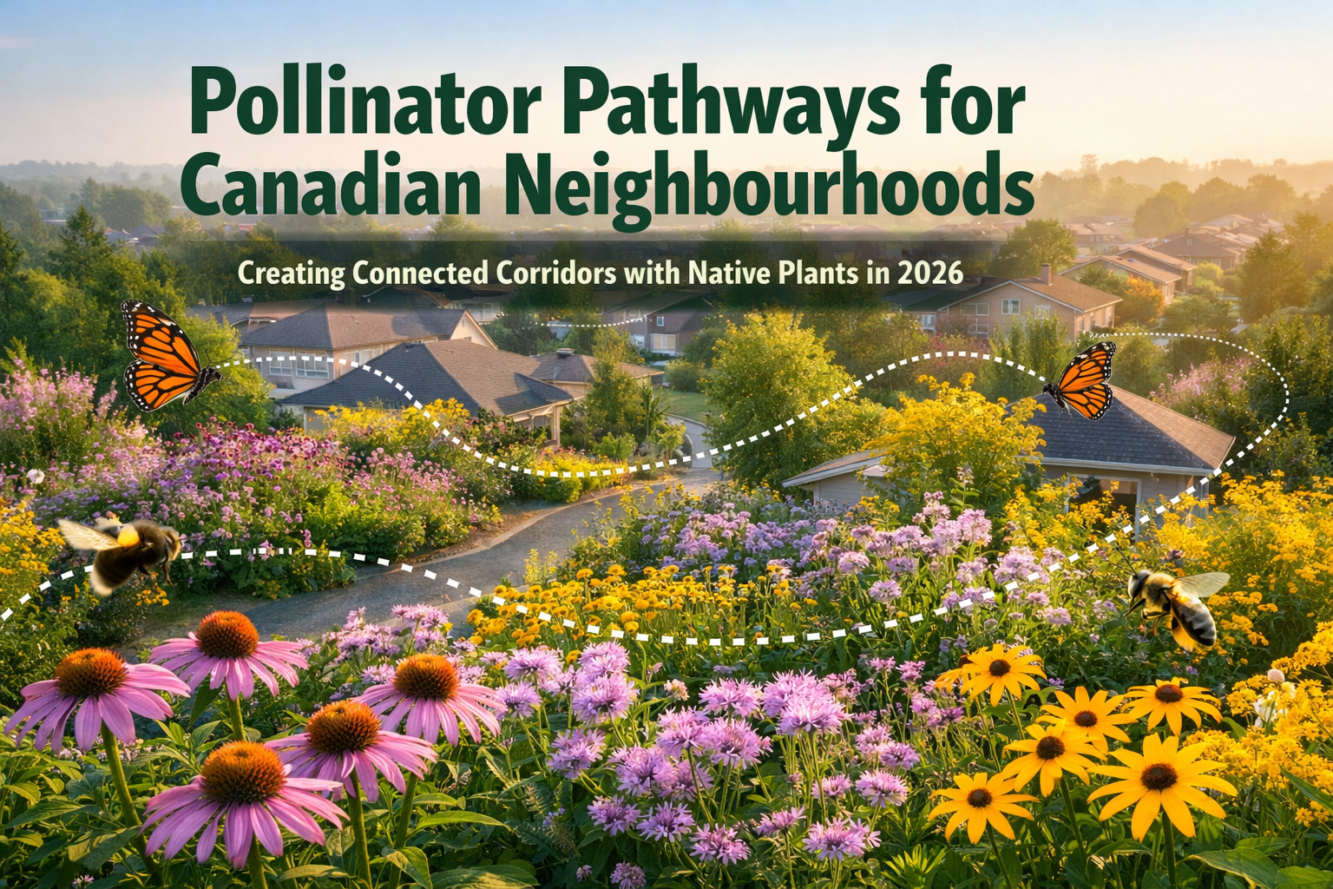
Pollinator Pathways for Canadian Neighbourhoods: Creating Connected Corridors with Native Plants in 2026

Last updated: March 4, 2026
Key Takeaways
- A pollinator pathway connects individual gardens across a neighbourhood so bees, butterflies, and other pollinators can safely travel, feed, and reproduce along a continuous corridor of native plants.
- Toronto alone supports 360+ native bee species and 100+ butterfly species, but these populations depend on linked habitat, not isolated patches [3].
- Community-led projects like The Ground Crew in East Toronto are already distributing native seeds to residents and building neighbourhood-scale corridors in 2026 [2].
- Grants such as Toronto’s PollinateTO program offer up to $5,000 for residents creating pollinator habitat [3].
- Stratford, Ontario, is planting 500+ pollinator-friendly street trees as part of its Bee City Canada renewal, extending its existing pathway network [4].
- Choosing long-blooming native species matched to your hardiness zone keeps corridors functional from spring through fall.
- Eliminating neonicotinoid pesticides and adding shallow water sources are two low-cost actions that dramatically improve corridor success.
- National Pollinator Week (June 22–28, 2026) offers a coordinated moment to launch or expand local pathway projects [5].
Quick Answer
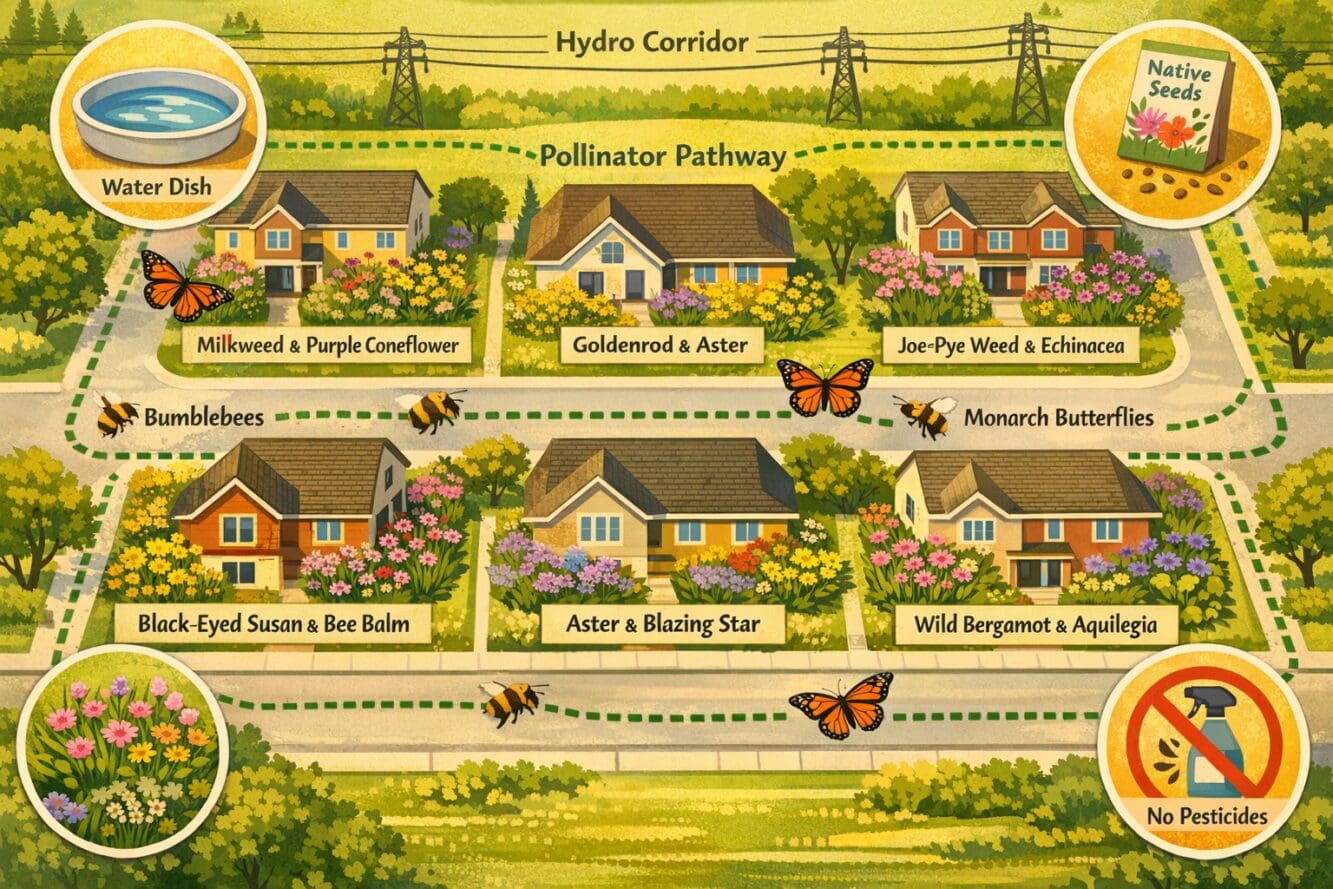
Pollinator pathways for Canadian neighbourhoods turn isolated yards into a connected regional ecosystem by planting native species in sequence along streets, laneways, and hydro corridors. In 2026, municipal programs, community seed-sharing events, and federal awareness campaigns like the Canadian Wildlife Federation’s “Secret Life of Grasslands” are making it easier than ever for Canadians to participate [1]. The core idea is simple: when enough neighbours plant overlapping bloom schedules of native wildflowers, shrubs, and trees, pollinators gain safe migration and foraging routes across otherwise hostile urban landscapes.
What Is a Pollinator Pathway and Why Does It Matter in 2026?
A pollinator pathway is a chain of pollinator-friendly gardens, green spaces, and naturalized areas that together form a continuous corridor. Instead of one backyard acting as a dead-end food stop, linked gardens let bees, butterflies, moths, and hoverflies move safely between feeding and nesting sites.
This matters because habitat fragmentation is the leading pressure on Canadian pollinators. A single garden surrounded by pavement and mowed lawn offers limited value. But that same garden, connected to a neighbour’s wildflower patch 50 metres away, which connects to a boulevard planting, which connects to a park meadow, creates a functional corridor.
Why 2026 is a turning point:
- The Canadian Wildlife Federation launched “The Secret Life of Grasslands” in February 2026, a national campaign focused on conserving disappearing grassland habitats that pollinators depend on [1].
- The Ground Crew in East Toronto has been hosting winter seed-sharing events (including Valentine’s Day and St. Patrick’s Day distributions) to get native seeds into residents’ hands before spring planting [2].
- Stratford’s Bee City Canada renewal includes 500+ native street trees specifically chosen for pollinator value [4].
These aren’t isolated efforts. They signal a shift from individual garden projects toward coordinated, neighbourhood-scale planning, which is exactly what pollinator pathways for Canadian neighbourhoods require.
Which Native Plants Work Best for Connected Corridors in Canada?
The most effective corridor plants are native species that bloom at different times across the growing season, ensuring pollinators always have food available. Choose species matched to your USDA/Canadian hardiness zone (most of southern Ontario is zone 5–6; the Prairies range from zone 2–4).
Spring bloomers (April–May):
- Wild columbine (Aquilegia canadensis)
- Virginia bluebells (Mertensia virginica)
- Red-osier dogwood (Cornus sericea) — shrub
Summer bloomers (June–August):
- Wild bergamot (Monarda fistulosa)
- Common milkweed (Asclepias syriaca) — critical for Monarchs
- Joe-Pye weed (Eutrochium maculatum)
- Black-eyed Susan (Rudbeckia hirta)
Fall bloomers (September–October):
- New England aster (Symphyotrichum novae-angliae)
- Goldenrod (Solidago spp.)
- Smooth blue aster (Symphyotrichum laeve)
Decision rule: If you can only plant three species, choose one from each bloom period. This gives pollinators continuous forage from April through October. The Ontario Pollinator Pathway website offers region-specific planting guides for Ontario ecosystems [6].
Common mistake: Buying “wildflower mixes” from big-box stores that contain non-native or invasive species. Always source seeds from Canadian native plant nurseries or community seed libraries like The Ground Crew’s distributions [2].
For more on how communities are rethinking traditional lawn spaces, see how LawnShare helps create vibrant biodiverse havens.
How Do You Start a Pollinator Pathway in Your Neighbourhood?
Starting a pathway doesn’t require municipal approval or a large budget. It requires coordination between neighbours and a shared commitment to native planting.
Step-by-step process:
- Map existing green spaces. Walk your street and note front gardens, boulevard strips, community gardens, schoolyards, church grounds, and hydro corridors. These are potential corridor nodes.
- Recruit 5–10 neighbours. A pathway works when gardens are spaced no more than 250 metres apart (the foraging range of many native bees). Even three or four committed households on a single block make a difference.
- Choose a shared plant list. Agree on 8–12 native species that cover spring, summer, and fall blooms. Share seedlings or coordinate a bulk seed order.
- Eliminate pesticides along the corridor. Neonicotinoids are especially harmful to bees. Toronto’s Pollinator Protection Strategy specifically recommends procurement policies that exclude neonicotinoid-treated plants and seeds [3].
- Add water sources. A shallow dish with pebbles and fresh water at each garden node gives pollinators hydration stops along the corridor.
- Register your pathway. Organizations like the Ontario Pollinator Pathway maintain maps of registered corridors, which helps connect your pathway to adjacent neighbourhood efforts [6].
- Celebrate and expand. National Pollinator Week (June 22–28, 2026) is an ideal launch date [5]. Host a garden walk to recruit more participants.
Toronto’s strategy specifically encourages partnerships with Master Gardeners, landscape professionals, business improvement areas, condominium boards, and faith organizations to spread habitat creation across public and private land [3]. This community-led model is what makes pathways scalable.
Residents interested in broader community greening efforts may also find value in pop-up events for community gardens and mobile park programs.
What Can Canadian Cities Learn from Existing Corridor Projects?
Several Canadian projects already demonstrate what works at scale.
| Project | Location | Scale | Key Feature |
|---|---|---|---|
| Scarborough Centre Butterfly Trail | Toronto | 40 hectares | Hydro corridor converted from mowed grass to functioning meadow [3] |
| The Ground Crew Pathway | East Toronto | Neighbourhood-wide | Community seed distribution; winter sowing events [2] |
| Stratford Bee City Renewal | Stratford, ON | Municipal | 500+ native street trees added to extend existing pathway [4] |
| CWF Rights-of-Way Restoration | Great Lakes region | Multi-municipal | Native wildflower meadows along Monarch migration routes [1] |
The Scarborough example is especially instructive. A 40-hectare hydro corridor that was previously barren mowed grass was transformed into meadow habitat supporting butterflies and native bees [3]. Hydro corridors exist in nearly every Canadian city and are often underused. They’re already linear, already connected, and already publicly managed — making them ideal backbone infrastructure for pollinator pathways.
The Canadian Wildlife Federation partners with rights-of-way managers across the Great Lakes shoreline to restore native wildflower meadows along Monarch butterfly migration routes [1]. This approach treats utility corridors as ecological infrastructure, not just electrical infrastructure.
Those interested in the broader paradigm shift needed to address climate change and biodiversity loss will find pollinator pathways are a practical, ground-level expression of that shift.
How Much Does It Cost to Create a Pollinator Pathway?
Costs vary widely depending on scale, but neighbourhood pathways are among the most affordable conservation actions available.
Individual garden conversion:
- Native seed packets: $3–$15 each (or free through community seed swaps like The Ground Crew’s events [2])
- Native plant plugs: $3–$8 per plant from native nurseries
- A 10-square-metre front garden conversion using plugs: roughly $50–$150
- Shallow water dish with pebbles: under $10
Neighbourhood coordination costs:
- Printing flyers and hosting a planning meeting: $50–$100
- Bulk seed order for 10 households: $100–$300
Grant funding available:
- Toronto’s Pollinate TO program provides up to $5,000 per project for pollinator habitat creation [3]
- Many municipalities offer similar small grants through environmental or beautification programs
Choose grants if: the project involves public or semi-public land (schoolyards, community gardens, boulevard plantings). For private front gardens, the out-of-pocket cost is modest enough that most households can participate without funding.
Common mistake: Over-investing in hardscape (raised beds, decorative borders) instead of maximizing planting area. Pollinators need plants, not pavers. Keep the budget focused on diverse native species.
Community members exploring the connection between environmental action and local engagement might also appreciate learning about the Enchanted Evening fundraiser supporting Save Georgian Bay.
Why Should Pesticide Reduction Be Part of Every Pollinator Pathway?
Even the best-planted corridor fails if the plants or surrounding areas are treated with pesticides that kill the pollinators it’s meant to support.
Neonicotinoids are systemic insecticides absorbed into plant tissue, including pollen and nectar. A bee visiting a neonicotinoid-treated flower ingests the pesticide directly. Toronto’s Pollinator Protection Strategy explicitly recommends excluding neonicotinoid-treated plants and seeds from City procurement [3], and this principle applies equally to home gardens.
Practical steps for pesticide-free corridors:
- Ask nurseries whether their plants were grown with neonicotinoids. If they can’t confirm, buy elsewhere.
- Replace herbicide-based weed control with manual weeding or dense native groundcover that outcompetes weeds naturally.
- Accept some insect damage on plants. A few chewed leaves are a sign the ecosystem is working.
- Talk to neighbours about reducing or eliminating lawn chemical treatments along the corridor route.
“A pollinator pathway treated with neonicotinoids is a pollinator trap, not a pollinator corridor.”
This is one area where coordination between neighbours matters most. A single lawn treatment service spraying adjacent to a native garden can undermine the entire corridor’s function.
For a broader look at ditching conventional lawn care, see why it’s time to ditch the lawn and go natural.
How Do Pollinator Pathways Connect to Larger Conservation Goals in 2026?
Neighbourhood pathways are the local building blocks of regional and national pollinator conservation strategies.
The Canadian Wildlife Federation has advocated for coordinated pollinator habitat creation across federal, provincial, and municipal levels, including recommendations to the Green Budget Coalition and the Commission for Environmental Cooperation [1]. The CWF’s 2026 “Secret Life of Grasslands” campaign specifically targets the grassland ecosystems that many pollinators depend on for nesting and overwintering [1].
How the scales connect:
- Yard scale: Individual native gardens provide food and nesting habitat.
- Neighbourhood scale: Connected gardens form pathways that allow daily foraging movement.
- Municipal scale: Programs like PollinateTO and Stratford’s Bee City renewal link neighbourhood pathways to parks, hydro corridors, and street tree networks [3][4].
- Regional scale: CWF’s rights-of-way restoration along Monarch migration routes connects municipal corridors into flyway-level habitat [1].
This multi-level framework means that planting native milkweed in a Collingwood front yard contributes to Monarch survival along the entire Great Lakes migration corridor. The action is local; the impact is regional.
Those following the shift to cleaner energy will recognize a parallel pattern: distributed, local actions aggregating into system-wide change.
What Are Common Mistakes When Building Pollinator Pathways?
Avoid these pitfalls that reduce corridor effectiveness:
- Planting only one bloom period. A garden full of black-eyed Susans looks great in July but offers nothing in May or October. Stagger bloom times.
- Ignoring nesting habitat. Many native bees nest in bare soil or hollow stems. Leave patches of unmulched ground and don’t cut back all dead stems in fall.
- Spacing gardens too far apart. Small-bodied native bees forage within 200–500 metres. If the next garden node is a kilometre away, the corridor has a gap.
- Using cultivars instead of straight species. Double-petalled cultivars often produce less nectar and pollen. Choose straight native species when possible.
- Forgetting about water. Pollinators need water, especially during hot summers. A shallow dish refreshed daily is sufficient.
Frequently Asked Questions
How far apart can gardens be in a pollinator pathway?
Ideally no more than 250 metres for small native bees. Butterflies can travel farther, but shorter gaps benefit the widest range of species.
Do I need to remove my entire lawn to participate?
No. Converting even a 2-by-3-metre strip of lawn to native plants creates a useful corridor node. Front boulevard strips and foundation plantings count.
Can I start a pollinator pathway in winter?
Yes. The Ground Crew in East Toronto runs winter seed-sowing events where native seeds are scattered on snow, allowing natural cold stratification before spring germination [2].
Are pollinator pathways only for southern Ontario?
No. The concept applies across Canada. Prairie provinces can use native prairie species like prairie crocus and blazing star. BC corridors might feature red flowering currant and Oregon grape. Match species to your hardiness zone.
Do pollinator pathways attract wasps or stinging insects?
Native bees are generally non-aggressive. Solitary bees (the majority of native species) rarely sting. The species attracted to native wildflowers are not the yellowjackets that bother picnics.
What is Bee City Canada and how does it relate to pathways?
Bee City Canada is a designation program for municipalities that commit to pollinator protection. Stratford’s 2026 Bee City renewal, for example, includes expanding its pollinator pathway with 500+ native street trees [4].
Where can I find native plant seeds in Canada?
Community seed libraries, native plant nurseries (search for members of the Canadian Nursery Landscape Association), and organizations like The Ground Crew [2]. The Ontario Pollinator Pathway website also lists regional sources [6].
Is there funding available for pollinator pathway projects?
Yes. Toronto’s PollinateTO grant offers up to $5,000 per project [3]. Check your municipality for similar environmental grant programs.
When is National Pollinator Week in 2026?
June 22–28, 2026 [5]. It’s an ideal time to launch a neighbourhood pathway or host a community planting event.
How do I know if my pathway is working?
Monitor for increased pollinator diversity. Count the number of bee and butterfly species you observe over a season. Apps like iNaturalist help with identification and create useful baseline data.
Conclusion
Pollinator pathways for Canadian neighbourhoods represent one of the most practical, affordable, and impactful conservation actions available in 2026. The model is straightforward: plant native species that bloom across the full growing season, connect gardens close enough for pollinators to travel between them, eliminate pesticides along the route, and add water sources.
Actionable next steps:
- This week: Identify three to five neighbours willing to participate and walk your street to map potential corridor nodes.
- This month: Order native seeds or plugs matched to your hardiness zone, prioritizing at least one species per bloom period (spring, summer, fall).
- By June 22: Plant your corridor nodes and register your pathway with the Ontario Pollinator Pathway [6] or a similar regional organization.
- June 22–28: Use National Pollinator Week [5] to host a garden walk and recruit additional neighbours.
- Ongoing: Apply for grants like PollinateTO [3], share surplus seeds, and expand the corridor each year.
Every connected garden strengthens the corridor. The bees, butterflies, and moths doing the essential work of pollination don’t recognize property lines — and the most effective conservation strategy in 2026 is one that doesn’t either.
References
[1] Pollinators – https://cwf-fcf.org/en/explore/pollinators.html
[2] Planting Seeds In The Snow Can Help Create Pollinator Pathway In East Toronto – https://beachmetro.com/2026/01/29/planting-seeds-in-the-snow-can-help-create-pollinator-pathway-in-east-toronto/
[3] Draft Pollinator Strategy – https://www.toronto.ca/services-payments/water-environment/environmentally-friendly-city-initiatives/reports-plans-policies-research/draft-pollinator-strategy/
[4] Stratford Renewal2026 – https://beecitycanada.org/wp-content/uploads/2026/01/Stratford-Renewal2026.pdf
[5] Pollinator Partnership – https://www.pollinator.org
[6] Ontario Pollinator Pathway – https://www.pollinator-pathway.org/state/ontario
Content, illustrations, and third-party video appearing on GEORGIANBAYNEWS.COM may be generated or curated with AI assistance or reproduced pursuant to the fair dealing provisions of the Copyright Act, R.S.C. 1985, c. C-42. Attribution and hyperlinks to original sources are provided in acknowledgment of applicable intellectual property rights. Such referencing is intended to direct traffic to and support the original rights holders’ platforms.
Much Appreciate You Sharing This Post - It Helps MUCH!!!