





















Last updated: May 12, 2026
The Toys “R” Us PPA Finals concluded the 2025-2026 season with a high-stakes pool play format that divided the top 8 singles players and top 16 doubles teams into two four-player pools, where each competitor played three matches against pool opponents. Top seeds dominated the weekend, with Ben Johns and Anna Leigh Waters earning double gold, while the weighted point system (200 for playing, 300 for wins, 700 for semifinals, 1,300 for championships) rewarded deep tournament runs and shaped final rankings. The event at Life Time Rancho San Clemente showcased breakout performances, strategic partner selections, and set the narrative for the 2026 tour season ahead.
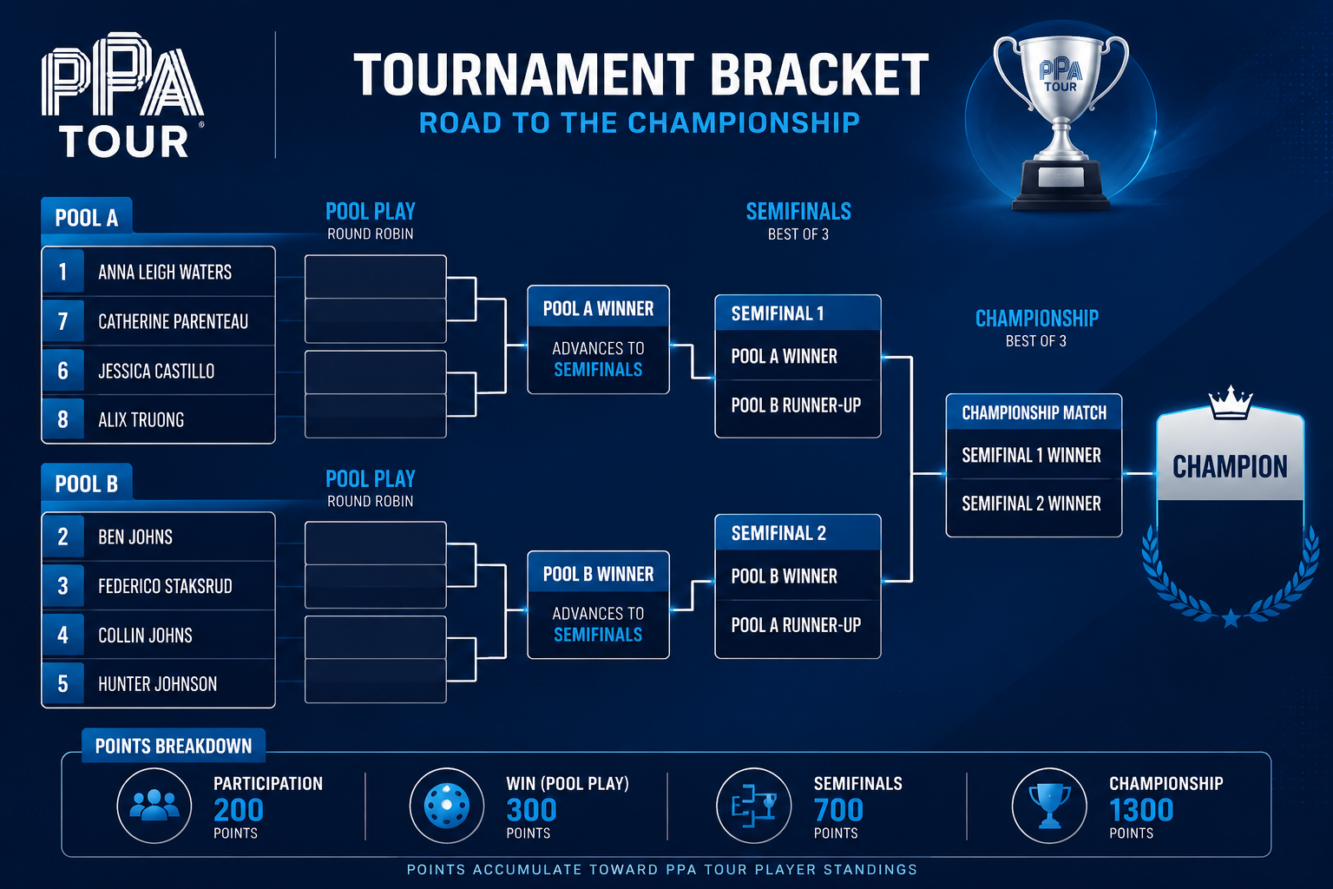
The Toys “R” Us PPA Finals used a round-robin pool play system that guaranteed every qualified player multiple high-stakes matches. The top 8 men’s and women’s singles players were divided into two four-player pools, with each competitor facing all three pool opponents [2]. Similarly, the top 16 men’s and women’s doubles teams were split into pools for preliminary competition.
Pool Play Structure:
This format differed from traditional single-elimination brackets by prioritizing match volume and consistency. A player could lose one pool match and still advance by winning their other two, whereas in bracket play, a single loss ends the tournament. The round-robin approach rewarded sustained excellence over the weekend rather than one hot match.
Common mistake: Assuming all three pool matches carried equal weight. While each match awarded the same points (200 for playing, 300 for winning), the strategic implications varied—players often adjusted tactics based on their pool standings heading into the final pool match.
The Finals featured a heavily weighted point structure designed to reward deep tournament runs and make championship Sunday pivotal for final rankings. Pool play matches awarded 200 points simply for competing and an additional 300 points for winning (500 total per victory) [1]. This baseline ensured all qualified players earned substantial points for reaching the Finals.
Complete Point Breakdown:
| Round | Points for Playing | Points for Winning | Total for Win |
|---|---|---|---|
| Pool Play Match | 200 | 300 | 500 |
| Semifinal | — | 700 | 700 |
| Championship | — | 1,300 | 1,300 |
The escalating point values meant a player who won all three pool matches (1,500 points), their semifinal (700 points), and the championship (1,300 points) could earn 3,500 points total—more than three times the 1,000 points awarded for winning a regular PPA Open event.
Strategic implication: Players trailing in season rankings needed to reach at least the semifinals to make meaningful gains, while top-ranked players could maintain position with solid pool play performances. Choose aggressive tactics in pool play if you’re chasing rankings; play conservatively if protecting a lead.
Ben Johns and Anna Leigh Waters dominated the Finals weekend, each capturing double gold by winning both mixed doubles together and their respective singles or doubles events [1]. This marked their third consecutive year establishing themselves as the standard-setters in professional pickleball, validating their top seedings and season-long consistency.
Top Performers:
The tournament recap was titled “The Top Seeds Dominate,” confirming that higher-seeded players and teams advanced furthest through pool play and medal rounds [1]. This outcome validated the PPA’s seeding methodology based on season-long performance rather than single-event results.
Edge case: Waters’ knee injuries (visible left knee brace and heavy right knee taping from the previous week in Atlanta) forced her singles withdrawal but didn’t prevent her from competing in doubles, where partner support reduced lateral movement demands [1].
Anna Leigh Waters’ withdrawal from singles competition due to knee injuries created a significant reshuffling of the women’s singles draw. Waters, who would have been the top or second seed, pulled out after wearing a left knee brace and heavy tape on her right knee the previous week in Atlanta [1]. Her absence opened the door for Kate Fahey to claim the top seed position and allowed Liz Truluck to take the final qualifying spot.
Ripple Effects:
Waters still competed in women’s doubles and mixed doubles, capturing gold in both events alongside her regular partners [1]. This selective participation suggests the knee issues specifically affected the lateral movement and extended rallies required in singles play, where no partner can cover court areas.
Decision rule: If nursing an injury, prioritize doubles formats where partner support reduces individual court coverage demands and match duration is typically shorter than singles.
The 2025-2026 season marked the PPA Tour’s first fall-through-spring season structure, abandoning the traditional calendar-year format. This shift moved the Finals from December to May, fundamentally changing how players approached season planning, training cycles, and peak performance timing [1].
Key Changes:
The May Finals date kept the event at Life Time Rancho San Clemente (111 Avenida Vista Montana, San Clemente, CA 92672) [7], which offered “picturesque” weather and strong crowd attendance for high-level competition [1]. The venue’s climate control and outdoor courts benefited from spring temperatures rather than winter variability.
Common mistake: Assuming the season format change only affected scheduling. The shift actually influenced player conditioning programs, sponsor activation timing, media coverage patterns, and fan engagement strategies throughout the year.
The PPA Tour ran two professional tournaments simultaneously at Life Time Rancho San Clemente—the prestigious PPA Finals for top-8 and top-16 qualifiers, and a PPA 500 event open to players who didn’t qualify for the Finals [1]. The 500 event awarded 500 points to winners, positioning it between PPA Open events (1,000 points) and Challenger events (125 points) in the tour hierarchy.
Dual-Tournament Structure:
This structure ensured players who narrowly missed Finals qualification (ranked 9-20 in singles, 17-32 in doubles) could still compete for meaningful points and prize money rather than sitting idle during the season’s most important weekend. The 500-point prize represented half the value of a regular Open event, making it worthwhile for players chasing year-end rankings.
Strategic consideration: Choose the PPA 500 if ranked just outside Finals qualification—winning it (500 points) beats losing in pool play at the Finals (600 points for three losses), though Finals participation guarantees higher minimum earnings.
The Finals results established the official 2025-2026 season rankings and set the competitive narrative heading into the 2026 calendar portion of the tour. Players who performed well secured top seedings for early 2026 events, while those who underperformed face pressure to regain form quickly.
Post-Finals Implications:
Ben Johns and Anna Leigh Waters’ double gold performances reinforced their status as the players to beat in 2026, maintaining their three-year dominance streak [1]. Their consistency across formats (singles, doubles, mixed) makes them the benchmark for measuring other players’ progress.
For players ranked 5-15: Use the off-season to analyze Finals match footage and identify tactical adjustments—the gap between top-4 and mid-tier players often comes down to shot selection under pressure rather than raw skill differences.
The PPA Tour 2025-2026 Season Finale delivered high-stakes drama through its innovative pool play format, where the top 8 singles players and top 16 doubles teams competed in round-robin pools before advancing to medal rounds. The weighted point system—awarding 200 points for participation, 300 for wins, 700 for semifinals, and 1,300 for championships—ensured that every match carried significant ranking implications. Ben Johns and Anna Leigh Waters captured double gold, Judit Castillo emerged as a breakout performer, and the historic fall-through-spring season format proved successful with its May Finals timing at Life Time Rancho San Clemente.
Actionable Next Steps:
The 2025-2026 season finale established clear hierarchies while revealing emerging challengers ready to disrupt the established order in 2026. As the tour transitions fully into its new fall-through-spring format, the May Finals proved that spring timing maximizes both playing conditions and competitive intensity for professional pickleball’s premier event.
What was the format of the PPA Tour 2025-2026 Season Finale? The Finals used a pool play format with two four-player pools in each division. Each competitor played three matches against pool opponents, with the top two from each pool advancing to semifinals [2].
How many points could players earn at the PPA Finals? Pool play matches awarded 200 points for playing and 300 for winning (500 total per win). Semifinals earned 700 points and championships awarded 1,300 points, with maximum total earnings of 3,500 points for winning all matches [1].
Why did Anna Leigh Waters withdraw from singles? Waters withdrew from singles competition due to knee injuries, including a left knee brace and heavy taping on her right knee observed the previous week in Atlanta. She continued competing in doubles events [1].
Where was the PPA Tour 2025-2026 Season Finale held? The Toys “R” Us PPA Finals took place at Life Time Rancho San Clemente (111 Avenida Vista Montana, San Clemente, CA 92672) in May 2026 [7].
Who won the most titles at the Finals? Ben Johns and Anna Leigh Waters each captured double gold—Johns won men’s singles and mixed doubles, while Waters won women’s doubles and mixed doubles, marking their third consecutive year of dominance [1].
What is a PPA 500 event? A PPA 500 event awards 500 points to the winner, positioned between PPA Open events (1,000 points) and Challenger events (125 points). One ran concurrently with the Finals for non-qualifiers [1].
How did the season format change for 2025-2026? The PPA Tour shifted from a calendar-year season to a fall-through-spring format (2025-2026), moving the Finals from December to May and creating a continuous season narrative [1].
Could top seeds choose their doubles partners? Yes, top seeds were permitted to select their doubles partners for the Finals, with most choosing their regular season partners to maintain chemistry and tactical familiarity [1].
What made Judit Castillo’s performance notable? Castillo, seeded 4th in women’s singles pool play, delivered a “miracle” performance that earned extensive media coverage and elevated her profile heading into 2026 [4].
How did pool play differ from single-elimination brackets? Pool play guaranteed three matches per competitor and allowed players to advance despite one loss, whereas single-elimination ends a tournament after one defeat. This format rewarded consistency over single-match performance.
What were the championship implications of the Finals? Finals results determined final 2025-2026 season rankings, influenced initial 2026 tournament seedings, affected sponsorship negotiations, and shaped Player of the Year and other season-end award considerations.
Did weather affect the May Finals timing? The May timing at Life Time Rancho San Clemente provided ideal spring weather conditions, avoiding the December holiday conflicts and winter variability while maintaining strong spectator attendance [1].
[1] The Top Seeds Dominate The Ppa Tour Finals Tournament Recap – https://www.thedinkpickleball.com/the-top-seeds-dominate-the-ppa-tour-finals-tournament-recap/
[2] Toys R Us Ppa Finals Will Cap The 2025 26 Year – https://pickleball.com/news/toys-r-us-ppa-finals-will-cap-the-2025-26-year
[4] Watch – https://www.youtube.com/watch?v=2P7PQAfXBdg
[7] Ppa Finals – https://ppatour.com/tournament/2026/ppa-finals/