
















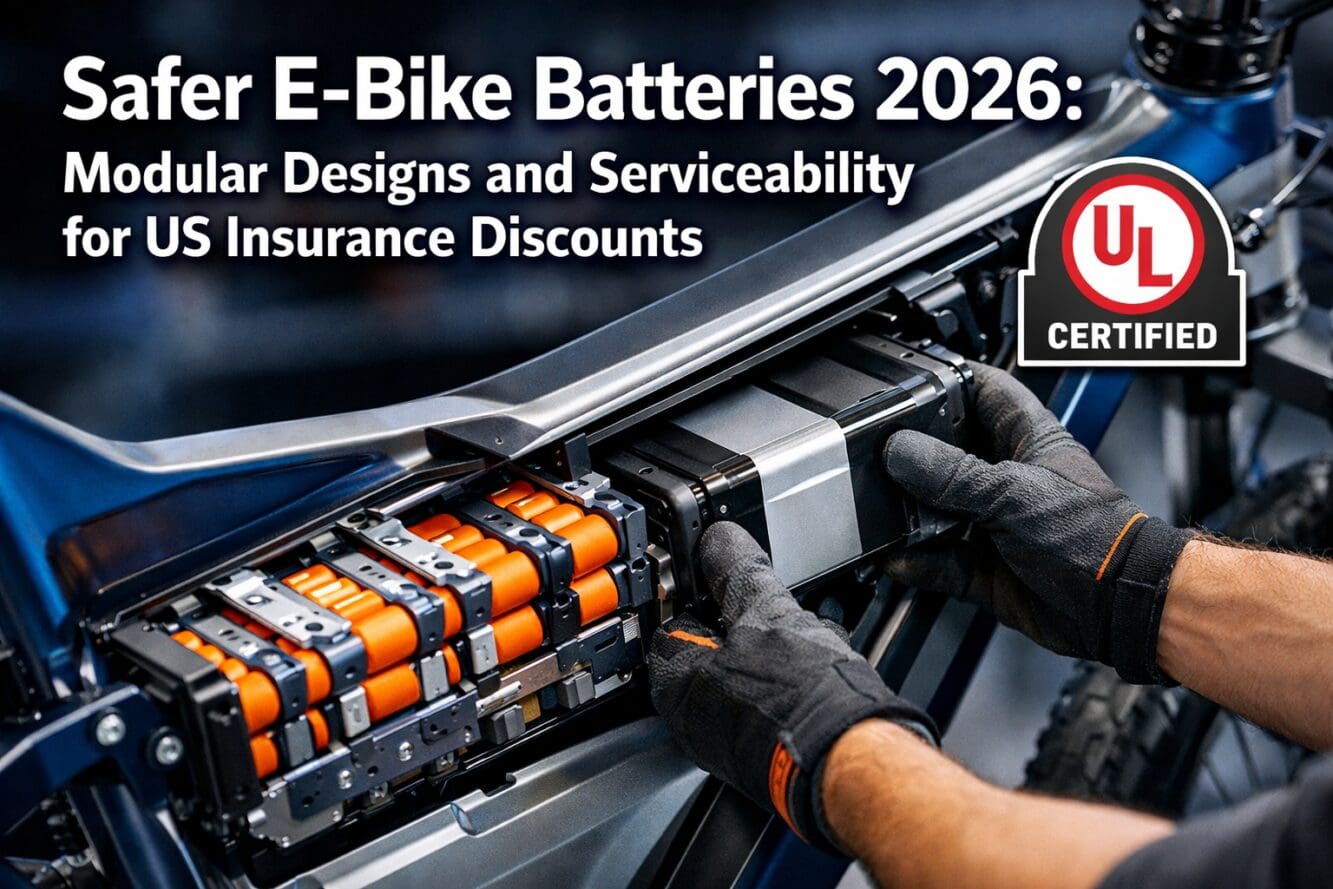
Safer E-Bike Batteries 2026: Modular Designs and Serviceability for US Insurance Discounts
Last updated: February 25, 2026
Key Takeaways
- Modular battery designs let riders swap depleted packs in 90 seconds, isolate cell failures, and simplify repairs without replacing entire battery systems
- UL 2849 and UL 2271 certifications are becoming mandatory in California and may unlock 10-15% insurance premium discounts in regulated markets
- 21700 cells store 20% more energy than older 18650 technology while running cooler and lasting longer[4]
- Dual battery configurations combine integrated and external packs (500Wh + 500Wh) to double riding range without charging stops[2]
- Fire-resistant housing with internal cell separation and thermal barriers prevents catastrophic failures in 2026 battery architectures[1]
- Solid-state prototypes showcased at CES 2026 promise faster charging and non-flammable chemistry, with mass production planned by 2028[5]
- California SB 1271 requires batteries sold in the state to meet recognized safety standards, creating a template for national regulation[2]
Quick Answer
Safer e-bike batteries in 2026 feature modular designs that allow quick swaps, easy repairs, and better failure isolation compared to older monolithic packs. These architectures meet UL safety certifications required by California law and may qualify riders for insurance discounts of 10-15% in regulated markets. The shift combines improved cell chemistry (21700 cells), fire-resistant construction, and intelligence-driven battery management systems that prioritize thermal stability over maximum range.
What Makes Modular E-Bike Battery Designs Safer in 2026?
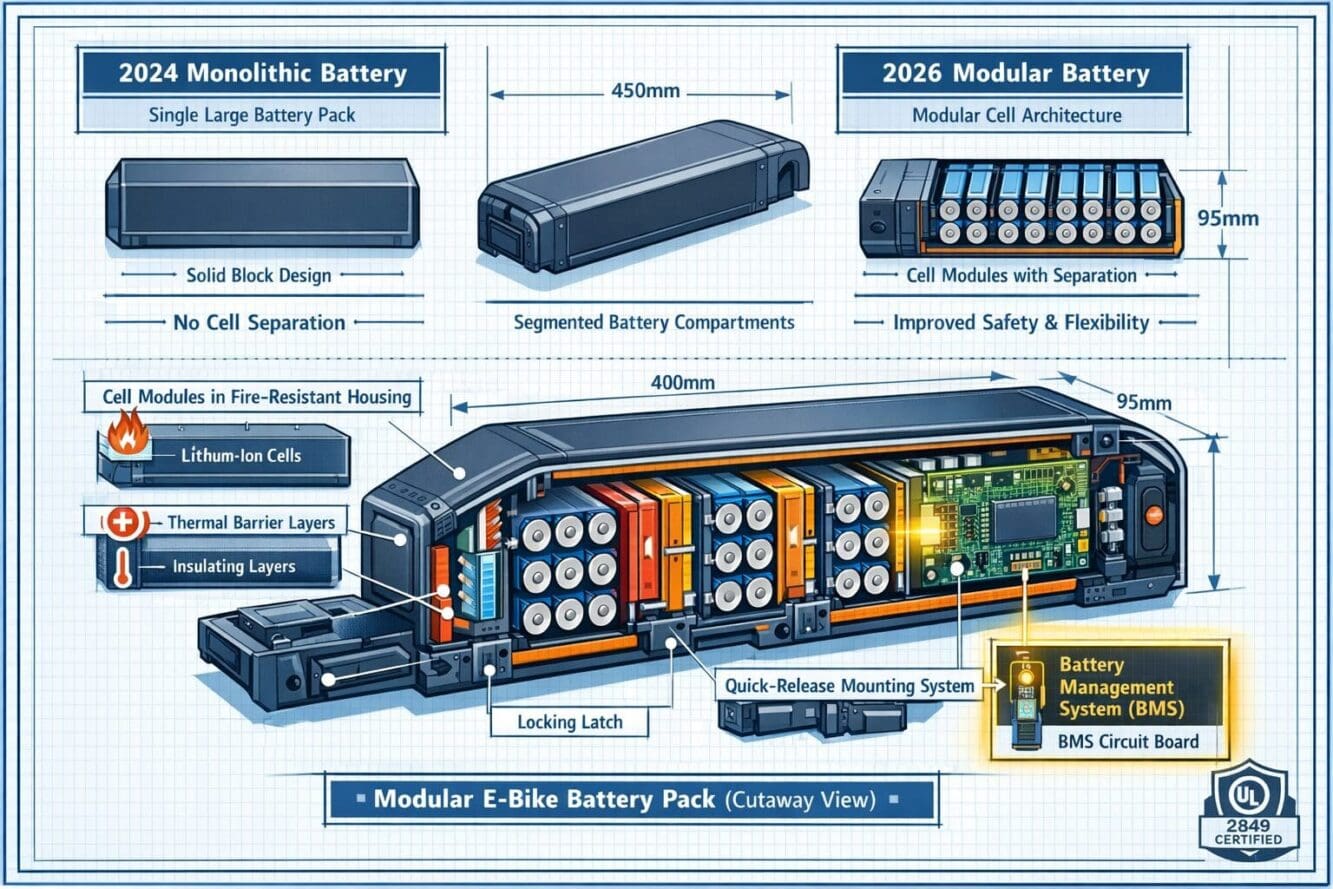
Modular battery packs isolate failures and simplify maintenance, reducing the risk of catastrophic battery events[1]. Instead of one large sealed unit, 2026 designs segment cells into separate compartments with thermal barriers between modules.
Key safety improvements include:
- Segmented cell architecture – Individual modules contain 10-20 cells each with fire-resistant separators
- Thermal runaway mitigation – If one module overheats, barriers prevent fire from spreading to adjacent cells
- Reinforced pack construction – Fire-resistant materials replace plastic housings used in pre-2024 batteries[1]
- Improved environmental sealing – Protection against water, dust, and corrosion extends battery lifespan and prevents short circuits[1]
Pre-2024 batteries relied on passive thermal protection. Modern 2026 models feature active and layered systems that monitor temperature across multiple zones[1]. This means the Battery Management System (BMS) can shut down individual modules before problems escalate.
Choose modular designs if: You ride in varied weather, need extended range with dual battery setups, or want the option to replace only damaged sections rather than the entire pack.
How Do Modular Batteries Enable Quick Swaps and Extended Range?
Modular and swappable designs allow riders to carry spare batteries and replace them in minutes, effectively doubling ride time without waiting[4]. New e-bikes increasingly enable quick battery swaps, with many allowing different models to share the same pack or support rapid exchanges[4].
Practical swap benefits:
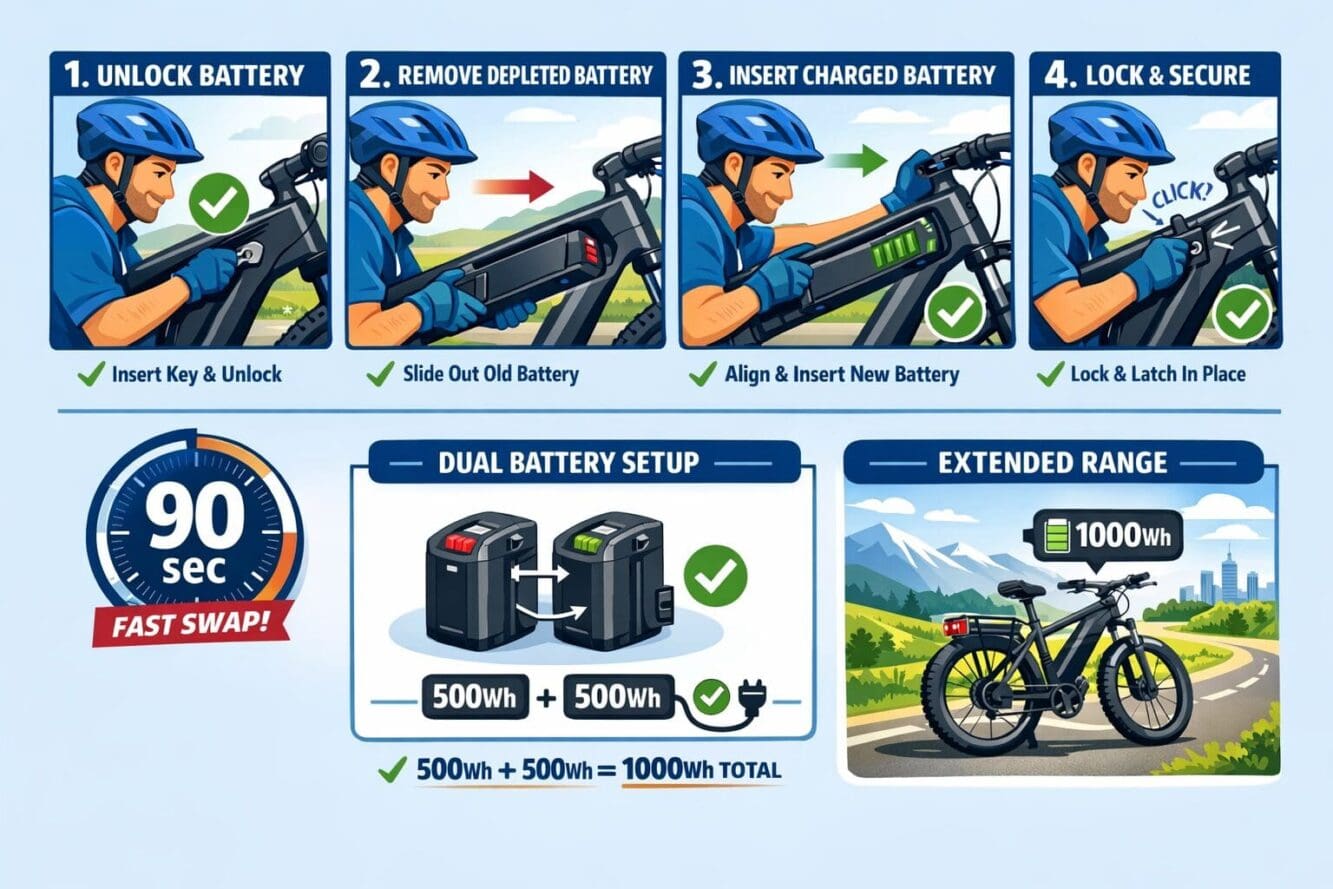
- 90-second replacement – Most 2026 modular systems use tool-free latches and alignment guides
- Dual battery configurations – Combine a standard integrated battery (500-630 Wh) with an optional external battery (250-500 Wh)[2]
- Range extension – Dual setups effectively double riding range for long-distance tours and extended commutes without range anxiety[2]
- Standardized mounting – 48V systems dominate the US market, supporting interoperability across brands[4]
The industry is shifting from 18650 cells to 21700 cells (21mm × 70mm), which store approximately 20% more energy than older technology[4]. These newer cells run cooler and last longer, enabling longer single-charge range while maintaining the same physical battery size.
Common mistake: Assuming all modular batteries are cross-compatible. Always verify voltage (36V, 48V, 52V) and mounting system compatibility before purchasing spare packs.
What Certifications Unlock Insurance Discounts for Safer E-Bike Batteries in 2026?
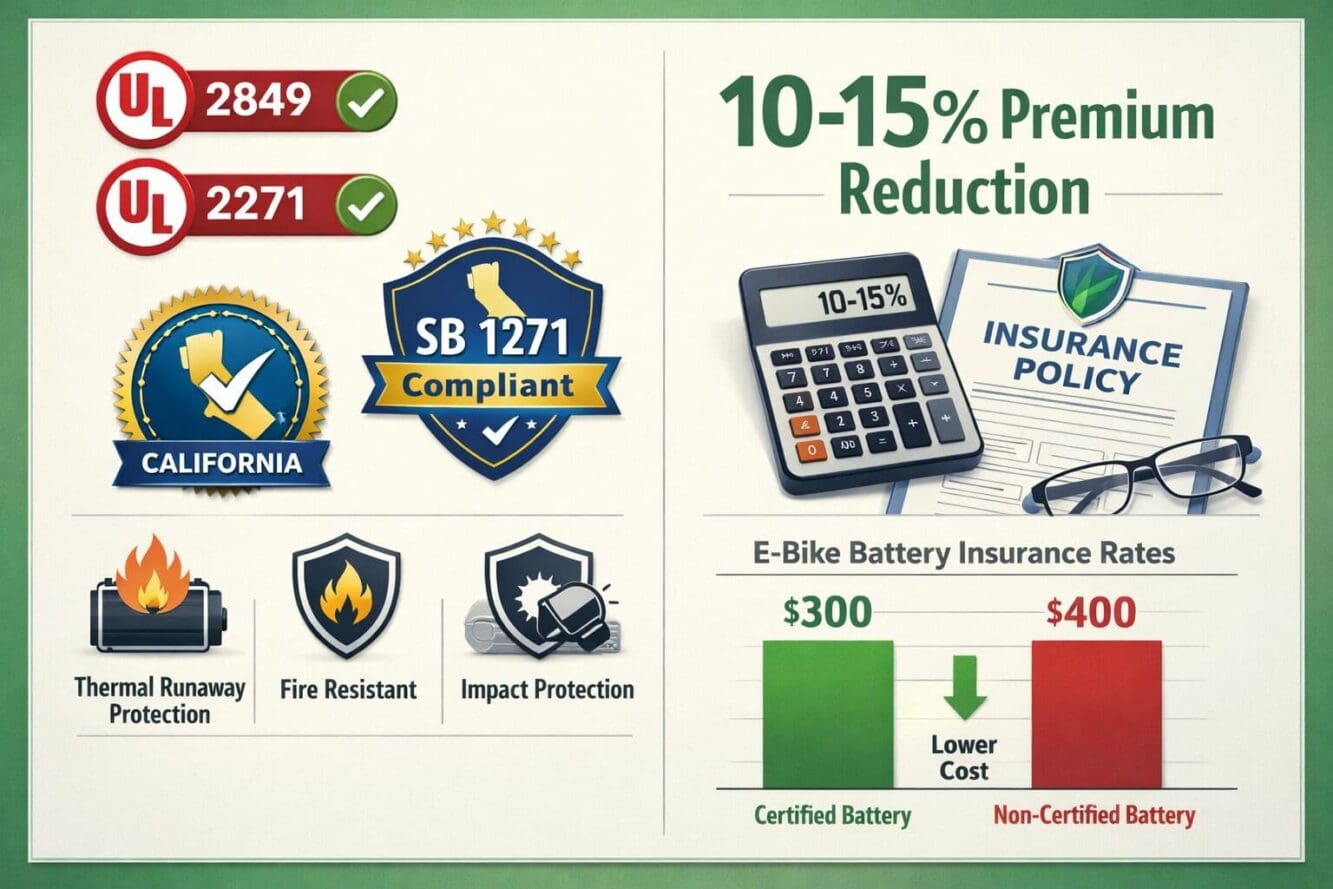
California leads US regulation through SB 1271, which requires e-bike batteries, chargers, and components sold or leased in California to meet recognized standards including ANSI/CAN/UL 2849, UL 2271, or EN 15194[2]. This establishes a state-level template for certification requirements that insurers are starting to recognize.
UL-first design encompasses:
- Electrical systems engineered for fault containment from the concept stage[1]
- Battery packs designed specifically for thermal runaway mitigation[1]
- Charger-wiring-battery integration tested as a single system rather than separate components[1]
This comprehensive approach provides clear documentation for regulators, retailers, and consumers[1]. Insurance companies in regulated markets are beginning to offer premium reductions of 10-15% for e-bikes with certified battery systems because the data shows fewer fire-related claims.
Decision rule: If you live in California or plan to insure your e-bike, choose models with UL 2849 or UL 2271 certification. The upfront cost difference (typically $100-200) pays back through insurance savings within 18-24 months.
The US lacks a single federal motor-vehicle-style type-approval for standard e-bikes; CPSC handles product recalls but enforcement remains fragmented. Recent high-profile battery recalls from inexpensive imported e-bikes underscore why certification matters[2].
How Does Serviceability Reduce Long-Term Battery Costs?
Modular designs allow technicians to replace individual damaged modules rather than discarding the entire battery pack. This cuts replacement costs by 40-60% compared to sealed monolithic designs.
Serviceability advantages:
| Feature | Monolithic Battery | Modular Battery (2026) |
|---|---|---|
| Cell replacement | Entire pack disposal | Individual module swap |
| Repair cost | $600-900 full replacement | $200-400 module replacement |
| Diagnostic capability | Limited external testing | Module-level BMS monitoring |
| Failure isolation | Total system shutdown | Affected module only |
| Upgrade path | None (sealed unit) | Module capacity upgrades |
The European Commission removed a proposed right-to-repair mandate requiring single battery cell replacement, citing safety concerns about opening battery repair wider[3]. However, module-level serviceability strikes a balance—certified technicians can safely replace entire modules without exposing individual cells.
Edge case: Some manufacturers void warranties if non-certified technicians service modular batteries. Always check warranty terms before attempting repairs, even on modular systems designed for serviceability.
For riders concerned about environmental impact, understanding fossil-fuelled deniers in politics helps contextualize why battery recycling and serviceability matter for sustainable transportation.
What Battery Management System Features Improve Safety?
Intelligence-driven Battery Management Systems (BMS) in 2026 actively monitor and protect batteries rather than simply reporting status. Modern BMS chips track temperature across multiple zones, balance cell charging, and predict failure patterns before they become dangerous.
Advanced BMS capabilities:
- Multi-zone thermal monitoring – Sensors track temperature in 4-8 different battery sections
- Predictive failure analysis – AI algorithms identify degradation patterns weeks before failure
- Active cell balancing – Ensures all cells charge and discharge evenly, extending pack lifespan
- Fault containment protocols – Automatically isolates problematic modules and alerts riders
Pre-2024 batteries used passive thermal protection; 2026 models feature active and layered systems[1]. When the BMS detects abnormal temperature rise in one module, it can reduce power output, activate cooling protocols, or shut down that specific section while keeping other modules operational.
Choose advanced BMS if: You regularly ride in extreme temperatures (below 32°F or above 95°F), frequently charge to 100%, or need maximum battery lifespan (1000+ charge cycles).
Are Solid-State Batteries Ready for E-Bikes in 2026?
Solid-state battery technology prototypes were showcased at CES 2026, promising faster charging, higher energy density, and safer, non-flammable chemistry compared to lithium-ion[5]. ProLogium and Donut Lab demonstrated prototypes with high capacity and rapid charging; ProLogium plans mass production of solid-state e-bike batteries by 2028[5].
Current solid-state status:
- Prototype stage – Working demonstrations exist but aren’t commercially available for e-bikes yet
- 2028 production target – First mass-produced solid-state e-bike batteries expected in 24-30 months[5]
- Safety advantages – Non-flammable solid electrolyte eliminates thermal runaway risk entirely
- Cost barrier – Early production will be 2-3x more expensive than lithium-ion
For 2026 purchases, lithium-ion batteries with modular designs and UL certification remain the practical choice. Solid-state technology will likely debut in premium e-bikes ($4,000+) before trickling down to mid-range models by 2030.
Future-proofing tip: Choose e-bikes with modular battery mounts that could potentially accept solid-state packs when they become available. Some manufacturers are designing mounting systems with future upgrades in mind.
How Do Dual Battery Systems Work for Extended Range?
Dual battery systems combine a standard integrated battery (500-630 Wh) with an optional external battery (250-500 Wh), effectively doubling riding range for long-distance tours and extended commutes without range anxiety[2]. The BMS manages both packs as a unified system, drawing power strategically to maximize efficiency.
Dual battery configuration benefits:
- Sequential discharge – System drains external battery first, preserving integrated pack for emergencies
- Hot-swappable external packs – Replace depleted external battery mid-ride without powering down
- Balanced wear – BMS alternates primary pack to equalize charge cycles across both batteries
- Modular expansion – Add external battery only when needed for long trips
Most US e-bikes operate on 48V battery packs, balancing power and safety[4]. This standardization means external batteries from different manufacturers may work with your primary system if voltage and connector types match.
Cost consideration: External battery packs typically cost $400-700. Calculate whether the extended range justifies the investment based on your typical riding distances. For daily commutes under 25 miles, a single high-capacity battery (630+ Wh) may be more economical.
What Should Riders Check Before Buying Modular Batteries?
Before purchasing modular e-bike batteries or battery-equipped bikes in 2026, verify these critical specifications to ensure safety, compatibility, and insurance eligibility.
Pre-purchase checklist:
✓ Certification status – UL 2849, UL 2271, or EN 15194 marking visible on battery housing
✓ Voltage match – Must exactly match bike controller (36V, 48V, 52V, etc.)
✓ Capacity rating – Measured in watt-hours (Wh); higher numbers = longer range
✓ Cell type – 21700 cells preferred over older 18650 technology[4]
✓ BMS features – Multi-zone thermal monitoring and active cell balancing
✓ Warranty coverage – Minimum 2 years for battery, 1 year for BMS
✓ Module replacement availability – Confirm manufacturer stocks replacement modules
✓ Insurance compatibility – Check if certification qualifies for premium discounts
Red flags to avoid:
- No visible certification markings or vague “safety tested” claims
- Unusually cheap prices (under $300 for 500+ Wh capacity)
- Seller cannot provide BMS specifications or thermal protection details
- Battery housing shows signs of damage, swelling, or previous repairs
For context on how technology regulations affect consumer safety, explore discussions about AI tools and their oversight frameworks.
Frequently Asked Questions
How much do modular e-bike batteries cost in 2026?
Modular batteries with UL certification range from $500-900 for 500-750 Wh capacity. Premium dual battery systems cost $1,200-1,800 total. Individual replacement modules run $200-400, about half the cost of replacing monolithic packs.
Can I upgrade my old e-bike to use modular batteries?
Possibly, but it requires matching voltage, mounting system, and controller compatibility. Most pre-2024 e-bikes use proprietary battery mounts that won’t accept newer modular designs without custom fabrication.
Do all insurance companies offer discounts for certified batteries?
Not yet. Currently, only insurers in California and a few other regulated markets offer 10-15% premium reductions for UL-certified battery systems. This is expected to expand as more states adopt safety standards.
How long do modular e-bike batteries last?
Quality modular batteries with active BMS last 1,000-1,500 charge cycles (3-5 years of daily use). Individual modules may degrade at different rates, allowing partial replacement to extend total pack lifespan to 6-8 years.
Are modular batteries heavier than traditional designs?
Slightly. The additional housing, thermal barriers, and module separators add 0.5-1.5 pounds compared to equivalent-capacity monolithic packs. The safety and serviceability benefits typically outweigh the minor weight increase.
Can I fly with modular e-bike batteries?
Airlines restrict lithium batteries over 100 Wh in checked luggage. Most e-bike batteries (500+ Wh) exceed this limit. Some modular systems allow removing individual modules under 100 Wh for air travel, but always check airline policies first.
What happens if one module fails in a modular battery?
The BMS isolates the failed module and continues operating on remaining modules at reduced capacity. You can ride home safely, then replace only the damaged module rather than the entire pack.
Do modular batteries charge faster than traditional ones?
Charge speed depends on BMS and charger specifications, not modularity. However, dual battery systems let you charge both packs simultaneously using two chargers, effectively halving total charge time.
Are Chinese-made modular batteries safe?
Safety depends on certification, not country of origin. Chinese manufacturers like ProLogium produce UL-certified batteries meeting US safety standards[5]. Always verify certification markings regardless of manufacturing location.
Can I mix different capacity modules in one battery pack?
No. All modules in a pack must have identical voltage, capacity, and chemistry. Mixing specifications causes unbalanced charging and premature failure. Replace modules with exact manufacturer-specified equivalents.
How do I dispose of old modular battery modules?
Take them to certified e-waste recycling facilities or battery collection programs. Never throw lithium batteries in regular trash. Many bike shops and electronics retailers offer free battery recycling services.
Will solid-state batteries work with current modular systems?
Early solid-state batteries (arriving 2028) will likely require new mounting systems and BMS integration[5]. Some manufacturers are designing forward-compatible mounts, but most current modular systems won’t accept solid-state packs without modifications.
Conclusion
Safer e-bike batteries in 2026 represent a fundamental shift from maximizing range at any cost to prioritizing thermal stability, serviceability, and regulatory compliance. Modular designs with UL certification offer riders tangible benefits: 90-second battery swaps, 40-60% lower repair costs through module replacement, and potential insurance premium reductions of 10-15% in regulated markets.
The convergence of improved cell chemistry (21700 technology), fire-resistant construction, and intelligence-driven battery management systems creates a new baseline for what riders should expect. California’s SB 1271 requirements are pushing the entire industry toward certified safety standards that benefit everyone, even in states without formal regulations.
Next steps for riders:
- Verify certification – Only purchase batteries with visible UL 2849 or UL 2271 markings
- Check insurance eligibility – Contact your insurer to confirm if certified batteries qualify for discounts
- Prioritize serviceability – Choose modular designs from manufacturers that stock replacement modules
- Plan for dual batteries – If you regularly ride over 40 miles, invest in a compatible external battery pack
- Stay informed – Follow solid-state battery development for potential upgrades in 2028-2030
The shift toward safer, modular e-bike batteries isn’t just about meeting regulations. It’s about building sustainable transportation infrastructure where riders can confidently use their e-bikes for years, knowing the power source is both safe and serviceable. As certification requirements expand and insurance companies recognize the reduced risk, the economic case for choosing safer batteries will only strengthen.
For broader context on how sustainable technology choices impact communities, explore how the shift to cleaner energy is unstoppable in reshaping transportation and power systems.
References
[1] 2026 E-Bike Tech to Watch: Safer Batteries, Smarter BMS & UL-First Design – https://www.favoritebikes.com/blogs/news/2026-e-bike-tech-to-watch-safer-batteries-smarter-bms-ul-first-design
[2] Modular Battery Systems: The Future of E-Bike Power and Performance – https://tamobykesport.com/blogs/blog/modular-battery-systems-the-future-of-e-bike-power-and-performance
[3] Top Electric Bike Battery Options 2026 Insights – https://www.sunnalsolar.com/blog/top-electric-bike-battery-options-2026-insights/
[4] E-Bike Battery Trends 2026: What U.S. Riders Can Expect Next – https://cykebikes.com/blogs/news/e-bike-battery-trends-2026-what-u-s-riders-can-expect-next
[5] CES 2026 E-Bike Innovations: Transforming Mobility and Technology – https://www.hovsco.com/blogs/news/ces-2026-e-bike-innovations-transforming-mobility-and-technology
Content, illustrations, and third-party video appearing on GEORGIANBAYNEWS.COM may be generated or curated with AI assistance or reproduced pursuant to the fair dealing provisions of the Copyright Act, R.S.C. 1985, c. C-42. Attribution and hyperlinks to original sources are provided in acknowledgment of applicable intellectual property rights. Such referencing is intended to direct traffic to and support the original rights holders’ platforms.