





















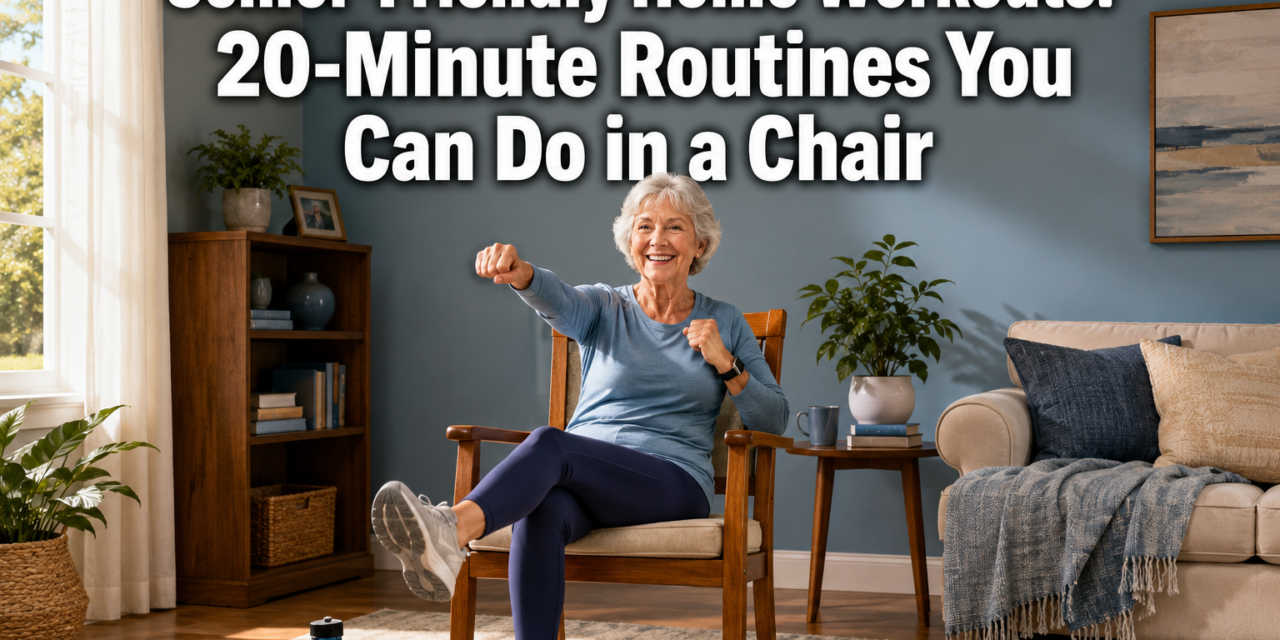
Senior-Friendly Home Workouts: 20-Minute Routines You Can Do in a Chair
Last updated: June 11, 2026
Quick Answer
Senior-friendly home workouts using a chair are safe, effective routines that build strength, improve flexibility, and support balance without requiring floor work or a gym membership. A well-structured 20-minute session, done three to five times per week, can meaningfully reduce fall risk and support daily independence. These routines are especially well-suited for older adults managing arthritis, poor balance, or post-surgical recovery.
Key Takeaways
- A 20-minute chair workout typically includes a warm-up, upper body, lower body, core work, and a cool-down, in that order [1]
- Use a sturdy, non-wheeled chair without armrests for maximum stability and safety [2]
- Chair exercises genuinely build muscle strength and improve flexibility, making daily tasks easier [2]
- Seniors with arthritis can modify movements by reducing range of motion and avoiding painful joint positions [4]
- Aim for three to five sessions per week, adjusting intensity to your current fitness level [3]
- No special equipment is required, though light resistance bands or small hand weights can add challenge
- Chair yoga and standard chair exercises differ in focus: chair yoga emphasizes breath and flexibility; standard routines prioritize strength and cardio
- Even imperfect, consistent effort produces real health benefits over time [6]
What Are the Best Chair Exercises for Seniors with Limited Mobility
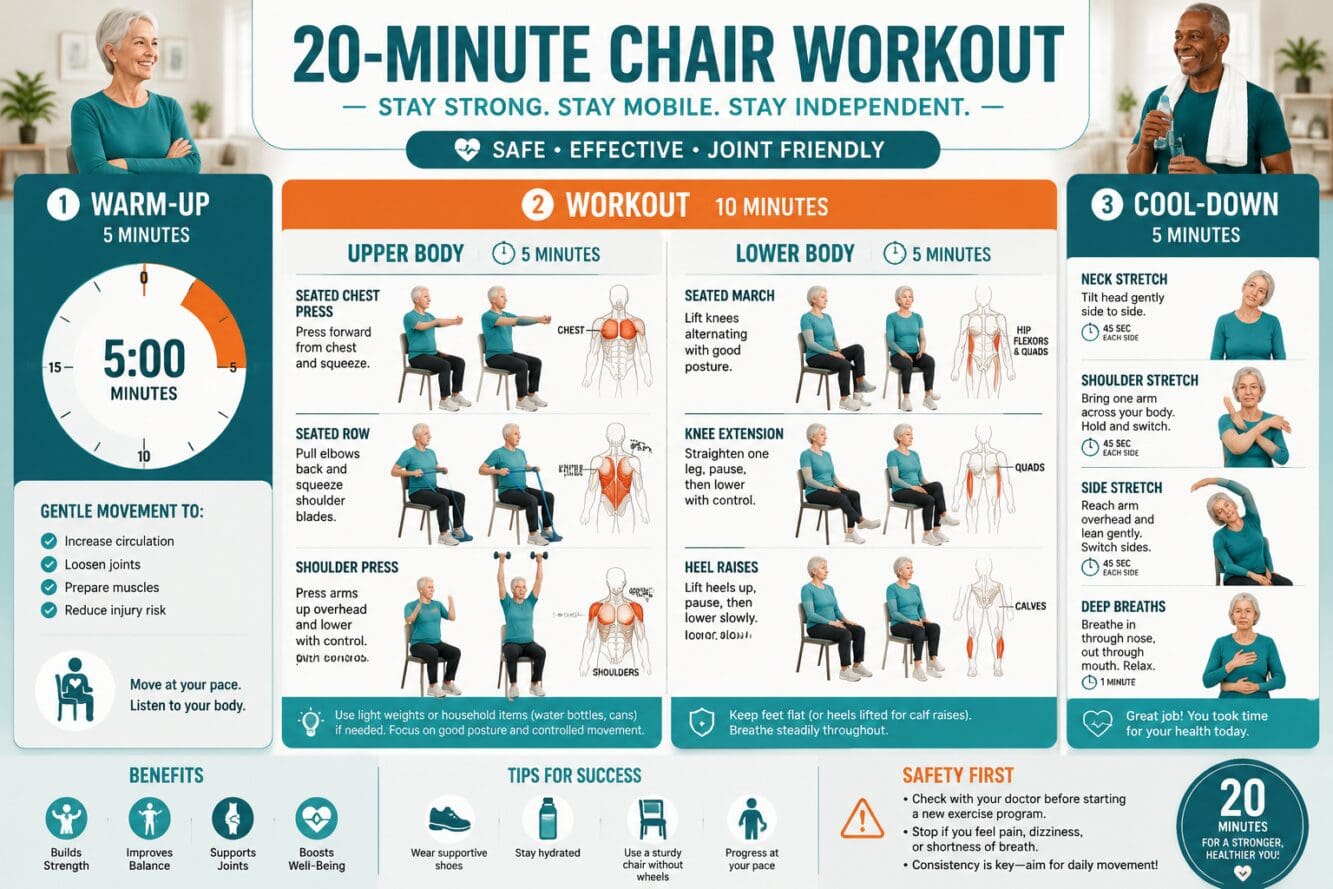
The most effective chair exercises for seniors with limited mobility target multiple muscle groups without requiring standing or floor work. Good starting points include seated marches, leg extensions, heel raises, shoulder rolls, bicep curls, and overhead presses [1].
Sample 20-minute routine structure:
SegmentDurationFocusWarm-up2 minutesNeck tilts, ankle circles, arm circlesUpper body5 minutesShoulder rolls, bicep curls, chest pressLower body5 minutesSeated marches, leg extensions, heel raisesCore4 minutesPelvic tilts, seated knee lifts, seated twistsCool-down3 minutesHamstring stretch, chest opener, figure-four stretch
This structure follows a clinically recommended sequence that reduces injury risk while covering all major muscle groups [1].
Choose this routine if: you have not exercised in months, you use a cane or walker, or you find standing exercises unstable.
How Can Seniors with Arthritis Modify Chair Workouts
Seniors with arthritis can safely participate in chair workouts by reducing range of motion, slowing movement speed, and skipping any exercise that causes sharp joint pain. The goal is to move through a comfortable range, not a full one [4].
Practical modifications:
- Replace full bicep curls with partial curls that stop before elbow discomfort
- Use lighter resistance or no resistance at all on flare-up days
- Substitute wrist circles for grip-heavy exercises if hand joints are affected
- Perform ankle circles and toe raises instead of heel raises if ankle arthritis is present
- Take longer rest periods between sets
A common mistake is stopping all movement during an arthritis flare. Gentle range-of-motion exercises, even slow ankle circles, help maintain joint lubrication and reduce stiffness over time.
Are Chair Exercises Actually Effective for Building Strength
Yes, chair exercises build real, functional strength, particularly in the legs, core, and upper body. Harvard Health Publishing confirms that chair-based routines enhance strength, flexibility, and stamina, directly supporting performance of daily activities and reducing fall risk [2].
Resistance can be added progressively using light hand weights or resistance bands once bodyweight movements feel easy. Consistency matters more than intensity, especially in the first several weeks [6].
What Equipment Do You Need for Senior Chair Workouts at Home
No equipment is required to start. The only essential item is a sturdy, armless, non-wheeled chair that does not slide on the floor [2].
Optional add-ons that increase variety:
- Light dumbbells (1 to 3 lbs) for upper body exercises
- A resistance band looped around the chair legs for leg work
- A yoga strap or towel for assisted stretches
Cost is minimal. Free video resources, including a well-reviewed 20-minute seated workout for adults over 60, are available on YouTube at no cost [5]. Structured DVD programs or streaming subscriptions typically range from $10 to $30 per month, depending on the platform.
How Many Calories Can Seated Exercises Burn
Calorie burn from seated exercises is lower than standing cardio but still meaningful. A moderate 20-minute chair workout burns an estimated 50 to 100 calories for most older adults, depending on body weight, exercise intensity, and how much muscle is engaged. This estimate assumes a mix of light resistance and rhythmic movement; purely passive stretching burns less.
Can chair exercises help with weight loss for older adults? Chair workouts support weight management when combined with a balanced diet, but they are unlikely to drive significant weight loss on their own. Their primary value is maintaining muscle mass, which naturally declines with age and directly affects metabolic rate.
Which Chair Workouts Are Safe After Surgery or for Medical Conditions
Seniors recovering from hip or knee surgery should consult their surgeon or physiotherapist before starting any chair routine. Generally, gentle ankle circles, seated marching, and upper body movements are permitted early in recovery, but leg extension depth and hip flexion angles must be restricted based on surgical guidelines [3].
Medical conditions that may require a doctor’s clearance before starting:
- Recent joint replacement (hip, knee)
- Uncontrolled hypertension
- Active heart failure or unstable angina
- Severe osteoporosis with vertebral fracture history
- Uncontrolled diabetes with peripheral neuropathy
If any of these apply, get clearance first. Chair exercises are not universally risk-free simply because they are seated.
What Is the Difference Between Chair Yoga and Regular Chair Exercises
Chair yoga and standard chair exercises both use a seated position but serve different primary goals. Chair yoga focuses on breath awareness, gentle flexibility, and relaxation through adapted yoga poses. Standard chair exercises prioritize muscular strength, light cardiovascular conditioning, and functional movement patterns [4].
Choose chair yoga if: stress relief, flexibility, and mindfulness are your main goals.
Choose standard chair exercises if: building leg strength, improving posture, or preventing falls is the priority.
Many seniors benefit from combining both approaches across the week.
How to Prevent Injury During Seated Workout Routines
The single most important safety step is chair selection. Use a firm, flat-seated chair with no wheels and no armrests, placed on a non-slip surface [2]. Beyond that, a proper warm-up and cool-down reduce muscle strain significantly.
Injury prevention checklist:
- Sit with feet flat on the floor, hip-width apart
- Keep the spine tall, not arched or slumped
- Never hold your breath during exertion; exhale on the effort
- Stop immediately if you feel sharp pain, dizziness, or chest tightness
- Progress gradually: add one new exercise or one extra set per week, not per session
A stress-relieving stretch at the end of each session also helps the body recover and signals the nervous system to downshift after exertion.
Are Chair Workouts Good for Balance and Flexibility
Yes. Regular chair-based movement improves both flexibility and the neuromuscular coordination that underpins balance. Exercises like seated leg extensions, heel-to-toe raises, and torso rotations train the stabilizing muscles around the hips and ankles, which are directly linked to fall prevention [2].
Flexibility gains come from consistent stretching during the cool-down phase. Hamstring stretches, chest openers, and figure-four hip stretches are particularly beneficial for older adults who spend long periods sitting [1].
Common Mistakes Seniors Make When Starting Chair Workouts
The most frequent errors are skipping the warm-up, progressing too fast, and choosing the wrong chair. Each of these raises injury risk unnecessarily.
Other common mistakes:
- Using a wheeled office chair, which can roll during movement
- Holding the breath during resistance exercises
- Doing the same routine every day without rest days
- Stopping entirely after one missed session rather than resuming gradually
- Expecting results within a week rather than within four to six weeks
Consistency over perfection is the guiding principle. Showing up three times a week with modest effort outperforms one intense session followed by a long gap [6].
FAQ
How often should seniors do chair exercises?
Three to five times per week is the general recommendation, with at least one rest day between more intense sessions [3].
Can I do chair exercises if I have osteoporosis?
Yes, with modifications. Avoid deep forward bends and spinal rotation under load. Focus on gentle strengthening and posture work, and confirm with your doctor if you have a history of vertebral fractures.
Is a 20-minute session long enough to see results?
Yes. Consistent 20-minute sessions performed three or more times weekly produce measurable improvements in strength and flexibility within four to eight weeks [1].
Do I need to warm up before a chair workout?
Always. A two-minute warm-up of gentle neck tilts, ankle circles, and arm circles prepares joints and reduces the risk of muscle strain [1].
Can chair exercises replace walking?
They complement walking rather than replace it. If walking is not possible, chair cardio (such as seated marches and rapid arm movements) provides a partial cardiovascular substitute.
What should I wear for a chair workout?
Comfortable, non-restrictive clothing and flat, supportive shoes with non-slip soles. Avoid bare feet on slippery floors.
Are there free chair workout resources online?
Yes. A well-reviewed 20-minute seated exercise video for adults over 60 is available on YouTube and covers mobility, balance, and strength [5].
Can chair exercises help with back pain?
Gentle core exercises like pelvic tilts and seated knee lifts can reduce lower back discomfort over time, but anyone with diagnosed spinal conditions should get physiotherapy guidance first.
Conclusion
Senior-friendly home workouts using a chair are one of the most accessible and evidence-supported ways for older adults to stay strong, mobile, and independent in 2026. A 20-minute routine that covers warm-up, upper body, lower body, core, and cool-down can be done safely at home with no equipment and no gym membership.
Actionable next steps:
- Select a sturdy, armless, non-wheeled chair and place it on a non-slip surface.
- Start with three sessions per week using the 20-minute structure outlined above.
- If you have arthritis, a recent surgery, or an uncontrolled health condition, speak with your doctor or physiotherapist before beginning.
- Track your sessions for four weeks. Most people notice improved energy and easier daily movement within that window.
- Consider exploring somatic chair yoga as a complementary practice on rest days for added flexibility and stress relief.
Regular movement, even from a chair, is one of the most powerful tools available for healthy aging. Start small, stay consistent, and build from there.
References
[1] Chair Exercises Seniors – https://ageplacehub.ca/blog/chair-exercises-seniors/?utm_source=openai
[2] Chair Exercises For Seniors Boosting Strength Flexibility And Stamina – https://www.health.harvard.edu/exercise-and-fitness/chair-exercises-for-seniors-boosting-strength-flexibility-and-stamina?utm_source=openai
[3] Chair Exercises Seniors Seated Workout Routine – https://mobilephysiotherapist.co.uk/blog/chair-exercises-seniors-seated-workout-routine.html?utm_source=openai
[4] Chair Exercises For Seniors – https://health.clevelandclinic.org/chair-exercises-for-seniors/?utm_source=openai
[5] Watch – https://www.youtube.com/watch?v=tyYfIsMiXj8&vl=en-US&utm_source=openai
[6] Chair Exercises For Seniors – https://chairtaichi.org/chair-exercises-for-seniors?utm_source=openai