




















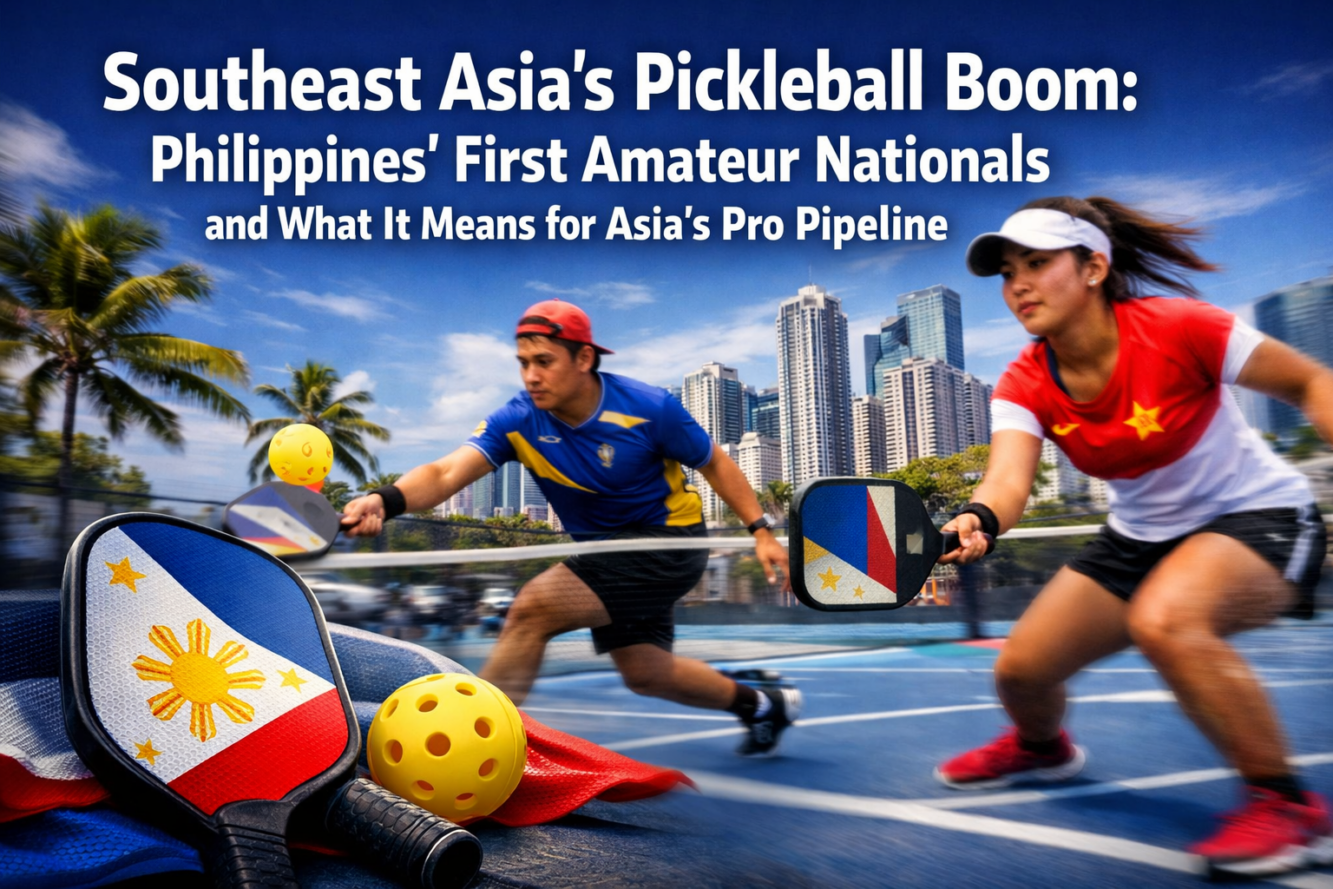
Southeast Asia’s Pickleball Boom: Philippines’ First Amateur Nationals and What It Means for Asia’s Pro Pipeline

Last updated: March 19, 2026
Quick Answer
The Philippines is hosting its first-ever amateur national pickleball championship from March 28-30, 2026, marking a structural shift in Southeast Asian pickleball development. The Skechers Pickleball First Philippine Pickleball Amateur Nationals serves as an official qualifier for international pro competitions and introduces a unified player registry system that creates clear pathways from grassroots play to professional circuits—mirroring the rapid development model that propelled India’s pickleball scene.

Key Takeaways
- First National Championship: The Skechers Pickleball First Philippine Pickleball Amateur Nationals runs March 28-30, 2026, at Tela Park Pickleball Center in Las Piñas[1]
- Pro Pipeline Access: Tournament serves as official qualifier for EPIC World Amateur Championships, connecting Filipino players to international professional opportunities[1]
- Unified Player System: Philippine Pickleball Federation launched mandatory Philippine Pickleball Player Registry (PPPR) for all competitive participants[1]
- International Standards: Competition follows 2026 USA Pickleball Rulebook and Rally Scoring format, aligning with global competitive standards[1]
- Dual Ranking Integration: Players earn both Philippine Ranking Points and Global Pickleball Rankings (GPR) through DUPR synchronization[1]
- Registration Deadline: March 20, 2026, with limited slots per division on first-come, first-served basis[1]
- Grassroots to Elite Pathway: System designed to track players from first tournament through national team selection
- Regional Impact: Philippines positioning itself as Southeast Asia’s gateway to professional pickleball circuits
What Makes the Philippine Amateur Nationals a Turning Point for Southeast Asia’s Pickleball Boom?
The inaugural Philippine Pickleball Amateur Nationals represents the first fully structured national championship in Southeast Asia with direct connections to international professional pathways. Unlike informal tournaments that have dominated the region, this event establishes standardized competition formats, official rankings, and qualification routes to global pro circuits.
The tournament’s significance extends beyond a single event because it introduces infrastructure that didn’t exist before:
- Official national player registry linking all competitive participants to a unified database
- Standardized rulebook application matching USA Pickleball international standards
- Direct qualification pathway to EPIC World Amateur Championships
- Synchronized ranking systems connecting local, national, and global rating platforms
The Philippine Pickleball Federation partnered with Pickleball Global to create a centralized tournament management platform that tracks player progress from first competition through elite-level qualification[1]. This mirrors the development model that accelerated India’s emergence as an Asian pickleball powerhouse, where structured pathways helped convert recreational interest into competitive depth.
For Southeast Asian players, the Philippines now offers what was previously only available by traveling to North America or Europe: a legitimate domestic route to professional recognition.

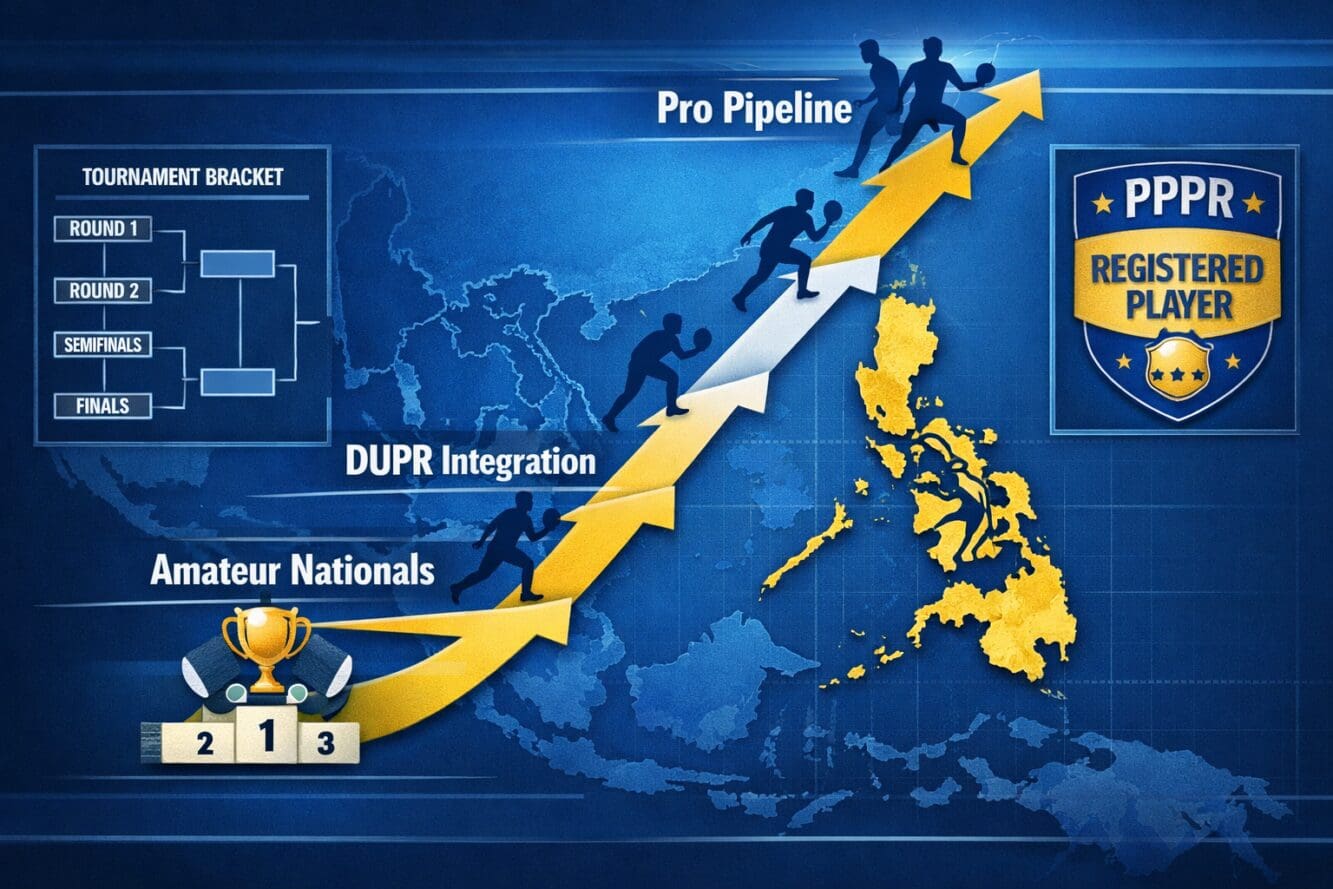
How Does the Philippine Pickleball Player Registry (PPPR) Create Structure for Asia’s Pro Pipeline?
The PPPR system functions as a mandatory identification and tracking mechanism for all tournament participants in the Philippines. Every player competing in sanctioned events must have an active PPPR ID linked to their DUPR (Decathlon Universal Pickleball Rating) account[1].
What the PPPR system tracks:
- Individual player tournament history and results
- Philippine national ranking points across all competitive divisions
- Eligibility status for national team selection pathways
- Progression through skill levels (3.0 through 5.0+ divisions)
- Qualification achievements for international competitions
The system serves players at every level, from beginners entering their first local tournament to competitive athletes chasing national rankings and international qualification[1]. This democratizes access to organized competitive structures that were previously informal or regionally fragmented.
Common mistake to avoid: Players sometimes register for tournaments without completing PPPR and DUPR linking requirements. Both registrations must be active before the March 20 deadline, or tournament entry will be denied regardless of payment status.
The registry creates accountability and continuity that didn’t exist when tournaments operated independently without shared player databases. Coaches and scouts can now identify rising talent through verifiable competitive records rather than word-of-mouth reputation.

What Role Does DUPR Integration Play in Connecting Filipino Players to Global Rankings?
The Philippine Pickleball Federation’s partnership with Pickleball Global synchronizes the PPPR system with DUPR, allowing players to earn both Philippine Ranking Points and Global Pickleball Rankings (GPR) points simultaneously from the same tournament results[1].
DUPR functions as the international standard for pickleball skill rating, similar to tennis’s ATP/WTA rankings but accessible to all skill levels. When Filipino players compete in PPPR-sanctioned tournaments, their results automatically update both their national standing and their global DUPR rating.
Why dual ranking matters for the pro pipeline:
- International visibility: Scouts and tournament directors worldwide can discover Filipino talent through DUPR profiles
- Qualification credentials: Many international tournaments use DUPR ratings as entry requirements
- Skill verification: Players can prove their competitive level when seeking sponsorships or team opportunities
- Cross-border competition: Filipino players can enter regional tournaments in Thailand, Singapore, or Malaysia with recognized ratings
This integration removes a major barrier that previously kept Southeast Asian players isolated from global competitive circuits. Before unified systems, a strong player in Manila had no way to demonstrate their skill level to tournament organizers in other countries except by traveling and competing in person.
The Philippine Pickleball League describes itself as the “fastest growing pickleball community in the Philippines,” offering tournament participation, player networking, and progress tracking through these integrated systems[4].
How Does the Tournament Format Align With International Professional Standards?
The Skechers Pickleball First Philippine Pickleball Amateur Nationals follows the 2026 USA Pickleball Rulebook and employs Rally Scoring format throughout all divisions[1]. This alignment ensures Filipino players develop skills and strategies that transfer directly to international competition.
Key format elements:
- Rally Scoring: Points scored on every serve regardless of serving team, matching the format increasingly adopted by professional tours
- USA Pickleball rules: Official international rulebook governing serve mechanics, fault calls, and court conduct
- Division structure: Multiple skill-level brackets (3.0, 3.5, 4.0, 4.5, 5.0+) allowing appropriate competition placement
- Sanctioned officiating: Certified referees applying consistent rule interpretation
Choose this tournament if: You want competitive experience that prepares you for international events. The standardized format means skills and strategies developed here translate directly to tournaments in other countries.
Skip this tournament if: You prefer casual recreational play without strict rule enforcement. The amateur nationals maintains professional competitive standards throughout.
The venue, Tela Park Pickleball Center in Las Piñas, provides dedicated pickleball courts rather than converted tennis facilities, offering proper court dimensions and surface quality that match international tournament standards[2].
What Does This Development Mean for Southeast Asia’s Professional Pickleball Pipeline?
The Philippine model creates a replicable framework that other Southeast Asian nations can adopt to develop their own pro pipelines. The combination of national federation structure, unified player registry, international ranking integration, and qualification pathways addresses the infrastructure gaps that previously prevented regional talent development.
Comparison to India’s rapid development:
India established similar structures in 2022-2023 and quickly produced internationally competitive players who now compete on global professional tours. The Philippines is following this blueprint with several advantages: stronger existing recreational player base, corporate sponsorship interest (Skechers partnership), and geographic positioning as a regional hub.
What changes for Southeast Asian players:
- Clear progression path: Visible steps from local club play to national competition to international qualification
- Verifiable credentials: Official rankings and ratings that prove competitive ability
- Regional competition opportunities: As more Southeast Asian nations adopt similar systems, cross-border tournaments become feasible
- Sponsorship potential: Brands can identify and support rising talent through transparent ranking systems
The tournament serves as an official qualifier for the EPIC World Amateur Championships, giving Filipino players direct access to a major international amateur event that feeds into professional circuits[1].
Edge case to consider: Players who developed skills informally without tournament experience may find their actual competitive level differs significantly from their self-assessment. The DUPR rating system quickly calibrates to true skill level through match results, which can be humbling but provides accurate placement for future competition.
How Does Organized Structure Transform Recreational Interest Into Competitive Depth?
The shift from informal pickup games to structured competitive pathways fundamentally changes how players develop and progress. When tournaments operate independently without shared infrastructure, talented players often plateau because they lack clear goals, competition tracking, or advancement opportunities.
Before federation structure:
- Players compete in isolated local tournaments with no record continuity
- Skill levels assessed subjectively without standardized measurement
- No clear pathway from recreational to competitive to elite levels
- International opportunities require independent research and self-funding
After federation structure:
- Unified player registry tracks complete competitive history
- DUPR ratings provide objective skill measurement
- Visible progression pathway with defined milestones
- Official qualification routes to international events
The Philippine Pickleball Federation’s infrastructure creates what sports development experts call “competitive scaffolding”—each level of achievement provides clear visibility to the next level, motivating continued participation and skill development.
For recreational players, knowing that casual club play can lead to local tournaments, then regional competition, then national championships, and ultimately international qualification creates engagement that sustains long-term participation. For competitive athletes, transparent ranking systems and qualification pathways provide the structure necessary to pursue pickleball seriously.
This mirrors successful development models in other sports where organized youth and amateur systems feed talent into professional ranks. The Philippines is building this infrastructure rapidly rather than waiting for organic evolution over decades.
What Are the Practical Steps for Players to Enter the Pro Pipeline Through This System?
Players interested in pursuing competitive pickleball through the Philippine system need to complete specific registration and participation steps before the March 20, 2026 deadline[1].
Step-by-step entry process:
- Create PPPR account: Register at the Philippine Pickleball Federation website to obtain official player ID
- Link DUPR account: Create or connect existing DUPR profile to PPPR registration
- Verify active status: Confirm both registrations show active status before tournament registration
- Select appropriate division: Choose skill level bracket based on current DUPR rating or self-assessment
- Register for tournament: Complete entry for Skechers Pickleball First Philippine Pickleball Amateur Nationals before March 20
- Confirm participation: Receive official confirmation and division placement
After tournament participation:
- Results automatically update PPPR national rankings
- DUPR rating adjusts based on match outcomes against rated opponents
- Qualification status for EPIC World Amateur Championships determined by performance
- Player profile becomes visible to scouts, coaches, and tournament organizers
Common mistake: Waiting until the registration deadline to start the PPPR and DUPR setup process. Account verification can take several days, and technical issues near deadlines may prevent timely registration. Start the process at least one week before March 20.
The system is designed to accommodate players at all levels, from those entering their first competitive event to experienced players seeking international qualification[1]. The key is completing registration requirements and participating in sanctioned events that feed into the ranking system.
Frequently Asked Questions
What is the Philippine Pickleball Amateur Nationals?
The Skechers Pickleball First Philippine Pickleball Amateur Nationals is the Philippines’ inaugural national championship tournament, held March 28-30, 2026, at Tela Park Pickleball Center. It serves as an official qualifier for international amateur championships[1].
Do I need a PPPR ID to compete in Philippine tournaments?
Yes, all players competing in sanctioned Philippine tournaments must have an active PPPR ID linked to their DUPR account. This requirement applies to the amateur nationals and all future federation-sanctioned events[1].
How does this tournament connect to professional pickleball?
The tournament serves as an official qualifier for the EPIC World Amateur Championships, which feeds into professional circuits. Players also earn DUPR ratings that make them visible to international scouts and tournament organizers[1].
What is Rally Scoring and why does it matter?
Rally Scoring awards points on every serve regardless of which team is serving, unlike traditional side-out scoring. It’s increasingly used in professional tournaments, so competing with this format prepares players for higher-level competition[1].
Can beginners participate in the amateur nationals?
Yes, the tournament includes multiple skill divisions starting at 3.0 level. Players should register for the division matching their current skill level or DUPR rating to ensure appropriate competition placement[1].
What’s the registration deadline for the 2026 tournament?
Registration closes March 20, 2026, with slots allocated on a first-come, first-served basis. Late registrations cannot be accommodated due to bracket and scheduling requirements[1].
How does the DUPR rating system work?
DUPR (Decathlon Universal Pickleball Rating) calculates skill level based on match results against other rated players. It updates automatically after each sanctioned tournament, providing an objective measure of competitive ability that’s recognized internationally[1].
Why is the Philippines important for Southeast Asian pickleball development?
The Philippines is establishing the first comprehensive national federation structure in Southeast Asia with unified player registry, international ranking integration, and clear pathways to professional competition. This model can be replicated across the region[1][2].
What does it cost to register for PPPR and DUPR?
PPPR registration through the Philippine Pickleball Federation has specific fee structures detailed on their website. DUPR offers both free and premium membership options. Tournament entry fees are separate and vary by division[1].
Can international players compete in the Philippine Amateur Nationals?
Tournament eligibility details are specified in the official registration information. Contact the Philippine Pickleball Federation directly for international player participation requirements and qualification implications.
How does this compare to pickleball development in other Asian countries?
The Philippine model closely follows India’s successful development framework, which rapidly produced internationally competitive players through structured federation systems, unified rankings, and clear progression pathways from amateur to professional levels.
What happens after the 2026 Amateur Nationals?
Top performers qualify for the EPIC World Amateur Championships. All participants receive updated PPPR national rankings and DUPR ratings that position them for future tournaments and potential national team selection.
Conclusion
Southeast Asia’s pickleball boom is reaching a critical inflection point with the Philippines’ first amateur national championship. The Skechers Pickleball First Philippine Pickleball Amateur Nationals, running March 28-30, 2026, represents more than a single tournament—it’s the foundation of infrastructure that transforms recreational interest into competitive depth and creates legitimate pathways to professional play.
The Philippine Pickleball Federation’s unified player registry, DUPR integration, and international qualification connections provide the structural framework that Southeast Asian pickleball has lacked. By following India’s rapid development model and establishing clear progression from grassroots to elite competition, the Philippines is positioning itself as the regional hub for competitive pickleball development.
Actionable next steps for players:
- Register now: Complete PPPR and DUPR registration before the March 20 deadline if you want to compete in the amateur nationals
- Choose your division carefully: Select the skill bracket matching your current ability for appropriate competition and accurate rating development
- Participate consistently: Enter multiple sanctioned tournaments throughout 2026 to build ranking points and DUPR rating accuracy
- Track your progress: Monitor your PPPR national ranking and DUPR rating to measure improvement and identify qualification opportunities
- Connect with the community: Join the Philippine Pickleball League to access networking, training resources, and tournament information
For Southeast Asian pickleball, the question is no longer whether the region can produce professional-level players—it’s how quickly other nations will adopt similar structures to compete with the Philippines’ head start. The infrastructure is now in place. The pathway is clear. The boom is becoming a sustainable competitive ecosystem.
References
[1] Philippine Pickleball Federation – https://www.pickleball.ph
[2] Skechers Pickleball First Philippine Pickleball Amateur Nationals All Set – https://pickleballnewsasia.com/skechers-pickleball-first-philippine-pickleball-amateur-nationals-all-set/
[3] Philippines Gears Up For Inaugural Skechers Pickleball Amateur Nationals Amid Growing Popularity – https://www.timesnownews.com/sports/pickleball/philippines-gears-up-for-inaugural-skechers-pickleball-amateur-nationals-amid-growing-popularity-article-153855110
[4] Philippine Pickleball League – https://www.phpickleballleague.com
Content, illustrations, and third-party video appearing on GEORGIANBAYNEWS.COM may be generated or curated with AI assistance or reproduced pursuant to the fair dealing provisions of the Copyright Act, R.S.C. 1985, c. C-42. Attribution and hyperlinks to original sources are provided in acknowledgment of applicable intellectual property rights. Such referencing is intended to direct traffic to and support the original rights holders’ platforms.
Much Appreciate You Sharing This Post - It Helps MUCH!!!