
















🇨🇦 Canadian Stories That Make You Proud to Be Canadian: Real Moments of Everyday Bravery
Last updated: June 2, 2026
Quick Answer: Canadian Stories That Make You Proud to Be Canadian: Real Moments of Everyday Bravery are not confined to war memorials or history books. They happen on icy docks, in suburban driveways, and in small-town community halls. Canada’s bravery recognition system has awarded the Medal of Bravery to over 3,300 people [5], which means quiet courage is far more common here than most Canadians realize.
Key Takeaways
- Canada’s Medal of Bravery has been awarded to over 3,300 individuals for acts of courage in hazardous circumstances [5]
- The Star of Courage, Canada’s second-highest bravery award, has been presented to 461 people as of 2019 [4]
- Everyday Canadian heroism often looks like neighbours pulling someone from a burning home, seniors fighting food insecurity, or a Coast Guard officer braving a winter storm
- Indigenous definitions of bravery frequently center on community protection and long-term resilience, not just single dramatic acts
- Canadian heroism stories span every province, but rural and coastal communities produce a disproportionate number of documented rescues
- Common mistakes in telling these stories include over-dramatizing or stripping away the cultural and community context
- Verified platforms and publications exist for Canadians who want to share or find these stories
- Everyday heroes who go unrecognized often include caregivers, crossing guards, and volunteer first responders
What Are Some Real Canadian Hero Stories from Everyday People
Everyday Canadian heroes are ordinary people who act without hesitation when someone needs help. Their stories are documented through bravery awards, community news, and national publications.
In January 2026, residents of Surrey, British Columbia, ran toward a burning home after an explosion and pulled a man to safety [1]. No training, no uniform, just neighbours doing what felt right. That same spirit showed up in 1972 when Edward Joseph Duff of St. John’s, Newfoundland, dove 12 metres into the sea near Torbay to try to save a drowning friend [3]. The Carnegie Hero Fund Commission has also recognized a 1917 rescue in Bonavista, Newfoundland, where five men saved hunters stranded on a drifting ice floe [8].
These are not outliers. They are part of a long, documented pattern of Canadian bravery that rarely makes national headlines.
How Canadians Show Kindness and Courage in Small Moments
Small-scale Canadian courage shows up in acts that cost nothing but personal risk or effort. It is the kind of bravery that does not come with a press release.
Examples include:
- Stopping on a highway in a snowstorm to help stranded motorists get to safety
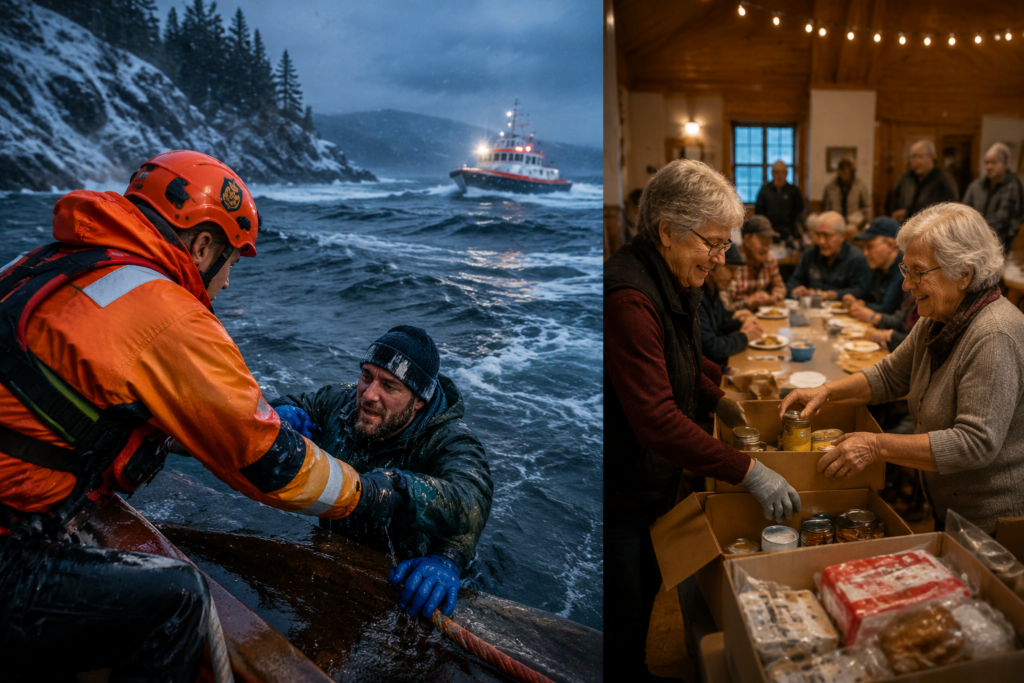
- Seniors in Lumby, B.C., who built a community food and friendship network in November 2025 to address isolation and hunger [1]
- Volunteer snowplow operators who clear roads for elderly neighbours without being asked (see more on community snowplow efforts)
- Bystanders who perform CPR before paramedics arrive
The pattern: Canadian everyday bravery tends to be community-first rather than individual-glory-first. The act is done, and the person goes home.
Examples of Canadians Helping Strangers During Tough Times
Documented examples of Canadians helping strangers span coast to coast and go back over a century.
First Officer Leslie Palmer of the Canadian Coast Guard was recognized for rescuing two fishermen stranded in a severe winter storm near Prince Rupert, B.C. [2]. The conditions were dangerous enough that most people would have waited. Palmer did not. In 1917, five Newfoundland men rowed out in freezing conditions to save hunters on a drifting ice floe [8]. In 2026, Surrey neighbours did not wait for firefighters before acting to save a man from a burning building [1].
Linda Pruessen’s 2021 book Canadian Courage profiles 35 Canadians who showed bravery in the face of danger, injustice, and adversity [6], offering a curated look at how widespread this behaviour actually is.
Difference Between Canadian Heroism and American Heroic Stories
Canadian and American heroism stories share a common thread of courage, but they are framed and celebrated differently. American heroism is often portrayed through individual triumph and public recognition. Canadian heroism tends to be quieter, more communal, and frequently goes uncelebrated by the hero themselves.
Key differences:
FactorCanadian HeroismAmerican HeroismToneUnderstated, community-focusedOften individualistic, celebrated publiclyRecognitionBravery medals, local newsNational media, viral momentsMotivation (as told)”Anyone would have done it”Often framed as personal convictionCultural contextTied to community survival, especially ruralTied to individual freedom narratives
This is not a value judgment. It reflects different cultural storytelling traditions. Canadian stories often gain meaning precisely because the hero downplays what they did.
Are There Canadian Stories of Bravery That Are Not About Being Polite
Yes, and this is an important distinction. Canadian bravery is not just about holding doors or saying sorry. Real documented acts involve physical danger, moral courage, and social risk.
Duff’s dive into the sea [3], Palmer’s Coast Guard rescue in a winter storm [2], and the Surrey neighbours who ran into a burning building [1] all involved genuine physical peril. Beyond physical acts, moral courage appears in Canadians who stand up for Canada on issues of justice, environmental protection, and community rights, often at personal cost.
Common mistake: Reducing Canadian identity to politeness erases the real courage that defines so many Canadian stories.
What Kinds of Everyday Canadian Heroes Do Not Usually Get Recognized
The least-recognized Canadian heroes tend to be those whose work is invisible until something goes wrong. These include:
- Volunteer firefighters in rural communities who respond to calls while holding full-time jobs
- Caregivers (often women) who manage medical crises at home without formal support
- Crossing guards and school volunteers who intervene in dangerous situations
- Indigenous community leaders who manage crises in under-resourced northern communities
- Seniors who organize mutual aid networks, like those in Lumby, B.C. [1]
These people rarely apply for awards. Their acts are often witnessed only by the person they helped.
How Indigenous Canadians Define Everyday Bravery
For many Indigenous communities across Canada, bravery is not a single dramatic act. It is a sustained commitment to protecting family, community, land, and culture, often in the face of systemic barriers.
Indigenous definitions of courage frequently include:
- Continuing cultural practices under pressure
- Speaking Indigenous languages publicly when they were historically suppressed
- Advocating for clean water and land rights in remote communities
- Raising children with cultural identity intact through intergenerational trauma
This broader definition of bravery is worth including in any conversation about Canadian stories of courage. It reframes heroism as something ongoing rather than episodic.
Where to Find Verified True Stories of Canadian Community Support
Verified sources for true Canadian bravery and community support stories include:
- Canadian Geographic publishes documented profiles of courage [2][3]
- The Governor General’s website lists all Bravery Award recipients by year
- Carnegie Hero Fund Commission maintains a historical archive of recognized Canadian rescues [8]
- Care Impact / Neighbourly documents recent community acts across Canada [1]
- Georgian Bay News covers local community stories from the Georgian Bay region
- Goodreads and public libraries carry books like Canadian Courage [6]
Avoid relying solely on social media for verification. Cross-reference with at least one institutional source before sharing a story as fact.
Which Canadian Provinces Have the Most Inspiring Everyday Hero Stories
No single province holds a monopoly on courage, but geography and community structure shape the frequency and type of documented stories.
- British Columbia: Coastal rescues, wildfire community responses, urban neighbourly acts (Surrey 2026 [1], Prince Rupert [2])
- Newfoundland and Labrador: A long history of maritime rescues and ice-related heroism [3][8]
- Ontario: Urban good Samaritan acts, volunteer emergency response in rural areas
- Prairie provinces: Farm community mutual aid, especially during extreme weather
- Northern territories: Indigenous-led community resilience in under-resourced conditions
Rural and coastal communities tend to produce more documented rescue stories, partly because formal emergency services take longer to arrive, so neighbours act first.
Who Can Share Their Personal Canadian Pride Moments
Any Canadian can share a story of everyday bravery, and doing so matters. These stories build community identity and inspire others.
Ways to share:
- Submit to local news outlets like Georgian Bay News
- Nominate someone for a Governor General’s Bravery Award through the Chancellery of Honours
- Contribute to community-focused media platforms that document neighbourly acts [1]
- Write to the Carnegie Hero Fund if the act meets their criteria [8]
Who this applies to: Anyone who witnessed or experienced an act of everyday courage. You do not need to be the hero to tell the story.
Common Mistakes People Make When Telling Canadian Heroism Stories
The biggest mistake is stripping away context. A rescue story without its setting, the relationships involved, and the risks taken becomes just a headline.
Other common errors:
- Exaggerating for drama when the real story is already compelling
- Ignoring the hero’s own words about why they acted
- Erasing cultural context, especially in Indigenous bravery stories
- Focusing only on physical acts and missing moral or social courage
- Not verifying the facts before sharing widely
Good storytelling about Canadian bravery is specific, grounded, and respectful of the people involved. The heroes of D-Day and today’s neighbourhood rescuers alike deserve accuracy, not embellishment.
FAQ
What is the highest bravery award in Canada?
The Cross of Valour is Canada’s highest bravery decoration, awarded for acts of the most conspicuous courage in circumstances of extreme peril. Below it sit the Star of Courage and the Medal of Bravery.
How many people have received Canada’s Medal of Bravery?
Over 3,300 individuals have received the Medal of Bravery for acts of courage in hazardous circumstances [5].
Can an ordinary citizen nominate someone for a Canadian bravery award?
Yes. Anyone can submit a nomination to the Governor General’s Chancellery of Honours. The nomination should include a detailed description of the act and supporting documentation.
Are Canadian bravery stories mostly about military service?
No. While military bravery is recognized separately, Canada’s civilian bravery awards cover a wide range of acts including rescues, interventions, and community protection [4][5].
Where can I read verified stories of Canadian everyday heroes?
Canadian Geographic, the Carnegie Hero Fund archive, and books like Canadian Courage by Linda Pruessen are reliable starting points [2][3][6][8].
Is it true that most Canadian heroes say “anyone would have done it”?
This is a well-documented cultural pattern in Canadian heroism accounts. Many award recipients downplay their actions, which reflects a broader cultural tendency toward modesty over self-promotion.
Do Indigenous Canadians have formal bravery recognition systems?
Many Indigenous communities have their own systems for recognizing courage and community service, which often predate Canadian federal award structures and reflect different values around collective responsibility.
How recent are the documented Canadian bravery stories available online?
Sources like Care Impact document stories from 2025 and 2026 [1], while the Carnegie Hero Fund archive includes cases going back to the early 1900s [8].
Conclusion
Canadian Stories That Make You Proud to Be Canadian: Real Moments of Everyday Bravery are happening right now, in every province and territory. They do not always make the news. A neighbour pulls someone from a burning home. A Coast Guard officer goes out in a storm. Seniors build a food network because no one else will. These acts are documented, verifiable, and worth telling accurately.
Actionable next steps:
- Look up your province’s Governor General’s Bravery Award recipients from the past five years. The list will surprise you.
- If you witnessed an act of courage in your community, contact a local outlet like Georgian Bay News or a national platform to share it.
- Nominate someone. The Chancellery of Honours nomination process is open to all Canadians and takes less than an hour to complete.
- Read one verified collection of Canadian courage stories, whether that is Canadian Courage [6] or a Canadian Geographic profile [2][3].
The stories are there. They just need to be told.
References
[1] S05e18 – https://www.careimpact.ca/neighbourly/s05e18?utm_source=openai
[2] Profile Courage Canadian Coast Guard Rescued Fishermen Stranded Winter Storm – https://canadiangeographic.ca/articles/profile-courage-canadian-coast-guard-rescued-fishermen-stranded-winter-storm/?utm_source=openai
[3] Profile In Courage The Canadian Man Who Dove 12 Metres Into The Sea To Try And Save A Friend – https://canadiangeographic.ca/articles/profile-in-courage-the-canadian-man-who-dove-12-metres-into-the-sea-to-try-and-save-a-friend/?utm_source=openai
[4] Star Of Courage (Canada) – https://en.wikipedia.org/wiki/Star_of_Courage_%28Canada%29?utm_source=openai
[5] Medal Of Bravery (Canada) – https://en.wikipedia.org/wiki/Medal_of_Bravery_%28Canada%29?utm_source=openai
[6] Canadian Courage – https://www.goodreads.com/en/book/show/55743324-canadian-courage?utm_source=openai
[7] In Their Own Words: Canadian Stories of Valour and Bravery – https://publications.gc.ca/site/eng/9.919615/publication.html?wbdisable=true&utm_source=openai
[8] Centennial Archive – https://www.carnegiehero.org/resources2/centennial-archive/?utm_source=openai