





















☀️ What the fungal networks can teach us | David Suzuki

By David Suzuki
Far too many people seem intent on destroying this precious planet. Whether it’s through ignorance or greed or both, one thing is clear: they don’t understand how it works. Even those of us who want to protect Earth and the life it supports don’t fully comprehend its marvels.
A new global mapping study illustrates just how much there is to uncover. The research, by Society for the Protection of Underground Networks, or SPUN, finds that “if every arbuscular mycorrhizal fungal hypha in the world from the top 15 centimeters of soil were laid end-to-end … they would stretch from Earth to the sun — about a billion times. That’s roughly 110 quadrillion kilometers of hyphae.”
“There could be up to 10 metres (32ft) of mycorrhizal network in just a teaspoon of soil,” study lead author Justin Stewart said.
Why is this important? SPUN explains: “Arbuscular mycorrhizal fungi shuttle water, phosphorous and nitrogen to 70 percent of land plant species. In exchange, these fungi receive carbon from plants, drawing down the equivalent of roughly 4 billion tons of carbon dioxide, or 11 percent of the CO2 emissions from fossil fuels. Through this relationship, mycorrhizal fungi helped shape life on land for 450 million years.”
This and other recent research into the role of fungi and mycorrhizal networks have implications for everything from forestry to agriculture to human survival.
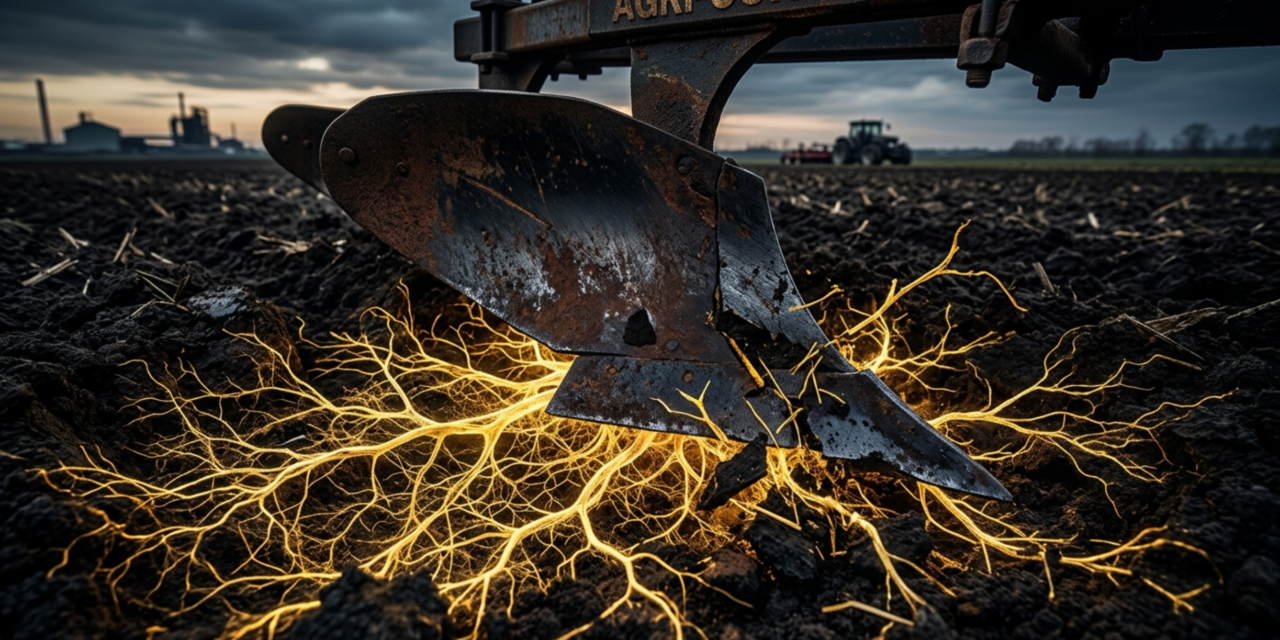
Many of our activities are harming these life-supporting networks. Stewart notes that agricultural practices such as tilling and fertilizer and fungicide use destroy or disrupt the essential symbiotic relationships between plants and fungi.

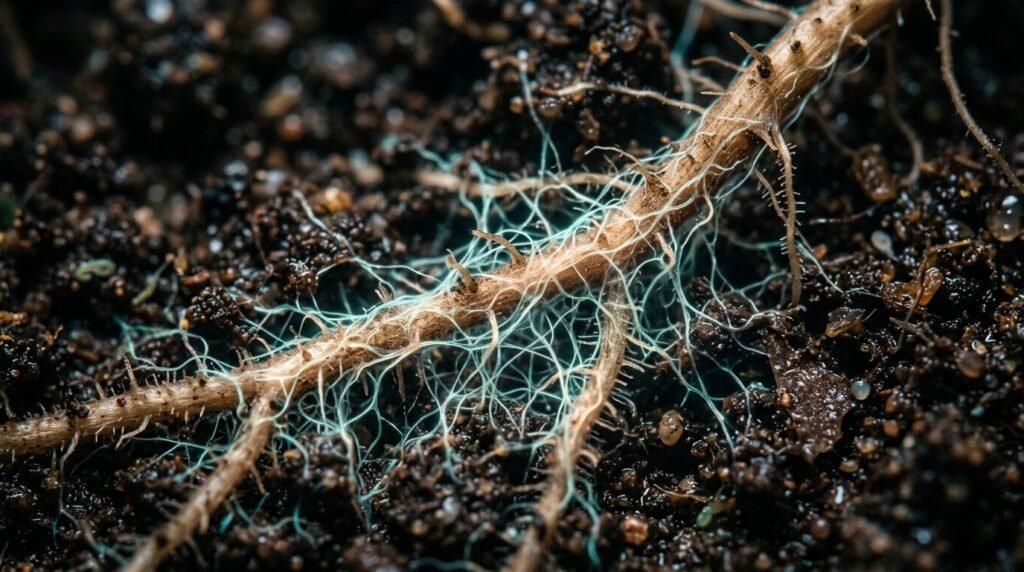
The researchers found that network densities in cropland were 47.3 per cent lower than in wild ecosystems. Grasslands have the densest systems, but these “are often poorly protected and are becoming increasingly degraded,” the Guardian reports.
Protecting the networks could prevent chemicals such as nitrogen and phosphorus from entering waterways and could reduce agricultural fertilizer use, as the fungi help plants obtain nutrients naturally, and improve carbon storage in soils.
Research by Canadian forestry scientist and author Suzanne Simard and others has shown that mycorrhizal networks also contribute to healthy forests, something not widely understood as industry started replacing diverse older forests with single-species plantations after logging.
Although fungi have been around for a billion years, they weren’t classified as separate from plants and animals until the 1960s. Previously thought of as plants, they actually have more in common with animals, as they “lack chlorophyll and cannot carry out photosynthesis,” the Canadian Encyclopedia notes.
So far, we’ve only identified a small percentage of the estimated 3.8 million fungi species that exist.
What the fungal networks illustrate is something that many Indigenous Peoples have long known — that everything is interconnected. It also illustrates the hubris of colonizers and capitalists who have long seen the planet as little more than a source of “resources” for the taking. Even Western science, with its propensity toward reductionism, has often missed the bigger picture. It’s a short-sighted view of the world — unlike the world view of many Indigenous Peoples, who look back and forward many generations.
When we log old-growth forests, blast mountains away for minerals or clear land for large industrial agriculture operations or residential developments, we’re not just taking resources or replacing barren areas with more useful (to us) infrastructure; we’re destroying natural systems and creating cascading effects throughout the very systems on which our health and lives depend.
Those who seek only short-term profit and power — through extracting minerals and gas, coal and oil or clearing rainforests to raise cattle or damming valleys for power — fail to consider the impacts they’re having. Not only do they lack understanding of the complex processes beneath their feet, they don’t seem to know or care about the intricate connections above.
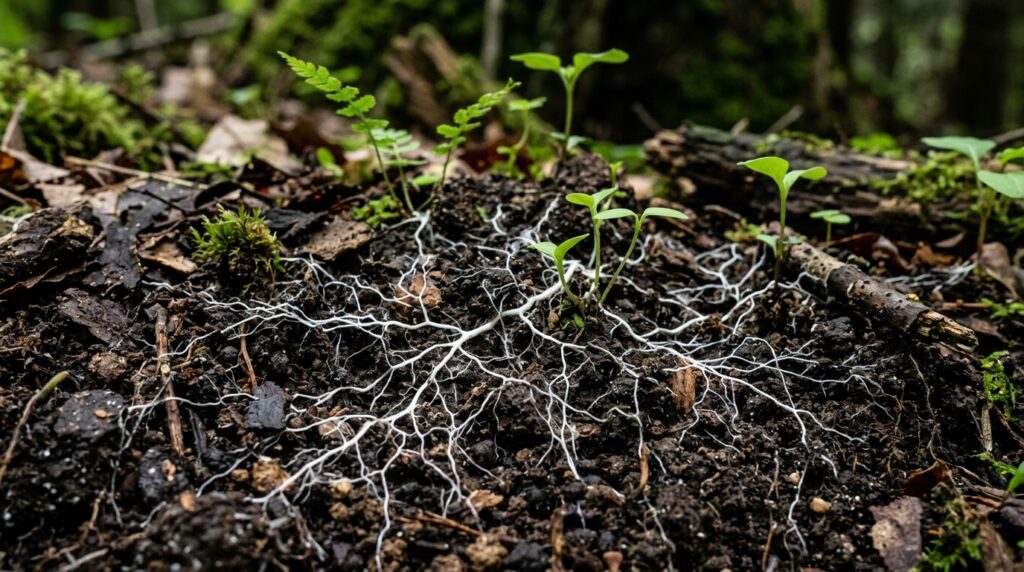
As we learn more about this fragile but resilient planet, our only home, we see how everything is interconnected and how critical it is to tread lightly, to protect and restore natural systems and to find harmonious ways of living with nature, of which we are a part.
We still have much to learn, but we now know enough to realize that we must quickly find better ways of living. We can’t go on wrecking the complex, interconnected systems on which our health and survival depend.
David Suzuki is a scientist, broadcaster, author and co-founder of the David Suzuki Foundation. Written with David Suzuki Foundation Senior Writer and Editor Ian Hanington.
Learn more at davidsuzuki.org.
REFERENCES:
New global mapping study:
https://www.science.org/doi/10.1126/science.adu4373
Society for the Protection of Underground Networks:
SPUN explains:
https://www.spun.earth/mapping/a-hidden-infrastructure
Guardian reports:
Canadian forestry scientist and author Suzanne Simard:
Fungi have been around for a billion years:
https://www.rciscience.ca/blog/fantastic-fungi
Canadian Encyclopedia notes:
https://thecanadianencyclopedia.ca/en/article/fungus
Much Appreciate You Sharing This Post - It Helps MUCH!!!