























💊 Food as Medicine: How Whole Foods Are Reshaping Chronic Disease Care in Clinics

Last updated: July 2, 2026
A cardiologist in Boston now writes prescriptions for kale, lentils, and salmon. A family clinic in Ontario stocks a fridge full of produce next to its exam rooms. This isn’t a wellness trend, it’s a documented shift in how medicine is being practiced, backed by insurers, hospitals, and public health agencies on both sides of the Atlantic.
Quick Answer
Food as medicine, using food as medicine and incorporating this approach in health care clinics as part of treatment plans for chronic disease is gaining popularity, with more people prioritizing whole foods over supplements. Doctors now prescribe specific dietary patterns, produce boxes, and medically tailored meals to help manage diabetes, heart disease, hypertension, and obesity. It works alongside (not instead of) standard care, and a growing number of insurers cover it.
Key Takeaways
- Food as medicine uses targeted nutrition to prevent, manage, or reverse chronic disease.
- It’s clinical, measurable, and prescribed, not the same as “eating healthy.”
- Whole foods outperform most supplements for chronic disease outcomes, according to major reviews.
- Medicare, Medicaid pilots, and several Canadian and European health systems now cover parts of it.
- It’s most effective for type 2 diabetes, hypertension, heart disease, and metabolic syndrome.
- Results can appear in 6 to 12 weeks, though full benefits take months.
- It’s not a replacement for insulin, chemotherapy, or emergency medication.


What does food as medicine actually mean?
Food as medicine is the clinical use of specific foods and dietary patterns to prevent, manage, or treat disease. It includes doctor-prescribed produce, medically tailored meals, nutrition counseling, and structured eating protocols like the Mediterranean or DASH diets.
The U.S. White House Conference on Hunger, Nutrition, and Health (2022) formally endorsed the term, and the American Heart Association has published clinical guidance on it. In Canada, groups like the South Georgian Bay Community Health Clinic integrate nutrition into primary care visits.
How does food as medicine work for chronic diseases?
It works by targeting the biological drivers of disease, inflammation, insulin resistance, blood pressure, gut microbiome balance, and lipid levels, through nutrients delivered in their natural food matrix.
Three main delivery models exist:
- Produce prescriptions, vouchers for fruits and vegetables at grocery stores or farmers’ markets.
- Medically tailored meals, home-delivered meals designed by registered dietitians for a specific diagnosis.
- Nutrition-focused clinic visits, structured counseling with follow-up labs.
Can food really replace medication for diabetes or heart disease?
Sometimes for early type 2 diabetes and mild hypertension, but rarely for advanced disease. A 2018 study in The Lancet (Lean et al., DiRECT trial) showed nearly half of participants with type 2 diabetes achieved remission through a structured whole-food diet program under medical supervision.
Choose food-first if: you have prediabetes, early-stage hypertension, or metabolic syndrome, and your doctor agrees.
Keep medication if: you have type 1 diabetes, advanced heart failure, or your doctor hasn’t cleared a taper.
What’s the difference between food as medicine and just eating healthy?
Eating healthy is general and self-directed. Food as medicine is clinical, prescriptive, and tied to a diagnosis with measurable outcomes.
| Feature | Eating Healthy | Food as Medicine |
|---|---|---|
| Prescribed by | Yourself | Physician or dietitian |
| Tied to a diagnosis | No | Yes |
| Tracked with labs | No | Yes (A1C, LDL, BP) |
| Insurance-eligible | No | Sometimes |
| Duration | Ongoing | Defined treatment window |
How are doctors using food as medicine in clinics now?
Clinics screen patients for food insecurity, prescribe produce or meals, refer to registered dietitians, and track biomarkers over 3 to 12 months. Major U.S. health systems (Kaiser Permanente, Geisinger), Canadian community health clinics, and European primary care networks (notably in Finland and the Netherlands) run these programs.
Some clinics, including certain integrative practices in the Georgian Bay region, combine food prescriptions with lifestyle coaching and lab monitoring.
Which foods are considered medicine for specific health conditions?
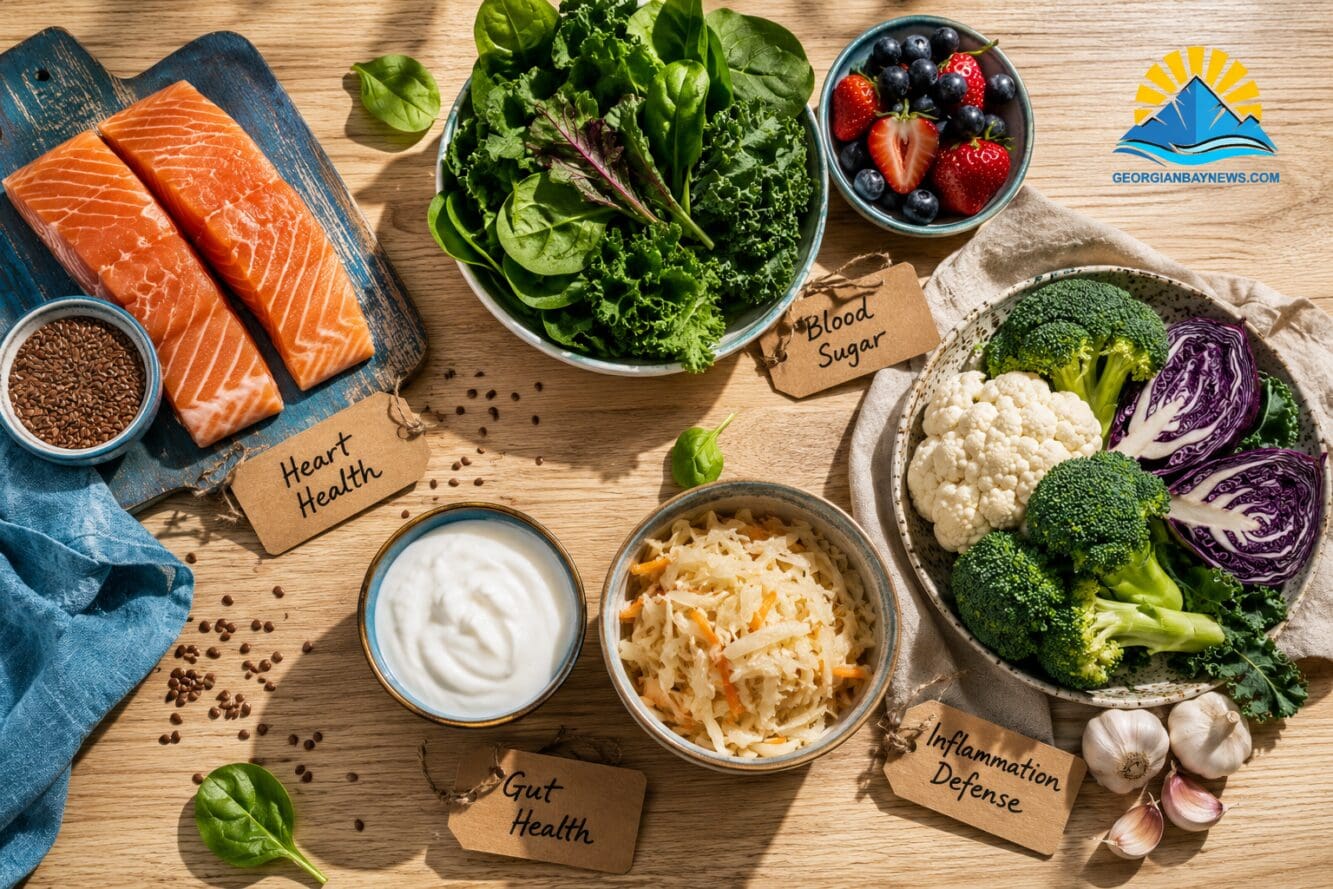
Different conditions respond to different food patterns. Below are patterns supported by peer-reviewed evidence:
- Type 2 diabetes: leafy greens, legumes, nuts, whole grains, berries, olive oil
- Heart disease: fatty fish, walnuts, oats, beans, extra-virgin olive oil (Mediterranean pattern)
- Hypertension: DASH pattern, low-sodium whole foods, potassium-rich produce, low-fat dairy
- Fatty liver disease: cruciferous vegetables, coffee, reduced added sugar
- IBS and gut health: fermented foods, soluble fiber, low-FODMAP where indicated
Is food as medicine covered by insurance?
Coverage is expanding but uneven. In the U.S., Medicare Advantage plans and several state Medicaid programs cover medically tailored meals and produce prescriptions as of 2024-2026. Canada’s provincial health plans cover registered dietitian visits in many primary care settings. In Europe, the UK’s NHS, Germany, and the Netherlands cover clinical nutrition therapy for specific diagnoses.
Ask your provider: “Do you have a food prescription program or a referral to a covered dietitian?”
What training do doctors need to prescribe food as medicine?
Most medical schools offer under 25 hours of nutrition training, according to a 2019 report in The Lancet Planetary Health. To prescribe food as medicine competently, physicians typically pursue:
- Certification through the American College of Lifestyle Medicine (ACLM)
- Continuing education from the Academy of Nutrition and Dietetics
- Partnership with a Registered Dietitian (RD) for co-management
Who shouldn’t rely on food as medicine alone?
People with type 1 diabetes, active cancer under treatment, severe kidney disease, eating disorders, or acute cardiac events need conventional medicine as their foundation. Food supports these treatments but cannot replace them.
Pregnant patients, children, and older adults with frailty should only follow food-based protocols under supervision to avoid nutrient gaps.
What are common mistakes people make with food as medicine?
- Treating it as a diet fad instead of a treatment plan
- Stopping medications without physician approval
- Buying expensive “superfoods” instead of affordable staples like beans and oats
- Expecting results in two weeks
- Ignoring portion size and total calories
- Replacing whole foods with protein powders or greens supplements
How long does it take to see results from food as medicine?
Blood pressure and blood sugar often improve within 4 to 8 weeks. Cholesterol shifts appear around 8 to 12 weeks. Weight and A1C changes typically stabilize between 3 and 6 months. Sustained remission requires ongoing adherence.
What’s the difference between food as medicine and supplements?
Whole foods deliver nutrients in complex combinations (fiber, phytochemicals, cofactors) that supplements cannot replicate. Landmark trials, including the VITAL study (NEJM, 2019) on vitamin D and omega-3 supplements, have repeatedly shown supplements underperform whole-food diets for chronic disease prevention.
Supplements have a role in documented deficiencies (B12, iron, vitamin D in northern climates) but not as a substitute for a therapeutic diet. Practical strategic food choices tend to outperform stacking capsules.
Are there any risks or side effects to food as medicine?
Yes, though generally mild. Rapid dietary changes can cause digestive discomfort, hypoglycemia in patients on diabetes medication (dose adjustments are essential), interactions with blood thinners (leafy greens and warfarin), and nutrient imbalances if the diet is too restrictive. Always coordinate with your prescriber.
Where can I find a doctor who practices food as medicine?
Search the American College of Lifestyle Medicine directory, ask your primary care provider for a Registered Dietitian referral, or contact community health clinics, many now embed nutrition services. In Canada, look for Family Health Teams. In Europe, ask your GP about lifestyle medicine clinics or covered dietitian referrals. Community-focused clinics like those profiled by Dr. John Miller often lead this shift regionally, part of broader efforts to help people stay healthier through prevention.
FAQ
Is food as medicine evidence-based?
Yes. Major trials including PREDIMED, DiRECT, and DASH show measurable reductions in cardiovascular events, diabetes remission, and blood pressure.
Can I do food as medicine without a doctor?
You can eat well on your own, but “food as medicine” specifically means a clinician-guided plan tied to a diagnosis.
How much does it cost?
Produce prescription programs are often free or subsidized. Medically tailored meals cost $8,$15 per meal, frequently covered by insurance.
Does it work for mental health?
Emerging evidence (SMILES trial, 2017) shows Mediterranean-style diets improve moderate depression, but food is an adjunct, not a replacement, for mental health care.
Are organic foods required?
No. Conventional produce still delivers the therapeutic benefit. Affordability matters more than organic status.
Can kids do food as medicine?
Yes, under pediatric supervision, especially for obesity, fatty liver, and type 2 diabetes, which are rising in children.
Conclusion
Food as medicine is moving from the margins into mainstream clinical care because the results are measurable and the model is scalable. If you have a chronic condition, or want to prevent one, take three practical steps this month:
- Ask your doctor for a Registered Dietitian referral and lab baseline (A1C, LDL, BP).
- Adopt one evidence-based pattern (Mediterranean or DASH) for 90 days.
- Track outcomes, not just weight, energy, sleep, blood pressure, blood sugar.
Whole foods won’t replace every medication, but they’re increasingly the first prescription in the room.
Sources
- Lean MEJ et al. “Primary care, led weight management for remission of type 2 diabetes (DiRECT).” The Lancet, 2018.
- White House Conference on Hunger, Nutrition, and Health National Strategy, 2022.
- Estruch R et al. “PREDIMED trial: Mediterranean diet and cardiovascular events.” NEJM, 2018.
- Manson JE et al. “VITAL Trial: Vitamin D and Omega-3 Supplementation.” NEJM, 2019.
- Jacka FN et al. “SMILES trial: Dietary improvement for major depression.” BMC Medicine, 2017.
- American Heart Association Scientific Statement on Food as Medicine, 2023.
- Health Canada, Dietary Guidance, 2019.
- NHS England, Nutrition and Hydration Guidance, 2023.
Content, illustrations, and third-party video appearing on GEORGIANBAYNEWS.COM may be generated or curated with AI assistance or reproduced pursuant to the fair dealing provisions of the Copyright Act, R.S.C. 1985, c. C-42. Attribution and hyperlinks to original sources are provided in acknowledgment of applicable intellectual property rights. Such referencing is intended to direct traffic to and support the original rights holders’ platforms.
Much Appreciate You Sharing This Post - It Helps MUCH!!!