


















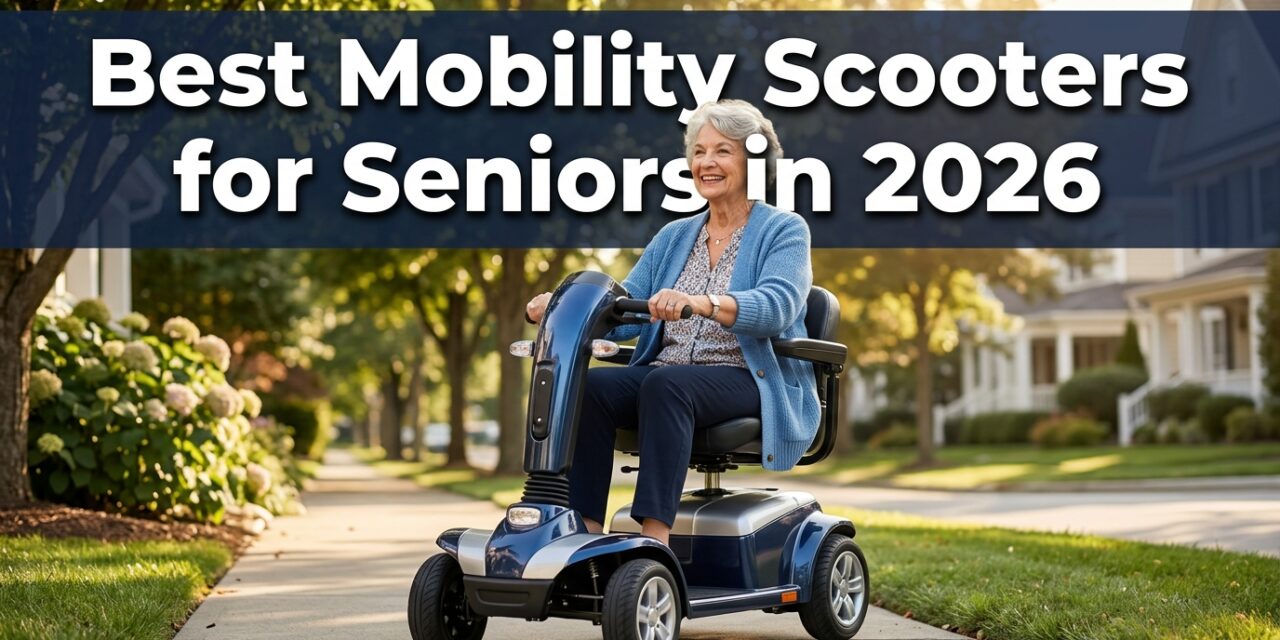
🛺 Best Mobility Scooters for Seniors in 2026: Features, Safety, and Real-World Reviews
Last updated: May 23, 2026
Quick Answer
The best mobility scooters for seniors in 2026 fall into three clear categories: travel/folding models (ideal for portability and trips), mid-size four-wheel scooters (best all-around for daily outdoor use), and heavy-duty units (for heavier users or rough terrain). Four-wheel designs remain the safest default for most seniors, while ultra-light folding scooters under 40 lbs are the fastest-growing segment. Prices range from roughly $700 to $6,000 depending on category and features [6].
Key Takeaways
- Four-wheel scooters offer better lateral stability and are the recommended default for seniors with balance concerns [4].
- Travel/folding scooters (under 40 lbs) are growing fast; the Pride iRide at ~32 lbs is a leading 2026 example [3].
- Prices span $700–$6,000: entry-level four-wheel models start around $700–$1,200; heavy-duty units run $3,500–$6,000 [6].
- Battery life typically ranges from 10–25 miles per charge; real-world range under load is often 20–30% less than spec-sheet claims [1].
- Anti-tip design and downhill braking are the two most critical safety features for seniors, according to Consumer Reports [5].
- Medicare Part B may cover a scooter if a doctor certifies medical necessity and the supplier is Medicare-approved.
- Weight capacity on standard models runs 250–300 lbs; heavy-duty models support 400–500 lbs [9].
- Brand support matters: Pride, Golden Technologies, Drive Medical, and Afikim are consistently rated for parts availability and warranty coverage [9].
- Poor fit (wrong seat height, tiller angle) is a leading cause of returns and discomfort — always confirm adjustability before buying [1].
- There is no single “best” scooter for all seniors; the right model depends on where and how it will be used most [7].
What Exactly Is a Mobility Scooter and How Does It Help Seniors?
A mobility scooter is a battery-powered personal vehicle with a seat, handlebars (called a tiller), and three or four wheels, designed to help people who can sit upright but have difficulty walking long distances. For seniors, scooters extend independence by enabling grocery runs, park walks, medical appointments, and travel without relying on others.
Unlike power wheelchairs, scooters require some upper-body control and the ability to transfer on and off independently. They are best suited for seniors who can walk short distances but fatigue quickly, or who manage pain, arthritis, or cardiovascular conditions that limit stamina.
Who it’s NOT for: Seniors who cannot sit upright unsupported, or who need full-time powered seating, are generally better served by a power wheelchair. A physician or occupational therapist can help make that call.
How Much Do Mobility Scooters Typically Cost in 2026?
Mobility scooter prices in 2026 break down by category, and knowing the tiers prevents overspending or buying underpowered equipment.
CategoryTypical Price RangeBest ForEntry-level 4-wheel$700 – $1,200Budget buyers, light daily useTravel / folding$1,500 – $3,000Portability, air travel, tripsMid-size outdoor$1,200 – $2,500Everyday outdoor useHeavy-duty$3,500 – $6,000Higher weight capacity, rough terrain
Hidden costs to budget for: replacement batteries ($150–$400), extended warranties, and accessories like baskets or weather covers [6].
What’s the Difference Between a 3-Wheel and 4-Wheel Mobility Scooter?
Four-wheel scooters are more stable; three-wheel scooters turn more tightly. The choice comes down to where the scooter will be used most.
- 4-wheel models have a wider wheelbase, making them far less likely to tip on uneven ground, ramps, or curb cuts. Consumer Reports consistently rates them higher for stability [5]. Best for: outdoor paths, sidewalks, shopping centers.
- 3-wheel models have a tighter turning radius, which helps in narrow hallways and small store aisles. The trade-off is reduced lateral stability, especially on slopes or soft ground. Best for: primarily indoor use or very flat environments.
Choose a 4-wheel model if: the senior has any balance concerns or will use the scooter outdoors regularly. Choose a 3-wheel model only if indoor maneuverability is the top priority and terrain is consistently flat [4].
Which Mobility Scooters Are Best for Indoor vs. Outdoor Use?
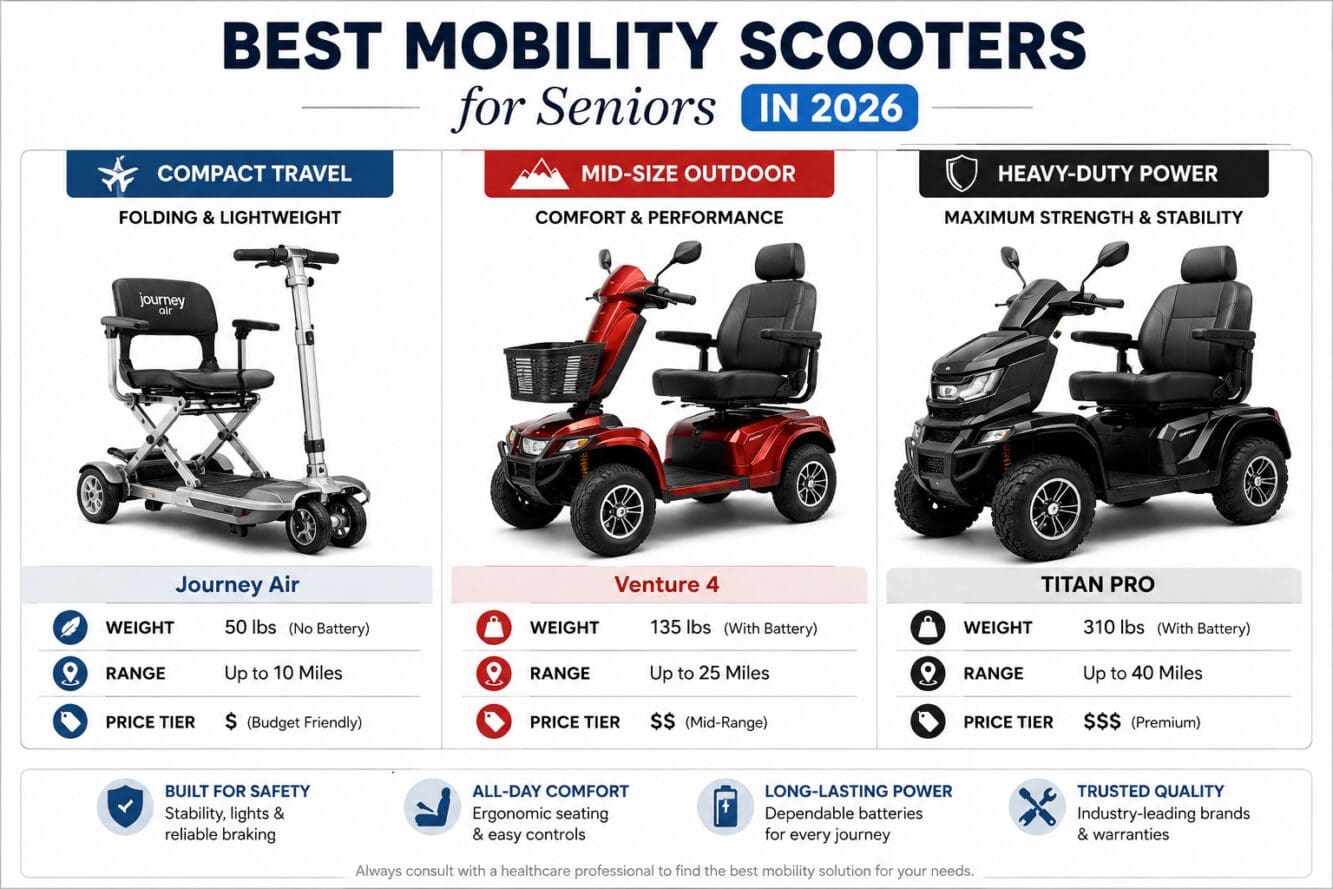
Indoor scooters need tight turning radius and compact footprint; outdoor scooters need ground clearance, suspension, and range. Many seniors need both, which is why mid-size 4-wheel models with moderate turning radius are the most popular all-around choice.
Best for indoors:
- Compact 3-wheel or small 4-wheel designs with turning radius under 40 inches
- Low ground clearance is fine on flat floors
- Slower top speed (4 mph) is sufficient
Best for outdoors:
- Full-size 4-wheel scooters with at least 3–4 inches of ground clearance
- Pneumatic (air-filled) tires absorb bumps better than solid foam tires
- Range of 15+ miles per charge for longer outings
- Anti-tip wheels at the rear for ramp and curb safety [5]
For seniors focused on staying safe in their community, an outdoor-capable 4-wheel scooter with anti-tip protection is the safer long-term investment.
Are Mobility Scooters Covered by Medicare or Insurance?
Medicare Part B may cover a mobility scooter if a doctor documents that the senior has a mobility-limiting condition and cannot use a cane or walker effectively. The scooter must be classified as a “power-operated vehicle” under durable medical equipment (DME) rules, and the supplier must be Medicare-enrolled.
Key steps for Medicare coverage:
- Get a face-to-face evaluation with a physician or treating provider.
- Obtain a written order stating medical necessity.
- Purchase from a Medicare-enrolled DME supplier.
- Expect Medicare to cover approximately 80% of the approved amount after the deductible; a supplemental plan may cover the remaining 20%.
Important caveat: Medicare does not cover scooters purchased purely for convenience. Documentation must clearly link the scooter to a diagnosed medical condition affecting mobility. Private insurers vary widely — always confirm coverage terms before purchasing.
What Safety Features Should I Look for in a Senior Mobility Scooter?
Anti-tip wheels, smooth downhill braking, and low-speed precision control are the three non-negotiable safety features for seniors in 2026, according to Consumer Reports testing criteria [5].
Full safety checklist:
- Anti-tip rear wheels — prevent backward tipping on ramps and inclines
- Automatic braking — scooter stops when the throttle is released (electromagnetic braking is most reliable)
- Feathered throttle control — allows very slow, precise movement indoors
- Wide, stable wheelbase — reduces lateral tipping risk during turns
- Bright LED lighting — front and rear lights for low-visibility conditions
- Horn or audible alert — for pedestrian-heavy environments
- Non-slip footplate and armrests — reduces fall risk during transfers
- Clear, large-print controls — reduces user error, especially for seniors with arthritis or vision changes [1]
Most senior accidents on scooters occur at low speed during turns, curb cuts, or ramp transitions — not at top speed [5]. Prioritize handling and braking over maximum speed.
For broader senior safety resources, the Building Safety Month coverage at Georgian Bay News offers useful context on home and mobility safety planning.
How Do I Know If I’m a Good Candidate for a Mobility Scooter?
A mobility scooter is a good fit if a senior can sit upright independently, transfer on/off with minimal assistance, and has enough hand and arm function to operate the tiller. An occupational therapist or physiatrist can provide a formal assessment if there is any uncertainty.
Good candidate indicators:
- Can walk short distances (10–50 feet) but fatigues quickly over longer distances
- Has a diagnosed condition (arthritis, COPD, heart disease, MS) that limits walking endurance
- Does not require postural support beyond a standard seat back
- Has cognitive ability to operate the scooter safely in traffic or public spaces
Edge case: Seniors with mild dementia may still use scooters safely in controlled environments (home, care facility grounds) but should be assessed individually for outdoor or public use.
What Are Common Mistakes Seniors Make When Choosing a Mobility Scooter?
The most common mistake is buying based on price or looks rather than fit, use case, and real-world portability. Poor fit is a leading cause of returns and dissatisfaction [1].
Avoid these errors:
- Buying too small to save money, then finding the scooter can’t handle outdoor terrain
- Ignoring disassembly weight — a scooter listed at 80 lbs may have a heaviest single piece of 45 lbs, which many caregivers cannot safely lift
- Trusting spec-sheet range — real-world battery range under a full load is typically 20–30% lower than advertised [1]
- Skipping a test ride — seat comfort, tiller reach, and throttle sensitivity vary significantly between models
- Overlooking after-sales support — choosing an off-brand with no local repair network can leave a senior without mobility for weeks [9]
Can Mobility Scooters Fit in a Car or Van?
Most mid-size and heavy-duty scooters require a vehicle lift or ramp and do not fit in a standard car trunk. Travel and folding scooters are specifically designed for car transport.
- Travel/folding scooters (under 40 lbs): fit in most car trunks when folded or disassembled into 2–3 pieces; some fold automatically with one button [3]
- Mid-size scooters (60–100 lbs): typically disassemble into 4–5 pieces; the heaviest piece is often 30–50 lbs; require a hatchback or SUV
- Heavy-duty scooters (100–200 lbs): require a vehicle lift, trailer, or accessible van
For seniors who travel frequently, the EV technology advances driving lighter battery designs are making sub-40-lb folding scooters increasingly practical for air and car travel [3].
How Long Do Mobility Scooter Batteries Typically Last?
Most mobility scooter batteries provide 10–25 miles of range per charge under ideal conditions, but real-world range under a full user load is typically 15–20% less. Charging time is usually 6–8 hours overnight [1].
Battery lifespan (the battery itself, not per-charge range):
- Sealed lead-acid batteries: 12–18 months with regular use
- Lithium-ion batteries (found in travel models): 2–4 years with proper care
- Replacement cost: $150–$400 depending on battery type and model
Practical tip: Always ask the vendor for range estimates at the buyer’s actual body weight, not the spec-sheet maximum. Battery performance also degrades in cold weather, which matters for seniors in northern climates.
What Weight Capacity Do Mobility Scooters Support, and Are There Options for Heavier Seniors?
Standard mobility scooters support 250–300 lbs; heavy-duty models are rated for 400–500 lbs. Seniors should always choose a model with a capacity at least 20–25 lbs above their actual weight (including typical cargo) to protect the motor and braking system over time [1].
Heavy-duty options to know:
- Brands like Pride, Golden Technologies, and Drive Medical all offer bariatric or heavy-duty lines
- These models feature reinforced frames, wider seats (20–22 inches), and stronger motors
- Expect higher price points ($2,500–$5,000) and heavier overall weight [9]
Common mistake: Buying a standard-capacity scooter and regularly exceeding its rating accelerates wear on the motor, brakes, and battery, and creates a safety risk on inclines.
What Maintenance Do Mobility Scooters Require?
Mobility scooters need relatively simple but consistent maintenance: regular battery charging, tire checks, and periodic cleaning of electrical contacts. Neglecting maintenance is the most common cause of premature breakdowns [1].
Basic maintenance schedule:
- Daily: Charge battery after use (avoid letting it fully drain); check tiller and seat are secure
- Weekly: Wipe down the frame; check tire pressure on pneumatic tires
- Monthly: Inspect brakes for responsiveness; check all bolts and connections for tightness
- Annually: Have a qualified technician inspect the motor, battery health, and brake system
Choose brands with strong parts pipelines (Pride, Golden Technologies, Afikim, Drive Medical) so tires, batteries, and controllers are readily available if something needs replacing [9].
FAQ
Q: What is the lightest mobility scooter available in 2026?
The Pride iRide Lightweight Folding Scooter weighs approximately 32 lbs total, making it one of the lightest options available in 2026 and suitable for airline travel [3].
Q: Can a mobility scooter be used in the rain?
Most scooters have some water resistance but are not fully waterproof. Light rain is generally manageable; avoid puddles and never submerge the battery compartment. Check the manufacturer’s IP rating before riding in wet conditions.
Q: How fast do mobility scooters go?
Most senior-oriented scooters have a top speed of 4–6 mph. Heavy-duty outdoor models may reach 8 mph. Speed is not a priority feature — low-speed control and braking matter far more for safety [5].
Q: Do I need a license to ride a mobility scooter?
In most Canadian provinces and U.S. states, no driver’s license is required for mobility scooters used on sidewalks or in pedestrian areas. Rules vary for road use — check local regulations.
Q: How do I transport a scooter on an airplane?
Airlines generally permit mobility scooters as checked assistive devices at no extra charge, but require advance notice and may have battery size restrictions. Lithium-ion batteries must meet watt-hour limits. Confirm with the airline at least 48 hours before travel [3].
Q: What is the best brand of mobility scooter for seniors in 2026?
Pride Mobility, Golden Technologies, Drive Medical, and Afikim are consistently rated highest for reliability, warranty support, and parts availability [9].
Q: Can a mobility scooter go up hills?
Most standard scooters handle gentle inclines (up to 6–8 degrees). Heavy-duty models with stronger motors manage steeper slopes. Always check the manufacturer’s maximum incline rating before purchasing for hilly terrain.
Q: How do I know what seat size I need?
Measure hip width while seated and add 1–2 inches for comfort. Most standard seats are 16–18 inches wide; heavy-duty models offer 20–22 inches. Adjustable armrests and seat height are also important for proper fit [1].
Conclusion
The best mobility scooters for seniors in 2026 are not defined by speed or flashy features — they are defined by stability, fit, real-world portability, and reliable after-sales support. Start by identifying the primary use case: indoor maneuverability, everyday outdoor errands, travel portability, or high-weight-capacity durability. From there, match the scooter category to that need, confirm the seat and tiller are adjustable, and verify that the brand offers accessible parts and warranty support.
Actionable next steps:
- Consult a physician or occupational therapist to confirm a scooter is the right mobility aid.
- Identify your primary use case (indoor, outdoor, travel, heavy-duty).
- Test-ride at least two models before purchasing — seat comfort and throttle feel vary significantly.
- Ask the vendor for real-world range at your body weight, not the spec-sheet number.
- Confirm Medicare or insurance eligibility before paying out of pocket.
- Choose a brand with strong local service support and readily available replacement parts.
For seniors committed to staying safe and maintaining independence, a well-chosen mobility scooter is one of the most practical investments available in 2026.
References
[1] Best Mobility Scooters For Seniors Buying Guide – https://www.intcowheelchair.com/news/best-mobility-scooters-for-seniors-buying-guide
[2] Top 5 Best Mobility Scooters For 2026 (Video) – https://www.youtube.com/watch?v=k8qON281K8U
[3] Best Portable Mobility Scooters Under 40 Lbs In 2026 – https://www.paiseec.com/blogs/knowledge/best-portable-mobility-scooters-under-40-lbs-in-2026
[4] Best Mobility Scooter For Seniors – https://skywardmedical.com/blogs/news/best-mobility-scooter-for-seniors
[5] Best Mobility Scooters – Consumer Reports – https://www.consumerreports.org/health/mobility-scooters/best-mobility-scooters-a1002132141/
[6] Best Mobility Scooters – Reviewed – https://www.reviewed.com/accessibility/best-right-now/best-mobility-scooters
[7] Best Mobility Scooters In Each Category 2026 Q2 (Video) – https://www.youtube.com/watch?v=XP7DuPMjsNw
[8] Mobility Scooter Comparison – MovingLife – https://us.movinglife.com/pages/mobility-comparison
[9] Top Mobility Scooter Brands – AssistedLiving.org – https://www.assistedliving.org/best-mobility-scooters/top-mobility-scooter-brands/
Content, illustrations, and third-party video appearing on GEORGIANBAYNEWS.COM may be generated or curated with AI assistance or reproduced pursuant to the fair dealing provisions of the Copyright Act, R.S.C. 1985, c. C-42. Attribution and hyperlinks to original sources are provided in acknowledgment of applicable intellectual property rights. Such referencing is intended to direct traffic to and support the original rights holders’ platforms.