






















When Sarah Chan opened her work email on a cold January morning in 2026, she never expected the message that would change her career trajectory. The subject line was simple: “Organizational Update.” Inside, Amazon’s senior vice president Beth Galetti announced that approximately 16,000 roles across the company would be affected by organizational changes—and Sarah’s position was one of them. She wasn’t alone. Thousands of Amazon employees worldwide faced the same reality as the tech giant embarked on one of the largest workforce restructurings in its history. The Amazon layoffs sent shockwaves through the technology sector, raising questions about job security, corporate strategy, and the future of work in an increasingly uncertain economic landscape.

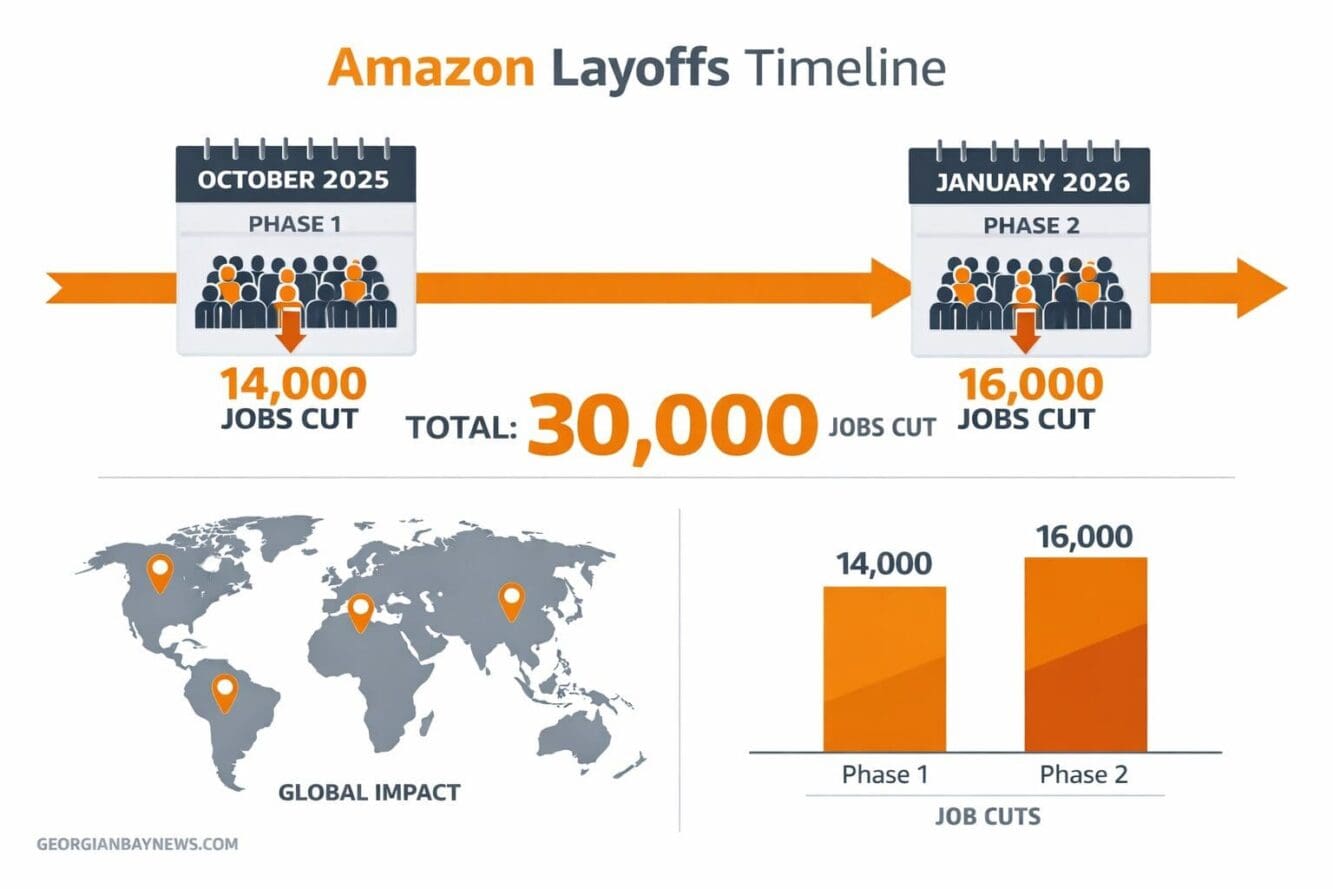
The magnitude of these workforce reductions cannot be understated. When Amazon confirmed the Amazon layoffs affecting 16,000 employees in January 2026, it marked the second major wave of cuts within just three months. Combined with the October 2025 reductions, the company eliminated approximately 30,000 positions—a number that rivals the entire workforce of many mid-sized corporations[2].
Beth Galetti, Amazon’s senior vice president of people experience and technology, framed the decision as part of broader efforts to “reduce layers, increasing ownership, and removing bureaucracy.”[1] This language echoes similar restructuring announcements from other tech giants, suggesting an industry-wide recalibration following years of rapid pandemic-era expansion.
Amazon’s restructuring unfolded in distinct phases:
| Phase | Timeline | Roles Affected | Focus Areas |
|---|---|---|---|
| Phase One | October 2025 | ~14,000 roles | Initial organizational streamlining |
| Phase Two | January 2026 | ~16,000 roles | Completion of restructuring efforts |
| Total | Oct 2025 – Jan 2026 | ~30,000 roles | Company-wide reorganization |
This staggered approach allowed different teams to complete their organizational changes on varying timelines, though the human impact remained consistent across both waves[1].
The tech industry has experienced significant volatility in recent years, with software engineering roles facing particular uncertainty. Amazon’s restructuring reflects broader trends affecting technology workers globally.
The Amazon layoffs cast a wide net across the organization. Unlike targeted cuts focused on specific underperforming divisions, these reductions touched virtually every corner of Amazon’s global operations—from Amazon Web Services to retail operations, from corporate functions to technology teams.
The layoffs affected employees across Amazon globally, though the timing and specific support mechanisms varied based on local labor laws and country-level requirements[1]. For American workers, the impact was particularly significant given Amazon’s massive US footprint. Canadian employees faced similar uncertainty, while workers in Europe, Asia, and other regions navigated their own regional employment regulations.
Real Story: Marcus Thompson, a 12-year Amazon veteran based in Seattle, described the experience as “surreal.” “You build relationships, you contribute to projects you believe in, and then suddenly you’re told your role is being eliminated as part of ‘organizational efficiency,'” he shared in an online forum. “The 90-day window feels generous on paper, but finding a comparable internal role when 16,000 people are competing is incredibly challenging.”
Importantly, these cuts primarily affected corporate and technology roles rather than frontline warehouse or delivery workers. The restructuring targeted middle management layers, specialized technical positions, and administrative functions—roles that Amazon leadership deemed duplicative or non-essential to core operations.
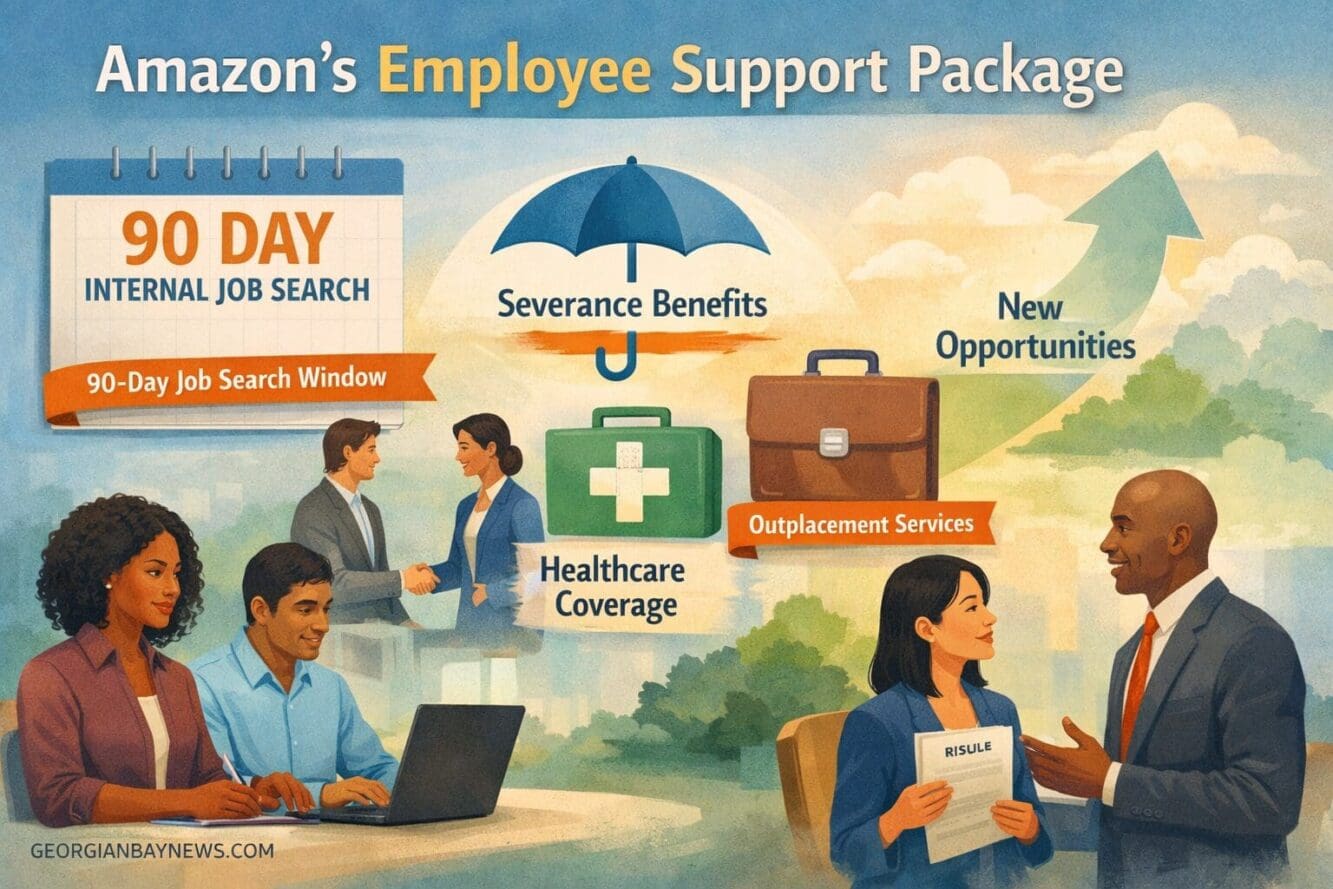
Despite the difficult news, Amazon implemented several support mechanisms to ease the transition for affected employees. Understanding these benefits is crucial for anyone navigating similar corporate restructurings.
Most US-based employees impacted by the Amazon layoffs received a 90-day period to explore and apply for other positions within the company[1]. This internal mobility window represents a meaningful opportunity—Amazon employs over 1.5 million people globally, and new positions open regularly.
Key advantages of the internal search period:
However, the challenge lies in competition. With thousands of qualified internal candidates vying for limited openings, success requires strategic networking, skill positioning, and sometimes flexibility regarding location or role type.
For employees unable to secure internal positions, Amazon provides a comprehensive severance package including[1]:
These benefits exceed legal minimums in most jurisdictions, reflecting Amazon’s recognition of the disruption these changes cause in employees’ lives. Similar corporate restructuring has affected major Canadian retailers and other industries facing economic headwinds.
The timing and scale of the Amazon layoffs raise important questions: Why implement such significant cuts when Amazon remains profitable? What strategic objectives drive these decisions?
Beth Galetti’s memo emphasized the goal of “reducing layers” within the organization[1]. Over years of rapid growth, Amazon—like many tech companies—accumulated management layers that slowed decision-making and diluted accountability. By flattening the organizational structure, leadership aims to:
The broader economic context matters too. Rising interest rates, inflation concerns, and slowing consumer spending have pressured tech companies to demonstrate fiscal discipline. Investors increasingly reward efficiency over growth-at-any-cost strategies.
Amazon’s leadership likely views these cuts as proactive positioning for potential economic challenges ahead—similar to how businesses across sectors are preparing for economic uncertainty.
Critically, Amazon emphasized that despite the layoffs, the company will “continue hiring and investing in strategic areas and functions that are critical to our future”[1]. This signals a reallocation rather than pure reduction—moving resources from legacy or less strategic areas toward:
The company’s AI initiatives and cloud services represent growth areas where selective hiring continues even as other divisions contract.
The ripple effects of Amazon layoffs extend far beyond those directly affected. These workforce reductions influence entire communities, regional economies, and industry-wide employment trends.
In tech hubs like Seattle, Austin, and the San Francisco Bay Area, Amazon represents a major employer whose hiring and firing decisions significantly impact local economies. When thousands of well-compensated professionals suddenly enter the job market, consequences include:
Smaller communities with Amazon facilities face proportionally greater impact, as the company often represents one of the largest local employers.
Amazon’s restructuring doesn’t occur in isolation. Throughout 2025 and into 2026, major tech companies including Meta, Google, Microsoft, and others announced significant workforce reductions[3]. This industry-wide pattern suggests:
For tech workers, this represents a fundamental shift from the seller’s market of previous years to increased competition and job insecurity.
If you’re among those impacted by the Amazon layoffs—or concerned about similar cuts at your employer—strategic action can improve your outcomes.
Week 1-2: Assess and Plan
Week 3-8: Active Internal Search (if applicable)
Week 9-12: External Preparation
Even if you’re not directly affected, these layoffs offer important lessons:
The changing landscape for software engineers underscores the importance of continuous learning and adaptation.
One crucial element of Beth Galetti’s announcement deserves emphasis: her explicit statement that this is not “the beginning of a new rhythm – where we announce broad reductions every few months.”[1]
This reassurance matters for remaining employees who might otherwise live in constant fear of additional cuts. However, Galetti acknowledged that teams will “continue to evaluate the ownership, speed, and capacity to invent for customers”[1]—suggesting that while massive company-wide reductions may not recur, targeted adjustments remain possible.
Corporate communications require careful interpretation. While Amazon states these aren’t recurring broad cuts, the company reserves flexibility to:
For employees, this means job security depends increasingly on alignment with strategic priorities and demonstrated value delivery.
As we move deeper into 2026, the Amazon layoffs represent more than a single company’s restructuring—they signal broader transformations in how technology companies operate and how careers unfold in the digital economy.
1. Flatter Organizations: Expect continued reduction in middle management layers across tech companies, with individual contributors taking greater ownership.
2. AI-Augmented Roles: Positions increasingly require collaboration with AI tools, with purely manual tasks automated away.
3. Flexible Workforce Models: Growing mix of full-time employees, contractors, and gig workers as companies optimize for agility.
4. Skills Over Credentials: Demonstrated capabilities matter more than traditional degrees or tenure.
5. Geographic Flexibility: Remote work enables talent access beyond traditional tech hubs, though some companies pull back on full remote options.
While layoffs create genuine hardship, they also create opportunities:
The disruption also prompts necessary conversations about work-life balance, career sustainability, and what people ultimately value in their professional lives.
The Amazon layoffs affecting 16,000 employees in January 2026 represent a significant moment for the technology industry and the thousands of families directly impacted. While Beth Galetti’s memo emphasized organizational efficiency and strategic focus, the human cost remains substantial—careers disrupted, families stressed, and communities affected.
Yet within this challenging reality lie opportunities for growth, reinvention, and resilience. For those affected, the 90-day internal search window and comprehensive severance packages provide crucial support during transition. For the broader tech workforce, these events underscore the importance of continuous learning, strong professional networks, and financial preparedness.
If you’re directly affected:
If you’re a tech worker elsewhere:
For leaders and policymakers:
The story of Amazon’s 2026 restructuring continues to unfold. While the immediate impact creates uncertainty and hardship, the long-term effects will shape how we think about corporate structure, career development, and the evolving relationship between employers and employees in an AI-driven future.
For thousands like Sarah Chen, who opened that fateful email in January, the journey ahead involves both challenge and opportunity. Their resilience, adaptability, and determination will write the next chapter—not just of their own careers, but of the broader transformation reshaping work in the 21st century.
[1] Amazon Layoffs Corporate Jan 2026 – https://www.aboutamazon.com/news/company-news/amazon-layoffs-corporate-jan-2026
[2] Amazon Confirms 16000 More Job Cuts Bringing Total Layoffs To 30000 Since October – https://www.geekwire.com/2026/amazon-confirms-16000-more-job-cuts-bringing-total-layoffs-to-30000-since-october/
[3] Recent Company Layoffs Laying Off Workers 2026 – https://www.businessinsider.com/recent-company-layoffs-laying-off-workers-2026
GEORGIANBAYNEWS.COM shares video content from YouTube creators under fair use principles. We respect creators’ intellectual property and include direct links to their original videos, channels, and social media platforms whenever we feature their content. This practice supports creators by driving traffic to their platforms.
Some content and illustrations on GEORGIANBAYNEWS.COM are created with the assistance of AI tools.