




















Blackcurrant Revival in Canadian Vegetable Gardens: Sweet, Vitamin-Rich Varieties for 2026 Harvests and Recipes
Last updated: March 18, 2026
Quick Answer: Blackcurrants are making a strong comeback in Canadian home gardens in 2026, driven by cold-hardy varieties that thrive from Zone 3 onward, a surge in culinary interest, and McCormick naming black currant its Flavor of the Year. Canadian gardeners can expect high yields, excellent vitamin C content, and versatile harvests for jams, cordials, and fresh eating — often outperforming blueberries in yield per shrub and soil adaptability.
Key Takeaways
- McCormick named black currant its 2026 Flavor of the Year, describing it as “sweet, tart, and rich” — a signal that demand for home-grown blackcurrants will rise sharply. [4]
- Top Canadian varieties include Titania, Ben Sarek, and Tiben — all hardy to Zone 3 and well-suited to most Canadian climates. [1][2]
- Tiben produces 8–11 pounds of fruit per shrub and ripens in mid-to-late July, making it one of the most productive options available. [2]
- Newer Cassissima® varieties (Black Bells, Black Marble, Little Black Giant, Noiroma) offer Brix values of 16–20°, meaning noticeably sweeter fruit than traditional tart blackcurrants. [3]
- Blackcurrants tolerate heavier, less acidic soils than blueberries, making them easier to establish in typical Canadian garden beds.
- McGinnis Berry Crops in British Columbia runs the only currant breeding program in North America, developing varieties with rust resistance and higher sugar content for North American tastes. [5]
- Blackcurrants are extremely high in vitamin C — roughly four times the amount found in oranges, gram for gram.
- Harvest season runs from late June through August, depending on variety and region.
Why Are Blackcurrants Making a Comeback in Canada?
Blackcurrants fell out of favour in North America for decades, partly due to a federal ban (lifted in 2003) that restricted growing to protect the timber industry from white pine blister rust. That ban is long gone, and the Blackcurrant Revival in Canadian Vegetable Gardens is now in full swing.
Several forces are converging in 2026:
- McCormick’s Flavor of the Year designation for black currant is pushing the berry into mainstream recipes, cocktails, and packaged foods. [4]
- Lubera Edibles has declared 2026 “the year of blackcurrants,” spotlighting new sweeter Cassissima® varieties. [3]
- Canadian breeders are producing varieties with better rust resistance and higher sugar content suited to local palates. [5]
- Home gardeners are seeking fruit shrubs that deliver high yields with minimal inputs — and blackcurrants fit that profile well.
“A berry featuring a distinct yet balanced flavor profile that’s sweet, tart, and rich.” — McCormick, on naming black currant its 2026 Flavor of the Year [4]
Which Blackcurrant Varieties Work Best for Canadian Gardens?
The best varieties for Canadian conditions combine cold hardiness, disease resistance, and good fruit quality. Titania, Ben Sarek, and Tiben are the three most reliable choices for most Canadian growing zones.
| Variety | Hardiness Zone | Yield per Shrub | Key Strength |
|---|---|---|---|
| Tiben | Zone 3+ | 8–11 lbs | High yield, mid-July harvest [2] |
| Titania | Zone 3+ | High | Disease resistance, large berries [1] |
| Ben Sarek | Zone 4+ | Moderate | Compact size, excellent fruit quality [1] |
| Black Bells (Cassissima®) | Zone 4–5 | Moderate | Very sweet (Brix 16–20°) [3] |
| Little Black Giant (Cassissima®) | Zone 4–5 | High | Sweet, suitable for small spaces [3] |
Choose Tiben if yield is the priority and the garden is in a colder zone. Choose Ben Sarek for smaller spaces or container growing. Choose Cassissima® varieties if fresh eating and sweetness matter more than raw volume.
Tiben originates from Poland and carries resistance to rust strains found in coastal British Columbia — a useful trait for West Coast gardeners. [2]
How Do You Plant and Grow Blackcurrants in Canada?
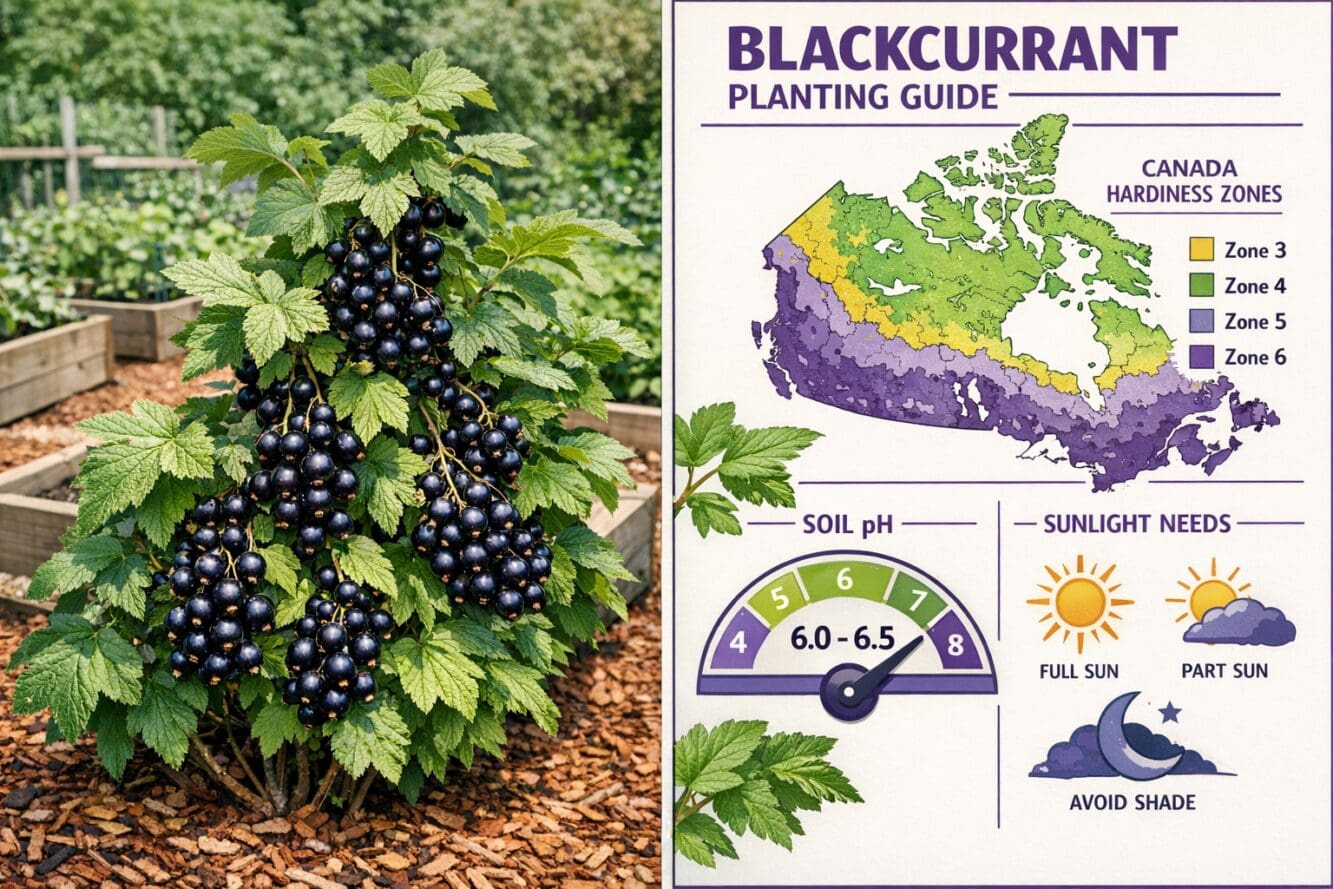
Blackcurrants are straightforward to establish. They prefer full sun to partial shade, tolerate heavier soils than blueberries, and do not require the strict soil acidification that blueberries demand.
Step-by-step planting guide:
- Choose the right site. Full sun produces the best yields. Partial shade is acceptable but reduces fruit set.
- Prepare the soil. Aim for a pH of 6.0–6.5. Work in compost to improve drainage and fertility.
- Plant in early spring or fall. Space shrubs 1.5–1.8 metres apart to allow air circulation.
- Plant slightly deeper than the nursery pot level to encourage new shoots from the base.
- Mulch generously with wood chips or straw to retain moisture and suppress weeds.
- Water consistently during the first growing season. Established shrubs are reasonably drought-tolerant.
- Prune in late winter. Remove wood older than three years to keep yields high. [6]
If you’re new to fruit shrubs, reviewing common raised bed garden mistakes before planting can save a lot of frustration in the first season.
Common mistake: Planting too close together. Poor air circulation encourages powdery mildew, one of the main disease issues for blackcurrants in humid Canadian summers.
What Pests and Diseases Should Canadian Growers Watch For?
The main threats to blackcurrants in Canada are powdery mildew, white pine blister rust, and currant fruit fly. Choosing resistant varieties is the single most effective prevention strategy.
- Powdery mildew: Appears as white powder on leaves. Improve air circulation by spacing plants well and pruning regularly. Titania and Tiben both carry good mildew resistance. [1][2]
- White pine blister rust: A fungal disease that can affect blackcurrants. Tiben is specifically resistant to rust strains in British Columbia. [2] McGinnis Berry Crops in B.C. breeds for rust resistance as a core trait. [5]
- Currant fruit fly: Larvae tunnel into berries. Pick fruit promptly at ripeness and clean up fallen fruit to break the cycle.
- Aphids: Common but manageable with a strong water spray or insecticidal soap.
Thinking about broader garden health and nature-directed stewardship practices can also support a healthier growing environment for fruit shrubs.
How Do Blackcurrants Compare to Blueberries for Canadian Home Gardens?
Blackcurrants outperform blueberries on several practical measures for Canadian gardeners. They tolerate a wider soil pH range, establish faster, and typically yield more fruit per shrub in the first few years.
| Factor | Blackcurrants | Blueberries |
|---|---|---|
| Soil pH needed | 6.0–6.5 | 4.5–5.5 (strict) |
| Cold hardiness | Zone 3+ | Zone 4–5 (most varieties) |
| Years to first good yield | 2–3 | 3–5 |
| Yield per mature shrub | 8–11 lbs (Tiben) [2] | 5–7 lbs (estimate) |
| Vitamin C content | Very high | Moderate |
The trade-off: blueberries are milder in flavour and more familiar to many Canadian palates. Blackcurrants have a bolder, more complex taste that works better in cooked applications and drinks.
What Are the Best Recipes for a 2026 Blackcurrant Harvest?
Blackcurrants shine in cooked and preserved recipes where their intense flavour concentrates. Fresh eating is also possible, especially with the newer sweeter Cassissima® varieties. [3]
Top uses for a Canadian blackcurrant harvest:
- 🫙 Classic blackcurrant jam — High natural pectin means jam sets reliably without added pectin.
- 🥤 Blackcurrant cordial — Simmer berries with sugar and water, strain, and bottle. Dilute to serve.
- 🍷 Cassis syrup — A non-alcoholic version of the French liqueur, excellent over ice cream or in sparkling water.
- 🥧 Summer crumble or pie — Mix with apples or raspberries to balance tartness.
- 🍦 Sorbet or frozen dessert — The deep colour and bold flavour make an impressive result.
- 🥣 Smoothie booster — Freeze in portions and blend into smoothies for a vitamin C boost all winter.
McCormick’s 2026 Flavor of the Year designation means blackcurrant is also appearing in savoury applications — think glazes for duck or lamb, vinaigrettes, and cocktail syrups. [4]
For those interested in connecting food culture with community events, Georgian Bay’s local trail and community programming often features local producers and seasonal harvests worth exploring.
FAQ: Blackcurrant Growing in Canada
Q: Are blackcurrants legal to grow across all Canadian provinces?
Yes. The federal restrictions that once limited currant growing in parts of North America have been lifted. Some individual provinces or municipalities may have local rules, so checking with a local extension office is worthwhile.
Q: How long before a blackcurrant shrub produces a full harvest?
Expect a small harvest in year two and a full yield by year three. Tiben and Titania are among the faster-establishing varieties. [1][2]
Q: Do blackcurrants need a second plant for pollination?
Blackcurrants are largely self-fertile, so a single shrub will produce fruit. Planting two or more varieties can increase yield through cross-pollination.
Q: What is the Brix value and why does it matter?
Brix measures sugar content in fruit. Traditional blackcurrants typically fall around 10–12° Brix. The new Cassissima® varieties reach 16–20° Brix, making them noticeably sweeter and more appealing for fresh eating. [3]
Q: Can blackcurrants grow in containers?
Ben Sarek and Little Black Giant are compact enough for large containers (at least 40 litres). Container plants need more frequent watering and annual top-dressing with compost.
Q: When is the best time to plant blackcurrants in Canada?
Early spring (as soon as the ground can be worked) or early fall are both suitable. Spring planting gives the shrub a full growing season to establish before winter.
Q: How much sun do blackcurrants need?
Full sun (6+ hours daily) produces the best yields. They will grow in partial shade but produce less fruit.
Q: Are blackcurrants high in vitamins?
Yes. Blackcurrants are exceptionally high in vitamin C, and also contain vitamin K, potassium, and anthocyanins — the antioxidant compounds that give them their deep colour.
Q: What is the best blackcurrant variety for cold climates like Manitoba or northern Ontario?
Tiben and Titania are both rated to Zone 3, making them the safest choices for colder regions. [1][2]
Q: Where can Canadian gardeners buy blackcurrant plants?
Specialty nurseries, online Canadian plant retailers (such as West Coast Plants and Hardy Fruit Trees), and local garden centres in fruit-growing regions carry blackcurrant stock. Ordering early in the season is recommended as supply sells out.
Conclusion
The Blackcurrant Revival in Canadian Vegetable Gardens is well-timed and well-supported. Cold-hardy varieties like Tiben, Titania, and Ben Sarek give Canadian growers from Zone 3 onward a reliable, high-yielding fruit shrub that asks for less fuss than blueberries and delivers impressive nutritional value. The arrival of sweeter Cassissima® varieties and McCormick’s 2026 Flavor of the Year designation mean both the garden and the kitchen have strong reasons to make room for blackcurrants this season.
Actionable next steps for 2026:
- Order plants now — stock at Canadian nurseries sells out by late spring.
- Choose Tiben for yield, Ben Sarek for small spaces, Cassissima® for sweetness.
- Prepare beds this spring — adjust soil pH to 6.0–6.5 and add compost.
- Plan at least two shrubs for cross-pollination and a meaningful harvest.
- Bookmark a cordial and jam recipe before the July harvest arrives.
Exploring community food and garden initiatives in the Georgian Bay region can also connect local growers with broader conversations about sustainable, local food production.
References
[1] Blackcurrant – https://www.hardyfruittrees.ca/produit/other-fruits-growing-northern-canada/blackcurrant/
[2] Tiben Blackcurrant – https://westcoastplants.ca/products/tiben-blackcurrant
[3] Cassissima Blackcurrants As Plant Of The Year 2026 – https://gaertnerbuch.luberaedibles.com/en/cassissima-blackcurrants-as-plant-of-the-year-2026-p230
[4] McCormick Unveils the 2026 Flavor of the Year: Black Currant – https://news.mccormick.com/2025-12-09-McCormick-R-Unveils-the-2026-Flavor-of-the-Year-Black-Currant
[5] Currants – https://cropsandsoils.extension.wisc.edu/currants/
[6] How To Grow Black Currant – https://www.growveg.com/plants/us-and-canada/how-to-grow-black-currant/
Content, illustrations, and third-party video appearing on GEORGIANBAYNEWS.COM may be generated or curated with AI assistance or reproduced pursuant to the fair dealing provisions of the Copyright Act, R.S.C. 1985, c. C-42. Attribution and hyperlinks to original sources are provided in acknowledgment of applicable intellectual property rights. Such referencing is intended to direct traffic to and support the original rights holders’ platforms.