




















Mobility Exercises for Seniors: Daily 15-Minute Routine to Stay Flexible and Independent

Last updated: May 21, 2026
Quick Answer: A daily 15-minute mobility routine targeting the hips, ankles, and thoracic spine can meaningfully improve flexibility, reduce fall risk, and help seniors maintain independence for everyday tasks like climbing stairs, reaching overhead, and getting up from a chair. No equipment is needed — just a sturdy chair and enough floor space to stand comfortably.
Key Takeaways
- Mobility training focuses on joint range of motion, which is different from strength or cardio work — and it’s often the missing piece for seniors.
- The hips, ankles, and thoracic spine are the three areas most responsible for functional independence in daily life.
- A 15-minute daily routine is enough to produce noticeable improvements in flexibility within 4 to 8 weeks for most adults over 65.
- No equipment is required; a sturdy chair is the only prop needed for balance support.
- Most healthy seniors can start immediately without a doctor’s visit, though those with recent joint replacements, fractures, or uncontrolled conditions should check first.
- Chair-based modifications make every exercise in this routine accessible for people with limited range of motion.
- Consistency matters more than intensity — daily short sessions outperform occasional long ones.
- These exercises directly support fall prevention by improving ankle stability and hip control.
What Is Mobility Training and Why Does It Matter After 65?
Mobility training means moving joints through their full, pain-free range of motion. It’s not stretching alone, and it’s not strength training — it sits between the two, teaching the body to control movement rather than just hold a position.
After age 65, joints stiffen because connective tissue loses water content and muscles shorten from prolonged sitting. The result: smaller, more cautious movements that feed a cycle of further stiffness. Mobility work interrupts that cycle. For older adults, the payoff is practical — bending to tie shoes, turning to check traffic while driving, or stepping off a curb without hesitation.
What’s the Difference Between Mobility and Strength Training for Seniors?
Mobility training restores the range of motion a joint can move through actively, while strength training builds the muscle force to move against resistance. Both matter, but mobility comes first: a stiff joint can’t be strengthened safely.
Think of it this way: strength training fills a cup, and mobility determines how big the cup is. Seniors who skip mobility work and focus only on strength often plateau or develop compensatory pain because the underlying joint restriction never gets addressed. A stay healthier lifestyle includes both, but for someone just starting out, 15 minutes of daily mobility is the higher-leverage entry point.
The Daily 15-Minute Routine: Mobility Exercises for Seniors to Stay Flexible and Independent
This equipment-free routine covers the three areas most critical for daily function: hips, ankles, and thoracic spine. Do each exercise in order. Use a sturdy chair for balance where noted.

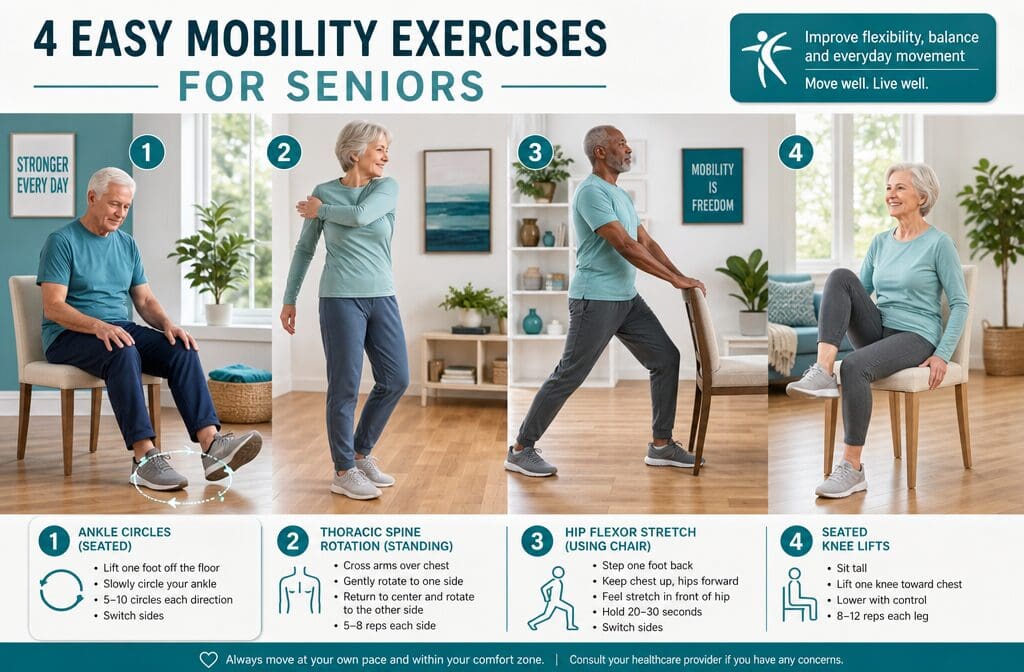
⏱ Total time: 15 minutes | Equipment: Sturdy chair | Frequency: Daily
ExerciseTarget AreaDurationChair Needed?Ankle CirclesAnkles1 min each sideOptionalHeel-to-Toe RocksAnkles + Balance2 minYesStanding Hip CirclesHips2 minYesHip Flexor Step-Back StretchHips1.5 min each sideYesSeated Thoracic RotationThoracic Spine2 minYesCat-Cow (Chair Version)Thoracic Spine2 minYesNeck Half-CirclesCervical Spine1 minNo
How to do each exercise:
- Ankle Circles — Seated, lift one foot slightly and draw slow, full circles with the toes. Reverse direction. Keeps ankle joints lubricated and improves proprioception.
- Heel-to-Toe Rocks — Standing behind a chair, slowly rock forward onto toes, then back onto heels. Builds ankle control critical for stair safety.
- Standing Hip Circles — Hands on chair back, feet hip-width apart. Draw large, slow circles with the hips, as if stirring a pot. Loosens hip capsule tissue.
- Hip Flexor Step-Back Stretch — Step one foot back into a gentle lunge, keeping the torso upright. Hold 20 seconds each side. Counteracts chair-sitting tightness.
- Seated Thoracic Rotation — Sit tall, arms crossed over chest, rotate slowly left and right. Improves the ability to turn while driving or reaching across the body.
- Chair Cat-Cow — Seated, hands on knees. Arch the back (cow), then round it (cat). Restores spinal segmental movement.
- Neck Half-Circles — Slowly drop the chin to chest, roll right to the shoulder, back to center, then left. Never roll the head fully back.
Can These Mobility Exercises Prevent Falls for Elderly People?
Yes — and the ankle and hip components are especially important. Falls in older adults most often result from poor ankle reactivity (the ability to catch a stumble) and weak hip control during single-leg moments like stepping off a curb. This routine directly trains both.
Ankle circles and heel-to-toe rocks improve proprioception, which is the body’s sense of joint position in space. Hip circles and the step-back stretch improve the hip’s ability to stabilize during weight shifts. Together, these changes reduce the “frozen” movement patterns that lead to trips and falls. For more on staying connected to community health resources in South Georgian Bay, local clinics often offer fall-prevention assessments that pair well with home routines like this one.
Are These Routines Safe for Someone With Knee Replacements or Arthritis?
For most people with arthritis or knee replacements (past 12 weeks post-op), gentle mobility work is not only safe but recommended by most physiotherapists. The key is to stay within a pain-free range and avoid deep knee flexion in the early stages.
Modifications for arthritis or post-surgical knees:
- Skip the step-back lunge; substitute a seated hip flexor tilt instead.
- Perform heel-to-toe rocks with both hands firmly on the chair.
- Reduce the arc of hip circles to whatever feels comfortable — even small circles provide benefit.
Anyone within 12 weeks of a knee replacement, hip replacement, or spinal surgery should get clearance from their surgeon or physiotherapist before starting, even a gentle routine.
What Are the Best Mobility Exercises for Older Adults With Arthritis?
The best mobility exercises for arthritic joints are warm, slow, and rhythmic — not held static stretches. Movement pumps synovial fluid into the joint, which reduces morning stiffness and pain over time.
For arthritis specifically, ankle circles, seated thoracic rotation, and chair cat-cow are the safest starting points because they load joints minimally while still moving them through range. Avoid any exercise that causes sharp or pinching pain (dull aching during movement is normal and generally acceptable).
How Much Flexibility Can Seniors Realistically Regain After 65?
Meaningful flexibility gains are achievable after 65, though the rate is slower than in younger adults. Most seniors who practice daily mobility work report noticeable improvements in ease of movement within 4 to 6 weeks, and measurable range-of-motion gains within 8 to 12 weeks.
The realistic goal isn’t to return to a 30-year-old’s flexibility — it’s to recover enough range to perform daily tasks without compensation or pain. That bar is achievable for the vast majority of adults over 65, including those who have been sedentary for years. Strategic food choices that reduce inflammation (such as omega-3-rich foods) can also support joint mobility alongside exercise.
Do I Need a Doctor’s Approval Before Starting These Exercises?
Most healthy seniors do not need a doctor’s visit before starting a gentle, equipment-free mobility routine. These exercises are low-impact, involve no jumping or heavy loading, and are designed to be performed within a comfortable range.
Consult a doctor or physiotherapist first if you have:
- A joint replacement within the past 12 weeks
- Uncontrolled osteoporosis with recent fracture history
- Severe balance disorders (vestibular conditions)
- Active inflammatory arthritis flare
- Recent spinal surgery
When in doubt, a single appointment with a physiotherapist can provide personalized modifications and peace of mind.
What Equipment Do I Need to Do Senior Mobility Exercises at Home?
Nothing beyond a sturdy chair. The entire routine in this guide is equipment-free by design, so there’s no cost barrier and no reason to wait.
A chair with a solid back (not a wheeled office chair) serves as a balance support for standing exercises. A yoga mat or folded towel under the feet adds comfort for anyone standing on hard floors for extended periods, but it’s optional. Comfortable, non-restrictive clothing and bare feet or flat-soled shoes complete the setup.
How Often Should Seniors Do Mobility Workouts?
Daily is the target, and it’s achievable because 15 minutes fits into almost any schedule. Unlike strength training, mobility work doesn’t require recovery days — joints benefit from daily gentle movement.
If daily feels like too much at first, start with five days per week and build from there. Consistency over weeks matters far more than any single session. Many seniors find that attaching the routine to an existing habit — right after morning coffee, for example — makes it automatic within two weeks.
What Are Common Mistakes Seniors Make When Starting Mobility Training?
The most common mistake is pushing through sharp pain. Mild discomfort or a pulling sensation is normal; sharp, pinching, or joint pain is a signal to reduce the range or stop.
Other frequent errors:
- Moving too fast. Slow, controlled movement is more effective than quick repetitions.
- Holding the breath. Breathe steadily throughout — exhale on the effort phase.
- Skipping the ankles. Most people focus on hips and spine and neglect ankle mobility, which is a primary fall-risk factor.
- Stopping after one good week. Flexibility gains reverse quickly without consistent practice. Think of it as brushing teeth — daily maintenance, not a one-time fix.
Are There Modified Versions for People With Limited Range of Motion?
Every exercise in this routine has a seated or reduced-range version. People with very limited mobility can perform the entire routine seated in a chair without standing at all.
Seated-only modifications:
- Hip circles become seated hip tilts (tilt the pelvis forward and back while seated).
- Heel-to-toe rocks become seated foot pumps (lift heels, then toes, alternating).
- All spinal and neck exercises remain unchanged.
Starting with smaller ranges and building gradually is always better than forcing a larger range and causing a setback. For those managing social isolation alongside physical limitations, online or community-based mobility classes can add accountability and social connection to the routine.
Which Mobility Exercises Are Best for Improving Balance?
Heel-to-toe rocks and single-leg hip work are the most direct balance builders in this routine. Balance depends on ankle reactivity, hip stability, and the body’s ability to detect its position in space — all three of which are trained by this routine’s lower-body exercises.
For seniors whose balance is already compromised, always keep one or both hands on the chair during standing exercises. Progress to fingertip contact (rather than full grip) as confidence builds — this small change significantly increases the balance challenge without adding risk.
How Quickly Will I See Results From a Daily 15-Minute Routine?
Most seniors notice improved ease of movement and reduced morning stiffness within 2 to 4 weeks of daily practice. Measurable range-of-motion improvements typically show up between weeks 6 and 12.
The first changes are usually functional rather than dramatic: getting out of a car feels easier, reaching a high shelf requires less effort, or walking feels more fluid. These early wins are meaningful markers that the routine is working, even before flexibility tests show significant change.
FAQ
Q: Can I do this routine if I have osteoporosis?
Yes, with modifications. Avoid deep spinal flexion (rounding the back forcefully) and focus on upright, supported movements. The thoracic rotation and hip work in this routine are generally safe; confirm with your doctor if you have severe osteoporosis.
Q: Is 15 minutes really enough to make a difference?
Yes, for mobility specifically. Short, consistent daily sessions are more effective than longer, infrequent ones because joints respond to regular movement stimulus. Fifteen minutes daily outperforms 90 minutes once a week.
Q: Should I warm up before doing these exercises?
A 2-minute walk in place or gentle marching is sufficient. The routine itself starts with the lowest-intensity exercises and builds gradually, so it functions as its own warm-up.
Q: What if I feel sore the next day?
Mild muscle soreness is normal in the first week. Joint soreness or pain that lasts more than 24 hours is a signal to reduce range of motion or rest that area for a day before resuming.
Q: Can these exercises help with lower back pain?
Often yes. Tight hips and a stiff thoracic spine are common contributors to lower back pain. Improving mobility in those areas frequently reduces lumbar strain. However, active back pain with nerve symptoms (shooting pain down the leg) warrants a physiotherapy assessment first.
Q: Is this routine suitable for someone in their 80s?
Yes. The seated modifications make every exercise accessible regardless of age or current fitness level. Start with the fully seated version and progress at your own pace.
Q: Can I do this routine in the evening instead of the morning?
Absolutely. Evening mobility work can improve sleep quality by reducing muscle tension. The only advantage of morning sessions is that they address overnight stiffness directly, but consistency with timing matters more than which time you choose.
Q: How do I track progress without special equipment?
Use simple functional tests: Can you reach your arms overhead without arching the lower back? Can you turn your head fully left and right to check traffic? Can you put on socks while seated without strain? Repeat these checks monthly.
Conclusion: Start Today, Feel the Difference in Weeks
The Mobility Exercises for Seniors: Daily 15-Minute Routine to Stay Flexible and Independent outlined here requires no gym membership, no equipment, and no prior fitness experience. It targets the three joint areas — hips, ankles, and thoracic spine — that most directly determine whether everyday tasks feel easy or exhausting.
Actionable next steps:
- Print or bookmark this routine and place it somewhere visible (the fridge, a bathroom mirror).
- Do the seated version for the first three days to learn the movements before adding standing exercises.
- Set a daily 15-minute reminder on your phone or pair the routine with an existing morning habit.
- Check in with a physiotherapist or your local community health clinic if any exercise causes joint pain.
- Reassess your functional benchmarks (overhead reach, head rotation, sock test) at the 6-week mark.
Staying mobile isn’t about turning back the clock — it’s about keeping the range of motion needed for the life you want to live. Fifteen minutes a day is a reasonable investment for that return.
Content, illustrations, and third-party video appearing on GEORGIANBAYNEWS.COM may be generated or curated with AI assistance or reproduced pursuant to the fair dealing provisions of the Copyright Act, R.S.C. 1985, c. C-42. Attribution and hyperlinks to original sources are provided in acknowledgment of applicable intellectual property rights. Such referencing is intended to direct traffic to and support the original rights holders’ platforms.
Much Appreciate You Sharing This Post - It Helps MUCH!!!