



















Ontario Road Trip Itineraries: 5-Day Escapes for Last-Minute Getaways
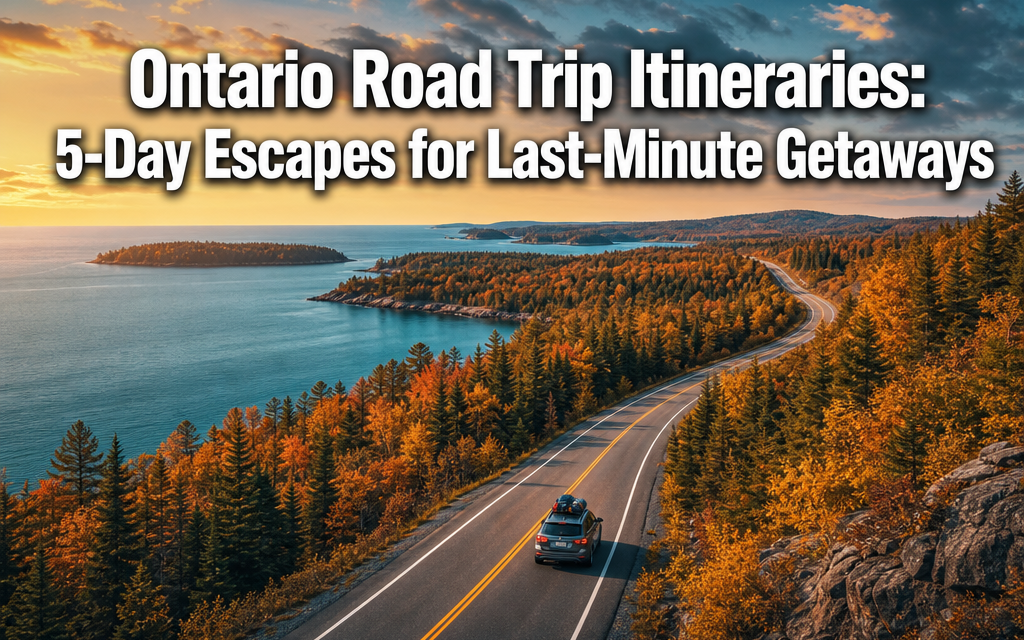
Ontario Road Trip Itineraries: 5-Day Escapes for Last-Minute Getaways
Last updated: May 24, 2026
Quick Answer: Ontario is one of Canada’s most road-trip-friendly provinces, offering five-day routes that cover everything from Great Lakes shorelines to ancient Canadian Shield wilderness — all without booking a flight. Whether the plan comes together a week out or the night before, these Ontario road trip itineraries for 5-day escapes give spontaneous travellers a clear, practical framework to hit the road fast.
Key Takeaways
- Five days is enough time to complete a full loop from Toronto through Georgian Bay, Algonquin Park, or Niagara and Prince Edward County.
- Last-minute Ontario road trips work best in summer (July–August) and early fall (September–October), when weather is predictable and most attractions are open.
- A standard two-wheel-drive sedan handles the vast majority of Ontario road trip routes; 4WD is only needed for backcountry trails.
- Budget travellers can estimate roughly $150–$250 CAD per person per day (fuel, food, camping or budget lodging) — though costs vary widely based on choices.
- Free and low-cost camping exists across Ontario’s provincial parks via the Ontario Parks reservation system, with some first-come, first-served sites available.
- Families with kids are well served by routes through Algonquin Park, Muskoka, and the Niagara region, all of which have structured, kid-friendly activities.
- The most common mistake first-time Ontario road trippers make is underestimating driving distances between northern destinations.
- Packing layers is non-negotiable — Ontario weather can shift dramatically within a single day, especially near Georgian Bay.
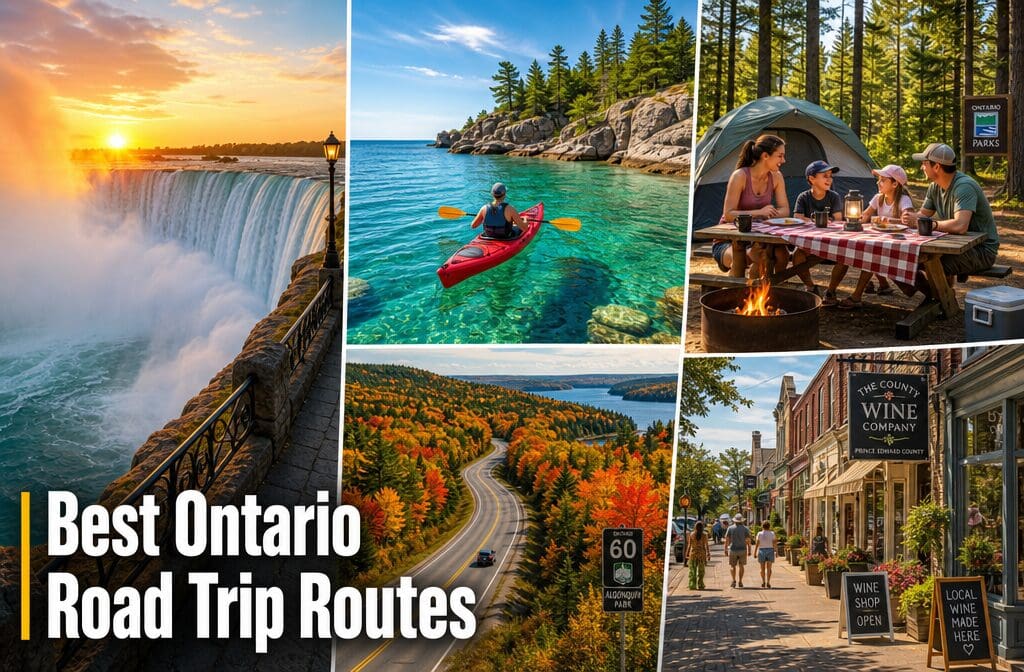
What Are the Best Road Trip Routes in Ontario for a 5-Day Trip?
Ontario’s geography makes it ideal for loop-style itineraries that return to the starting point without backtracking. The three strongest five-day routes for Ontario road trip itineraries are the Georgian Bay Loop, the Niagara-to-Prince Edward County Wine Route, and the Algonquin Wilderness Circuit.
Route 1: The Georgian Bay Loop (approx. 900 km)
Starting from Toronto, this loop heads north on Highway 400 to Barrie, then west to Collingwood and the Southern Georgian Bay region, east along the bay to Parry Sound, and back south through Muskoka. Day-by-day highlights include:
- Day 1: Toronto → Collingwood (Blue Mountain village, Scenic Caves)
- Day 2: Collingwood → Midland (Sainte-Marie among the Hurons, Georgian Bay Islands)
- Day 3: Midland → Parry Sound (30,000 Islands cruise, kayaking)
- Day 4: Parry Sound → Huntsville/Muskoka (lake swimming, small-town dining)
- Day 5: Huntsville → Toronto via Hwy 11 (Gravenhurst, optional Orillia stop)
Route 2: Niagara to Prince Edward County (approx. 700 km)
This southern route suits wine lovers and history buffs. Drive from Toronto to Niagara Falls, explore Niagara-on-the-Lake, cross to Hamilton for the waterfall trails, then head east along Lake Ontario to Prince Edward County’s wineries and Sandbanks Provincial Park.
Route 3: Algonquin Wilderness Circuit (approx. 800 km)
Head northeast from Toronto through Barrie to Huntsville, enter Algonquin Park via the West Gate on Highway 60, camp or stay in lodges, exit via the East Gate toward Ottawa, then return via Hwy 7 through Peterborough and the Kawarthas.
💡 Choose the Georgian Bay Loop if you want a mix of outdoor adventure and small-town charm. Choose the Algonquin Circuit if wildlife, canoeing, and forest immersion are the priority.
How Much Does a Typical Ontario Road Trip Cost?
A five-day Ontario road trip costs roughly $750–$1,250 CAD per person for a budget-conscious trip, or $1,500–$2,500+ CAD per person for mid-range comfort. These are estimates based on typical 2026 pricing for fuel, accommodation, food, and park fees — actual costs depend heavily on group size and choices.
Expense CategoryBudget OptionMid-Range OptionFuel (per vehicle)$150–$200$150–$200Accommodation (per person/night)$30–$60 (camping)$100–$180 (inn/motel)Food (per person/day)$30–$50 (grocery/cook)$60–$100 (restaurants)Park fees & activities$50–$100 total$150–$300 total5-Day Total (per person)~$750–$1,100~$1,500–$2,200
Splitting fuel and accommodation costs across two or more travellers cuts per-person spending significantly. Ontario Parks camping fees (as of 2026) range from roughly $42–$55 CAD per night for a serviced site, with some backcountry permits available at lower rates.
Which Ontario Destinations Are Good for Last-Minute Summer Travel?
Georgian Bay, Algonquin Park, and Prince Edward County are the top picks for last-minute Ontario summer travel because they offer walk-in or first-come, first-served access at many sites, and their main attractions don’t require advance booking. Niagara Falls is always accessible but gets crowded, so it works better as a one-night stop than a multi-day base.
For spontaneous trips, prioritize:
- Sandbanks Provincial Park (Prince Edward County) — first-come, first-served walk-in tent sites available most weekdays
- Killarney Provincial Park — stunning La Cloche Mountains; some sites bookable same-week
- Wasaga Beach — no reservation needed for day use; nearby campgrounds often have openings mid-week
Check the Georgian Bay News homepage for current regional travel conditions and local event listings before departure.
What Should I Pack for a Road Trip in Ontario?
Pack for variable weather, outdoor activity, and self-sufficiency on the road. Ontario’s climate swings from hot and humid in July to cool and rainy in September, especially near large bodies of water.
Essential packing list:
- Layers: a light fleece and a waterproof shell for every person
- Insect repellent (blackflies and mosquitoes are heavy May–July)
- Reusable water bottles and a small cooler for groceries
- Paper maps or downloaded offline maps (cell service drops in northern Ontario)
- First aid kit, sunscreen, and a headlamp for camping nights
- Ontario Parks pass or cash for park entry fees
- Portable phone charger
Avoid overpacking clothing — most Ontario road trip towns have laundromats. Focus on gear over fashion.
Are 5-Day Road Trips in Ontario Good for Families with Kids?
Yes, five-day Ontario road trips are well suited for families with children, provided the route is chosen carefully. The Georgian Bay Loop and the Niagara-to-PEC route both offer short driving legs (under three hours per day), structured attractions, and kid-friendly swimming spots.
Best family-friendly stops:
- Wasaga Beach — the world’s longest freshwater beach, shallow and safe for young swimmers
- Algonquin Park Visitor Centre — interactive wildlife exhibits, easy hiking trails
- Niagara Falls — the falls themselves, plus Clifton Hill for younger kids
- Discovery Harbour, Penetanguishene — living history site on Georgian Bay
Keep daily driving under 2.5 hours with kids in the vehicle. Build in unstructured beach or park time every afternoon.
What Are the Most Scenic Drives in Ontario?
Ontario’s most scenic drives include Highway 60 through Algonquin Park, the Bruce Peninsula’s Highway 6, and the Lake Superior Circle Route — though the latter is better suited to a 7–10 day trip. For a five-day itinerary, Highway 60 (Huntsville to Whitney) and the stretch of Highway 26 along Georgian Bay between Collingwood and Owen Sound deliver the most consistent scenery per kilometre.
Other standout scenic segments:
- Highway 35 through Haliburton Highlands — best in fall for colour
- County Road 33 (Loyalist Parkway) — follows Lake Ontario’s north shore through Prince Edward County
- Highway 17 west of Sudbury — Canadian Shield lakes and boreal forest
The conservation areas along Georgian Bay also offer short scenic detours worth adding to any northern Ontario itinerary.
How Do I Plan a Budget-Friendly Ontario Road Trip?
A budget Ontario road trip is achievable by combining provincial park camping, grocery store meals, and free natural attractions. The biggest cost lever is accommodation — switching from motels to tent camping cuts nightly costs by 60–70%.
Budget planning steps:
- Book Ontario Parks campsites as early as possible (reservations open 5 months in advance at OntarioParks.com).
- Plan a grocery run on Day 1 for breakfasts and lunches — eat out only for dinners.
- Use free provincial park day-use areas for swimming and hiking instead of paid attractions.
- Travel mid-week when campsite availability is higher and some attractions offer lower rates.
- Carpool — a group of four sharing one vehicle cuts per-person fuel costs to roughly $40–$60 for a five-day loop.
For cycling-friendly detours in towns like Collingwood or Prince Edward County, renting bikes for a half-day is often cheaper than paying for guided tours.
What Are Common Mistakes First-Time Ontario Road Trippers Make?
The single biggest mistake is underestimating driving times in northern Ontario. Google Maps distances look manageable, but two-lane highways, speed limits of 80–90 km/h, and construction zones in summer can add 30–60 minutes to any leg north of Barrie.
Other frequent mistakes:
- Not downloading offline maps — cell service disappears in Algonquin, Killarney, and along Highway 17
- Skipping insect repellent — blackfly season (May–June) is genuinely brutal in northern Ontario
- Booking non-refundable accommodation — weather and road conditions can change plans fast; choose flexible bookings
- Ignoring fuel levels — gas stations are sparse between towns in the north; fill up whenever the tank drops below half
- Arriving at provincial parks without a reservation in peak season — many campgrounds are fully booked weeks in advance in July and August
Which Areas of Ontario Are Best for Outdoor Adventures?
Georgian Bay, Algonquin Park, and Killarney Provincial Park are Ontario’s top outdoor adventure zones for a five-day road trip. Each offers canoeing, hiking, and wildlife viewing within a reasonable drive from Toronto or Ottawa.
- Georgian Bay: kayaking among the 30,000 Islands, rock climbing at Lion’s Head, sailing charters out of Parry Sound. The Southern Georgian Bay OPP detachment area covers a region rich in accessible water trails.
- Algonquin Park: canoe tripping (portage routes from one day to two weeks), moose spotting along Highway 60, backcountry hiking on the Western Uplands Trail
- Killarney: white quartzite ridges, turquoise lakes, and some of Ontario’s most challenging backcountry routes
Choose Georgian Bay if the group is mixed-ability. Choose Algonquin or Killarney for experienced paddlers and hikers who want genuine wilderness.
What Kind of Vehicle Do I Need for an Ontario Road Trip?
A standard two-wheel-drive sedan or hatchback handles all paved Ontario road trip routes comfortably. Four-wheel drive or all-wheel drive is only necessary if the plan includes unpaved forest roads, backcountry access routes, or winter travel.
- Sedan/hatchback: fine for all three main five-day routes
- SUV or crossover: useful for carrying camping gear and easier on rough gravel shoulders
- Truck or 4WD: needed only for remote forest access roads (e.g., reaching backcountry canoe put-ins in Algonquin)
If travelling in an EV, note that fast-charging infrastructure thins out significantly north of Barrie and east of Peterborough as of 2026. Plan charging stops carefully and carry the vehicle’s full charging cable kit. EV technology coverage in the Georgian Bay region is expanding but not yet comprehensive on all routes.
Are There Free Camping Spots Along Ontario Road Trip Routes?
Yes, free camping exists in Ontario, but it requires knowing where to look. Crown Land camping is legal and free across much of northern Ontario, provided the site is at least 30 metres from water and not within a provincial park boundary. The Ontario government’s Crown Land Use Policy Atlas (available online) maps eligible areas.
Free or very low-cost options:
- Crown Land along the Algonquin Highlands and north of Parry Sound — no fees, no reservations
- Backcountry permits in provincial parks — lower cost than front-country sites (roughly $12–$18 CAD per person per night in 2026, estimated)
- Some conservation authority areas — a few offer free day-use camping; check local conservation authority websites
Note: Crown Land camping requires self-sufficiency. There are no facilities, fire rings, or water. Carry a water filter and leave-no-trace gear.
What Time of Year Is Best for Road Tripping in Ontario?
Late June through early October is the best window for Ontario road trips. July and August offer the warmest weather and the most open attractions, while September and early October bring cooler temperatures, fewer crowds, and exceptional fall foliage — particularly along Highway 60 and through the Haliburton Highlands.
SeasonProsConsLate JuneLong daylight, warmBlackflies still presentJuly–AugustPeak conditions, all attractions openCrowded, campsite bookings fill fastSeptemberCooler, less crowded, fall colour beginsSome seasonal businesses close after Labour DayOctoberPeak fall colour, very few crowdsNights cold, some parks reduce servicesMayQuiet, affordableBlackflies, unpredictable weather
Avoid planning a five-day Ontario road trip in November through April unless the route is specifically designed around winter activities like snowmobiling or skiing in the Southern Georgian Bay ski area.
How Safe Are Rural Roads in Ontario for Road Trips?
Ontario’s rural highways are generally well maintained and safe for road trips. Highways 400, 11, 7, 60, and 17 are paved, regularly patrolled, and clearly signed. The main rural road hazards are wildlife crossings (especially moose and deer at dawn and dusk), unexpected frost in spring and fall, and reduced visibility in snow squall corridors near Georgian Bay.
Safety tips for rural Ontario driving:
- Drive at or below the posted speed limit on two-lane highways — passing zones are limited
- Scan road edges actively between dusk and 10 p.m. for deer and moose
- Check road conditions via Ontario 511 before heading north in spring or fall
- Carry a basic emergency kit: jumper cables, a blanket, water, and a flashlight
- Tell someone your route and expected check-in times if heading into remote areas
Rural Ontario roads are not inherently dangerous, but they demand more active attention than urban highways.
Conclusion: Plan Less, Drive More
Ontario road trip itineraries for 5-day escapes work precisely because the province packs so much variety into a driveable radius. Georgian Bay, Algonquin, Niagara, and Prince Edward County each deliver a genuinely different experience — and none of them require a plane ticket or months of planning.
Actionable next steps:
- Pick one of the three routes above that matches the group’s interests and fitness level.
- Check Ontario Parks (OntarioParks.com) for same-week campsite availability — mid-week openings are common even in July.
- Download offline maps for the route before leaving cell range.
- Pack layers, insect repellent, and a cooler — these three items solve 80% of common road trip discomforts.
- Set a loose daily driving limit of 2–3 hours and leave the rest of each day unscheduled.
The best Ontario road trip is the one that actually happens. Book the first night, point the car north, and adjust from there.
Frequently Asked Questions
Q: Can I do an Ontario road trip without camping?
Yes. All three main five-day routes pass through towns with motels, inns, and vacation rentals. Collingwood, Huntsville, Parry Sound, Picton, and Niagara-on-the-Lake all have solid non-camping accommodation options at various price points.
Q: How far in advance do I need to book Ontario Parks campsites?
Ontario Parks reservations open five months in advance for most sites. For last-minute trips, check the system daily for cancellations, or target first-come, first-served sites at smaller parks. Mid-week arrivals have the best walk-in odds.
Q: Is it safe to drive Highway 60 through Algonquin Park at night?
It’s legal but not recommended. Moose and deer crossings are frequent after dark on Highway 60, and a collision with a moose is extremely dangerous. Plan to be parked at your campsite before sunset.
Q: Do I need an Ontario Parks pass for every provincial park?
Each vehicle needs a day-use permit when entering a provincial park without a camping reservation. In 2026, day-use fees are approximately $20–$22 CAD per vehicle. An Ontario Parks annual pass (estimated $150–$170 CAD per vehicle) pays for itself after eight or more visits.
Q: What’s the best route for first-time Ontario road trippers?
The Georgian Bay Loop is the most beginner-friendly. It has short daily driving legs, excellent cell coverage for most of the route, a mix of towns and nature, and easy access to services throughout.
Q: Can I road trip Ontario in an electric vehicle?
Yes, but route planning around charging is essential. The Toronto–Barrie–Collingwood–Parry Sound corridor has reasonable EV charging infrastructure. Algonquin Park and more remote northern routes have significant gaps. Use PlugShare to map chargers before departure.
Q: What wildlife might I see on an Ontario road trip?
Common sightings include white-tailed deer, black bears, moose (especially in Algonquin), loons, bald eagles, and various waterfowl. Moose are most active at dawn and dusk near wetlands along Highway 60 and Highway 11.
Q: Is the Niagara-to-PEC route good for wine lovers?
It’s one of the best wine road trips in Canada. Niagara-on-the-Lake and Prince Edward County together have over 60 licensed wineries. Most offer tastings without advance booking on weekdays; weekend visits benefit from a reservation at popular estates.
Content, illustrations, and third-party video appearing on GEORGIANBAYNEWS.COM may be generated or curated with AI assistance or reproduced pursuant to the fair dealing provisions of the Copyright Act, R.S.C. 1985, c. C-42. Attribution and hyperlinks to original sources are provided in acknowledgment of applicable intellectual property rights. Such referencing is intended to direct traffic to and support the original rights holders’ platforms.