






















A Single Vaccine could protect against all coughs, colds and flus, researchers say…


Last updated: February 20, 2026
Researchers say a single vaccine could protect against all coughs, colds and flus — and the science behind that claim is advancing faster than most people realize. In February 2026, Stanford University scientists unveiled a nasal spray approach that left immune cells in the lungs on permanent standby against virtually any respiratory threat. Meanwhile, biotech company Centivax launched the first human clinical trial of a universal flu vaccine just days earlier. The era of the annual flu shot may be closer to its end than most people think.

💉 “What if one shot — or one sniff — could shield you from every winter illness at once?” That question, once confined to science fiction, is now being asked in some of the world’s most serious research laboratories.
🔑 Key Takeaways
- Stanford researchers developed a nasal spray vaccine that puts lung immune cells on “amber alert,” potentially protecting against all respiratory infections — not just one strain.
- The Stanford approach showed a 100-to-1,000-fold reduction in viruses penetrating the lungs in animal trials, with protection lasting roughly three months.
- Centivax launched a Phase 1 human clinical trial of its universal flu vaccine (Centi-Flu 01) in February 2026, backed by over $26 million from the Gates Foundation, NIH, and CEPI.
- The WHO reports 46 next-generation influenza vaccines currently in clinical development using diverse technology platforms.
- Human trials for the Stanford nasal spray have not yet begun — but experts are calling the research “really exciting” and a potential “major step forward.”
⚡ Quick Answer

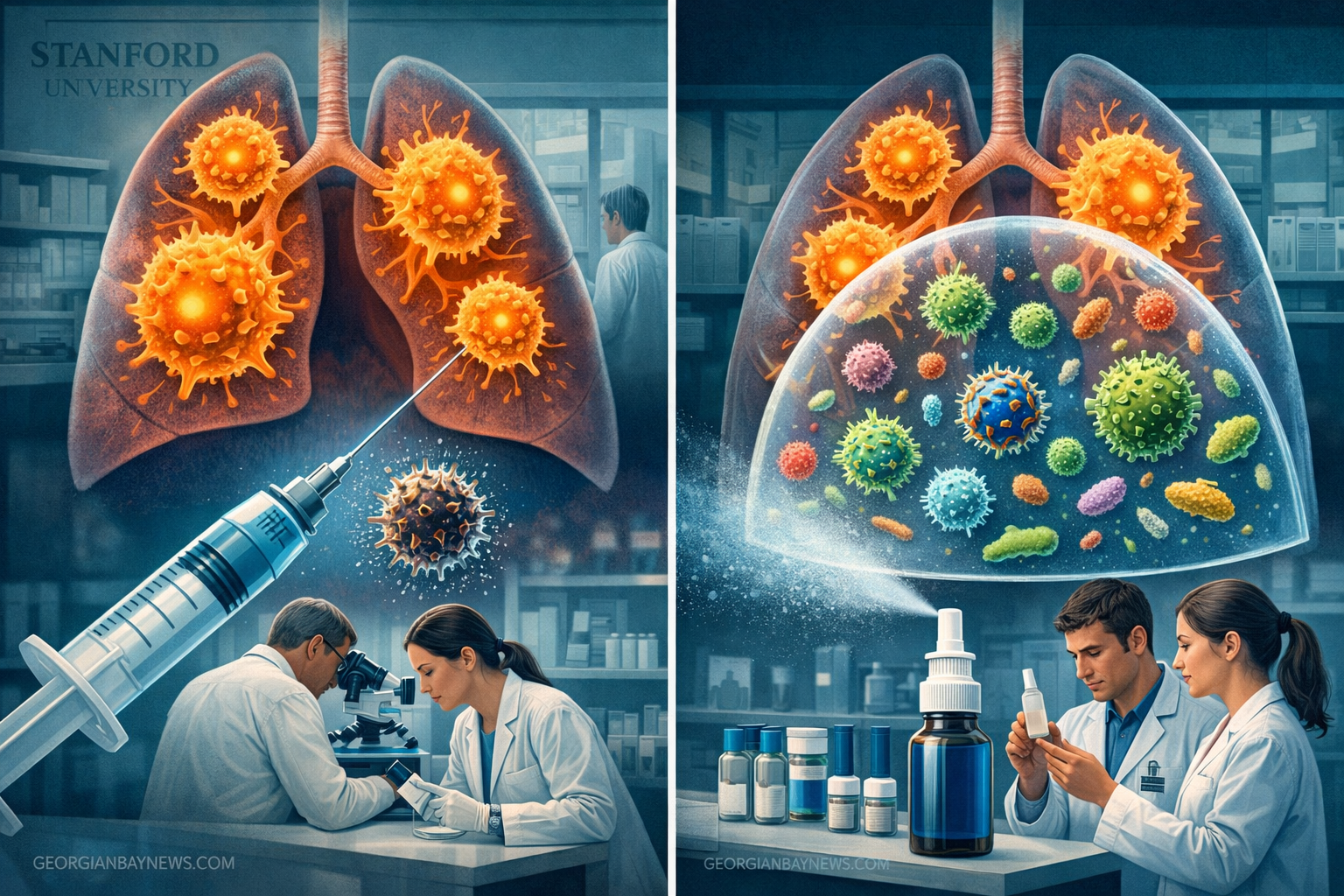
A single vaccine that protects against all coughs, colds, and flus is not yet available to the public, but multiple research teams are making rapid progress toward that goal in 2026. Stanford’s nasal spray vaccine uses a novel mechanism that trains lung immune cells to fight any respiratory pathogen — not just a specific one. Separately, Centivax has already begun human trials of a universal flu vaccine. Both approaches represent a significant departure from how vaccines have worked for over 200 years.
What Is the Stanford Nasal Spray Vaccine and How Does It Work?
Stanford University researchers developed a nasal spray vaccine designed to protect against a wide range of respiratory illnesses — including coughs, colds, flu, and bacterial lung infections — by changing how the immune system is activated, rather than what it targets.
Traditional vaccines work by introducing the immune system to a specific pathogen (or a piece of one), so it can recognize and fight that exact threat later. Stanford’s approach is fundamentally different. Instead of targeting a specific virus or bacteria, it mimics how immune cells communicate with each other, leaving white blood cells called macrophages in the lungs in a state of heightened readiness. Think of it as switching the immune system from “off” to “amber alert” — ready to respond to any respiratory invader, not just one it has been introduced to before.
Key features of the Stanford approach:
| Feature | Detail |
|---|---|
| Delivery method | Nasal spray |
| Mechanism | Mimics immune cell communication signals |
| Target cells | Macrophages (white blood cells) in the lungs |
| Pathogens covered | Viruses (flu, colds) + bacteria (S. aureus, A. baumannii) |
| Protection duration | Approximately 3 months (animal trials) |
| Efficacy | 100-to-1,000-fold reduction in lung virus penetration |
| Current stage | Animal testing only; human trials not yet started |
This is described as a “radical departure” from more than 200 years of vaccine design tradition — and for good reason. Every major vaccine developed since Edward Jenner’s smallpox work in the late 1700s has been built around teaching the immune system to recognize a specific threat. Stanford’s method skips that step entirely.
🧬 Why it matters: Bacterial species like Staphylococcus aureus and Acinetobacter baumannii — both confirmed in Stanford’s animal testing — are among the most dangerous hospital-acquired infections in the world. A vaccine that covers these alongside common cold viruses would be genuinely historic.
Common mistake to avoid: Don’t confuse “broad protection” with “complete protection.” The Stanford vaccine is not a cure-all. It primes the immune system to respond faster and more aggressively — it doesn’t guarantee zero infection. Duration of protection (currently three months in animals) will also need to be extended before a human product becomes viable.
Why Researchers Say a Single Vaccine Could Protect Against All Coughs, Colds and Flus
The core reason researchers believe a single vaccine could protect against all coughs, colds, and flus comes down to a shift in strategy: instead of chasing individual pathogens, new approaches target either conserved biological features shared across many pathogens or the immune system’s own response mechanisms.
For decades, the flu vaccine has been a moving target. Every year, health authorities try to predict which flu strains will dominate the season and reformulate the vaccine accordingly. Some years, they get it right. Many years, they don’t — and millions of people get sick anyway. The same problem applies to the common cold, which is caused by over 200 different viruses, making a traditional targeted vaccine essentially impossible.
The new wave of research solves this differently:
- Stanford’s approach bypasses pathogen-specific targeting entirely, activating a generalized immune defense in the lungs.
- Centivax’s Centi-Flu 01 targets conserved (unmutable) regions of the flu virus — parts of the virus that don’t change between strains, making it harder for the virus to “escape” the vaccine through mutation.
- The Peter Doherty Institute identified 27 viral fragments that the immune system consistently recognizes in influenza B viruses, increasing from 18 previously identified targets and offering new pathways for T cell-based influenza B vaccines.
The WHO’s updated December 2025 Preferred Product Characteristics now guide a broad pipeline of next-generation influenza vaccines, with the goal of saving millions of lives globally.
For a deeper look at how AI is accelerating medical diagnostics and research like this, see AI in medical diagnostics.
What Is Centivax’s Universal Flu Vaccine and Where Are Human Trials Now?
Centivax initiated the first human clinical trial of Centi-Flu 01, a pan-influenza universal flu vaccine candidate, in healthy adults aged 18–64 and those 65 and older in February 2026. This is a significant milestone — it means a universal flu vaccine is no longer just a laboratory concept. It’s being tested in real people right now.
Unlike annual seasonal vaccines, Centi-Flu 01 targets conserved (unmutable) regions shared across flu strains and subtypes, aiming to generate broad, durable immunity against seasonal and pandemic influenza.
What the trial looks like:
- The Phase 1A trial will evaluate efficacy using the hemagglutination inhibition (HAI) assay against more than 20 flu strains, comparing directly with existing standard-of-care vaccines, with results from 180 subjects expected within the year.
- Centivax received over $26 million in non-dilutive financing from the Bill & Melinda Gates Foundation, Coalition for Epidemic Preparedness (CEPI), National Institutes of Health (NIH), USDA, and Military Infectious Diseases Research Program.
Choose this approach if… you’re a policy-maker or public health official tracking universal vaccine readiness: Centi-Flu 01 is the most advanced candidate currently in human testing, with results expected before the end of 2026.
For more on how AI-designed molecules are accelerating drug and vaccine development, visit AI-designed molecules.
How Does This Compare to Existing Flu Vaccines and What Makes It Different?
Current flu vaccines are reformulated every year because influenza viruses mutate rapidly. The WHO and health agencies must predict, months in advance, which strains will circulate — and when predictions miss the mark, vaccine effectiveness drops sharply. Moderna’s mRNA-1010 vaccine candidate completed Phase 3 efficacy studies with preliminary results reported January 5, 2026, prompting the company to file for marketing authorization in the US, European, Canadian, and Australian regulatory agencies.
Here’s a side-by-side comparison of the main approaches:
| Vaccine Type | Target | Annual Update Needed? | Stage (2026) |
|---|---|---|---|
| Traditional seasonal flu shot | Predicted strains | ✅ Yes | Available now |
| Centivax Centi-Flu 01 | Conserved flu regions | ❌ No | Phase 1 human trial |
| Moderna mRNA-1010 | Broad flu strains via mRNA | Possibly reduced | Filing for authorization |
| Stanford nasal spray | Immune system activation (any pathogen) | ❌ No | Animal testing |
| Doherty T-cell vaccine | 27 influenza B fragments | ❌ No | Pre-clinical/early research |
The key difference is durability and breadth. A universal vaccine, if it works, could protect for years rather than months — and against strains that haven’t even emerged yet. That’s especially important for pandemic preparedness.
📌 Pull quote: “The goal isn’t just a better flu shot — it’s a vaccine that works before we even know what’s coming.”
What Did Researchers Find in Animal Trials of the Stanford Vaccine?
Animal trial results for the Stanford nasal spray vaccine are striking. The vaccine produced a 100-to-1,000-fold reduction in the amount of virus able to penetrate the lungs — a range that, if replicated in humans, would represent near-complete protection against respiratory infection.
Protection lasted approximately three months in the animal experiments, which is both promising and a limitation. Three months of coverage would require multiple doses per year in humans, similar to how some seasonal vaccines work now. Researchers will need to either extend that duration or design a dosing schedule that maintains coverage year-round.
Bacterial protection was also confirmed against two particularly dangerous species:
- 🦠 Staphylococcus aureus — a leading cause of skin infections, pneumonia, and sepsis, including the antibiotic-resistant MRSA strain.
- 🦠 Acinetobacter baumannii — a hospital-acquired pathogen increasingly resistant to antibiotics and listed by the WHO as a critical-priority organism.
Edge case to consider: The jump from animal models to human trials is where many promising vaccines have stumbled. The immune systems of mice and other lab animals respond differently than human immune systems, and what works in controlled animal settings doesn’t always translate. This is why the Stanford team’s next step — human trials — will be the true test.
For context on how environmental and health policy intersect with public health research, see this piece on why protectors are prosecuted and polluters praised.
Who Would Benefit Most From a Universal Respiratory Vaccine?
A single vaccine protecting against all coughs, colds, and flus would benefit nearly everyone — but some groups stand to gain far more than others.
Highest-priority beneficiaries:
- 👴 Older adults (65+): Flu and pneumonia are leading causes of hospitalization and death in this group. A universal vaccine that also covers bacterial infections could be lifesaving.
- 👶 Young children: Kids are both highly susceptible to respiratory illness and major vectors of transmission within households and schools.
- 🏥 Immunocompromised individuals: People undergoing chemotherapy, organ transplant recipients, or those with HIV face severe risk from infections that healthy adults shake off easily.
- 🩺 Healthcare workers: Constant exposure to respiratory pathogens makes a broad-spectrum vaccine especially valuable for frontline medical staff.
- 🌍 Low-income countries: Annual flu vaccine reformulation and distribution is expensive and logistically complex. A single, durable vaccine could dramatically improve global access.
Who may not be the primary focus yet:
- Healthy adults aged 18–45 with no underlying conditions — while they’d benefit, the immediate research priority is high-risk populations.
- People with specific allergies to vaccine components (always consult a healthcare provider).
For more on health, wellness, and the science of keeping your body strong, see The Fasting Expert: The Truth About Ozempic and Ally Vitally’s comprehensive guide to intermittent fasting.
What Are the Biggest Obstacles Before a Universal Vaccine Reaches the Public?
The science is exciting, but there are real hurdles between today’s research and a universal vaccine on pharmacy shelves.
1. Human clinical trials take time
Even with the most optimistic timelines, a vaccine moving from animal testing (Stanford) to Phase 1 human trials, then Phase 2, then Phase 3, and finally regulatory approval typically takes 5 to 15 years. Centivax’s trial, which is already in Phase 1, is the furthest along — but results are still expected only by end of 2026.
2. Safety must be proven at scale
Priming the immune system to be on “amber alert” constantly raises legitimate questions: Could it cause chronic inflammation? Could it trigger autoimmune responses? These questions can only be answered through careful, large-scale human trials.
3. Duration of protection needs extending
Three months of protection (Stanford’s animal data) is not enough for a practical public health tool. Researchers will need to find ways to extend that window significantly.
4. Manufacturing and distribution
A nasal spray vaccine that requires cold-chain logistics and precise dosing presents different manufacturing challenges than a standard injectable. Global distribution — especially to low-income countries — adds another layer of complexity.
5. Regulatory approval
Agencies like the FDA, EMA, and Health Canada will require extensive safety and efficacy data before approving any novel vaccine mechanism, particularly one as unprecedented as the Stanford approach.
⚠️ Common mistake: Assuming that “promising animal results” means a vaccine is “almost ready.” The history of medicine is full of treatments that worked beautifully in animals and failed in humans. Cautious optimism is warranted — not premature celebration.
For related reading on how emerging technologies face scrutiny and public debate, see The Hidden Cost of Innovation: How Generative AI Is Straining Our Power Grids.
Interactive Tool: Are You a High-Priority Candidate for a Universal Vaccine?
What Is the WHO Saying About Next-Generation Flu Vaccines in 2026?
The WHO reports 46 next-generation influenza vaccines currently in clinical development using diverse technology platforms, guided by the organization’s December 2025 updated Preferred Product Characteristics for next-generation flu vaccines.
The WHO’s involvement signals that this is not fringe science.
Much Appreciate You Sharing This Post - It Helps MUCH!!!