




















The Controversy Over the Gordie Howe Bridge: Politics, Trade, and a $5 Billion Standoff | VIDEOS

Last updated: January 16, 2026
The nearly complete Gordie Howe bridge connecting Detroit and Windsor sits ready to transform North American trade—but political tensions have turned this engineering marvel into a diplomatic flashpoint. After nearly a decade of construction and $5 billion in investment, the bridge remains closed as President Donald Trump demands compensation from Canada, citing alleged violations of American steel requirements and broader trade grievances[1][2].

Key Takeaways
- The Gordie Howe bridge is 95% complete but remains unopened due to President Trump’s February 2026 ultimatum demanding compensation from Canada before allowing the crossing to operate[1][2]
- Trump claims the project violated the Buy American Act by exclusively using Canadian steel, though Prime Minister Mark Carney confirms steel from both countries was used during construction[1][2]
- Michigan and Canada hold 50/50 joint ownership of the $5 billion project, with Canada covering Michigan’s construction costs through a non-recourse loan to be repaid via future toll revenues[1][3]
- The private Ambassador Bridge owners (Moroun family) have opposed the public bridge since its inception and allegedly provided misinformation to the Trump administration[3]
- Democratic U.S. Representatives from Michigan have introduced legislation to prevent presidential interference with the bridge opening
Quick Answer
The Gordie Howe bridge controversy centers on President Trump’s refusal to allow the nearly completed international crossing to open until Canada compensates the United States for what he describes as unfair treatment and alleged violations of American steel requirements. The dispute has created a political standoff over a project that took nearly a decade to build, cost $5 billion, and represents critical infrastructure for North American trade. Michigan officials and Canadian leaders have refuted Trump’s claims about steel sourcing and emphasized the bridge’s joint ownership structure.
What Is the Gordie Howe Bridge and Why Does It Matter?
The Gordie Howe bridge is a 1.5-mile cable-stayed bridge spanning the Detroit River between Detroit, Michigan, and Windsor, Ontario. Upon opening, it will become the longest bridge of its type in North America and the 10th longest globally[1].
This infrastructure project matters because it addresses decades of trade bottlenecks at the U.S.-Canada border. The existing Ambassador Bridge—a privately owned crossing—has created chronic congestion that costs businesses and consumers money every single day through delayed shipments and increased transportation expenses[3].
Key features of the bridge include:
- Six lanes for vehicle traffic (three in each direction)
- Dedicated lanes for commercial trucks separate from passenger vehicles
- Modern port of entry facilities on both sides with advanced inspection technology
- Pedestrian and bicycle paths for non-motorized crossing
- Joint ownership between Michigan and the Windsor-Detroit Bridge Authority (Canada)
The bridge honors hockey legend Gordie Howe, who played for the Detroit Red Wings and embodied the strong cultural and economic ties between the two nations.
What Sparked the 2026 Gordie Howe Bridge Controversy?
In February 2026, President Trump issued an ultimatum via Truth Social declaring he would not allow the Gordie Howe bridge to open “until the United States is fully compensated for everything we have given them, and also, importantly, Canada treats the United States with the Fairness and Respect that we deserve”[1][2].
This statement came amid broader trade tensions between the United States and Canada, including:
- U.S. tariffs on Canadian steel and aluminum
- Canadian retaliatory tariffs on American goods
- Ongoing USMCA trade negotiations and disputes
- Political pressure from various interest groups
Trump specifically claimed the bridge project violated the Buy American Act of 1933 by exclusively using Canadian steel in construction[1]. This accusation became the technical justification for blocking the bridge opening, though Canadian officials quickly disputed the claim’s accuracy.
Common mistake to avoid: Assuming the controversy is solely about steel sourcing. The dispute reflects deeper trade tensions and domestic political considerations on both sides of the border.
Former Michigan Governor Rick Snyder attributed Trump’s position to misinformation, suggesting that administration advisers received inaccurate information from the Ambassador Bridge owners, who have historically opposed the competing public bridge and would financially benefit from continued delays[3].
Who Owns the Gordie Howe Bridge and Who Paid for It?
The Gordie Howe bridge operates under a unique 50/50 joint ownership structure between the State of Michigan and the Canadian government (through the Windsor-Detroit Bridge Authority)[1][3].
Here’s how the financing works:
| Aspect | Details |
|---|---|
| Total Cost | Approximately $5 billion USD |
| Michigan’s Share | 50% ownership, zero upfront cost |
| Canada’s Contribution | Covered 100% of construction costs including Michigan’s portion |
| Repayment Structure | Non-recourse loan to be repaid through future toll revenues |
| Michigan’s Liability | None—if toll revenues fall short, Canada absorbs the loss |
| Operational Control | Shared equally between Michigan and Canada |
This arrangement means Michigan taxpayers bear no financial risk while gaining equal ownership and operational control of critical border infrastructure. Canada agreed to this structure to expedite the project and address trade flow issues affecting both nations.
Choose this ownership model if: You’re a state or province seeking major infrastructure without upfront capital costs, and your partner has strong incentive to complete the project for broader economic benefits.
Prime Minister Mark Carney emphasized this partnership structure when refuting Trump’s compensation demands, noting that Michigan already shares ownership and operation of the bridge with the Canadian government[1][2].
How Did the Moroun Family and Ambassador Bridge Factor Into This?
The Moroun family owns and operates the Ambassador Bridge, the private crossing that has held a monopoly on Detroit-Windsor vehicle traffic since 1929. They have actively opposed the Gordie Howe bridge project since its inception because a competing public bridge threatens their profitable monopoly[1][3].

The Moroun family’s opposition tactics have included:
- Supporting 2012 Michigan ballot measures designed to halt the Gordie Howe bridge construction (voters rejected these measures)
- Filing multiple lawsuits attempting to stop the project (courts dismissed these challenges)
- Pursuing damages claims for alleged losses during construction[1]
- Allegedly providing misinformation to Trump administration officials about steel sourcing and project details[3]
Former Governor Snyder stated bluntly that the Ambassador Bridge owners benefit financially from every day the Gordie Howe bridge remains closed, as their monopoly continues generating toll revenue without competition[3].
The congestion at the privately owned Ambassador Bridge creates real economic costs. Businesses face higher transportation expenses, goods arrive late, and prices increase for consumers on both sides of the border[3]. A second modern crossing would alleviate these bottlenecks and reduce the Moroun family’s market control.
Edge case: Private infrastructure owners opposing public alternatives is common globally, but few cases involve such direct political intervention at the presidential level to protect private monopoly interests.
What Is Michigan’s Congressional Response to Trump’s Ultimatum?
Several Democratic U.S. Representatives from Michigan have joined forces to introduce legislation that would prevent President Trump from blocking the Gordie Howe bridge opening. These lawmakers represent districts directly affected by border trade and economic activity.
The proposed bill aims to:
- Prohibit presidential interference with the bridge’s operational timeline
- Clarify Michigan’s ownership rights and operational authority
- Protect economic interests of Michigan businesses, workers, and communities
- Preserve international agreements between the United States and Canada
Representatives argue that the bridge represents critical infrastructure for Michigan’s economy, particularly for the automotive industry and manufacturing sector that depend on seamless cross-border supply chains.
Michiganers want this bridge, as Governor Snyder emphasized, because decades of congestion issues with the existing Ambassador Bridge monopoly have cost the state economically[3]. Local support for the project has remained strong throughout the construction period and has intensified since Trump’s ultimatum.
The legislation faces uncertain prospects in a divided Congress, but it demonstrates the political stakes for Michigan lawmakers whose constituents bear the economic costs of continued delays.
What Are the Economic Costs of Delaying the Gordie Howe Bridge Opening?
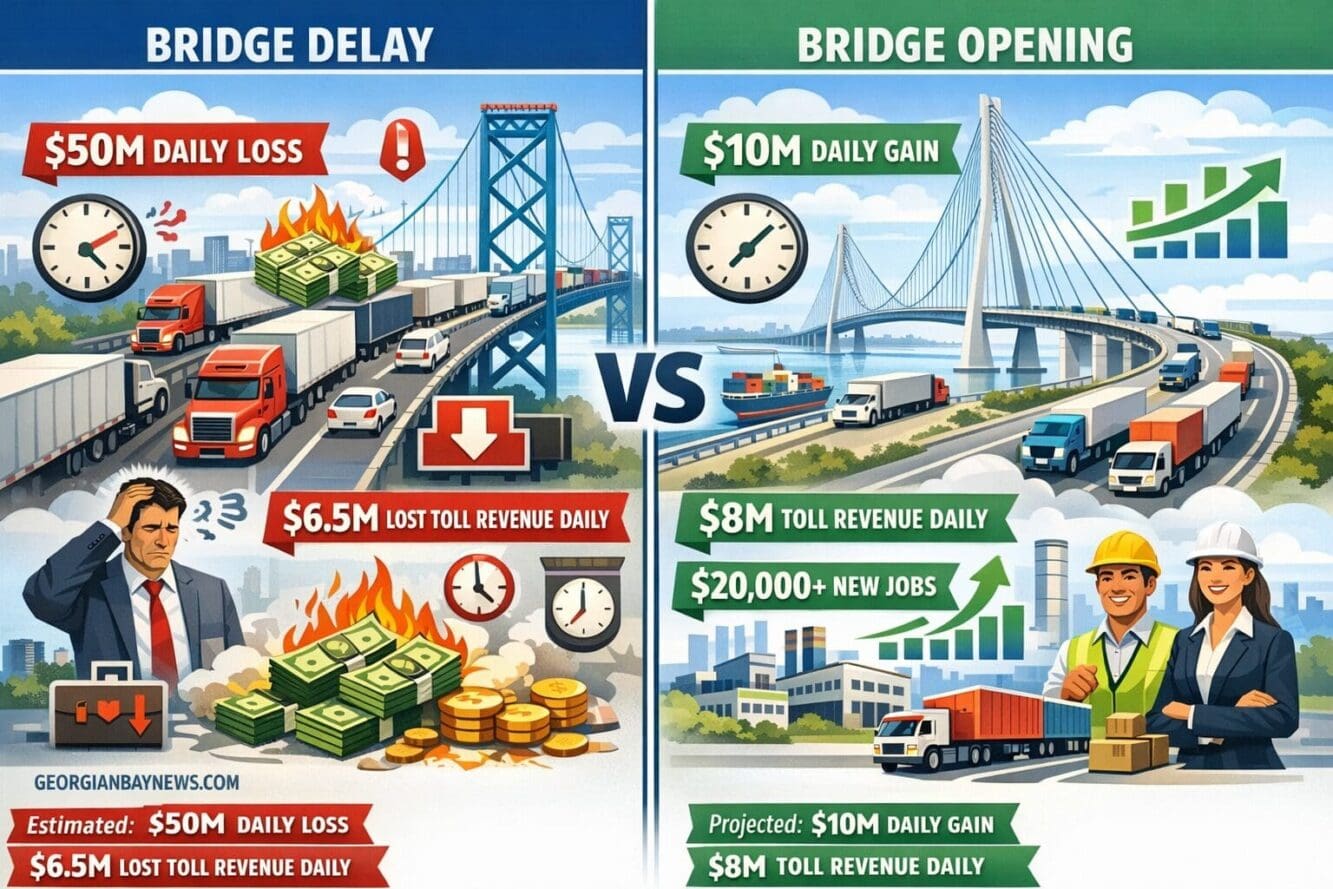
Every single day the Gordie Howe bridge remains closed costs the region economically through continued traffic bottlenecks and reduced goods flow[3]. These costs accumulate across multiple sectors and affect communities on both sides of the border.
Daily economic impacts include:
- Transportation delays for commercial trucks carrying time-sensitive goods
- Higher shipping costs passed along to businesses and consumers
- Lost productivity as goods sit in traffic queues instead of reaching factories
- Reduced competitiveness for North American manufacturers competing globally
- Foregone toll revenue that would repay construction costs and fund maintenance
- Delayed job creation in bridge operations, customs, and supporting services
The automotive industry faces particularly acute costs. Modern manufacturing relies on just-in-time delivery systems where parts arrive exactly when needed to minimize inventory costs. Border delays disrupt these systems, forcing companies to maintain larger (and more expensive) parts inventories or risk production shutdowns.
Small and medium-sized businesses suffer disproportionately because they lack the resources to absorb transportation cost increases or navigate congestion-related delays as effectively as large corporations.
For communities: The bridge was expected to create hundreds of permanent jobs in operations, customs, maintenance, and ancillary services. Each day of delay postpones these employment opportunities.
Former Governor Snyder noted that businesses face higher costs and prices due to the congestion created by reliance on a single crossing[3]. A second modern bridge would introduce competition, improve traffic flow, and reduce these structural economic inefficiencies.
What Is the Construction Status and Original Timeline?
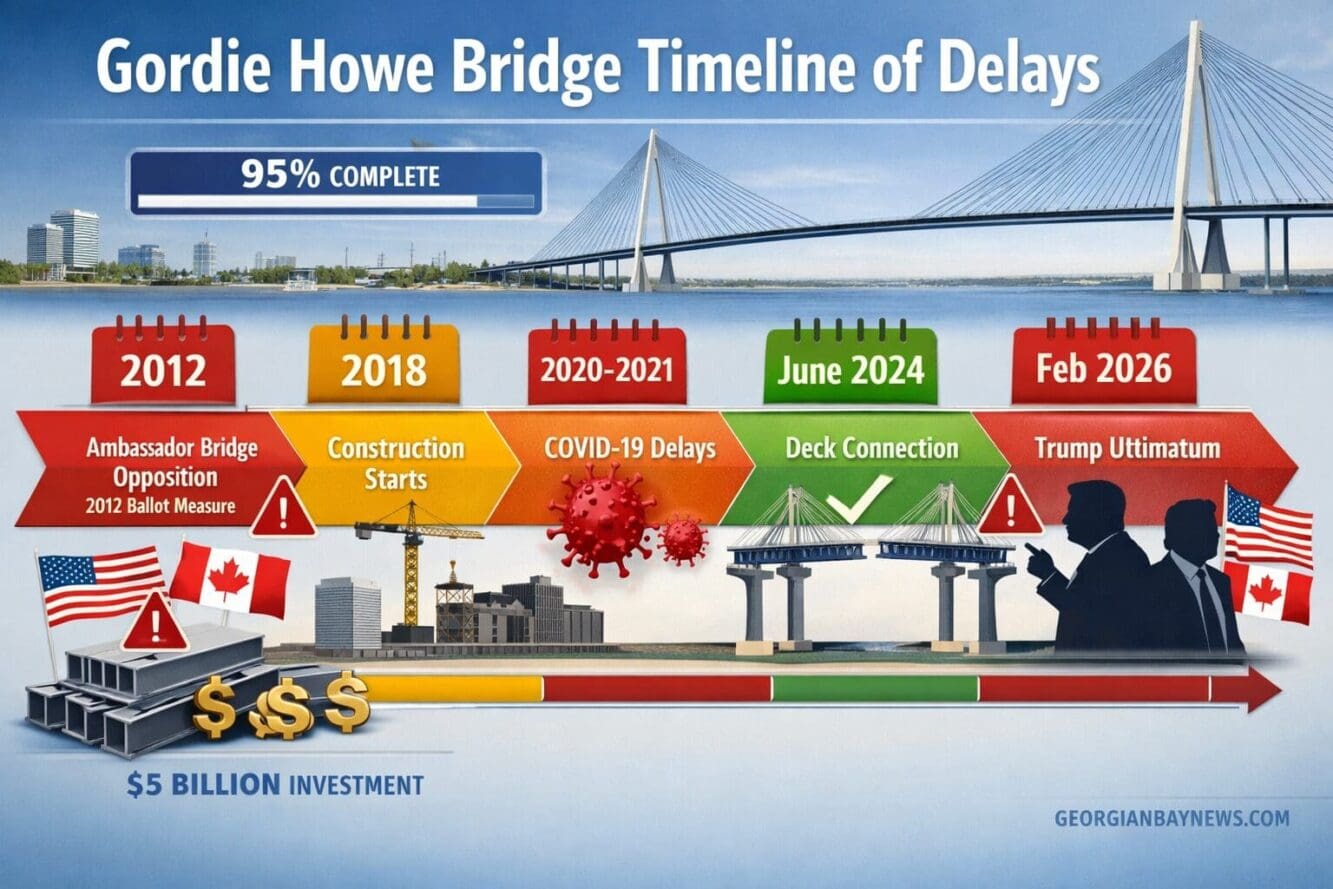
The Gordie Howe bridge reached a major construction milestone in June 2024 when the two bridge deck halves extending from Windsor and Detroit were successfully connected[1]. By late 2025, construction was approximately 95% complete with an overall expenditure of about $5 billion[1].
Construction timeline:
- 2012: Michigan voters reject ballot measures opposing the bridge
- 2018: Construction officially begins on both sides of the border
- 2020-2021: COVID-19 pandemic causes significant delays
- June 2024: Bridge deck halves connect in the middle of the Detroit River
- Late 2025: Construction nears completion; technology testing underway
- Early 2026: Original target opening date
- February 2026: Trump issues ultimatum blocking opening[1][2]
Delays resulted from multiple factors beyond the current political dispute. COVID-19 complications disrupted supply chains and workforce availability. Technology testing requirements for modern inspection systems took longer than anticipated. Port of entry completion issues on both sides required additional time to resolve[1].
The bridge represents cutting-edge engineering with its cable-stayed design, which uses towers and cables to support the deck rather than traditional suspension or beam structures. This design allows for the long span needed to cross the Detroit River while maintaining navigational clearance for ships.
If you’re tracking infrastructure projects: Political disputes often create longer delays than technical or construction challenges, and resolution timelines are harder to predict because they depend on negotiation rather than engineering solutions.
How Have Canadian Officials Responded to the Controversy?
Canadian Prime Minister Mark Carney directly refuted Trump’s steel allegation, clarifying that steel from both countries was used during construction and that Michigan shares ownership and operation of the bridge with the Canadian government[1][2].
Carney’s response emphasized several key points:
Factual corrections:
- Steel sourcing included both American and Canadian suppliers throughout construction
- The Buy American Act claim lacks factual foundation
- Michigan holds equal ownership and operational control
Partnership emphasis:
- The bridge represents a joint investment benefiting both nations
- Canada covered Michigan’s construction costs as part of a negotiated agreement
- Both countries share equally in future toll revenues and operational decisions
Economic arguments:
- Trade between the United States and Canada totals hundreds of billions of dollars annually
- Border infrastructure directly supports jobs and economic growth on both sides
- Delays harm businesses and workers in both countries
Canadian officials have maintained a diplomatic tone while firmly defending the project’s legitimacy and importance. They’ve avoided escalating rhetoric that might further complicate negotiations or damage broader U.S.-Canada relations.
The Canadian government has also engaged with Michigan state officials, business groups, and other stakeholders to build a coalition supporting the bridge opening. This strategy aims to demonstrate broad-based support that transcends partisan politics.
What Do Michigan Officials and Former Governors Say?
Former Michigan Governor Rick Snyder has been particularly vocal in defending the Gordie Howe bridge and criticizing the delay. He emphasized that “Michiganers want this bridge” because of decades of congestion issues with the existing Ambassador Bridge monopoly[3].
Snyder’s key arguments include:
Economic necessity:
- Businesses face higher costs every day due to border congestion
- Consumers pay higher prices because of transportation inefficiencies
- The regional economy loses competitiveness compared to other trade corridors
Misinformation concerns:
- Trump’s position stems from inaccurate information
- Ambassador Bridge owners allegedly provided misleading claims to administration officials
- These private interests benefit financially from continued delays[3]
Local support:
- Michigan residents and businesses overwhelmingly support the bridge
- Voters rejected attempts to block the project in 2012
- The bridge represents bipartisan infrastructure investment spanning multiple administrations
Current Michigan officials have echoed these themes while working with the state’s congressional delegation to find legislative solutions. They’ve emphasized Michigan’s equal ownership stake and the lack of financial risk to state taxpayers.
For state leaders: Infrastructure projects with strong local support but federal opposition create difficult political dynamics requiring coordination between state government, congressional delegation, and stakeholder coalitions.
What Happens Next for the Gordie Howe Bridge?
The Gordie Howe bridge remains in political limbo as of early 2026, with several possible paths forward:
Potential resolution scenarios:
- Negotiated agreement: U.S. and Canadian officials reach a compromise addressing Trump’s concerns while allowing the bridge to open
- Congressional action: Michigan’s proposed legislation successfully limits presidential authority to block the opening
- Legal challenge: Michigan or Canada pursues court action to enforce operational rights under existing agreements
- Political change: Shifts in administration priorities or personnel lead to policy reversal
- Continued stalemate: The dispute remains unresolved, extending delays indefinitely
Each scenario carries different timelines and probabilities. Negotiated agreements typically take weeks to months depending on complexity and political will. Congressional action faces uncertain prospects in a divided legislature. Legal challenges could take months or years to resolve through the court system.
What stakeholders can do:
- Businesses: Document and report economic costs of delays to elected officials
- Workers: Contact congressional representatives to emphasize job impacts
- Community members: Participate in public forums and advocacy campaigns
- Officials: Continue diplomatic engagement and explore all legal options
The controversy highlights how major infrastructure projects can become entangled in broader political disputes even after construction is essentially complete. Resolution will likely require addressing both the specific steel sourcing claims and the underlying trade tensions between the United States and Canada.
Frequently Asked Questions
When was the Gordie Howe bridge supposed to open?
The original target opening date was early 2026, but COVID-19 delays, technology testing requirements, and port of entry completion issues pushed the timeline back. Trump’s February 2026 ultimatum has now created an indefinite delay[1][2].
How long is the Gordie Howe bridge?
The bridge spans approximately 1.5 miles (2.5 kilometers), making it the 10th longest cable-stayed bridge globally and the longest in North America[1].
Did the Gordie Howe bridge only use Canadian steel?
No. Prime Minister Mark Carney clarified that steel from both the United States and Canada was used during construction, refuting Trump’s claim of exclusive Canadian steel sourcing[1][2].
Who paid for the Gordie Howe bridge construction?
Canada covered 100% of the $5 billion construction cost, including Michigan’s 50% ownership share, through a non-recourse loan to be repaid via future toll revenues. Michigan bears no financial liability[1][3].
Why do the Ambassador Bridge owners oppose the Gordie Howe bridge?
The Moroun family owns the Ambassador Bridge and has held a monopoly on Detroit-Windsor vehicle crossings since 1929. A competing public bridge threatens their profitable monopoly and toll revenue[1][3].
Can President Trump legally block the bridge from opening?
This question remains legally contested. Michigan congressional representatives have introduced legislation to prevent presidential interference, arguing the bridge represents state infrastructure with joint ownership rights[3].
How much does border congestion cost businesses?
Specific daily cost figures vary by industry and business size, but former Governor Snyder noted that congestion at the single existing crossing creates ongoing higher costs and prices that accumulate across the regional economy every day[3].
What happens if toll revenues don’t cover the construction costs?
Under the non-recourse loan agreement, Canada absorbs any shortfall. Michigan has no liability if toll revenues fall short of repaying the construction investment[1].
When did construction on the Gordie Howe bridge begin?
Official construction began in 2018 after years of planning and legal challenges. The project connected its two deck halves in June 2024, marking a major milestone[1].
What industries depend most on the Gordie Howe bridge opening?
The automotive industry, manufacturing sector, logistics companies, and agricultural exporters depend heavily on efficient border crossings. The just-in-time delivery systems used in modern manufacturing are particularly vulnerable to border delays[3].
Has Michigan voted on the Gordie Howe bridge project?
Yes. In 2012, Michigan voters rejected ballot measures supported by the Ambassador Bridge owners that would have blocked the Gordie Howe bridge construction, demonstrating strong public support for the project[1].
What makes the Gordie Howe bridge different from the Ambassador Bridge?
The Gordie Howe bridge features modern design with separate lanes for commercial trucks and passenger vehicles, advanced inspection technology, pedestrian and bicycle paths, and public ownership versus the Ambassador Bridge’s private ownership and outdated design[1].
Key Takeaways: Understanding the Gordie Howe Bridge Controversy
The Gordie Howe bridge sits 95% complete but unopened due to President Trump’s February 2026 ultimatum demanding Canadian compensation before allowing operations to begin[1][2]
Trump’s claim that the project violated the Buy American Act by exclusively using Canadian steel has been refuted by Canadian Prime Minister Mark Carney, who confirmed steel from both nations was used[1][2]
Michigan and Canada hold equal 50/50 ownership of the $5 billion bridge, with Canada covering all construction costs through a non-recourse loan creating zero financial liability for Michigan taxpayers[1][3]
The Moroun family’s Ambassador Bridge has maintained a profitable monopoly on Detroit-Windsor crossings since 1929, and the family has opposed the Gordie Howe bridge through ballot measures, lawsuits, and allegedly providing misinformation to Trump officials[1][3]
Former Michigan Governor Rick Snyder emphasized that “Michiganers want this bridge” and attributed Trump’s position to misinformation from Ambassador Bridge owners who benefit financially from continued delays[3]
Every day of delay costs the regional economy through transportation bottlenecks, higher business costs, increased consumer prices, and lost competitiveness for manufacturers depending on efficient cross-border supply chains[3]
Democratic U.S. Representatives from Michigan have introduced legislation to prevent presidential interference with the bridge opening, though the bill faces uncertain prospects in Congress
The bridge reached a major milestone in June 2024 when its two deck halves connected, and construction was nearly complete by late 2025 before the political dispute halted opening plans[1]
Resolution paths include negotiated agreements between U.S. and Canadian officials, congressional action limiting presidential authority, legal challenges, or continued political stalemate extending delays indefinitely
The controversy demonstrates how major infrastructure projects can become entangled in broader political and trade disputes even after construction is essentially complete, with private monopoly interests potentially influencing public policy decisions
Conclusion: The Path Forward for Cross-Border Infrastructure
The Gordie Howe bridge controversy represents more than a dispute over steel sourcing or trade compensation. It highlights the complex intersection of international relations, domestic politics, private business interests, and critical infrastructure needs that define modern cross-border projects.
Nearly a decade of planning, construction, and $5 billion in investment has produced a world-class bridge ready to transform North American trade flows. Yet political tensions and alleged misinformation have created a standoff that costs businesses, workers, and communities on both sides of the border every single day.
For stakeholders affected by this controversy:
Businesses should:
- Document specific costs created by border delays and congestion
- Contact congressional representatives with concrete economic impact data
- Join industry coalitions advocating for the bridge opening
- Explore alternative routing options while the dispute continues
Community members can:
- Stay informed about developments through reliable news sources
- Participate in public forums and advocacy campaigns
- Contact elected officials to express support for the bridge opening
- Share personal stories about how border delays affect daily life
Officials must:
- Continue diplomatic engagement to find compromise solutions
- Pursue all available legal and legislative options
- Communicate accurate information to counter misinformation
- Build coalitions across partisan lines around shared economic interests
The bridge honors Gordie Howe, a legendary athlete who embodied the strong cultural and economic ties between the United States and Canada. His legacy reminds us that these nations share more than a border—they share history, values, and mutual prosperity that transcends political disputes.
Resolution of this controversy will require good-faith negotiation, accurate information, and recognition that modern economies depend on efficient infrastructure that serves public interests rather than private monopolies. The Gordie Howe bridge stands ready to fulfill that role once political obstacles are removed.
The question facing leaders in 2026 is straightforward: Will they allow a completed, jointly owned bridge to serve the economic interests of millions of people, or will political disputes and private interests continue blocking critical infrastructure that both nations need?
References
[1] Gordie Howe International Bridge – https://www.britannica.com/topic/Gordie-Howe-International-Bridge
[2] What Controversy Arose In 2026 Regarding The Gordie Howe International Bridge – https://www.britannica.com/question/What-controversy-arose-in-2026-regarding-the-Gordie-Howe-International-Bridge
[3] Watch – https://www.youtube.com/watch?v=yszyyMPhK_0
[4] Gordie Howe Bridge Project Sparks Controversy – https://nationaltoday.com/us/mi/detroit/news/2026/02/16/gordie-howe-bridge-project-sparks-controversy
Some content and illustrations on GEORGIANBAYNEWS.COM are created with the assistance of AI tools.
GEORGIANBAYNEWS.COM shares video content from YouTube creators under fair use principles. We respect creators’ intellectual property and include direct links to their original videos, channels, and social media platforms whenever we feature their content. This practice supports creators by driving traffic to their platforms.
Much Appreciate You Sharing This Post - It Helps MUCH!!!