
























The power of awe: How nature can transform our perspective

By David Suzuki
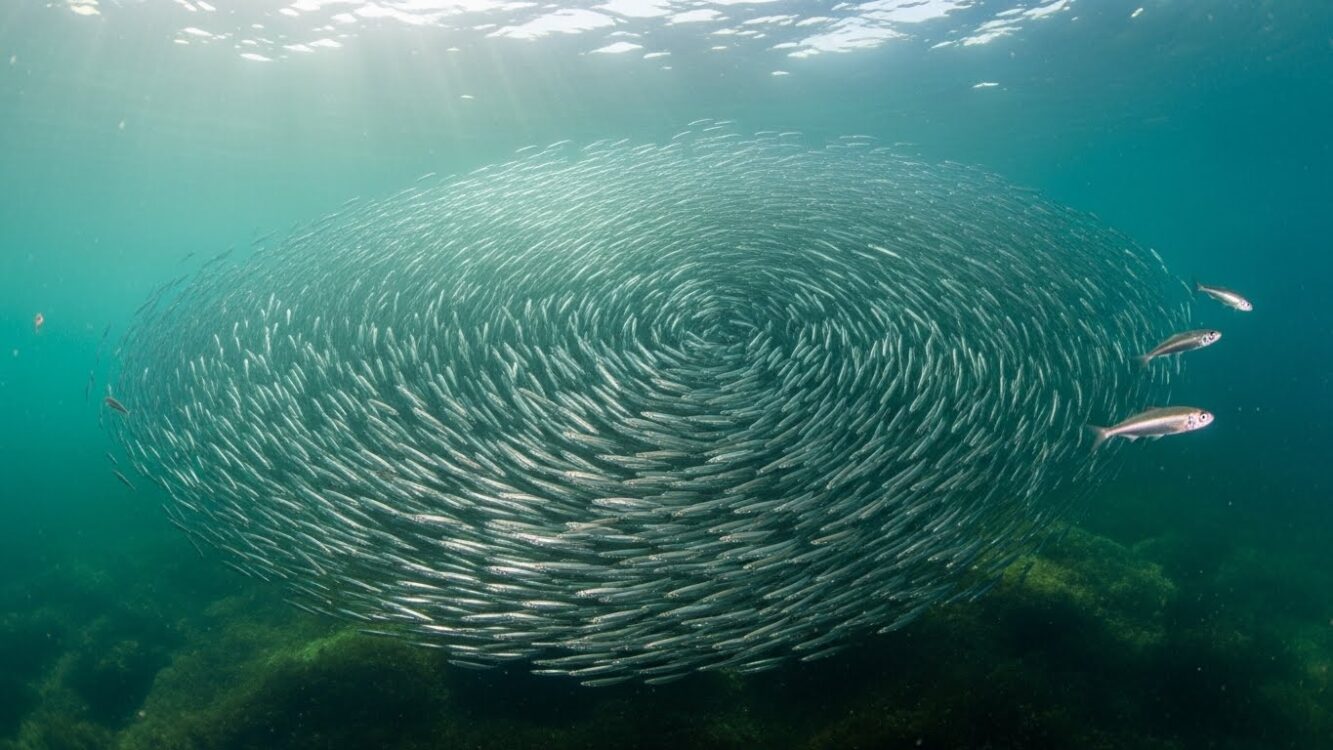
A large swarm of anchovies recently swam into Semiahmoo Bay near White Rock, British Columbia, staying for about a week. The abundance of tiny fish attracted an explosion of biodiversity. Thousands of gulls, grebes, surf scoters and the occasional sea lion amassed for an anchovy feast.
As many as 100 harbour seals also congregated, seemingly hunting as a pack — an occurrence with little to no documentation in scientific literature. It was a wildlife spectacle akin to a scene from a David Attenborough documentary, on a scale that many people today rarely see first-hand.
It’s one thing to learn about predator-prey relationships from a film or textbook, but seeing species interactions so viscerally offers a greater understanding of how everything is connected. In this case, huge numbers of fish resulted in more birds and seals, each with its place in the web of life. Witnessing such an abundance of biodiversity is awe-inspiring.
Australian journalist and author Julia Baird describes “awe” as the sensation that makes one feel small but more connected — often found in nature, art or human goodness. “When you see the beauty, vastness and fragility of nature, you want to preserve it. You see what we share, and how we connect. You understand being small,” she wrote in Phosphorescence.
Feeling awe from observing nature is not political. We can find commonality and unity in a shared sense of beauty, curiosity and amazement for the natural world.
If I could, I would roll out this spectacle on a cross-Canada tour to engage more people in the experience. Such an endeavour doesn’t seem absurd given findings from a recent study that looked at human connectedness to nature. We know this affinity has been declining with each generation — dropping by 60 per cent over 200 years, according to a 2025 study by University of Derby science professor Miles Richardson.
Perhaps even more alarming, a 2025 study by Swedish and Japanese researchers found that a love of nature is not something innate (a long-held assumption called “biophilia,” popularized by the great biologist E.O. Wilson). Rather, the study suggests a growing number of people feel fear, disgust or discomfort toward nature.
These researchers conducted a systematic global review of scientific articles from different disciplines (environmental sciences, social sciences, psychology). Their findings suggest that human emotions are shaped by our surroundings, including exposure to nature and media narratives.
Media can play a huge role, including vastly overrepresenting the risk wildlife poses to human life — often to the detriment of wilderness. The authors also found a trend of declining human-nature relationships over time. They attributed this to reduced contact with nature and limited knowledge about it reinforcing each other. These findings make sense given our increasingly urbanized and online global population.
How do we begin to build back biophilia? This question is critical to conservation. I’m worried that we’re losing biodiversity at a rate so fast that many of us will never witness a scene like that in Semiahmoo Bay. If people don’t care about the natural environment, and don’t see ourselves as part of it, we won’t fight to preserve it. We’re already seeing this trend in Canada, as federal and provincial politicians push through legislation and projects that harm nature.
One solution is to actively increase our knowledge and contact with nature. I see some hope with community science (also referred to as “citizen science”). It’s growing in significance every year, with millions of people contributing valuable data — including through the David Suzuki Foundation’s Butterflyway Project and work with iNaturalist.
Importantly, much of the data are open and accessible to all. I’ve witnessed people growing more enthusiastic about nature simply through the power of observation and learning.
Equally important for science, advances in computational power allow us to make the most of this huge volume of biodiversity data. Researchers are analyzing it to look for trends by studying, for example, changes in animal and plant abundance and distribution and gaining an understanding of the importance of species interactions. This is made possible through the simple act of paying attention to the world around us.
Having a sense of awe for nature dwarfs one’s own sense of importance and provides a critical catalyst for acting collectively to preserve something much bigger than ourselves.
David Suzuki is a scientist, broadcaster, author and co-founder of the David Suzuki Foundation. Written with David Suzuki Foundation Nature Director Erin Roger.
Learn more at davidsuzuki.org.
REFERENCES:
Swarm of anchovies recently swam in to Semiahmoo Bay:
Julia Baird:
Phosphorescence:
https://www.penguinrandomhouse.ca/books/639548/phosphorescence-by-julia-baird/9780593236932
2025 study by University of Derby science professor Miles Richardson:
https://www.mdpi.com/2673-4834/6/3/82
2025 study by Swedish and Japanese researchers:
https://esajournals.onlinelibrary.wiley.com/doi/10.1002/fee.70019
Biophilia:
https://www.pbs.org/wgbh/nova/article/conversation-eo-wilson
David Suzuki Foundation’s Butterflyway Project:
https://davidsuzuki.org/take-action/act-locally/butterflyway
Work with iNaturalist:
https://davidsuzuki.org/take-action/volunteer/bimby
Much Appreciate You Sharing This Post - It Helps MUCH!!!