






















Trump’s Threat to Block Gordie Howe Bridge: Escalating US-Canada Trade Tensions Explained


In a dramatic escalation of US-Canada relations, President Donald Trump took to Truth Social on February 9, 2026, threatening to block the opening of the nearly completed Gordie Howe International Bridge—a $6.4 billion infrastructure project connecting Detroit and Windsor, Ontario. This unexpected move has sent shockwaves through the cross-border trade community and raised serious questions about diplomatic relations, economic stability, and the future of North America’s most critical trade corridor. Trump’s threat to block the Gordie Howe Bridge represents more than just a infrastructure dispute; it signals escalating US-Canada trade tensions that could reshape the economic landscape for millions of workers and businesses on both sides of the border.

- 🌉 Trump threatened to prevent the Gordie Howe Bridge from opening until Canada provides “fairness and respect” and compensates the US, demanding at least half ownership of the jointly-owned structure[1]
- 💰 Canada fully funded the $6.4 billion project and plans to recoup costs through toll revenues, contradicting Trump’s ownership claims[1]
- 🤝 Potential conflict of interest emerged when billionaire Matthew Moroun, owner of the competing Ambassador Bridge, met with Commerce Secretary Howard Lutnick hours before Trump’s threat[1]
- 📊 The Detroit-Windsor corridor handles $360 million in daily trade, representing 25% of all US-Canada commerce, making this dispute economically significant[1]
- ⚖️ House Democrats launched an investigation into potential donor influence over Trump’s decision, demanding documentation from Moroun[2]
Key Takeaways
Understanding the Gordie Howe International Bridge Project

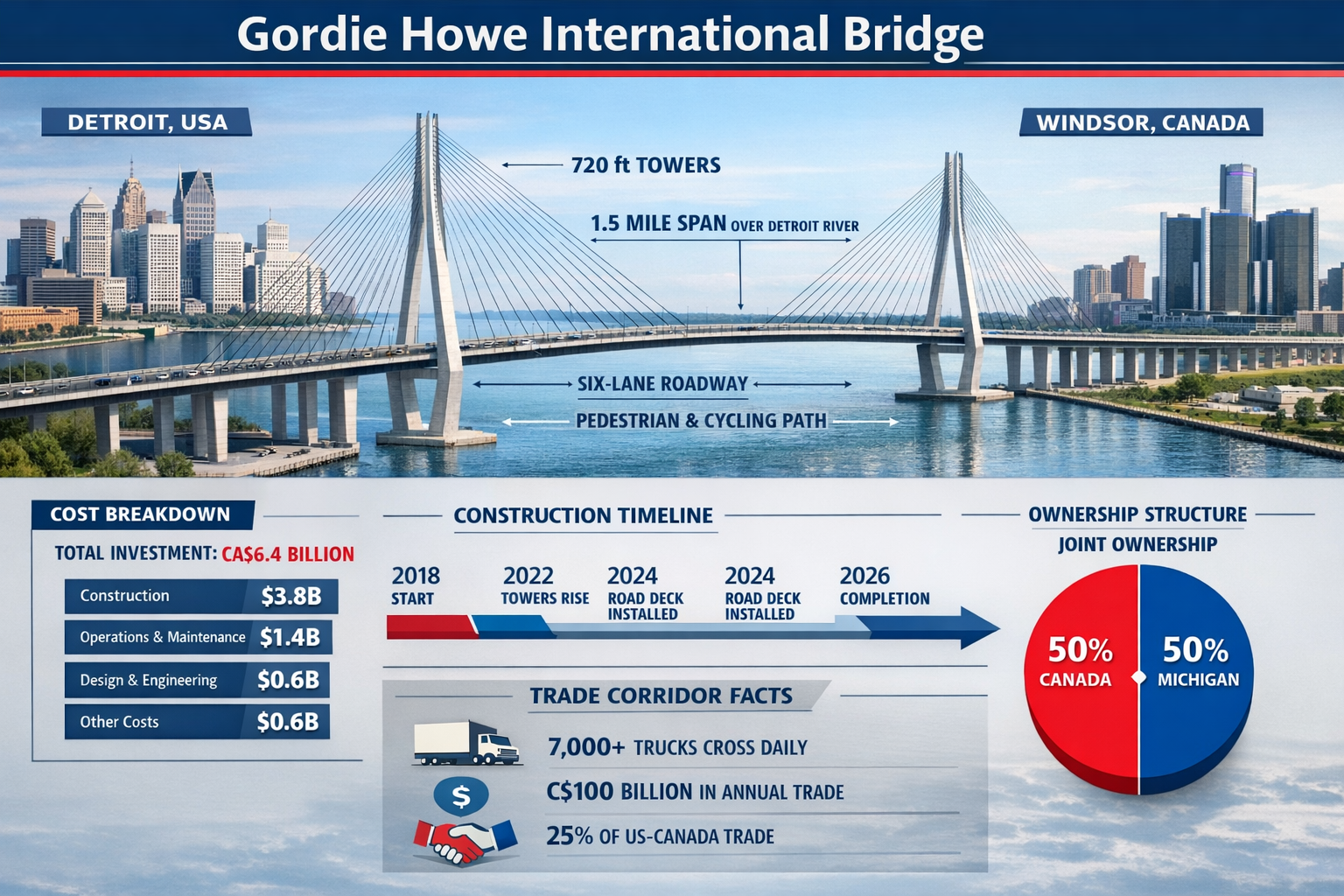
The Gordie Howe International Bridge represents one of North America’s most ambitious cross-border infrastructure projects. Named after the legendary Canadian hockey player, this massive undertaking has been in development since the early 2000s, with groundbreaking occurring in October 2018[1].
Bridge Specifications and Features
The structure spans an impressive 1.5 miles across the Detroit River, featuring:
- Six lanes for vehicular traffic
- Dedicated walking and biking paths
- Cable-stayed towers reaching 720 feet in height
- State-of-the-art port of entry complexes on both sides
- Direct connections to existing highway infrastructure
As of 2025, the bridge was reported to be 98% complete, with opening scheduled for early 2026[1]. The project was designed to provide crucial relief to the Detroit-Windsor corridor, which serves as the busiest commercial land border crossing between the United States and Canada.
Funding and Ownership Structure
Contrary to President Trump’s claims, the ownership structure of the Gordie Howe Bridge is clearly defined in the 2012 Canada-Michigan Crossing Agreement. The bridge will be:
- Jointly owned by the Government of Canada and the State of Michigan
- Fully funded by Canada (approximately CA$6.4 billion or $4.7 billion USD)
- Operated by Canada through the Windsor-Detroit Bridge Authority
- Financed through toll revenues collected on the Canadian side[1]
This arrangement came about after Michigan lawmakers declined to contribute financially to the project during former Republican Governor Rick Snyder’s administration, leading Canada to assume full construction costs while maintaining joint ownership[3].
Trump’s Threat to Block Gordie Howe Bridge: The Truth Social Announcement
On February 9, 2026, President Trump posted a lengthy statement on Truth Social that sent shockwaves through both the American and Canadian political establishments. His message outlined several grievances and made specific demands regarding the bridge project.
Key Claims in Trump’s Statement
The president’s post contained several assertions about US-Canada trade relations and the bridge project:
- Ownership demands: Trump claimed the US should own “at least one half” of the bridge asset, stating the revenues would be “astronomical”[1]
- “No US content” allegation: He falsely claimed the bridge was built with “virtually no U.S. content,” including steel[1]
- Dairy tariff complaints: Trump cited Canadian tariffs on US dairy products as “unacceptable”[4]
- Ontario alcohol restrictions: He complained that Ontario won’t allow US alcoholic products on its shelves[4]
- China cooperation concerns: Trump alleged that Prime Minister Mark Carney was attempting to make deals with China[4]
“I will not allow this bridge to open until the United States is fully compensated for everything we have given them, and also, importantly, Canada treats the United States with the Fairness and Respect that we deserve.” – President Donald Trump[1]
Factual Corrections to Trump’s Claims
Several of Trump’s assertions have been disputed by officials and contradicted by documented facts:
US Content Claim: The 2012 Crossing Agreement explicitly allowed for sourcing of both Canadian and US steel, and American materials were indeed used in construction[1]. Michigan Governor Gretchen Whitmer’s spokesperson confirmed that American steel and workers were involved in the bridge work[4].
Ownership Structure: The bridge is not solely owned by Canada, as Trump suggested. It’s a joint public asset owned by both Canada and Michigan under the 2012 agreement[1].
Permit Authority: While Trump indicated he might review the presidential permit issued over a decade ago, legal experts question whether he has the authority to unilaterally block a bridge opening based on a valid permit and international agreement[7].
The Moroun Connection: Potential Conflict of Interest
Perhaps the most troubling aspect of Trump’s threat to block the Gordie Howe Bridge involves the timing and potential conflict of interest surrounding his announcement.
The Ambassador Bridge Competition
For decades, the Moroun family has controlled the privately-owned Ambassador Bridge, which currently handles approximately $360 million in daily goods—representing 25% of the total value of US-Canada trade[1]. This monopoly has been extraordinarily profitable for the family.
The Gordie Howe Bridge poses a direct competitive threat to the Ambassador Bridge’s dominance. For years, the Moroun family actively opposed the new bridge project, recognizing it would break their monopoly on the critical Detroit-Windsor crossing.
The February 9 Meeting
According to reporting by The New York Times, Matthew Moroun—billionaire owner of the Ambassador Bridge—met with Commerce Secretary Howard Lutnick on February 9, 2026, just hours before Trump posted his threat about the Gordie Howe Bridge[1]. Sources indicated that Lutnick briefed Trump on this meeting shortly afterward[1].
This sequence of events raised immediate red flags about potential donor influence over presidential decision-making. The timing appeared too coincidental to ignore, particularly given the Moroun family’s clear financial interest in preventing the new bridge from opening.
Congressional Investigation
In response to these concerns, House Democrats took swift action. On February 12, 2026, Democratic lawmakers demanded that Moroun provide complete documentation of his meeting with Secretary Lutnick[2]. The investigation sought to determine whether:
- Private business interests influenced presidential policy
- Proper ethics protocols were followed
- The meeting constituted an improper attempt to use government power for private gain
Representative Haley Stevens led the introduction of anti-corruption legislation specifically designed to prevent Trump from blocking the Gordie Howe Bridge opening[7]. This legislative response underscored the seriousness with which lawmakers viewed the potential conflict of interest.
Similar to concerns about political influence in other Trump administration decisions, this situation highlighted ongoing questions about the intersection of business interests and government policy.
Canada’s Response: Prime Minister Carney Addresses the Threat
Canadian Prime Minister Mark Carney responded to Trump’s threat with a measured but firm approach, emphasizing facts and diplomatic engagement while defending Canada’s interests.
Carney’s Key Points
Speaking to reporters in Ottawa, Carney made several important clarifications:
- Direct communication: He confirmed speaking directly with President Trump about the bridge dispute[4]
- Funding facts: Carney explained that “Canada paid for the bridge, firstly”[4]
- Ownership clarification: He noted the bridge is “a property shared between the state of Michigan and the Canadian government”[4]
- US involvement: Carney emphasized that “American steel and workers were involved in the work for the bridge”[4]
- Resolution confidence: Despite the tensions, he stated the dispute “will be resolved”[4]
Canadian Government’s Broader Strategy
The Canadian response reflected a careful balancing act between:
- Defending Canadian interests and correcting factual inaccuracies
- Maintaining diplomatic relations with the United States
- Protecting economic stability in the crucial Detroit-Windsor corridor
- Reassuring stakeholders including businesses, workers, and border communities
The Windsor-Detroit Bridge Authority released a statement emphasizing the bridge’s progress and the significant economic benefits it would bring across North America, including investment encouragement, job creation, and improved trade efficiency[4].
Economic Impact: What’s at Stake for Both Nations
The dispute over Trump’s threat to block the Gordie Howe Bridge carries enormous economic implications for both the United States and Canada, particularly for the Great Lakes region.
Current Trade Volume
The Detroit-Windsor corridor represents the busiest commercial land border crossing in North America:
| Metric | Value |
|---|---|
| Daily trade value | $360 million (Ambassador Bridge alone) |
| Percentage of US-Canada trade | 25% of total value |
| Expected daily commuters (new bridge) | 6,000 people |
| Jobs supported by corridor | Tens of thousands |
Benefits of the New Bridge
The Gordie Howe International Bridge was designed to deliver multiple economic advantages:
Reduced congestion: By providing an alternative to the Ambassador Bridge, the new crossing would alleviate bottlenecks that cost businesses time and money.
Improved efficiency: Modern design and technology would speed up border processing and reduce delays for commercial trucks.
Enhanced competition: Breaking the Ambassador Bridge monopoly would likely lead to more competitive toll rates and better service.
Job creation: The bridge project has already created thousands of construction jobs and will support ongoing employment in operations and maintenance[6].
Regional development: The improved infrastructure is expected to attract new investment to both the Detroit and Windsor areas.
Risks of Delayed Opening
If Trump follows through on his threat to block the Gordie Howe Bridge, the consequences could be severe:
- Continued monopoly: The Moroun family’s Ambassador Bridge would maintain its exclusive control over the crossing
- Lost economic opportunity: Businesses would continue facing the inefficiencies of a single crossing option
- Diplomatic damage: US-Canada relations could suffer long-term harm
- Investor uncertainty: The dispute could discourage future cross-border infrastructure investments
- USMCA complications: The threat comes as negotiations are set to begin on the United States-Mexico-Canada Agreement[4]
Business leaders in Michigan have been vocal about the bridge’s importance. Glenn Stevens Jr. of the Detroit Regional Chamber emphasized the significance of the trade relationship with Canada, particularly in automotive, agriculture, and energy sectors[6].
Political Reactions: Michigan and Federal Responses
The response to Trump’s threat to block the Gordie Howe Bridge has been swift and largely bipartisan in Michigan, where the economic stakes are highest.
Michigan Governor Gretchen Whitmer
Governor Whitmer’s spokesperson, Stacey LaRouche, issued a strong statement defending the bridge project:
“The Gordie Howe International Bridge is all about jobs… It’s going to open one way or another, and the governor looks forward to attending the ribbon cutting.”[4]
The statement emphasized that the bridge represents “a tremendous example of bipartisan and international cooperation”[4], highlighting how the project had enjoyed support across party lines in Michigan.
Michigan Congressional Delegation
Michigan Democrats in Congress rallied to defend the bridge’s timely opening. Senator Gary Peters and other members of the delegation sent a letter to President Trump emphasizing the bridge’s critical importance to Michigan’s economy and national security[3].
Senator Kevin Hertel responded forcefully to the threats, stating: “President Trump’s threat to delay the opening of the Gordie Howe International Bridge is reckless and dangerous for Michigan’s economy”[5].
The congressional response included:
- Calls for immediate clarification of the administration’s position
- Demands for transparency regarding the Moroun meeting
- Introduction of legislation to prevent blocking the bridge opening
- Emphasis on the bridge’s importance for national security and economic competitiveness
White House Doubling Down
Despite the backlash, White House Press Secretary Karoline Leavitt confirmed that Trump has the authority to amend the bridge permit and doubled down on the president’s threat, though without offering specific details about implementation[4].
This stance suggested the administration was prepared to escalate the conflict rather than back down, raising concerns about the potential for a prolonged dispute.
Legal and Diplomatic Considerations
Trump’s threat to block the Gordie Howe Bridge raises complex legal and diplomatic questions that extend beyond simple infrastructure policy.
Presidential Authority Questions
Legal experts have debated whether the president actually has the authority to unilaterally block the bridge’s opening:
Existing permit: A presidential permit was issued over a decade ago authorizing the project[1]
International agreement: The 2012 Canada-Michigan Crossing Agreement is a binding international compact[1]
State involvement: Michigan is a joint owner, complicating federal intervention
Congressional role: Some argue Congress would need to be involved in any attempt to block the opening
International Law Implications
The dispute touches on several areas of international law:
- Treaty obligations: The US and Canada have numerous agreements governing cross-border infrastructure
- Trade commitments: USMCA provisions may be relevant to infrastructure that facilitates trade[4]
- Good faith principles: International law generally requires parties to act in good faith on agreements
- Dispute resolution: The Canada-Michigan agreement likely contains provisions for resolving disagreements
Diplomatic Precedent
Blocking the bridge would set a troubling diplomatic precedent:
- Future cross-border projects could face uncertainty
- International partners might question US reliability
- Retaliatory measures from Canada could follow
- The broader US-Canada relationship could suffer lasting damage
The situation reflects broader patterns of declining American optimism and international cooperation that have characterized recent political developments.
The Path Forward: Possible Resolutions
Despite the heated rhetoric, several potential paths exist for resolving the dispute over Trump’s threat to block the Gordie Howe Bridge.
Negotiated Settlement
The most likely outcome involves diplomatic negotiation between the US and Canadian governments:
- Direct talks between Trump and Carney to address concerns
- Potential side agreements on dairy, alcohol, or other trade issues
- Face-saving measures that allow Trump to claim victory
- Reaffirmation of existing ownership and operational arrangements
Prime Minister Carney’s statement that the issue “will be resolved” suggests confidence in this approach[4].
Congressional Intervention
If the administration persists, Congress might intervene:
- Legislation preventing the president from blocking the opening[7]
- Oversight hearings on the Moroun meeting and potential conflicts of interest
- Budget riders protecting the bridge project
- Bipartisan pressure from Michigan’s congressional delegation
Legal Challenges
Various parties could pursue legal remedies:
- Michigan could challenge federal interference with state property rights
- Canada could invoke dispute resolution mechanisms in the 2012 agreement
- Business groups could sue over economic harm from delayed opening
- Ethics watchdogs could pursue investigations into the Moroun connection
Economic Pressure
Market forces and business interests might ultimately prevail:
- Regional business coalitions advocating for the bridge opening
- Economic data showing costs of continued delays
- Pressure from automotive industry and other key sectors
- Public opinion in border communities favoring the bridge
The Detroit Regional Chamber and other business organizations have already begun mobilizing support for the bridge’s timely opening[6].
Conclusion: What This Means for US-Canada Relations
Trump’s threat to block the Gordie Howe Bridge represents far more than a dispute over a single infrastructure project. It symbolizes the fragile state of US-Canada relations in 2026 and raises fundamental questions about trade, diplomacy, and cross-border cooperation in North America.
The escalating US-Canada trade tensions highlighted by this dispute could have lasting consequences:
Economic uncertainty: Businesses on both sides of the border face unpredictability in planning and investment decisions
Diplomatic strain: Trust between the two nations, built over decades, faces serious testing
Regional impact: Communities in Michigan and Ontario that depend on cross-border commerce face anxiety about their economic future
Precedent concerns: The dispute may discourage future collaborative infrastructure projects
However, the strong bipartisan support for the bridge in Michigan, combined with Canada’s measured response and the clear economic benefits of opening the crossing, suggest that cooler heads may ultimately prevail.
Next Steps for Stakeholders
For businesses: Monitor the situation closely and engage with elected representatives to emphasize the economic importance of the bridge opening on schedule.
For workers: Stay informed about developments and support advocacy efforts by unions and industry groups promoting cross-border trade.
For citizens: Contact congressional representatives to express support for the bridge and concern about potential conflicts of interest in decision-making.
For policymakers: Continue pressing for transparency regarding the Moroun meeting and work toward diplomatic solutions that serve the public interest rather than private monopolies.
The Gordie Howe International Bridge stands as a testament to what’s possible when nations work together on shared infrastructure challenges. Whether it opens as scheduled or faces delays due to political maneuvering will say much about the current state of North American cooperation and the ability of democratic institutions to resist conflicts of interest.
As negotiations continue and the 2026 opening date approaches, all eyes will remain on this critical crossing and what it represents for the future of US-Canada relations in an increasingly complex geopolitical landscape.
References
[1] Trump Michigan Canada Gordie Howe Bridge Reversal – https://www.propublica.org/article/trump-michigan-canada-gordie-howe-bridge-reversal
[2] Gordie Howe Bridge Moroun Lutnick Trump Democrats – https://globalnews.ca/news/11673159/gordie-howe-bridge-moroun-lutnick-trump-democrats/
[3] Michigan Democrats To President Trump Timely Opening Of The Gordie Howe International Bridge Is Critical – https://www.slotkin.senate.gov/2026/02/17/michigan-democrats-to-president-trump-timely-opening-of-the-gordie-howe-international-bridge-is-critical/
[4] Explainer What Does The Gordie Howe Bridge Dispute Mean For US Canada Ties – https://www.aa.com.tr/en/americas/explainer-what-does-the-gordie-howe-bridge-dispute-mean-for-us-canada-ties/3835681
[5] Sen Hertel Responds To President Trumps Threats Toward Gordie Howe International Bridge Progress – https://senatedems.com/hertel/2026/02/11/sen-hertel-responds-to-president-trumps-threats-toward-gordie-howe-international-bridge-progress/
[6] Michigan Business Leaders React To Trumps Threat To Delay Gordie Howe Bridge Opening – https://www.detroitchamber.com/michigan-business-leaders-react-to-trumps-threat-to-delay-gordie-howe-bridge-opening/
[7] Stevens Leads Anti Corruption Bill Prevent Trump Blocking Gordie Howe Bridge – http://stevens.house.gov/media/press-releases/stevens-leads-anti-corruption-bill-prevent-trump-blocking-gordie-howe-bridge
Some content and illustrations on GEORGIANBAYNEWS.COM are created with the assistance of AI tools.
GEORGIANBAYNEWS.COM shares video content from YouTube creators under fair use principles. We respect creators’ intellectual property and include direct links to their original videos, channels, and social media platforms whenever we feature their content. This practice supports creators by driving traffic to their platforms.
Much Appreciate You Sharing This Post - It Helps MUCH!!!