






















Ontario RRSP and Tax Filing Strategy: March 31 Deadline Guide for Last-Minute 2025 Deduction Claims

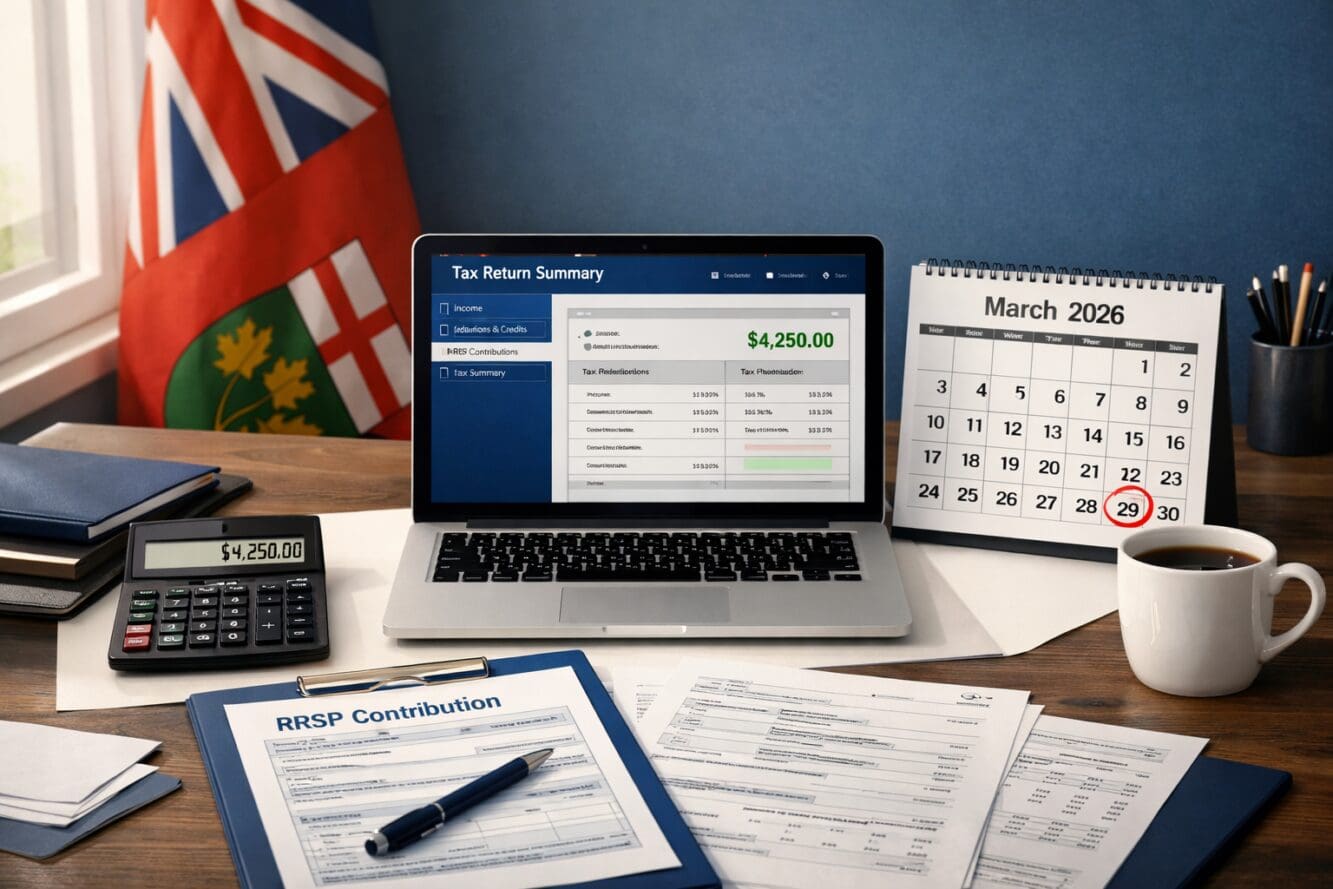
Please double-check the information in this post! I tasked one of my top AI Agents to pull this information together, which is in beta testing. I welcome your respectful comments – Malloy
Last updated: March 2, 2026
Key Takeaways
- The RRSP contribution deadline for 2025 tax deductions is March 2, 2026 (today), not March 31st
- March 31, 2026 is the tax filing deadline for most Canadians to submit their 2025 returns
- Maximum RRSP contribution for 2025 is $32,490 or 18% of your 2025 earned income, whichever is lower
- Contributions made today must clear by midnight to count toward 2025 deductions
- Bank transfers typically take 24-48 hours to process, so immediate action is required
- Each dollar contributed reduces taxable income; a $10,000 contribution in a 30% tax bracket saves approximately $3,000
- Contributions after March 2 count toward 2026 taxes, delaying benefits until you file in 2027
- Excess contributions above your limit trigger a 1% monthly penalty
- You’ll receive separate receipts for 2025 calendar year contributions and first 60 days of 2026
- Strategic timing between contribution and filing deadlines maximizes refund potential
Quick Answer
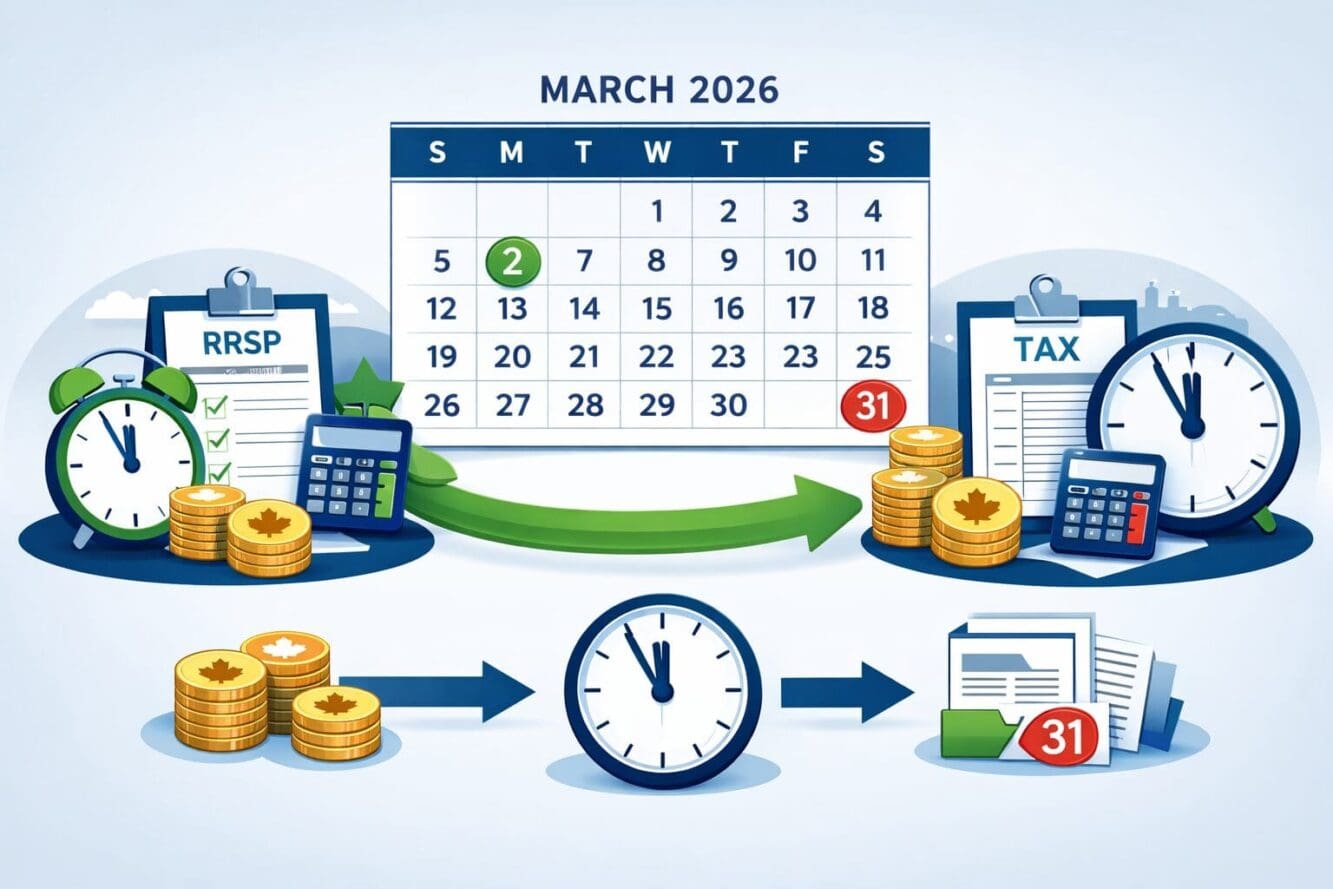
Ontario taxpayers face two critical deadlines in 2026: the RRSP contribution deadline of March 2, 2026 for claiming 2025 deductions, and the tax filing deadline of March 31, 2026. Contributions made by midnight tonight reduce your 2025 taxable income and increase potential refunds when you file by March 31. The maximum contribution is $32,490 or 18% of 2025 earned income, and contributions must clear your financial institution today to count[1][2][3].
What Is the Actual RRSP Deadline for 2025 Tax Deductions?
The RRSP contribution deadline for claiming deductions on your 2025 tax return is March 2, 2026, not March 31st. This date falls on a Monday because March 1 is a Sunday, and the Canada Revenue Agency (CRA) extends deadlines to the next business day when they fall on weekends[2][3].
Contributions made from January 1, 2026 through March 2, 2026 can be claimed on your 2025 tax return, along with any contributions made during the 2025 calendar year[1]. This 60-day window gives taxpayers flexibility to maximize deductions after receiving their T4 slips and calculating their exact tax situation.
Common mistake: Many people confuse the March 31 tax filing deadline with the RRSP contribution deadline. Missing the March 2 deadline means waiting an entire year to claim those contributions, even though you can still file your taxes on time.
If you contribute after March 2: Those contributions remain valid but count toward your 2026 tax year, meaning you won’t see the tax benefit until you file your 2026 return in 2027[1][3].
How Do the March 2 and March 31 Deadlines Work Together?
March 2, 2026 is the RRSP contribution deadline, while March 31, 2026 is the tax filing deadline for most Canadians. Understanding how these dates interact helps maximize your refund through strategic planning.
Here’s the optimal sequence:
- Before March 2: Make RRSP contributions based on your estimated 2025 income and tax situation
- March 2 deadline: Finalize all contributions you want to claim for 2025
- March 2-31 window: Prepare and file your tax return with RRSP deductions included
- After filing: Receive your tax refund, which reflects the reduced taxable income from RRSP contributions
Choose this strategy if: You receive your T4 slips early in February and can calculate exactly how much RRSP room you have. Contributing the maximum amount by March 2 and filing shortly after ensures the fastest refund processing.
Edge case: If you’re self-employed or have complex income sources, you might not know your exact contribution room until late February. In this case, contribute conservatively by March 2 to avoid over-contribution penalties, then use any remaining room in the following year.
What Are the 2025 RRSP Contribution Limits?
The maximum RRSP contribution for the 2025 tax year is $32,490 or 18% of your 2025 earned income, whichever is lower[1][2]. This limit applies to contributions made during 2025 plus the first 60 days of 2026 (January 1 through March 2).
Your personal contribution limit also includes unused room carried forward from previous years. You can find your exact contribution room on your 2024 Notice of Assessment or by logging into your CRA My Account.
For planning ahead: The 2026 contribution limit (claimable on 2026 taxes filed in 2027) increases to $33,810 or 18% of your 2025 earned income, whichever is lower[2].
Contribution Limit Quick Reference
| Tax Year | Maximum Contribution | Calculation Basis | Deadline |
|---|---|---|---|
| 2025 | $32,490 | 18% of 2025 income | March 2, 2026 |
| 2026 | $33,810 | 18% of 2025 income | March 1, 2027 |
Important: Employer pension plan contributions reduce your RRSP room through a “pension adjustment” that appears on your T4 slip[6].
How Can You Make Last-Minute Contributions That Count for 2025?
With today being March 2, 2026, you have only hours remaining to make contributions that count toward 2025 taxes. The method you choose determines whether your contribution clears in time.
Fastest options (process immediately):
- Online transfers from your linked bank account to your RRSP account
- In-person contributions at your financial institution branch
- Pre-authorized contributions set up before today
Slower options (may not clear in time):
- Bank transfers initiated today typically take 24-48 hours to process[3]
- Cheques deposited today may not clear by midnight
- Wire transfers depend on your institution’s processing times
Critical timing rule: Contributions must be received and processed by your financial institution by midnight on March 2, 2026 to count for 2025[3]. If you’re using online banking, initiate transfers immediately and confirm processing times with your bank.
Pro tip: If you’re cutting it close, call your financial institution to confirm same-day processing availability. Some banks offer expedited processing for RRSP contributions on deadline day.
How Do RRSP Deductions Maximize Your Tax Refund?
Each dollar you contribute to an RRSP reduces your taxable income dollar-for-dollar. The tax savings depend on your marginal tax rate, which is the rate you pay on your last dollar of income.
Example calculation: If you earn $80,000 in Ontario (approximately 30% marginal tax rate) and contribute $10,000 to your RRSP, you reduce your taxable income to $70,000. This saves approximately $3,000 in taxes ($10,000 × 30%)[3].
Tax bracket strategy: RRSP contributions are most valuable when you’re in a higher tax bracket. If your income fluctuates year-to-year, contribute when your income is high and claim deductions in high-tax years.
Ontario Tax Savings by Income Level (2025)
- $50,000 income: $10,000 contribution saves ~$2,400
- $75,000 income: $10,000 contribution saves ~$3,000
- $100,000 income: $10,000 contribution saves ~$3,500
- $150,000 income: $10,000 contribution saves ~$4,300
Flexibility option: You don’t have to claim all your contributions in the year you make them. You can carry forward the deduction to a future year when your income is higher, though most people benefit from claiming immediately[4].
What Happens If You Over-Contribute to Your RRSP?
Excess contributions above your limit trigger a 1% monthly penalty on the over-contribution amount[3]. The CRA allows a $2,000 lifetime buffer for over-contributions, but amounts beyond that are penalized.
If you over-contribute: You must file Form T1-OVP (Individual Tax Return for RRSP, PRPP and SPP Excess Contributions) within 90 days of the year-end to report the over-contribution[3]. You’ll pay the 1% penalty each month until you withdraw the excess or gain enough contribution room to absorb it.
How to fix over-contributions:
- Contact your financial institution to arrange an excess contribution withdrawal
- Complete Form T3012A (Tax Deduction Waiver on the Refund of Your Unused RRSP, PRPP, or SPP Contributions) to avoid withholding tax on the withdrawal
- File Form T1-OVP to report the over-contribution and calculate penalties
- Withdraw the excess amount as soon as possible to minimize penalties
Prevention strategy: Check your contribution room on your CRA My Account before making large contributions, especially if you have multiple RRSP accounts or made mid-year contributions you might have forgotten.
How Should You Handle RRSP Receipts for Tax Filing?
You will receive two separate RRSP contribution receipts if you contributed during both the 2025 calendar year and the first 60 days of 2026[2]. Understanding these receipts ensures you claim the correct amounts.
Receipt 1: Covers contributions made from January 1, 2025 through December 31, 2025
Receipt 2: Covers contributions made from January 1, 2026 through March 2, 2026
Both receipts can be claimed on your 2025 tax return if you choose to claim them. Financial institutions must provide these receipts by the end of February[9].
Filing steps:
- Gather both receipts from all RRSP accounts (including spousal RRSPs)
- Add up total contributions eligible for 2025 deduction
- Enter the total on line 20800 of your tax return
- Attach receipts if filing by paper; keep them for six years if filing electronically
- Verify the claimed amount doesn’t exceed your contribution limit
Common mistake: Forgetting about automatic monthly contributions made throughout 2025. Check your bank statements and RRSP account statements to capture all contributions.
What Is the Strategy for Spousal RRSP Contributions?
Spousal RRSP contributions follow the same March 2, 2026 deadline and count against your personal contribution limit, not your spouse’s[3]. This strategy helps balance retirement income between partners, potentially reducing overall family tax burden.
How it works: You contribute to an RRSP in your spouse’s name, claim the deduction on your tax return, but the funds belong to your spouse. When withdrawn, the income is taxed in your spouse’s hands (usually at a lower rate if they have less income).
Three-year attribution rule: If your spouse withdraws funds within three calendar years of your last spousal contribution, the withdrawal is attributed back to you for tax purposes[5]. Plan withdrawals carefully to avoid this.
Choose spousal RRSPs if:
- You earn significantly more than your spouse
- You want to split retirement income for tax efficiency
- Your spouse is younger and has more years until retirement
What Are the Next Steps After the March 2 Deadline?
After the RRSP contribution deadline passes, focus shifts entirely to tax filing. You have until March 31, 2026 to file your 2025 tax return and claim your RRSP deductions.
Immediate action items (March 2-31):
- Collect all tax documents: T4s, T5s, RRSP receipts, and other slips
- Calculate your total RRSP contributions eligible for 2025
- Use tax software or consult an accountant to prepare your return
- File electronically for fastest refund processing (typically 2 weeks)
- Set up direct deposit with CRA if you haven’t already
For self-employed individuals: Your filing deadline is June 15, 2026, but any taxes owing are still due March 31 to avoid interest charges[7].
Planning for 2026: Start making RRSP contributions early in the year rather than waiting until the deadline. Monthly contributions through automatic transfers help you:
- Benefit from dollar-cost averaging in your investments
- Avoid last-minute deadline stress
- Spread the tax benefit across the year if you adjust withholding
If you missed the deadline: Contributions made after March 2, 2026 count toward your 2026 tax year. You’ll claim them when you file your 2026 return in early 2027. The contribution still grows tax-free, but the deduction benefit is delayed by one year.
Conclusion
The Ontario RRSP and Tax Filing Strategy for 2026 requires understanding two distinct deadlines: March 2 for RRSP contributions and March 31 for tax filing. With the contribution deadline falling today, immediate action is essential if you want to reduce your 2025 taxable income and maximize your refund.
The maximum contribution of $32,490 (or 18% of earned income) can generate significant tax savings, particularly for higher-income earners. Each dollar contributed reduces taxable income and increases your refund based on your marginal tax rate. However, contributions must clear your financial institution by midnight tonight to count.
Your action plan:
- If you haven’t contributed yet: Make an immediate online transfer or visit your bank branch today
- Verify your contribution room: Check your CRA My Account to avoid over-contribution penalties
- Gather your receipts: Collect all RRSP receipts from 2025 and early 2026
- File your return: Submit your 2025 tax return by March 31 to claim deductions and receive your refund
- Plan ahead: Set up automatic monthly RRSP contributions for 2026 to avoid next year’s deadline rush
Strategic RRSP contributions combined with timely tax filing create a powerful wealth-building and tax-minimization strategy. Whether you’re making last-minute contributions today or planning for future years, understanding these deadlines and limits ensures you keep more of your hard-earned money working for your retirement.
Frequently Asked Questions
Can I contribute to my RRSP after March 2, 2026?
Yes, you can contribute any time during the year, but contributions after March 2, 2026 count toward your 2026 tax year and won’t be claimable until you file your 2026 return in 2027[1][3].
What happens if my bank transfer doesn’t clear by midnight on March 2?
The contribution won’t count for 2025 taxes. It will automatically apply to your 2026 contribution room, and you can claim it on your 2026 return filed in 2027[3].
Do I have to claim my RRSP contributions in the year I make them?
No, you can carry forward the deduction to future years when your income is higher. This strategy works well if you expect significant income increases[4].
How do I find my RRSP contribution limit?
Check your 2024 Notice of Assessment from CRA, log into your CRA My Account online, or call the CRA’s Tax Information Phone Service (TIPS) at 1-800-267-6999[2].
Can I contribute to both my RRSP and my spouse’s RRSP?
Yes, but all contributions (to your own RRSP and spousal RRSPs) count against your personal contribution limit, not your spouse’s[3][5].
What is the penalty for over-contributing to my RRSP?
You pay 1% per month on excess contributions above your limit plus the $2,000 buffer. The penalty continues until you withdraw the excess or gain enough room to cover it[3].
When will I receive my tax refund after filing?
Electronic filers typically receive refunds within 2 weeks, while paper filers wait 8 weeks or more. Direct deposit speeds up the process significantly[7].
Do employer pension contributions affect my RRSP room?
Yes, employer pension plan contributions create a “pension adjustment” that reduces your available RRSP contribution room. This appears on your T4 slip[6].
Can I withdraw my RRSP contributions immediately after making them?
Yes, but you’ll pay withholding tax on withdrawals (10-30% depending on amount), and you lose that contribution room permanently. Withdrawals are also taxed as income[6].
What if I’m self-employed—do the same deadlines apply?
Yes, the March 2 RRSP contribution deadline applies to everyone. Self-employed individuals have until June 15, 2026 to file taxes, but any taxes owing are due March 31 to avoid interest[7].
Should I maximize my RRSP or pay down debt?
It depends on your debt interest rate versus expected investment returns and your tax bracket. High-interest debt (over 5-6%) typically takes priority, while RRSP contributions make sense for high-income earners with low-interest debt[4].
How long do I need to keep my RRSP receipts?
Keep all tax documents, including RRSP receipts, for at least six years in case CRA requests them during an audit or review[9].
Please double-check the information in this post! I tasked one of my top AI Agents to pull this information together, which is in beta testing. I welcome your respectful comments – Malloy
References
[1] Rrsp Contribution Deadline – https://www.gtaaccounting.ca/blog/rrsp-contribution-deadline
[2] Rrsp Deadline Contribution Limits Rules And The First 60 Days Explained – https://www.hrblock.ca/blog/rrsp-deadline-contribution-limits-rules-and-the-first-60-days-explained
[3] Rrsp Deadline 2026 Canada Tax – https://immigrationnewscanada.ca/rrsp-deadline-2026-canada-tax/
[4] Last Minute Rrsp Planning Deadline Limits And More – https://www.rbcroyalbank.com/en-ca/my-money-matters/inspired-investor/investing-academy/last-minute-rrsp-planning-deadline-limits-and-more/
[5] Rrsp Deadline – https://www.cooperators.ca/en/personal/resource-centre/plan-ahead/rrsp-deadline
[6] How Does An Rrsp Work – https://www.td.com/ca/en/investing/direct-investing/articles/how-does-an-rrsp-work
[7] 4712329 Early 2026 Tax Tips – https://ca.rbcwealthmanagement.com/marc-derome/blog/4712329-Early-2026-tax-tips
[8] Last Minute Rrsp Contribution 2026 – https://www.questrade.com/learning/last-minute-rrsp-contribution-2026
[9] Contribution Year – https://www.canada.ca/en/revenue-agency/services/tax/businesses/topics/completing-slips-summaries/financial-slips-summaries/rrsp-contribution-receipt-return/contribution-year.html
Content, illustrations, and third-party video appearing on GEORGIANBAYNEWS.COM may be generated or curated with AI assistance or reproduced pursuant to the fair dealing provisions of the Copyright Act, R.S.C. 1985, c. C-42. Attribution and hyperlinks to original sources are provided in acknowledgment of applicable intellectual property rights. Such referencing is intended to direct traffic to and support the original rights holders’ platforms.
Much Appreciate You Sharing This Post - It Helps MUCH!!!