






















Portable MRI Scanners Revolutionize Remote Canadian Healthcare: Game-Changing Tech & Accessibility Wins

Sharing is SO MUCH APPRECIATED!


Imagine living hundreds of kilometres from the nearest MRI machine—and waiting nearly five months just to get a brain scan. For millions of Canadians in remote and rural communities, that scenario is not hypothetical. It is a daily reality. But a wave of portable and modular MRI technology is finally changing the equation. Portable MRI scanners revolutionize remote Canadian healthcare: game-changing tech, accessibility wins, and adoption trends are converging in 2026 to reshape how diagnostic imaging reaches the people who need it most. With at least 16 mobile MRI devices now operating across the country [1], and new modular installations slashing deployment timelines in half [3], Canada is witnessing a quiet but powerful transformation in medical access.

Key Takeaways
- 🧲 At least 16 mobile MRI units are currently active across Canada, with some shared among multiple communities [1].
- ⏱️ Canadian MRI wait times hit a median of 18.1 weeks in 2025, underscoring the urgent need for portable solutions [5].
- 🏥 Modular MRI installations like Saskatchewan’s first MRI Cassette™ cut project timelines by roughly 50% [3].
- 🧠 Low-field portable MRI (64 mT) uses machine learning to produce diagnostic-quality brain images at a fraction of traditional costs [2].
- 🤝 Portable scanners serve as complementary screening tools, triaging patients and easing pressure on hospital-based systems [2].
How Portable MRI Scanners Revolutionize Remote Canadian Healthcare: Game-Changing Tech Behind the Breakthrough
The technology driving this shift comes in two main forms: ultra-portable low-field scanners and modular high-field MRI units. Both address the same core problem—geographic inequity in diagnostic imaging—but they do so in very different ways.
Low-Field Portable MRI: Small Machine, Big Impact
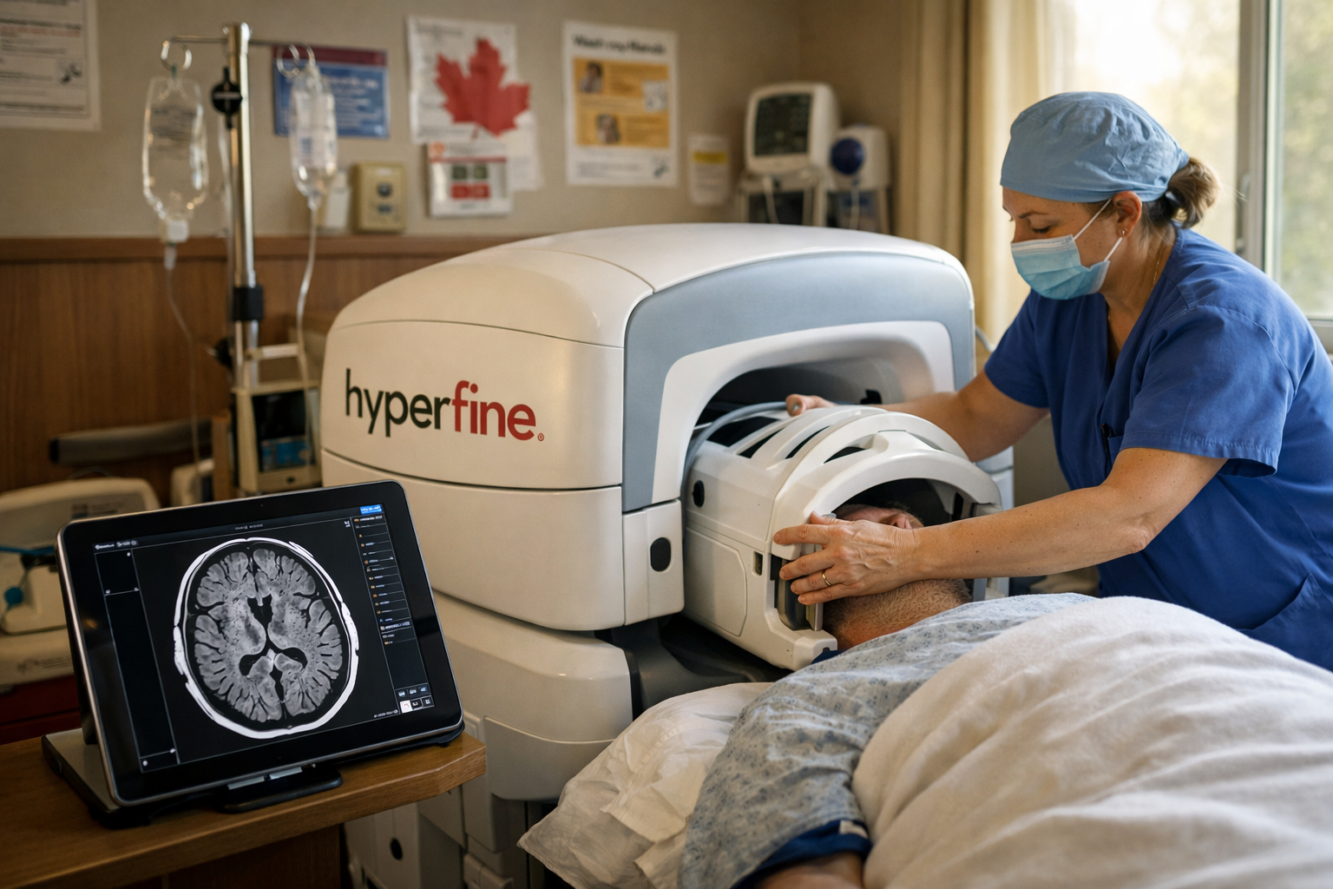
Dr. Shannon Kolind’s research team at the University of British Columbia received one of Canada’s first Hyperfine portable MRI systems, funded by the Bill and Melinda Gates Foundation [2]. The device uses a 64 millitesla (mT) magnetic field—dramatically lower than the 1.5 tesla clinical scanners or 3 tesla research scanners found in major hospitals. Despite that difference, advanced coil technology and machine learning algorithms allow the portable unit to produce excellent diagnostic images [2].
💡 “The portable MRI has the potential to change the future of healthcare.”
— Centre for Brain Health Canada [2]
Key advantages of low-field portable MRI include:
- Plug-and-play operation — runs on a standard electrical outlet
- Bedside use — no need to transport patients to a radiology suite
- Safety for more patients — safe for individuals with certain metal implants or disabilities that make traditional high-field MRI dangerous [2]
- Lower cost — a fraction of the price of conventional MRI infrastructure
These scanners are currently limited to head imaging only, though research teams are working to expand capabilities to other body areas [2]. Even with that limitation, the applications are transformative—from stroke detection to monitoring neurological conditions in communities that previously had zero MRI access.
Modular High-Field MRI: Full Power, Fast Deployment
On the other end of the spectrum, modular MRI cassettes deliver full clinical-grade imaging in a prefabricated housing unit. On March 10, 2026, St. Joseph’s Hospital in Estevan, Saskatchewan, installed the province’s first modular MRI Cassette™ housing a Siemens MAGNETOM Flow.Elite 1.5T system [3]. The entire project—from initiation to operational imaging—took less than one year, compared to the 18–24 months typically required for traditional MRI suite construction [3].
| Feature | Low-Field Portable MRI | Modular MRI Cassette |
|---|---|---|
| Magnetic Field | 64 mT | 1.5 T |
| Imaging Scope | Head only (currently) | Full body |
| Setup Time | Minutes (plug-in) | Months (prefab install) |
| Best For | Screening, triage, bedside | Full diagnostic workups |
| Cost | Lower | Higher (but faster ROI) |
| Mobility | Highly portable | Semi-permanent modular |
This dual-track approach means communities can choose the solution—or combination of solutions—that fits their needs and budgets. As innovations in technology continue to reshape public services, portable MRI stands out as one of the most impactful advances for rural Canada.
Accessibility Wins: Closing the Diagnostic Gap in Rural and Northern Canada
The Wait Time Crisis
Canada’s healthcare system has long struggled with diagnostic imaging backlogs. In 2025, the median MRI wait time reached 18.1 weeks [5]. For patients in remote northern communities, actual wait times can stretch far longer once travel logistics are factored in. Flights to urban centres, accommodation costs, and time away from work create barriers that disproportionately affect Indigenous communities, elderly patients, and low-income families.
Portable MRI directly attacks this problem by bringing the scanner to the patient rather than the patient to the scanner.
Real-World Clinical Applications 🩺
The clinical impact is already measurable across several key areas:
- Bedside stroke assessment — During the COVID-19 pandemic, portable MRI allowed clinicians to detect strokes at the bedside, eliminating the risk of transporting critically ill patients to traditional imaging suites [2].
- Intraoperative brain imaging — Mobile brain scanners are now being used mid-surgery in Canadian hospitals, giving neurosurgeons real-time imaging guidance [4].
- Multiple sclerosis monitoring — Dr. Kolind’s team received funding from Brain Canada and Michael Smith Health Research BC to study portable MRI applications for MS diagnosis and ongoing patient monitoring [2].
- Pediatric brain development — Research funded by the Gates Foundation focuses on studying malnutrition’s effects on brain development in low- and middle-income settings [2].
These use cases demonstrate that portable MRI is not a novelty—it is a clinically validated tool already saving lives and improving outcomes. The broader conversation about how technology giants can support healthcare innovation is directly relevant to scaling these systems.
Serving Vulnerable Populations
One often-overlooked benefit: portable low-field MRI is safe for patients who cannot undergo traditional MRI scans. People with certain metal implants, pacemakers, or physical disabilities that make lying still in a narrow bore impossible now have a viable imaging option [2]. This represents a genuine accessibility win that extends beyond geography.
Adoption Trends: Where Canada Stands in 2026
Growing Fleet, Growing Ambition
With at least 16 mobile MRI devices operating nationally [1], Canada’s portable MRI fleet has grown significantly. Some units are shared between multiple communities, maximizing coverage across vast distances. Provincial health authorities are increasingly viewing portable and modular MRI as a cost-effective strategy to meet growing demand without the capital expense and construction delays of traditional installations.
The Saskatchewan modular project illustrates this trend perfectly. By cutting deployment time by approximately 50% [3], the MRI Cassette™ model offers a blueprint that other provinces are watching closely.
Complementary, Not Competitive
It is important to understand that portable MRI systems are positioned as complementary screening tools, not replacements for traditional MRI [2]. The workflow looks like this:
- Initial screening with portable MRI at the community level
- Triage and prioritization based on findings
- Referral to full-field MRI only when clinically necessary
This approach reduces unnecessary patient transfers, shortens wait lists, and ensures that high-field hospital scanners are reserved for the cases that truly require them. As communities explore innovative approaches to public health infrastructure, portable MRI fits naturally into a more distributed care model.
Challenges Ahead ⚠️
Despite the momentum, several challenges remain:
- Regulatory frameworks — Health Canada approval pathways for emerging low-field devices are still evolving
- Workforce training — Technologists need specialized training for portable systems
- Connectivity — Remote communities may lack the bandwidth for cloud-based image processing and AI-assisted analysis
- Funding models — Provincial health budgets must adapt to support non-traditional imaging infrastructure
The hidden costs of powering advanced technology also apply here, as even low-field MRI requires reliable electricity—a challenge in some off-grid northern communities.
What This Means for Canadian Communities
For towns across regions like Georgian Bay, Simcoe County, and beyond, the portable MRI trend signals a broader shift toward decentralized healthcare delivery. Communities that have historically relied on urban hospital networks for advanced diagnostics may soon have screening-level MRI available locally.
This aligns with ongoing community health and wellness initiatives and local hospital fundraising efforts that recognize the importance of keeping care close to home.
🏔️ For a patient in a fly-in community in Northern Ontario, a portable MRI scanner is not just a machine. It is the difference between a diagnosis made in days versus months.
Conclusion
Portable MRI scanners revolutionize remote Canadian healthcare: game-changing tech, accessibility wins, and adoption trends are converging to create a more equitable diagnostic landscape in 2026. From low-field bedside devices powered by machine learning to modular high-field installations deployed in under a year, the options are expanding rapidly. With 16+ mobile units already active and research teams pushing the boundaries of what portable imaging can do, Canada is building a model that other nations are beginning to follow.
Actionable next steps for stakeholders:
- 🏛️ Provincial health authorities should evaluate modular MRI cassette programs to reduce wait times in underserved regions.
- 🏥 Hospital administrators should explore portable MRI as a triage and screening complement to existing infrastructure.
- 👩⚕️ Clinicians should stay current on low-field MRI capabilities, particularly for stroke, MS, and pediatric applications.
- 🗣️ Community advocates should push for portable MRI inclusion in rural health funding proposals.
The technology exists. The evidence is growing. The question now is how quickly Canada will scale it.
References
[1] Watch – https://www.youtube.com/watch?v=9uci80zSTtE
[2] New Portable MRI Has The Potential To Change The Future Of Healthcare – https://www.centreforbrainhealth.ca/news/new-portable-mri-has-the-potential-to-change-the-future-of-healthcare/
[3] Advancing Diagnostic Care: Saskatchewan’s First Modular MRI Cassette™ To House One Of Canada’s First MAGNETOM Flow.Elite MRI Systems – https://www.newswire.ca/news-releases/advancing-diagnostic-care-saskatchewan-s-first-modular-mri-cassette-tm-to-house-one-of-canada-s-first-magnetom-flow-elite-mri-systems-800188922.html
[4] Mobile Brain Scans Sound Like Science Fiction But They’re Now Helping More – https://unpublished.ca/news-feed-item/2026-03-11/mobile-brain-scans-sound-like-science-fiction-but-theyre-now-helping-more?page=5
[5] Canada’s Health Care System Features Old And Outdated Medical Equipment – https://www.fraserinstitute.org/commentary/canadas-health-care-system-features-old-and-outdated-medical-equipment
[6] Longwoods – https://www.longwoods.com/newsdetail/22986
Content, illustrations, and third-party video appearing on GEORGIANBAYNEWS.COM may be generated or curated with AI assistance or reproduced pursuant to the fair dealing provisions of the Copyright Act, R.S.C. 1985, c. C-42. Attribution and hyperlinks to original sources are provided in acknowledgment of applicable intellectual property rights. Such referencing is intended to direct traffic to and support the original rights holders’ platforms.
Sharing is SO MUCH APPRECIATED!